If you've ever felt stuck in one spot on the neck, endlessly repeating the same licks, you've come to the right place. The pentatonic scale is the backbone of blues, rock, and countless other genres, but many players only scratch the surface by learning a single 'box' pattern. The secret to unlocking true melodic freedom and navigating the entire fretboard with confidence lies in mastering all 5 pentatonic scale shapes.
Think of these five interconnected patterns as a complete GPS for your guitar. Once you understand how they link together across the neck, you'll never feel lost or confined to one position again. This guide is your comprehensive roadmap, designed to move you beyond just memorizing diagrams.
We will break down each of the 5 pentatonic scale shapes with clear fretboard diagrams and TAB, explore its unique fingering and character, and provide actionable licks you can use immediately. You'll also get a structured practice plan with exercises for connecting the shapes, ensuring you can apply these concepts in your own improvisation. Prepare to transform your lead playing from predictable to profound. To get the most out of these lessons, supplement your practice with the interactive video lessons and jam tracks included in a TrueFire All Access Trial.
Welcome to the cornerstone of the pentatonic system. If you've ever dipped your toes into lead guitar, this is likely the first pattern you learned. Often called the 'Em' shape because its open-position fingering forms a perfect E minor pentatonic scale, Shape 1 is the most recognized and foundational of all 5 pentatonic scale shapes. Its symmetrical, two-notes-per-string layout makes it intuitive to learn and serves as the "home base" from which countless rock and blues solos are launched.
The power of this shape lies in its direct relationship with the 6th-string root note. Whatever note your index finger plays on the low E string becomes the key of the minor pentatonic scale. This makes it incredibly easy to find your bearings and start improvising over backing tracks in any minor key.
Let's use the key of A minor for our example. The root note 'A' is found at the 5th fret of the low E string. This is your anchor point for Shape 1.
TAB Example:
e|-------------------5-8-|
B|-----------------5-8---|
G|---------------5-7-----|
D|-------------5-7-------|
A|-----------5-7---------|
E|---------5-8-----------|
Notice the root notes are on the 5th fret of the low E, 5th fret of the D, and 5th fret of the high E string. Identifying these root notes is crucial for resolving your licks and making them sound musical.
Mastering Shape 1 goes beyond just memorizing the notes; it's about making it feel like second nature. This shape is the launchpad for iconic licks from legends like B.B. King, Eric Clapton, and Stevie Ray Vaughan.
Here's how to internalize it:
Key Insight: This shape is your "safe zone." When you're lost during a solo, you can always return to Shape 1 to find a strong, resolving note. It's the most reliable pattern in the system.
While this vertical box is powerful, true fretboard freedom comes from connecting it to other shapes. For a deeper understanding of how this pattern links across the neck, you can explore more about developing a horizontal vision of the pentatonic scale.
To start applying this shape and the other four, explore thousands of lessons, jam tracks, and interactive tools with a TrueFire All Access Trial.
Moving up from our home base, we arrive at Shape 2. This pattern is the crucial "bridge" that connects Shape 1 to the rest of the fretboard, allowing you to break free from the single-box mentality. Often called the 'Am' shape because its open-position fingering outlines an A minor pentatonic scale, Shape 2 shifts your hand position up the neck and opens up new melodic possibilities. It's an essential component in the system of 5 pentatonic scale shapes, known for enabling fluid, expressive solos that travel across the strings.
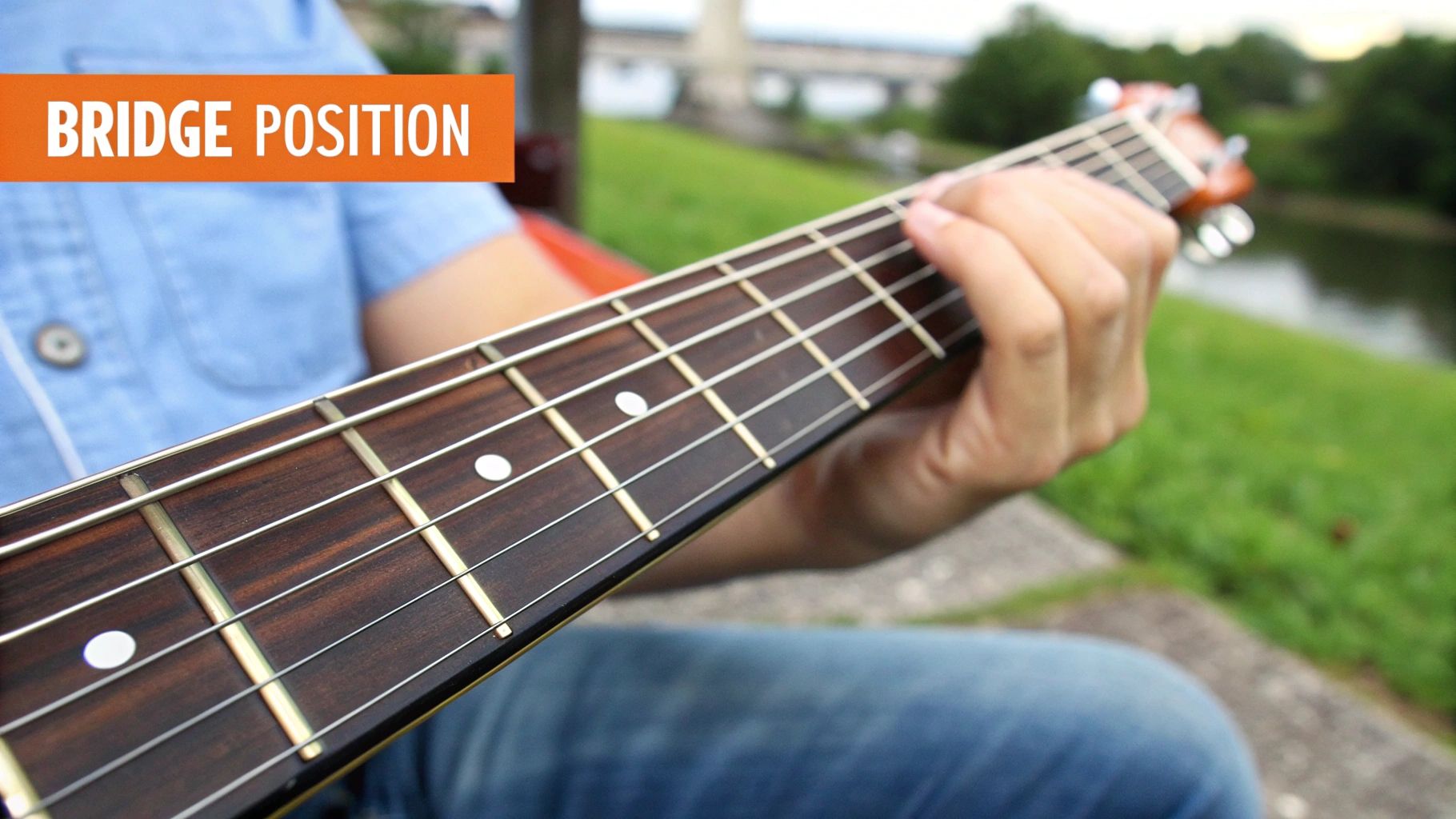
The defining characteristic of this shape is that its lowest root note is found on the 5th string (A-string). This new anchor point encourages a different fretting-hand approach and is the key to creating longer, more sophisticated melodic lines. Players like Carlos Santana and Joe Satriani masterfully use this shape to build tension and release as they glide between positions.
Continuing in the key of A minor, Shape 2 begins where Shape 1 left off. The first note of this shape is the last note of Shape 1 on the low E string.
TAB Example:
e|-------------------8-10-|
B|-----------------8-10---|
G|---------------7-9------|
D|-------------7-9--------|
A|-----------7-10---------|
E|---------8-10-----------|
Notice the new root note locations: the 10th fret on the A-string and the 10th fret on the B-string. Targeting these 'A' notes will help your phrases sound resolved and intentional when improvising in the key of A minor.
The goal with Shape 2 is to see it not as an isolated pattern but as a direct extension of Shape 1. Mastering the transition between these two is a fundamental step toward fretboard fluency.
Here's how to internalize it:
Key Insight: Think of Shape 2 as the 'connector'. It's the first step in seeing the pentatonic scale as a single, interconnected scale that spans the entire neck, rather than five separate boxes.
Learning to seamlessly integrate this pattern is a game-changer. For a deeper dive, you can explore tutorials on incorporating pentatonics into your lead playing.
To start connecting these shapes and unlock thousands of other guitar lessons, jam tracks, and interactive tools, explore a TrueFire All Access Trial.
Now we arrive at a shape that often challenges players but unlocks incredible technical facility. Shape 3, sometimes called the 'Dm' shape due to its open-position D minor pentatonic fingering, is a crucial connector piece in the 5 pentatonic scale shapes puzzle. Its wider stretches and less intuitive layout push your fingers in new ways, making it a fantastic tool for building dexterity and speed.
This shape is characterized by its root note on the D string (4th string), which offers a different melodic perspective. Moving into this position encourages you to break free from the more common fingerings of Shapes 1 and 2, paving the way for more sophisticated lines and faster runs, a favorite of players like Eddie Van Halen and Steve Vai.
Continuing in the key of A minor, we'll find the root note 'A' for this shape at the 7th fret of the D string. This is your new anchor point. Notice the wider fret-stretch required on the B string.
TAB Example:
e|--------------------8-10-|
B|------------------8-10---|
G|----------------7-9------|
D|--------------7-9--------|
A|-----------7-10----------|
E|---------8-10------------|
The root notes here are located on the 10th fret of the A string, the 7th fret of the D string, and the 10th fret of the B string. Targeting these notes will help ground your phrases and prevent your solos from sounding like a purely technical exercise.
Shape 3 is a gateway to more advanced techniques. Mastering its unique fingering is essential for fluidly navigating the entire neck. It's less about comfortable blues licks and more about building a solid technical foundation.
Here's how to internalize it:
Key Insight: Treat this shape as your fretboard gym. The effort you put into mastering its less-comfortable stretches will pay huge dividends in your overall speed, accuracy, and picking-hand synchronization.
While often associated with rock and metal, this shape's intervallic structure can be adapted for more complex genres. For a look at how these patterns can be modified for sophisticated harmony, you can learn more about the many ways to use the jazz pentatonic scale.
To apply this shape and build your technical command, explore thousands of lessons, jam tracks, and interactive tools with a TrueFire All Access Trial.
Now we venture higher up the neck into Shape 4, a pattern that truly opens up the upper register of the fretboard. This shape is often associated with the 'Am' barre chord shape and is a favorite for players like Prince and Jimi Hendrix who loved to push their solos into soaring, expressive territory. While it might feel less intuitive at first compared to Shapes 1 and 2, mastering this pattern is a critical step in connecting all 5 pentatonic scale shapes and achieving total fretboard command.
This shape's layout encourages fluid, horizontal movement and provides access to a different set of expressive bends and vibrato possibilities. It's the key to breaking free from the lower and middle sections of the neck and making your solos climb to a dramatic peak.
Let's continue in the key of A minor. To find Shape 4, we locate the root note 'A' on the G string, which is at the 14th fret. This becomes our new anchor point.
TAB Example:
e|-----------------------12-15-|
B|--------------------13-15----|
G|-----------------12-14-------|
D|--------------12-14----------|
A|-----------12-15-------------|
E|--------12-15----------------|
The root notes in this shape are found at the 15th fret of the low E string, 12th fret of the A string, 14th fret of the G string, and the 15th fret of the high E string. Recognizing these notes is vital for landing your phrases with authority when soloing in this higher register.
Shape 4 is your gateway to high-energy, screaming solos. Its wider fret spacing in the upper register requires a slightly different approach to fretting and bending.
Here's how to internalize it:
Key Insight: This shape is the launchpad for your solo's climax. Use it to build tension and excitement, delivering your most impactful licks when the music calls for a peak.
By mastering Shape 4, you unlock a new level of expression and gain the confidence to navigate the entire neck. It's an essential tool for crafting memorable, dynamic guitar solos.
To put this shape and the others into a musical context, explore the vast library of lessons and jam tracks with a TrueFire All Access Trial.
We've arrived at the final pattern, the peak of the mountain that connects back to the beginning. Shape 5 is the last piece in the puzzle of the 5 pentatonic scale shapes, completing the full cycle around the fretboard. It's often called the 'G#' shape because its open-position fingering outlines a G# minor pentatonic scale. This shape is your gateway to screaming, high-register solos and serves as the crucial link that bridges the gap back to Shape 1, one octave higher.
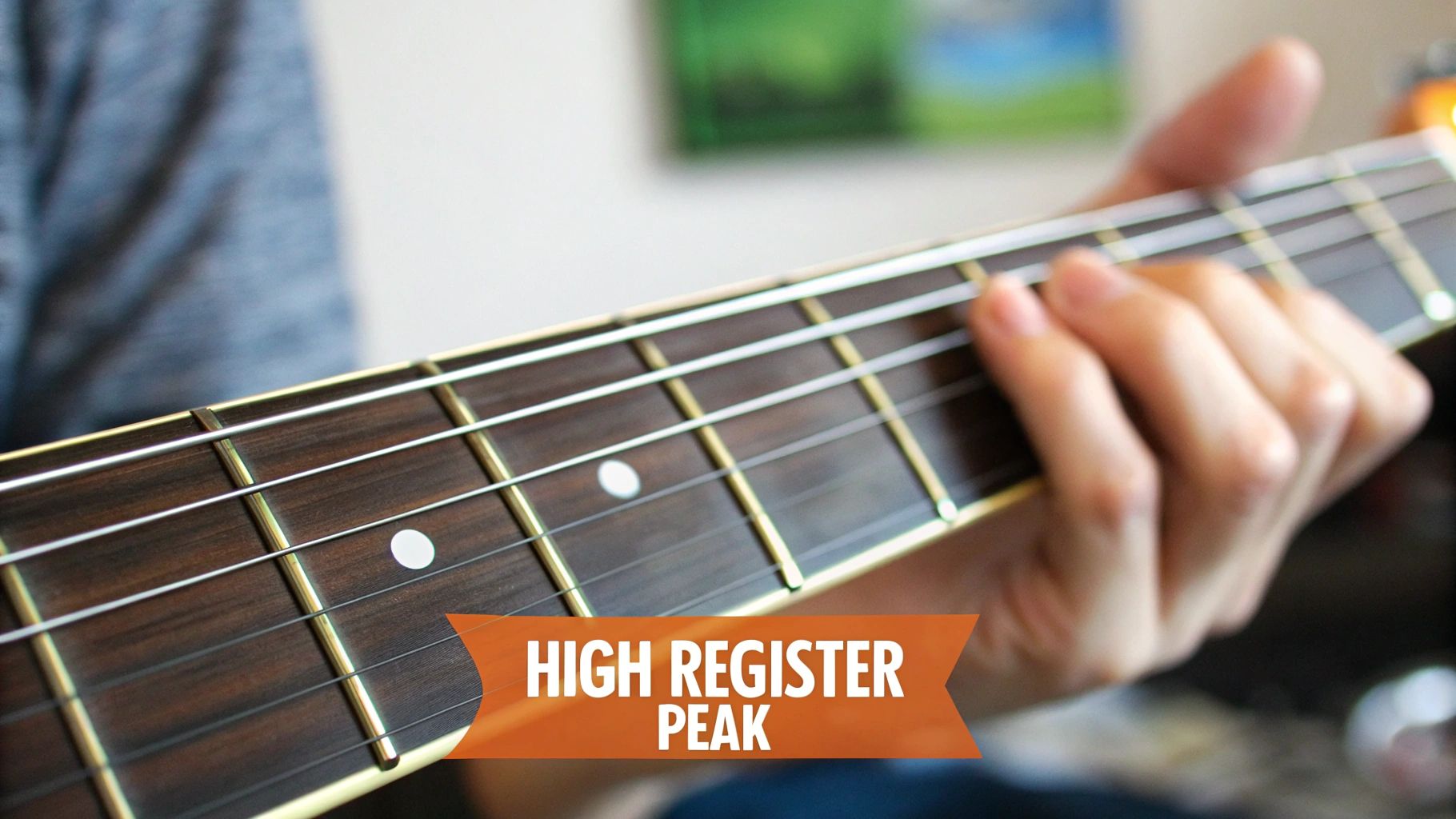
The defining characteristic of this shape is its root note placement on the 2nd (B) string. Mastering this pattern gives you complete fretboard freedom, allowing you to traverse the entire neck without getting lost. It's the shape that modern virtuosos like Joe Satriani and John Petrucci use to create dramatic, climactic moments in their solos.
Continuing in the key of A minor, Shape 5 is located just below Shape 4. The root note 'A' is found at the 17th fret of the low E string and, more importantly for this shape's orientation, at the 17th fret of the high E string.
TAB Example:
e|-----------------------15-17-|
B|--------------------15-17----|
G|-----------------14-16-------|
D|--------------14-17----------|
A|-----------15-17-------------|
E|--------15-17----------------|
Notice how playing the notes at the 17th fret of the low E, A, B, and high E strings gives you the root note 'A'. Understanding this allows you to end your high-flying licks on a powerful, resolving note.
Shape 5 is less of a "home base" and more of a "destination." It's where you go to add excitement and intensity to your playing. Due to its higher position on the neck, the frets are closer together, requiring a slightly different fretting-hand approach.
Here's how to conquer it:
Key Insight: Think of Shape 5 as the climax of your musical story. It's not the starting point, but rather the high point you build towards, providing dynamic contrast and a powerful emotional impact before resolving.
By mastering this final shape, you unlock the ability to see the pentatonic scale not as five separate boxes, but as one continuous, interconnected pathway across the entire fretboard.
To solidify this final connection and master all five shapes, explore targeted lessons and jam tracks with a TrueFire All Access Trial.
| Shape | Implementation Complexity 🔄 | Resource Requirements ⚡ | Expected Outcomes ⭐📊 | Ideal Use Cases 💡 | Key Advantages |
|---|---|---|---|---|---|
| Shape 1 - The Em Pentatonic (First Position) | Low 🔄 — compact, minimal stretching | Low ⚡ — open/first-position, standard setup | ⭐ — strong foundational phrasing; limited range 📊 | Beginner improvisation, low‑register blues | Easy to learn; builds muscle memory; iconic licks |
| Shape 2 - The Am Pentatonic (Second Position/G Form) | Medium 🔄 — wider spacing, transition practice | Medium ⚡ — requires position shifts, metronome practice | ⭐⭐ — extends range and fluidity across neck 📊 | Connecting positions, legato/flowing solos | Bridges shapes; improves finger dexterity and shifts |
| Shape 3 - The D Pentatonic (Third Position/D Form) | Medium–High 🔄 — precise placement, some stretching | Medium–High ⚡ — middle-fret access, technique work | ⭐⭐ — speed and independence; novel melodic options 📊 | Speed metal, economy picking, technical exercises | Promotes finger independence; ideal for speed-building |
| Shape 4 - The B Pentatonic (Fourth Position/B Form) | High 🔄 — high‑register comfort required | High ⚡ — access to higher frets; possible lighter strings | ⭐⭐ — brighter tones; expands upper-fret vocabulary 📊 | High-register leads, expressive bends, transitions | Opens upper fretboard; smooth continuation of system |
| Shape 5 - The G# Pentatonic (Fifth Position/High E Form) | High 🔄 — most physically demanding | Very High ⚡ — highest frets, extended range or 7+ strings helpful | ⭐⭐⭐ — completes full-fretboard mastery; peak solo moments 📊 | Virtuosic solos, concert improvisation, climactic passages | Completes five-shape cycle; enables full neck visualization |
You have now explored the complete fretboard map for one of the most essential tools in modern guitar playing: the minor pentatonic scale. We have meticulously detailed each of the 5 pentatonic scale shapes, from the familiar territory of Shape 1 to the often-underutilized patterns of Shapes 4 and 5. But simply memorizing the dots on a diagram is only the first step. The true goal is to transform this collection of shapes from a rigid set of boxes into a fluid, interconnected highway for musical expression.
The journey forward is about connection, context, and creativity. No single shape is more important than another; they are all just different windows looking out at the same musical landscape. Your immediate task is to move beyond seeing five separate scales and start seeing one single, unified scale that spans the entire length of the neck. This mental shift is the key to unlocking true fretboard freedom. It's the difference between a player who is trapped in a box and one who can effortlessly follow the melody in their head, regardless of their position on the neck.
To bridge the gap between academic knowledge and artistic application, focus on a structured practice routine that emphasizes connections. Don't just run the shapes up and down; that builds finger memory without building musicality. Instead, dedicate your practice time to the following strategic exercises:
This process requires patience and dedication, but the reward is immeasurable. By internalizing these 5 pentatonic scale shapes and, more importantly, the pathways between them, you are no longer just playing patterns. You are making music. You are equipping yourself with the foundational language used in countless blues, rock, jazz, and country solos. This is your vocabulary for improvisation, the very toolkit that will allow you to speak through your instrument.
Ready to apply these shapes with world-class instructors and a massive library of jam tracks? A TrueFire All Access Trial gives you the guided lessons and interactive tools you need to connect these patterns and transform them into compelling music. Start your free trial at TrueFire and accelerate your journey from playing scales to speaking the language of guitar.
