Imagine plugging in your guitar and, instead of the usual silence, you’re suddenly backed by a pro-level band, ready to jam whenever you are. That’s the magic of using backing tracks for guitar practice. It’s the single best tool for turning solitary scale drills into a genuine, exciting musical experience.
This one simple shift in your routine will help you develop an unshakable sense of timing, sharpen your improvisational instincts, and finally start to feel how songs are actually put together.
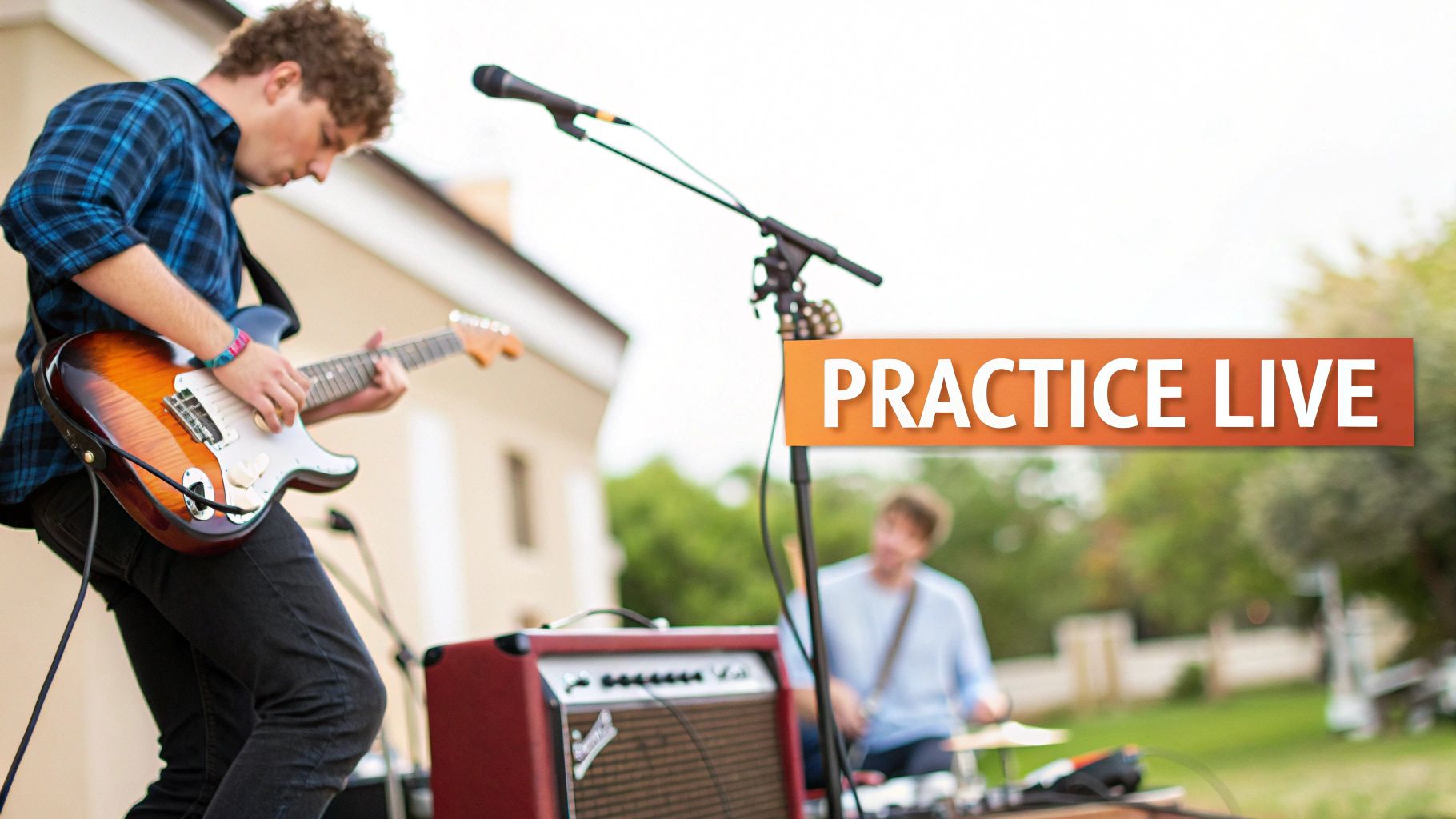
Let’s be honest: the sterile, robotic click of a metronome can suck the life out of a practice session. While it’s an essential tool for building a solid rhythmic foundation, it completely lacks the soul of real music. Backing tracks are the perfect bridge between mechanical practice and musical performance.
Instead of just running scales up and down the neck, you’re forced to listen, react, and find your place within a musical context. It’s the difference between practicing typing exercises and actually writing a story. One builds a mechanical skill; the other develops your creative voice.
This shift in approach has had a massive impact on how guitarists learn. The global Guitar Instruction market, which leans heavily on immersive tools like these, was valued at $936.15 million in 2021 and is projected to hit $2,229.7 million by 2033. This growth shows just how many players are catching on to the benefits of practicing with a virtual band.
Practicing with backing tracks develops skills a metronome simply can’t touch. It’s not just about being on the beat; it’s about feeling the groove. You learn to lock in with the drummer’s hi-hat or follow a bassist’s walking line, which cultivates a much deeper sense of musicality.
This method helps you internalize things you’d otherwise miss:
The ultimate goal is to move beyond just playing the correct notes and start making music that feels alive. Backing tracks are your most direct path there, teaching you to listen and respond just like you would in a real band.
One of the biggest hurdles for guitarists is making the jump from practicing alone in a bedroom to playing with other people. This is where using backing tracks for guitar practice becomes your secret weapon. You get so used to hearing and feeling a full arrangement that joining a jam session or band rehearsal feels far less intimidating.
This kind of regular, context-rich practice builds the muscle memory and ear training you need to feel comfortable in almost any musical situation. It’s all about building a solid foundation, which is a key component of what makes for the perfect guitar practice routine. By making every session feel like a live performance, you’re not just learning licks—you’re becoming a more complete musician.
To see how this works in a structured learning environment, you might want to check out a TrueFire All Access Trial, which pairs a massive library of jam tracks with world-class lessons.
With a whole universe of backing tracks just a click away, finding the right ones can feel like digging through dusty crates for a specific record in a massive, disorganized music store. The real trick isn’t just finding any track—it's about finding the ones that actually help you hit your practice goals. Curating a solid library of backing tracks for guitar practice is one of the most powerful things you can do for your playing.
It all starts with knowing where to look. Sure, a quick YouTube search will give you thousands of results, but the quality is all over the place. For structured, focused practice, you’re much better off with platforms built for the job.
Think of your backing track sources like your bandmates. You want reliable partners who push you to get better, not ones who are out of tune or off-beat.
Here’s a quick rundown of the main places modern guitarists are finding their grooves:
The demand for these tools has absolutely exploded. The guitar practice software market, which is packed with these kinds of resources, was valued at $397 million in 2024 and is projected to hit $484.95 million by 2033. That tells you just how many players are leaning on these tools to make practice more engaging. You can discover more about this market trend on archivemarketresearch.com.
Finding the right platform for backing tracks really depends on what you need as a player. A beginner learning basic chords has different needs than a pro tightening up their jazz vocabulary. Here’s a look at the most common sources and who they’re best for.
| Source Type | Best For | Key Features | Potential Drawbacks |
|---|---|---|---|
| Learning Platforms (e.g., TrueFire) | Serious learners, players of all levels seeking structure | Integrated lessons, tabs/notation, massive libraries, high-quality audio | Often requires a subscription |
| YouTube Channels | Casual practice, finding specific styles or artist vibes | Free access, huge variety, great for discovery | Inconsistent quality, ads can be disruptive |
| Dedicated Apps (e.g., iReal Pro, Anytune) | Players who need flexibility and on-the-go practice | Tempo/pitch control, looping, chord charts, portability | Can have a learning curve, may require in-app purchases |
| DAW & VSTs | Advanced players, composers, tech-savvy musicians | Full creative control, customizable, high-fidelity audio | Can be expensive and technically complex |
Ultimately, most players end up using a mix of these. You might use YouTube to find a quick blues track for a 15-minute jam, but fire up a dedicated platform when you’re really digging into a new concept.
To avoid falling down an endless rabbit hole of scrolling, you’ve got to search with intent. Just typing "guitar backing track" is way too vague. You need to be specific with your keywords to find exactly what you need to work on.
Think like you’re talking to a real band. You wouldn’t just ask for a "rock track," would you? You’d say something like:
That level of detail cuts through all the noise and gets you tracks that are perfectly matched to the technique or concept you're trying to nail down.
A well-chosen backing track does more than just keep time; it provides the ideal musical canvas for your practice. Finding a track that inspires you is half the battle, as it turns a practice session from a chore into a creative pursuit.
Your needs are going to change as you get better, and your library of backing tracks should grow right along with you. What challenges a beginner is completely different from what an advanced player needs to stay sharp.
For beginners, keep it simple and clean. Look for tracks with:
For intermediate and advanced players, it's time to embrace complexity:
By building a go-to playlist that targets both your strengths and your weaknesses, you create a powerful, personalized training ground. This is especially killer for working on genre-specific skills, and you can check out our Blues Jam Survival Guide for more ideas on how to put this into practice.
Whether you're a seasoned pro or just plugging in for the first time, the right backing tracks are out there. Taking a little time to find and organize them is an investment that pays off every single time you pick up your guitar. If you want a guided experience that pairs world-class lessons with a massive library of tracks, a TrueFire All Access Trial is a great place to start.
Just hitting ‘play’ on a random track and letting your fingers wander is fun, but it’s not where the real breakthroughs happen. If you want to see real progress, you need purposeful, structured practice. Using backing tracks for guitar practice isn;t about aimless jamming; it’s about creating a focused space to hammer out specific skills, measure your growth, and finally turn those weaknesses into strengths.
So, let’s map out some concrete practice routines you can steal and tweak. It;s time to move from just noodling to making noticeable gains.
The whole process of finding and using tracks effectively really just boils down to a simple workflow.
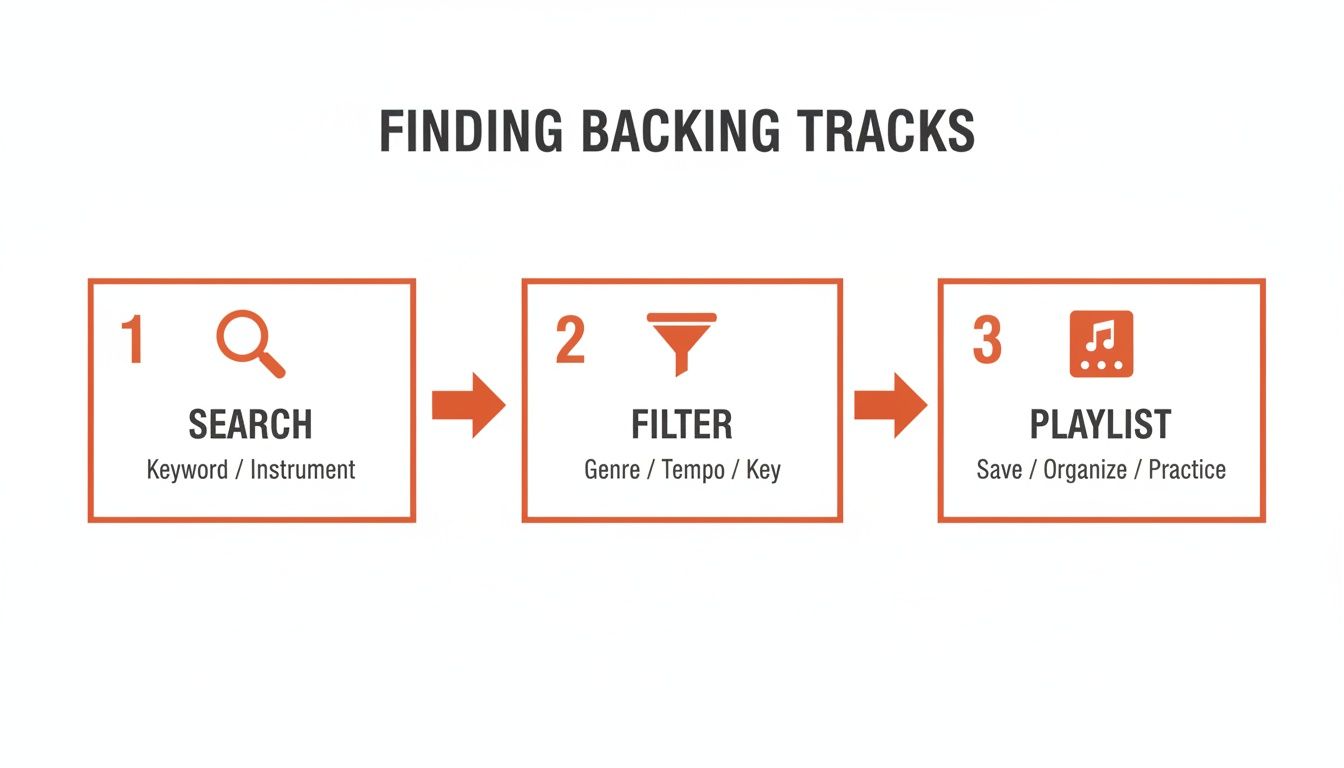
This little system highlights a key idea: a bit of organization goes a long way. When you search with intent, filter for what you actually need, and save the good stuff, you're building the foundation for a killer practice routine.
If you’re just starting out, your number one goal is building a rock-solid foundation in rhythm and feel. Forget the flashy licks for a minute. Your mission is to sound confident and intentional, even with just a few notes.
Here’s a simple but incredibly effective routine to get you there:
This kind of exercise forces you to build a strong rhythmic connection to the music, a skill a ton of self-taught players accidentally skip over. It trains your ear and your hands to work as a single unit with the "band."
Once you’re comfortable navigating a single scale and feeling the groove, it’s time to start making your playing more melodic and connected to the harmony underneath. The goal shifts from just playing "in key" to actually playing over the changes.
An intermediate player’s routine should be all about outlining the harmony:
A backing track becomes a harmonic playground. It gives you a safe space to experiment with new concepts like modes and arpeggios, hearing instantly how they work in a musical context without the pressure of a live band.
For the advanced guitarist, backing tracks are your lab for honing sophisticated phrasing and navigating complex harmony. The practice becomes less about what notes to play and more about how and when to play them.
Your routine should be designed to challenge both your ear and your creativity:
This methodical approach—isolating, dissecting, and repeating—is exactly how you develop the ability to weave fluid, coherent solos over even the trickiest chord changes.
By designing your practice this way, you make sure every session has a clear purpose. You’ll build skills methodically, see your progress, and turn your jam sessions into a powerful engine for musical growth. To explore a massive library of jam tracks perfectly paired with lessons for every level, check out a TrueFire All Access Trial.
Alright, you’ve put in the time structuring your practice routines and sharpening your technique. Now it’s time for the real fun: moving beyond the drills and into the art of musical conversation. This is where using backing tracks for guitar practice really starts to pay off, helping you find and develop your own creative voice.
Think of it this way: knowing your scales is like knowing the alphabet, but improvising is about telling a compelling story.
The biggest hurdle to overcome is a mental one. You have to stop thinking like a guitarist playing over a track and start thinking like a musician playing with the band. That shift in perspective is everything. You’ve got a rhythm section laying down the groove; your job is to add something meaningful to the conversation, not just shout over it.
One of the most powerful ways to start having that conversation is with call-and-response. Imagine you’re in a dialogue with the other instruments. The track offers up a chord progression or a rhythmic figure (the call), and your melodic phrase is the answer (the response).
For instance, if the bass player lays down a simple, punchy root-note line, you could answer with a short, lyrical melody that complements it. This creates a dynamic interplay that makes your solos feel intentional and deeply connected to the music.
Another killer technique is motif development. Instead of just stringing random licks together, you start with a single, small melodic idea—a motif—and build your entire solo around it.
This approach gives your solos a sense of coherence and direction. It’s the difference between rambling and making a memorable musical statement.
Think of the backing track as your band. Your responsibility is to listen intently to what the bass and drums are doing and let their groove guide your phrasing, dynamics, and note choices. This active listening is the heart of great improvisation.
We’ve all been there. You put on a jam track, and your fingers immediately start mindlessly running scales up and down the fretboard. I call it "scale-runner" syndrome. The notes might be technically correct, but there’s no story, no emotion, and zero connection to what’s happening underneath.
Backing tracks aren’t just a gimmick; they’re a cornerstone of modern guitar mastery, helping you practice in a way that feels like a real performance. There’s a reason pro audio sales in the U.S., which includes practice tech like this, climbed 3.3% to $1.59 billion. Musicians are using these exact tools to prep for the stage. In fact, surveys show that 70% of intermediate guitarists use backing tracks weekly to hone their skills.
So, how do you break free from the scale-running habit? You need exercises that force you to be more lyrical and deliberate.
Try this exercise:
This kind of limitation forces you to focus on rhythm, phrasing, bends, slides, and vibrato—all the stuff that gives your playing a unique personality. You'll quickly realize that how you play a note is often far more important than which note you play.
For a deeper dive into these concepts, you can learn masterful improvisation techniques for soloing in our detailed guide.
By embracing these approaches, you can transform your practice from a technical chore into a creative exploration. Every backing track becomes a fresh opportunity to experiment, tell a story, and find your own sound. To see this in action, I highly recommend checking out a TrueFire All Access Trial.
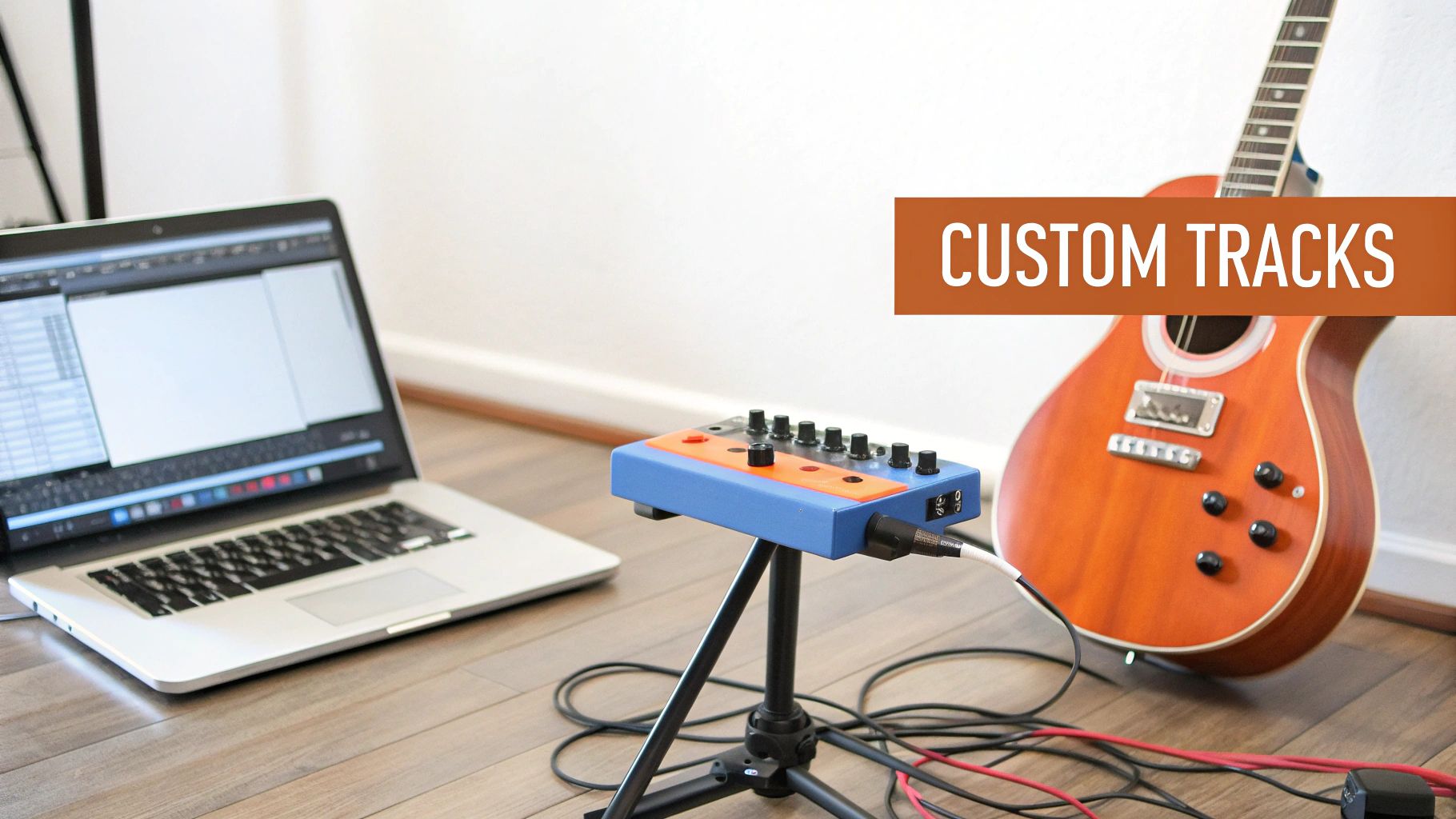
Sure, the internet is overflowing with jam tracks. But when you get serious about your practice, nothing beats creating a track that’s built specifically for you. This is how you target your weak spots and design a practice routine that actually moves the needle on your playing. And the best part? It’s way easier to get started than most people think.
You don't need a pro-level studio to create powerful backing tracks for guitar practice. In fact, your journey can start with one of the most immediate and satisfying tools a guitarist can own: a looper pedal.
A looper pedal is basically an instant practice partner. Its real power lies in its simplicity. You can lay down a chord progression and have it playing back in seconds, letting you flip from rhythm player to lead player on the fly.
Let’s say you’re trying to really nail a new mode, like Lydian. Instead of hunting for the perfect track online, you can whip one up yourself.
This same idea works wonders for drilling chord changes. If that switch from an Am7 to a D7 is giving you trouble, just loop those two chords. You can play that transition over and over in a real musical context until it becomes pure muscle memory.
When you're ready to move past simple vamps, free software like GarageBand or the web-based BandLab will open up a whole new world. These tools let you become a one-person band, building out much more detailed tracks with drums, bass, and specific chord changes.
Creating your own tracks is a potent form of active learning. The process of arranging a chord progression, programming a simple drum beat, and laying down a bass line forces you to think more deeply about song structure and how different instruments lock in together.
Think about that one tricky bridge section in a song you're learning. Instead of constantly rewinding a pre-made track, you can build just those eight bars yourself. This lets you isolate the problem area and work on it with surgical focus. For anyone wanting to dive deeper into recording, understanding the basics of a home recording setup is a fantastic next step.
Having this level of control is a total game-changer for your practice. You stop being just a passive listener and become an active creator of your own learning tools. It makes you a more thoughtful and well-rounded musician, someone who understands music from the inside out. When you're ready to see how a professional platform integrates these ideas, explore a TrueFire All Access Trial.
We’ve covered a lot of ground here, digging into how backing tracks for guitar practice can genuinely change the game for your playing. Think of it this way: using them consistently is the bridge between just practicing your guitar and actually making music. It’s how you build the muscle memory and the intuitive ear to step into any musical situation and feel right at home.
The journey from noodling in your bedroom to confidently jamming with others isn’t about logging endless, aimless hours. It’s all about purposeful, focused practice.
By now, you’ve got the playbook: find the right tracks, set clear goals for your sessions, and learn how to improvise like you’re having a conversation. This is how you stop just memorizing licks and start developing your own voice on the guitar. You’re learning the language of music by speaking it, day in and day out.
This is what internalizes the feel of a groove. It’s what teaches you to anticipate chord changes without even thinking. It’s the difference between knowing a scale and knowing how to use it to tell a story.
Every single time you play along with a backing track, you’re rehearsing for the real thing. You’re training your ears to listen, your hands to respond, and your mind to operate like you're part of a band, not just a soloist.
This kind of practice gets you ready for the real world of playing with other people, which is always dynamic and unpredictable. You learn to lock in with the drummer, feel out what the bass player is doing, and add something that serves the song. That holistic development is what separates a decent player from a truly compelling musician.
The secret is to never get too comfortable. Keep pushing yourself into new styles, different tempos, and unfamiliar chord progressions. When you do that, you're building a versatile skill set that lets you express yourself freely, no matter what kind of music is thrown your way. You're laying a foundation that will support your musical growth for years.
If you’re ready to really dive in, I can't recommend enough exploring an ecosystem built for this exact kind of deep learning. A TrueFire All Access Trial doesn’t just hand you a massive library of jam tracks; it pairs them with world-class lessons to guide you every step of the way.
Guitar players always have a ton of questions when they first dive into using backing tracks. It’s totally normal. Let’s tackle some of the most common ones so you can clear those hurdles and get right back to what matters—playing.
Always, and I mean always, start slower than you think you need to. It’s a classic mistake to jump in at full speed.
If you find a great track that’s cooking at 120 BPM, don’t try to keep up right away. Use a practice tool to knock it back to 80 or 90 BPM. This gives your brain and your fingers the space they need to actually learn the changes and map out ideas without that frantic, rushed feeling.
The goal here is clean, rhythmic playing. Once you can nail your lines perfectly at that slower speed, then you can start inching the tempo up, maybe 5-10 BPM at a time. This methodical approach is how you build real muscle memory and precision. Trying to fight the track at its original tempo from the get-go just builds frustration.
First, figure out the key. Most track titles give it away, like "A minor blues" or "Rock Jam in G." That’s your biggest clue.
For the vast majority of rock, pop, and blues tracks, the minor pentatonic scale is your golden ticket. It’s the safest and most effective place to start. If the track is in A minor, the A minor pentatonic scale is your home base. Simple as that.
Once you’re comfortable there, you can start getting more sophisticated. Try weaving in notes from the full major or minor scale, or even targeting specific notes from each chord in the progression with arpeggios. That’s when your solos start to sound less like you’re playing over the track and more like you’re playing with it.
Using the right scale is just the first step. The real magic happens when you start targeting the notes within each chord of the progression, which makes your solos sound like they truly belong to the song.
Absolutely. This is one of their superpowers. You can find tons of "minus-guitar" tracks for popular songs, which is basically like having the actual band in your room, ready to rehearse.
This kind of practice forces you to learn the song’s structure, timing, and dynamics—not just the isolated riffs. You’ll immediately discover where your part fits, when to come in, and—just as crucial—when to lay out and let the music breathe.
It’s context-based learning, which is so much more powerful than just looping a riff by yourself. Honestly, it’s one of the fastest ways to get a song down solid and prepare yourself for playing it with other musicians.
Ready to elevate your practice with a massive library of high-quality jam tracks and world-class lessons? Explore everything TrueFire has to offer with a 14-day free All Access Trial and start your journey today.
