Beginner guitar chord progressions are the secret handshake of musicians. As a guitar educator, I can tell you that these simple, repeatable patterns like G-C-D or C-Am-F-G are the secret sauce in thousands of songs. For new players, learning these core progressions is the absolute fastest way to go from practicing individual chord shapes to actually playing real music.
Ever strum a few chords and wonder why some combinations just click and sound like a real song, while others feel... random and messy? The answer isn't magic; it's the simple, powerful logic of music theory. Think of it this way: individual chords are like words, and a chord progression is a complete sentence that tells a musical story.
At the center of it all is the idea of a musical key. Every key has a "home base" chord, which we call the tonic or the I (one) chord. This is the chord that gives you that satisfying feeling of resolution, like finally coming home after a long journey.
The other chords in that key all have a specific relationship with this home base. Let's take the key of G Major. Here, the G chord is our I chord. Strum it. It feels stable, settled, and complete.
Now, move to a C Major chord (the IV chord in this key). It feels like you’ve stepped away from home, but in a pleasant, uplifting way. It creates a gentle lift that pairs beautifully with the G chord.
Finally, let’s bring in the D Major chord, our V chord. This one is different. The V chord creates a very distinct feeling of tension. When you play it, your ears practically beg to hear that G chord again to resolve everything. This constant push-and-pull between the I, IV, and V chords is the engine that drives a massive amount of the music we all know and love.
Grasping this simple relationship between the I, IV, and V chords is your first major breakthrough as a guitarist. It’s the moment you stop just memorizing shapes and start understanding the why behind the music.
Understanding this basic "home-tension-release" dynamic is what separates a noodler from a musician. You can dive deeper into the nuts and bolts in our 7-step chord progression theory guide. This knowledge is the key that unlocks your ability to:
By getting these fundamental beginner guitar chord progressions under your fingers, you’re building the vocabulary you need to truly speak the language of music.
If you're going to commit just one chord sequence to memory, make it the I-IV-V. This three-chord powerhouse is the undisputed backbone of countless songs across blues, folk, country, and rock and roll. It’s the essential musical sentence every guitarist needs to know.
We’re going to dig in using the key of G Major, which is absolutely perfect for beginners. The open chords G, C, and D are relatively easy to form and switch between, making them an ideal starting point for your first real progression.
In the key of G, our foundational chords are G (the I), C (the IV), and D (the V). Before even thinking about playing them in a sequence, get comfortable with each individual shape. If you need a refresher, check out the ultimate guitar chord chart for clear diagrams.
Once your fingers know where to go for each chord, you can focus on the real challenge: the transitions. The secret to clean chord changes isn't raw speed—it's anticipation. Your brain and fingers should be preparing for the next chord before the change actually happens. This foresight eliminates those awkward pauses that give away a beginner.
Don’t just play the chords; play the spaces between them. A smooth transition from a G to a C is just as important as the chords themselves. Think of the movement as part of the music.
Let’s get practical. Moving between G, C, and D smoothly requires economy of motion. Pay attention to how your fingers need to move between the shapes.
To make this progression sound like an actual song right away, use a simple and versatile strumming pattern: Down, Down, Up, Up, Down, Up. Apply this pattern to each chord, playing it once before moving to the next.
This simple structure isn't just a practice exercise; it's a ticket to playing real songs. The I-IV-V progression is the musical DNA for a huge catalog of popular music.
While we're starting in G, this progression exists in every key. Here are the chords you'd use for the I-IV-V in a few other beginner-friendly keys.
| Key | I (Tonic) | IV (Subdominant) | V (Dominant) | Example Song |
|---|---|---|---|---|
| G | G | C | D | "Sweet Home Alabama" - Lynyrd Skynyrd |
| C | C | F | G | "La Bamba" - Ritchie Valens |
| A | A | D | E | "Wild Thing" - The Troggs |
Learning these combinations opens up thousands of new songs. It shows how the same musical "story" can be told with different sets of chords, depending on the key. By mastering this one progression, you’re not just learning three chords; you’re learning the fundamental language of popular music.
The I–IV–V progression is the meat and potatoes of Western music—a rock-solid foundation. But what happens when you want to inject a little more feeling? A hint of melancholy, a touch of soul? The secret is surprisingly simple: just add one minor chord.
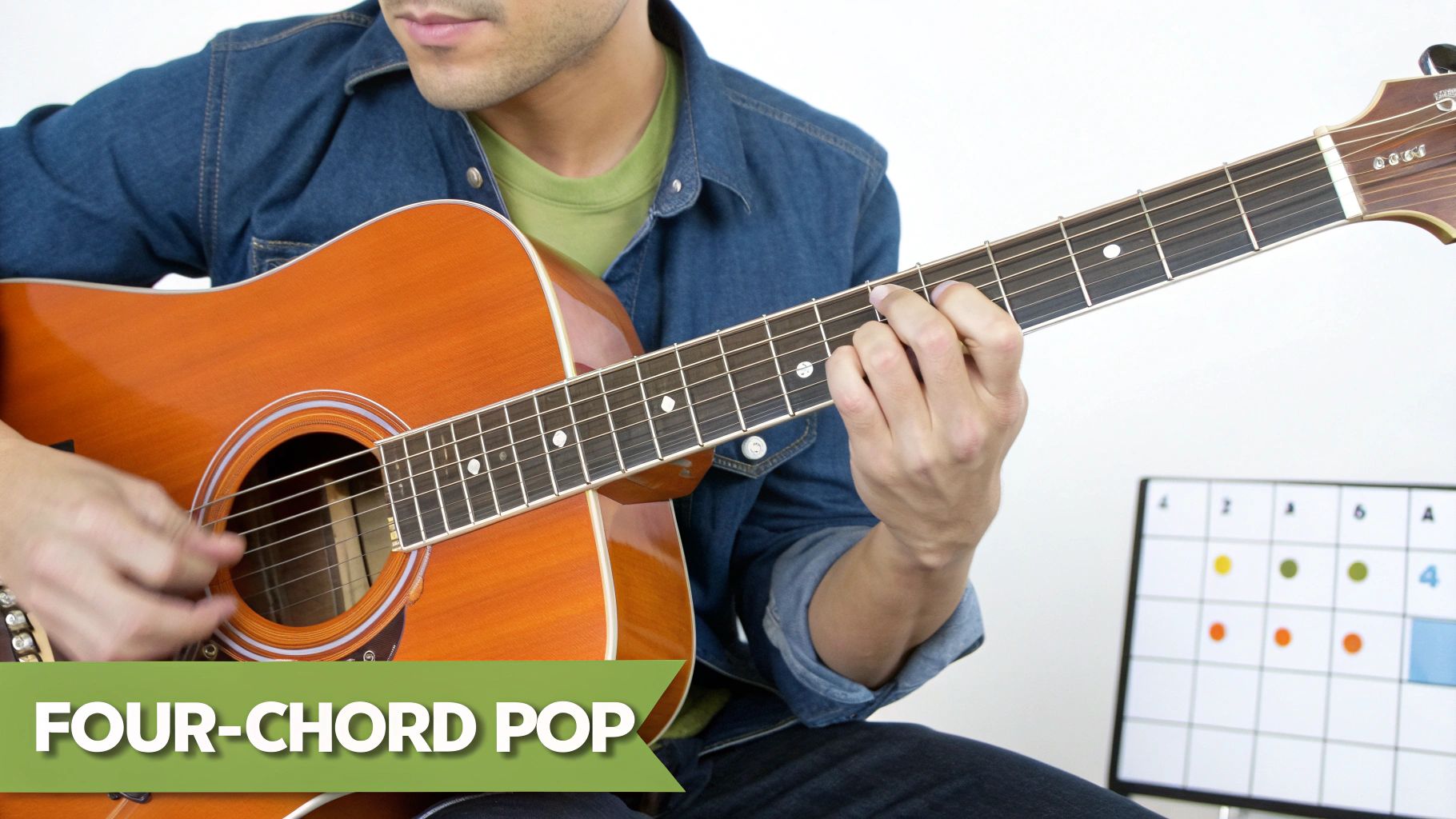
By bringing in the vi (six-minor) chord, you unlock what is arguably the single most dominant and emotionally resonant sequence in modern music: the I–V–vi–IV progression. This is the sound of decades of pop, rock, and acoustic hits. It’s the progression that makes listeners feel something.
In our home key of G Major, this means we’re adding the E minor (Em) chord to the mix. The full progression becomes G (I) – D (V) – Em (vi) – C (IV). Strum through that sequence a few times. Can you hear how that Em chord completely changes the mood? It introduces a subtle, reflective quality that the all-major I–IV–V just doesn't have.
The magic of the I–V–vi–IV is its perfect balance of familiarity and emotional depth. The G and D chords create that classic tension-and-release we already know. But dropping down to the E minor feels like a thoughtful pause or a moment of vulnerability before the C chord lifts the energy back up, leading you perfectly back home to G.
This emotional arc is incredibly powerful and versatile, which is why you hear it everywhere. It's a cornerstone of many beginner guitar chord progressions because the open chord shapes are accessible, but the musical result sounds surprisingly sophisticated.
The minor chord is your first real tool for emotional storytelling on the guitar. It’s the difference between stating a fact (I-IV-V) and sharing a feeling (I-V-vi-IV).
The new challenge here is getting that Em chord into the rotation and making the switches between all four chords feel effortless. Your goal is to burn these movements into your muscle memory until they’re completely automatic.
Try this focused practice routine:
Once you master this progression, you gain access to an enormous catalog of popular music. Beginner guitar chord progressions like G-Em-C-D (a common variation) are everywhere, letting new players tackle huge hits with just four easy chords. In fact, some analyses show these four shapes unlock a huge percentage of what you hear on the radio. This progression shines in tracks like Green Day's "Boulevard of Broken Dreams" and The Cranberries' "Zombie," which cycle these chords seamlessly. You can learn more about how common these progressions are and see the list of songs you can play with them.
Knowing the shapes for a few chord progressions is a massive first step, but it's really only half the story. You could play a perfect G-C-D sequence, but if you do it with a stiff, robotic strum, it's going to sound exactly like what it is—an exercise.
The real magic, the thing that turns a string of chords into actual music, happens in your rhythm hand. This is what makes people tap their feet. It’s the groove.
Let's get this out of the way: the most crucial tool in your rhythm toolbox is a steady down-up strumming motion. Picture your arm as a pendulum, swinging down on the main beats (1, 2, 3, 4) and swinging back up on the "ands" in between (&). Even if you're not actually hitting the strings on every single swing, keeping that motion constant is the secret to rock-solid timing.
Let's try a simple, universal pattern you can apply to that G-C-D progression. For each chord, give this a shot:
Down - Down-Up - Up - Down-Up
This little pattern is great because it forces you to keep your hand moving. It also introduces some syncopation by hitting the strings on the up-strums, which immediately adds more rhythmic flavor than just banging away on downstrokes. Take it slow at first and just focus on getting a clean, even sound.
A metronome is your best friend for developing an unshakable internal clock. Don't think of it as a drill sergeant; think of it as the most reliable bandmate you'll ever have. Start slow—maybe around 60 BPM—and only bump up the speed when you feel totally locked in.
Once you're comfortable with a basic pattern, it's time to add some texture and make your playing more dynamic. One of the simplest and coolest-sounding techniques is palm muting.
To pull this off, just gently rest the fleshy part of your picking hand on the strings, right down by the bridge. You're not mashing down; you're just lightly dampening the strings. When you strum now, instead of a ringing chord, you'll get a chunky, percussive "chka-chka" sound.
You can use this to create some serious contrast in a song:
This simple trick can make your playing sound way more professional and is a total staple in rock, pop, and acoustic music. If you want to dive deeper, you can find tons of strumming patterns to build up your rhythmic vocabulary.
Honestly, the best way to learn new rhythms is just to listen—really listen—to the music you already love. Pick a song that uses a simple progression you know. Instead of zoning in on the vocals or the lead guitar, try to focus only on the rhythm guitar part.
Try to copy the pattern on your own guitar, maybe with the strings muted at first. Once you have the feel, add the chords back in. This skill—learning to pull rhythms apart by ear—is absolutely vital for any guitarist and will serve you for your entire playing life.
Knowing the right chords is one thing. Changing between them smoothly and in time? That’s a whole different ballgame. The secret to fluid, confident chord changes isn't about rushing or mindless repetition. It's about smart, focused practice that burns precision right into your muscle memory.
Think of it like learning to type without looking at the keyboard. At first, you have to go painfully slow. But that deliberate, focused practice is what eventually unlocks speed and accuracy. The very same principle applies to the guitar fretboard.
Your first goal is to teach your fingers to move efficiently. They need to learn the shortest, most direct path to the next chord shape. When you rush, you introduce tension and sloppy technique, which only digs bad habits in deeper.
Instead, try making chord changes in slow motion without even strumming. Seriously.
Just watch your fingers. Are any of them making big, loopy movements? Can you keep some of them closer to the fretboard as they transition? This kind of hyper-focused, slow-motion practice is what trains your hands to be economical with their movement. That's the real foundation of speed.
Building a reliable rhythm is a process. It starts with a solid foundation, moves to precise timing, and finally lets you add expressive texture.
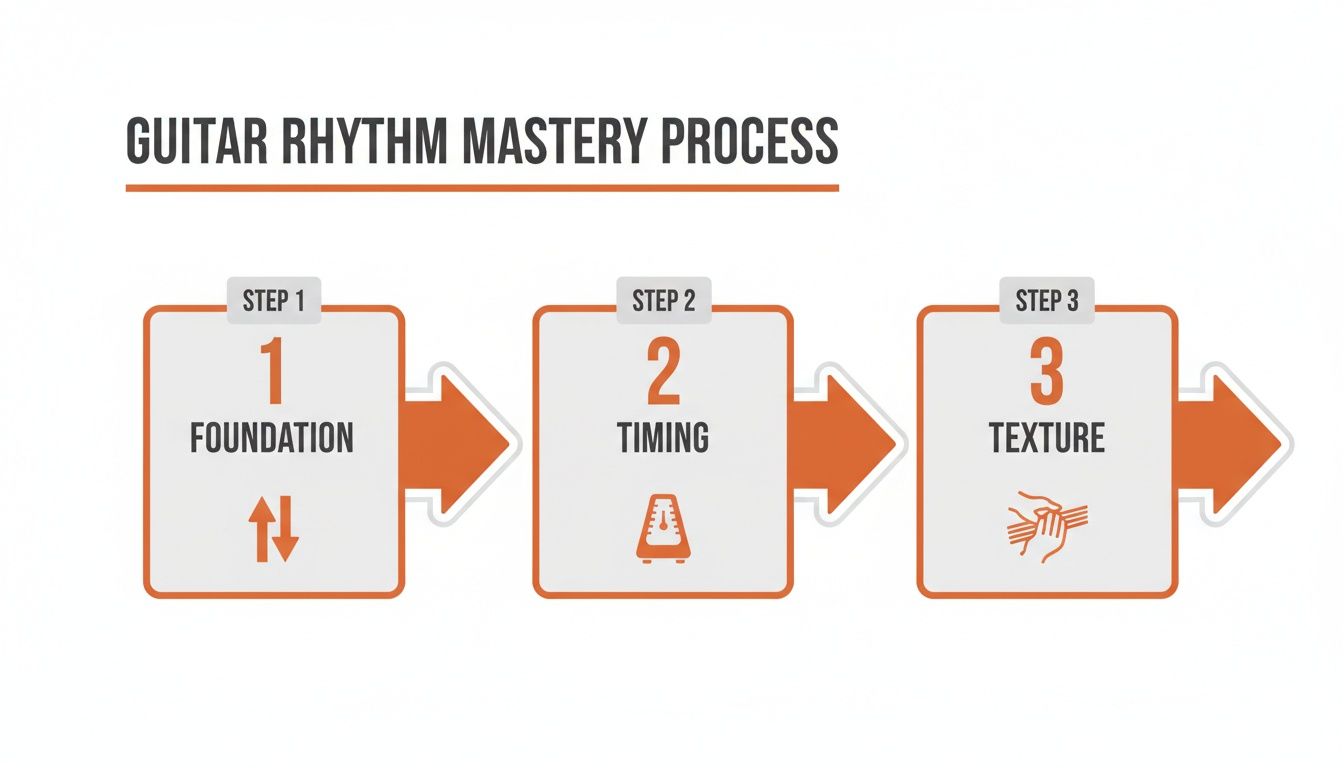
This visual breaks it down perfectly: you can't add that cool, textural feel until you’ve nailed your timing. And you can't nail your timing without a solid foundation.
Weaving these targeted drills into your daily routine can make a dramatic difference. They isolate the physical act of the change itself, turning those clunky, hesitant movements into something fluid and automatic.
The most effective practice sessions are almost always short and highly focused. Just 10-15 minutes of dedicated transition practice each day will get you way better results than an hour of aimless strumming once a week.
Another great strategy is to make your practice more musical with jam tracks. Instead of drilling changes in dead silence, playing along to a backing track forces you to make the change in time. It makes practice feel way less like a chore and more like a real jam session. For a deeper dive on this, check out our guide on how to learn guitar chords quickly with muscle memory.
So, you've got the building blocks of popular music under your fingers. Nicely done! With the I–IV–V and the classic "four-chord" pop progression in your back pocket, you can jam along to literally thousands of songs. Every single guitarist you look up to started exactly where you are right now, wrestling with these very same shapes.
The road ahead is all about staying curious. It's about exploring new keys and, more importantly, listening deeply to the music that gets you fired up to play in the first place. Think of these beginner guitar chord progressions as your launchpad for a lifetime of making music.
If you're looking for more structured guidance on your next steps, check out our advice on how to find the right guitar teacher for you.
Your progress from here is all about momentum. The skills you've just learned are the perfect foundation to build upon with structured, expert guidance.
To keep that fire lit and your momentum going, we invite you to start a TrueFire All Access free trial. You'll get instant access to a massive library of lessons, jam tracks, and everything else you need to become the guitarist you've always wanted to be.
When you're just starting to piece together your first chord progressions, it's totally normal to hit a few snags. Think of it as a rite of passage. Here are a few of the most common questions I hear from new players, with some quick answers to get you over the hump and back to making music.
This is almost always a finger placement issue, and it's something every single guitarist has dealt with. The fix usually comes down to two small adjustments.
First, check where your fingertips are landing. You want to press down firmly just behind the fret, not right on top of it or in the middle of the fret space. Second, really focus on arching your fingers—think of making a "claw" shape with your hand. This simple change lifts your fingers up and away from the other strings, preventing them from accidentally touching and muting strings they shouldn't. It takes a little time to build that hand strength, so be patient with yourself.
Honestly? Speed is the last thing you should worry about right now. Your only mission in the beginning is to achieve cleanliness and accuracy.
Trying to rush your chord changes before your muscle memory is locked in is a surefire way to build sloppy habits that are tough to unlearn later. A better approach is to grab a metronome, set it to a painfully slow tempo (like 60 BPM), and just focus on landing each chord change perfectly on the beat. Once you can nail the transition flawlessly a bunch of times in a row, then you can nudge the speed up a little.
For guitar players, the keys of G Major and C Major are fantastic starting points. Why? Because the core chords in these keys (G, C, D, Em, Am) are mostly open chords.
This means you can get right to work on the fundamentals—strumming patterns, keeping time, and smoothing out your transitions—without the added frustration of wrestling with tricky barre chord shapes. You'll build confidence and a solid foundation much faster.
Ready to put these tips into practice with world-class instructors? TrueFire is loaded with thousands of lessons and interactive jam tracks that will help you master these skills and so much more. Grab a TrueFire All Access Trial today to accelerate your learning.
