Before you dream of shredding solos or nailing complex chord progressions, your journey as a guitarist begins with a deceptively simple tool: the guitar pick. Developing a confident relationship with this little piece of plastic is the foundational first step toward unlocking your own unique sound. For any aspiring player, mastering beginner guitar picking is non-negotiable.
It's a classic rookie mistake to believe the flashy fretting hand does all the meaningful work. The truth? Your picking hand is the engine room of your playing—it dictates your tone, rhythm, and articulation. This is where your musical voice truly begins to emerge.
Forget rigid, one-size-fits-all instructions. As a music educator, my goal is to help you build a relaxed, confident foundation that prevents bad habits before they take root. This isn't just about hitting notes; it's about setting you up for a lifetime of enjoyable playing.
You're in good company on this journey. A recent analysis from Fender revealed that 16 million Americans started playing guitar over just a two-year period. That’s a massive community of new players on the exact same path.
Getting your basic picking mechanics right isn't a phase you outgrow; it’s a skill you'll rely on for your entire playing career. Here’s why a strong start is so critical from a pedagogical perspective:
Think of your picking hand as the "bow" for your instrument. Your fretting hand chooses the notes, but your picking hand determines how those notes are articulated—with power, finesse, confidence, or hesitation.
This is where we lay the groundwork. We'll cover everything from how to hold the pick correctly to the fundamental down-and-up motions that form the backbone of nearly every style of guitar music.
To explore thousands of structured lessons that will guide your entire guitar journey, from your very first pick stroke to advanced techniques, check out the TrueFire All Access Trial.
Excellent picking technique is not about a tense death grip. Far from it. It’s about achieving a relaxed equilibrium—a balance between firm control and fluid flexibility. How you hold that pick is the primary connection between your musical ideas and the instrument, so establishing good habits from day one is paramount.
From my experience, the most effective way to achieve a firm yet nimble grip is to start by making a loose fist with your picking hand. Don't clench it; just allow your fingers to curl in naturally.
Now, place the pick on the side of your index finger so the pointy end is aimed away from your palm. Finally, bring your thumb down to gently secure it. Your thumb and the side of your index finger should be the only points of contact. That's it. This method provides ample stability without creating the tension that leads to hand fatigue and a choked, thin tone.
Once you have a comfortable grip, the next piece of the puzzle is establishing a stable anchor for your hand. Without an anchor, your picking hand lacks a consistent point of reference, making precise and reliable movements nearly impossible. Most players establish a solid home base either on the guitar's bridge or its body.
Honestly, there is no single "correct" method. Experiment with both to discover what feels most natural and ergonomic for you. The goal is a position that allows for fluid, repeatable motion without making you feel locked in place. If you want to dive deeper into this, we've got a whole set of exercises in our guide on acoustic guitar warm-ups.
The progression from simply holding a pick to making music is a clear, logical path. It's about taking small, deliberate steps.
This illustrates a core teaching principle: once you are comfortable with the tool in your hand, you can begin building the mechanical skills that will eventually become the foundation of your unique musical voice.
Let's ensure you have the essentials down. Use this checklist as a quick reference to audit your form.
Use this quick reference to check your form against common best practices for a solid picking foundation.
| Technique Element | Best Practice for Beginners | Why It Matters |
|---|---|---|
| Pick Grip | Held between the pad of the thumb and the side of the index finger. | Provides a balance of stability for control and flexibility for speed. |
| Hand Tension | Relaxed and loose, avoiding a tight "death grip." | Prevents hand cramps and allows for fluid, dynamic playing. |
| Anchoring | Lightly rest the palm on the bridge or a finger on the body. | Creates a consistent reference point for accurate picking across strings. |
| Pick Depth | Only the very tip (1-2 mm) should make contact with the string. | Reduces resistance, making it easier to play cleanly and quickly. |
| Pick Angle | Slightly angled (15-30 degrees) to the string, not perfectly flat. | Softens the attack for a warmer, smoother, and less "clicky" tone. |
Internalizing these small details from the beginning will save you countless hours of frustration down the road. It's the difference between fighting the instrument and making it feel like a natural extension of yourself.
Subtle adjustments in how your pick meets the string can create massive differences in your tone. The two key variables to control are how deep the pick travels and the angle at which it strikes.
A classic beginner error is digging the pick too deeply between the strings. You only need the very tip to make contact—think 1-2 millimeters. This minimal depth significantly reduces resistance, which makes playing faster and cleaner much more achievable.
The angle is equally crucial. Striking the string with the pick held perfectly flat results in a bright, percussive attack. However, if you angle it slightly—around 15 to 30 degrees—the pick glides over the string, softening the attack and producing a warmer, smoother sound. This is your first foray into sculpting your tone, controlled entirely by your picking hand.
Mastering these mechanics is a lifelong pursuit, but a solid foundation makes everything that follows possible.
If you're ready to build the engine that drives your lead playing and makes your riffs sound tight and professional, it all begins with the most fundamental mechanic: alternate picking. This is the continuous down-up motion that guarantees efficiency and rhythmic accuracy.
Think of it like walking: you wouldn't take two consecutive steps with your left foot. Alternate picking applies that same intuitive logic to your picking hand, ensuring every stroke is deliberate and locked into the rhythm. This constant motion is the absolute key to playing everything from simple melodies to complex solos with control and precision.
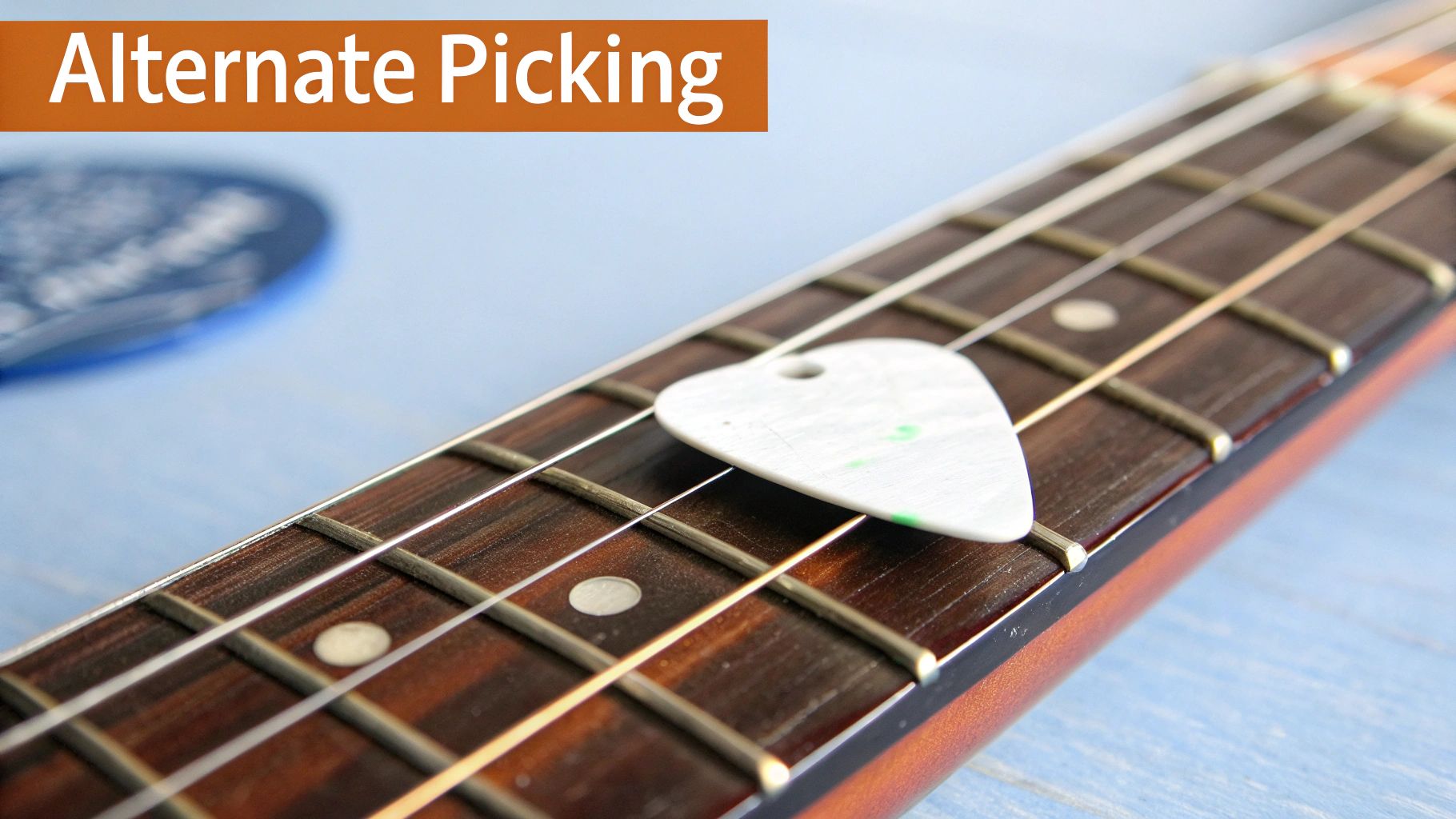
Let's burn this motion into your muscle memory with a simple, single-string drill. Grab your guitar, turn on a metronome, and set it to a slow, manageable tempo—around 60 BPM (beats per minute) is perfect.
Your picking hand should maintain a continuous, pendulum-like motion, even if there isn't a note to be played. The goal is to make this down-up movement completely automatic. Forget about speed for now; your sole focus is perfect timing and a consistent attack. Once you can execute this cleanly for a full minute, increase the tempo by 5 BPM. For more tips on this, you can explore some easy tricks for building speed and stamina on guitar.
Your metronome is your most important practice partner for building speed. It provides objective, honest feedback and forces you to develop a rock-solid internal clock. Never practice speed without it.
Once the strict down-up motion of alternate picking feels natural, we can introduce a subtle but powerful variation called economy picking. You can think of it as a hybrid of alternate picking and sweep picking, designed specifically to make crossing strings more efficient.
The rule is simple: when moving to a lower string (thicker), use a downstroke. When moving to a higher string (thinner), use an upstroke. This allows you to use a single, fluid motion to glide across the strings instead of having to "jump" over them.
Let's see this in action with a simple three-note pattern on the G, B, and high E strings.
Notice how this uses one continuous motion—a tiny "sweep"—to play the notes? It conserves a great deal of motion compared to what strict alternate picking would demand in that scenario. It feels smoother and requires less physical energy, which translates directly to faster, cleaner playing.
Economy picking is not a replacement for alternate picking; it is a specialized tool for specific applications, primarily when playing an odd number of notes per string before changing strings. Mastering both gives you a comprehensive toolkit to tackle any musical line with maximum efficiency. Practice both diligently to build a technical foundation that will serve you for years to come.
Alright, let's get your hands working together. Theory is essential, but building the physical synchronization between your picking and fretting hands is where the music truly happens. This section is all about practical exercises designed to forge that crucial link and build reliable muscle memory.
We'll begin with simple single-string patterns before advancing to multi-string exercises you'll encounter in real musical contexts. The goal is to make accurate picking feel automatic, so you can stop thinking about mechanics and focus on making music.
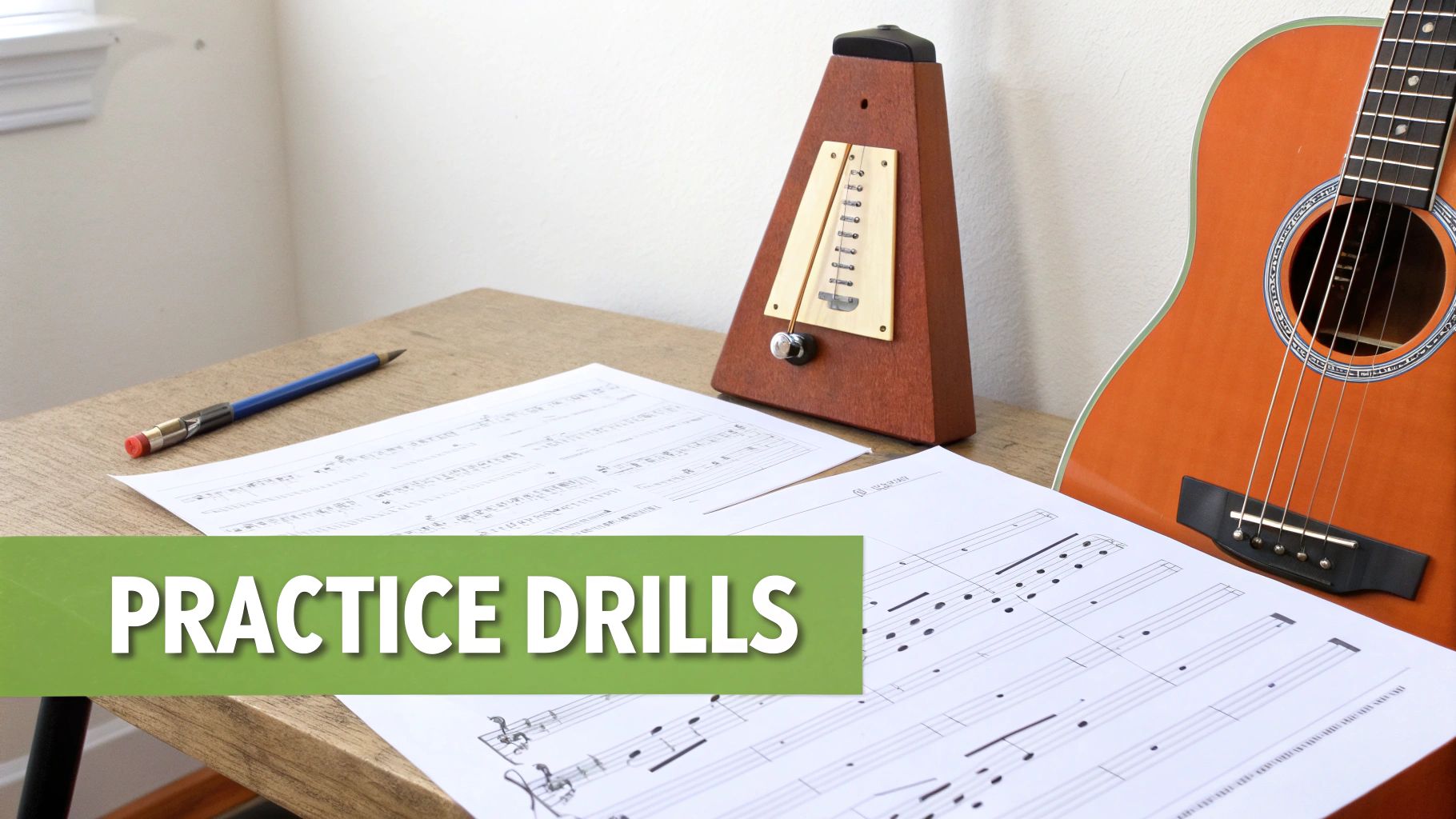
Let's start with the first coordination exercise I give all my students. It's often called the "Spider Walk," but the name isn't important—the objective is to get your hands moving in perfect sync.
Here's how to approach it:
Speed is not the objective here. Flawless timing is. Each pick stroke must land at the exact moment your finger frets the note. This is the bedrock of clean, professional-sounding guitar playing.
A classic beginner mistake is letting the fretting hand get ahead of the picking hand. If you hear buzzing or muted notes, slow down immediately. The mission is clean, synchronized execution on every repetition.
Once your hands feel synchronized on a single string, it's time to tackle string changes. This is a common hurdle because it demands greater precision from your picking hand.
An excellent way to practice this is by playing simple scale fragments. Let’s use a small piece of the A minor pentatonic scale, a pattern found in countless rock and blues songs.
Loop this two-string pattern repeatedly. Concentrate on the small, controlled motion your picking hand makes as it crosses from the E to the A string. Keep that movement tight and efficient.
Let's be honest—mechanical drills can become monotonous. This is where jam tracks become your secret weapon. Playing along to a backing track forces you to lock into a groove and apply your developing skills in a genuine musical context.
Suddenly, that A minor pentatonic fragment we just practiced is no longer just an exercise. Over a slow blues track in A minor, it becomes a musical phrase. This makes your practice time far more engaging and helps train your ear simultaneously.
For an excellent guide on structuring these sessions, check out our post on how to perfect your guitar practice.
Building coordination requires time and patience. Prioritize accuracy over speed, and remember to have fun with the process.
Here is a sample weekly routine to help you build these skills methodically without feeling overwhelmed. Consistency is key to seeing a significant improvement in your coordination and timing.
| Day | Focus (15-20 Minutes) | Tempo Goal (BPM) |
|---|---|---|
| Day 1 | Single-String Synchronization Drill (Low E string only) | 60-70 |
| Day 2 | A Minor Pentatonic Fragment (Two-string pattern) | 60-70 |
| Day 3 | Single-String Synchronization Drill (All six strings) | 65-75 |
| Day 4 | A Minor Pentatonic Fragment + Improvise with jam track | 65-75 |
| Day 5 | Combine both exercises into one continuous routine | 70-80 |
| Day 6 | Focus on your weakest exercise from the week | +5 BPM from last |
| Day 7 | Rest or light review | N/A |
Remember, the tempo goals are merely targets. The most important metric is playing cleanly and in time. If you can do that, speed will follow naturally.
Every single guitarist—from absolute beginners to seasoned professionals—hits roadblocks. It is an unavoidable part of the learning process, especially when dealing with fundamental mechanics like picking. The key is not to avoid mistakes, but to identify and correct them early before they become ingrained habits.
Let's diagnose the most common picking problems I see with new students. Use this as your troubleshooting guide to get back on track and play with clarity.
Ah, the "death grip." This is arguably the most pervasive mistake. It occurs when you hold the pick so tightly that your knuckles turn white, usually out of fear of dropping it. However, that intense pressure creates tension that radiates up your forearm, making fluid, rapid picking impossible and fatiguing your muscles quickly.
The fix is simple in concept: relax. Your goal is a grip that's firm enough for control but loose enough for flexibility. If you feel your hand cramping, that is your signal to stop, shake it out, and reset. You only need enough pressure to prevent the pick from shifting or falling.
Here's a quick diagnostic test: Hold the pick as you normally would and ask a friend to gently pull it from your fingers. They should be able to remove it with a light tug. If the pick is locked in place, you are holding on too tightly.
Correcting this single issue can be a game-changer for your tone, stamina, and speed. It’s often one of the first things we address when diagnosing common issues, and you can dig into more of them in our guide covering 7 mistakes every beginner guitarist makes.
The next common issue is picking from the elbow or shoulder. If you observe any proficient player, you'll notice their picking motion is incredibly efficient—it's small, controlled, and originates almost entirely from a subtle wrist rotation. When you engage your entire arm, you sacrifice fine motor control. It’s analogous to trying to write your name by moving your shoulder; the result is clumsy and imprecise.
To correct this, try anchoring the heel of your picking hand lightly on the bridge of your guitar. This simple act helps stabilize your arm and encourages the wrist to become the primary driver of the motion.
Do you ever notice that some of your notes are loud and aggressive while others are barely audible? This is the hallmark of an inconsistent attack. It means you are not striking the strings with the same depth and force on every stroke, which can make your playing sound uneven and amateurish.
The solution here lies in mindful, focused repetition. Choose a simple, single-string exercise and dedicate all your concentration to one goal: making every downstroke and upstroke sound identical in volume and tone. Record yourself playing a simple scale and listen back critically. Does every note possess the same clarity and volume? This type of focused listening is your most effective tool for developing a solid, reliable picking attack.
Nailing these fundamentals builds a strong foundation. It helps you break through frustrating plateaus and build genuine confidence in your playing.
To get guidance from world-class instructors who can walk you through every step, from fixing bad habits to mastering pro-level techniques, start a TrueFire All Access Trial.
You have put in the work to build a solid picking foundation. That is a significant accomplishment. But the journey doesn’t end here—in fact, this is where the real fun begins. Now that you are comfortable with hand synchronization and alternate picking, it’s time to explore new techniques that will expand your musical vocabulary.
The skills you possess now are the gateway to virtually any style you wish to pursue, from country and blues to rock and jazz. The key from this point forward is to remain curious and maintain a consistent, focused practice routine.
Two techniques will immediately unlock new creative possibilities for you. These approaches are particularly valuable because they blend the sharp attack of a pick with the nuance of fingerstyle, creating textures that are impossible to achieve with a plectrum alone.
Hybrid Picking: This technique involves using the pick (held between the thumb and index finger) in conjunction with your middle and ring fingers to pluck other strings simultaneously. It’s the secret behind the blazing "chicken pickin'" licks in country music, but it’s equally at home in jazz and rock for executing complex arpeggios and wide-interval melodic lines.
Basic Fingerstyle: While not strictly "picking" with a plectrum, learning some fundamental fingerstyle patterns is an invaluable skill for any guitarist. It’s a fantastic way to develop finger independence and gives you the ability to play intricate, multi-part arrangements—a cornerstone of acoustic, folk, and classical music.
My single biggest piece of advice as an educator is to never stop adding tools to your toolbox. Each new technique you master doesn't just give you a new trick; it fundamentally changes how you hear and approach the entire instrument.
If you're ready to explore one of these exciting techniques, we have an excellent guide on crafting creative lead parts with hybrid picking. Adding these skills to your repertoire will ensure your progress continues for years to come.
To continue your growth with world-class instructors guiding you every step of the way, explore the massive library of lessons available from TrueFire. Start your journey today with a TrueFire All Access free trial.
