So, what makes a set of guitar lessons genuinely great for a beginner? As a music educator, I can tell you it’s all about having a clear, progressive path to follow, guidance from someone who truly knows how to teach, and tools that actually make you want to pick up your guitar every day.
While a great private teacher is a fantastic option, today’s online platforms offer an incredible mix of affordability, flexibility, and interactive features that can get you playing faster and make practice feel less like a chore.
If you're looking for the best way to learn guitar, you’ve already taken the biggest step: the decision to start. The road from fumbling with strings to confidently playing songs is built on small, consistent wins. That initial learning experience is what builds the momentum you need to stick with it.
From my experience, the difference between becoming a lifelong player and letting your guitar gather dust often comes down to the quality of those first few lessons.
This guide is your roadmap. We're going to cut through the noise and show you what effective beginner lessons really look like, whether you're using a cutting-edge online platform or sitting down with a local teacher.
We’ll break down the essential ingredients for building a solid foundation so you can choose the right path for you. Think of this guide as your personal coach, here to demystify the fretboard and set you up for a fun, rewarding musical journey. You'll learn:
The world of guitar education has changed so much. The global market for guitar learning platforms hit $125 million in 2024 and is only getting bigger as more players discover just how powerful digital tools can be. This isn't just a trend; it's a reflection of a huge demand for learning that fits into our busy lives. You can find out more about the guitar education market growth and see for yourself.
Your goal isn't just to learn chords; it's to learn how to make music. The best lessons never lose sight of this, connecting every technical exercise to the ultimate joy of playing a song.
By the time you finish this guide, you’ll know exactly what to look for and how to get started on the right foot. For more must-have advice, check out our beginner's guide to starting guitar with 10 crucial tips to help you sidestep common frustrations.
This whole journey is about building skills and confidence, one chord at a time. To see how a well-rounded platform can completely change your learning experience, you can explore everything we talk about here with a TrueFire All Access Trial.
Let's be real: not all guitar lessons are created equal. This is especially true when you're just trying to figure out which end of the instrument is which. The best guitar lessons for beginners have nothing to do with shredding solos or heavy music theory. It’s all about building a solid, frustration-free foundation.
Think of it like building a house—you don't start with the roof. You need a blueprint and a strong base to build upon.
The single most important thing is a clear, structured curriculum. Sure, you can find a million one-off videos on YouTube, but jumping around randomly is a surefire way to get confused and leave massive gaps in your playing. A great learning path guides you logically from A to B, starting with the absolute essentials—how to hold the guitar, how to tune it, how to press a string without that awful buzzing sound—before you even think about your first chords.
This step-by-step progression is what keeps you from hitting a wall and wanting to quit. Every new skill should feel like the natural next step, building directly on what you just learned. That's how you stay motivated.
Beyond the roadmap, the instructor themselves makes all the difference. Just because someone is a world-class guitarist doesn't mean they're a world-class teacher. The best teachers are fantastic communicators who can break down tricky concepts into simple, easy-to-digest pieces.
They don't just show you what to play; they explain why it works and give you a solid plan for how to practice it. That’s the difference between just copying someone’s fingers and actually understanding the music you’re making.
Here’s a perfect example of what a structured curriculum, or what we call a Learning Path, looks like.
This visual guide shows you exactly how a beginner can move from the core fundamentals into more specialized styles in a clear, organized way. No guesswork involved.
Today's lessons have a huge leg up on the old-school methods: interactive practice tools. These are game-changers, turning what could be a repetitive chore into a practice session that's actually engaging and effective. You'll want to find lessons that include things like:
The secret to sticking with guitar is making practice feel like playing. When you're having fun and hearing yourself improve, motivation takes care of itself.
Finally, the biggest motivator of all is song-based learning. Drills and exercises have their place, but using them to play a song you actually love gives you immediate context and a huge sense of accomplishment. The best beginner courses get you playing real songs early, showing you exactly how that new G chord you just learned is used in a thousand hit tunes.
These four pillars—Structure, Quality Instruction, Practice Tools, and Song-Based Learning—are your recipe for success. You can see how all these pieces come together for yourself with a TrueFire All Access Trial.
When you’re just starting, you’re standing at a crossroads. There are a few different ways to learn guitar, and picking the right one comes down to your budget, your schedule, and how you personally learn best. The big decision right out of the gate is whether to go with online lessons or find a teacher in person.
For decades, the gold standard was finding a local teacher for one-on-one lessons. There’s a good reason for that. Nothing beats having an expert right there in the room with you, giving you real-time feedback. When a chord is buzzing or your hand position feels awkward, they can spot it and fix it on the spot. That kind of personalized coaching, tailored to your exact progress, is incredibly valuable.
But that level of attention comes with a price tag. Private lessons are easily the most expensive route, and they're not exactly flexible. You’re typically locked into a weekly time slot, which can be a real headache if you have a busy or unpredictable schedule.
This is where modern online platforms have really changed the game for aspiring guitarists. They offer massive libraries of video lessons, structured learning paths, and interactive tools you can tap into anytime, day or night. The whole setup is built for flexibility, letting you learn at your own pace, on your own time.
The biggest win here is the sheer amount of high-quality resources you get for a fraction of the cost of private lessons. Suddenly, you can learn from world-class instructors and even GRAMMY-winning artists you’d never have access to otherwise.
Now, you don't get that same immediate, in-person feedback. But the best platforms make up for it with powerful practice tools. Think slow-motion video, looping sections of a tricky solo, and jam tracks that make practicing feel less like a chore and more like a real jam session.
This infographic breaks down what really matters, no matter which format you choose.
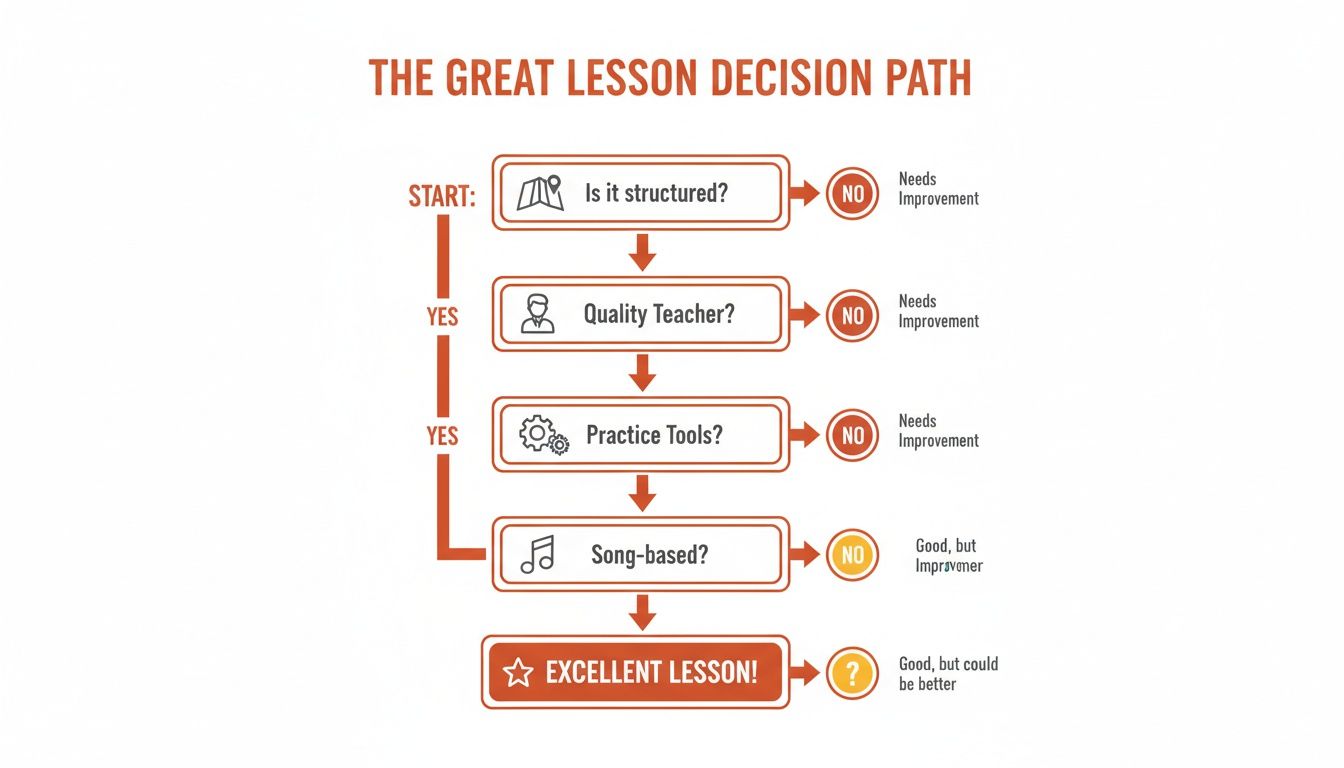
As you can see, the best learning experiences—online or off—are built on a solid foundation of structure, great teaching, effective tools, and a focus on playing actual songs.
| Feature | Online Platforms (e.g., TrueFire) | Private One-on-One Tutor | In-Person Group Class |
|---|---|---|---|
| Cost | Most Affordable ($10-$30/month) | Most Expensive ($40-$100+/hour) | Mid-Range ($20-$40/class) |
| Flexibility | Very High. Learn 24/7 at your own pace. | Low. Fixed weekly schedule. | Low. Fixed class time. |
| Personalized Feedback | Varies. Some have feedback options; otherwise self-directed. | Very High. Immediate, tailored feedback. | Low. Teacher's attention is divided. |
| Pacing | Self-paced. Rewind, re-watch, and skip as needed. | Custom-paced by the instructor for your needs. | Fixed pace of the group. |
| Instructor Variety | Massive. Access to hundreds of world-class teachers. | Limited to teachers available in your local area. | Limited to one teacher per class. |
| Learning Resources | Extensive. Jam tracks, tabs, slow-mo, looping. | Varies. Depends on what the teacher provides. | Limited. Usually a single handout or book. |
So, which path is yours? There’s no single correct answer, but here’s a simple way to look at it:
The most important factor isn't the format itself but the quality within that format. A poor in-person teacher is worse than a great online course, and vice versa.
Ultimately, the goal is to find a learning environment that keeps you inspired and consistently picking up your guitar. If you're leaning toward the in-person route, our guide on how to find the right guitar teacher for you has some great tips.
And if you want to see how a top-tier online platform combines structure, expert instruction, and powerful practice tools, you can explore everything for yourself with a TrueFire All Access Trial.
The journey from a quiet room to playing your favorite song happens one step at a time. Your first three months are crucial—this is where you forge the habits that will stick with you for a lifetime. It’s not a race; it's about building a rock-solid foundation, getting some momentum, and proving to yourself that you’ve got this.
Here’s a realistic, no-nonsense plan to take you from absolute zero to playing actual songs. It’s designed to be effective without feeling like a chore, hitting the milestones that really matter for a new player.
The goal for your first 30 days is simple: get comfortable holding and handling your guitar. Forget about shredding solos for now. This is all about learning the basic language of the instrument, which everything else will build on.
Your main goals this month are:
The most important skill you can learn in your first month is patience. Progress comes from consistent, focused repetition, not from rushing ahead.
Okay, you've got the fundamentals down. Month two is all about connection. This is where you start bridging the gap between individual chords to create something that actually sounds like music. The focus shifts from static shapes to fluid movement and rhythm.
Now, let's build on that foundation:
By the end of this month, you should be able to play simple two- or three-chord progressions. This is where the fun really kicks in, because you’ll start hearing pieces of songs you already know and love. For more pointers, our article on 5 smart practice tips for guitar players can help you make every session count.
In the final month of this initial push, you'll put all the pieces together. You’re going to move from just practicing parts of songs to playing entire songs. This is the payoff for all that foundational work you put in.
Your goals for the final month are:
The modern way of learning guitar has come a long way. Beginners are seeing huge benefits from structured digital paths—some studies show skill acquisition can be up to 40% faster than just noodling around on your own, thanks to tools like progress trackers and interactive chord charts.
This 90-day plan is a roadmap that works. To see it in action with an expert guiding you every step of the way, check out a TrueFire All Access Trial.
It’s one thing to know what works in theory, but seeing it in action is what really counts. We’ve built the entire TrueFire platform around what actually helps people learn guitar without the usual frustration. Every single feature is there to solve a real problem that new players face—the kind of stuff that makes people want to quit.
We don't just dump a massive library of random videos on you and wish you luck. Instead, we guide you through a logical, step-by-step path designed to build your skills the right way, right from the very beginning.
The journey from fumbling with your first chord to confidently playing songs needs a map. Without one, you’re just wandering in the dark. That’s exactly what TrueFire’s Learning Paths provide. Think of a course like "Learn Guitar 1" as your personal roadmap, designed by world-class educators to make sure you learn the right things in the right order.
You’ll start with the absolute must-knows: how to hold the guitar, how to get it in tune, and how to make your first clean notes. From there, you’ll move logically into chords, strumming patterns, and eventually, entire songs. You'll never be left wondering, "Okay, what's next?" The path is always laid out for you.
This structured approach is a game-changer for beginners. To get a better feel for how it works, you can check out the top five reasons guitarists choose TrueFire and see the difference a clear structure makes.
Imagine if your very first guitar teacher was a GRAMMY-winning artist or a top-tier session player. With TrueFire, that’s not a hypothetical—it’s reality. Our instructors aren't just incredible guitarists; they're gifted teachers who know how to break down complex ideas into simple, manageable steps.
Every lesson is shot in multi-angle HD video, so you can see exactly what their fretting hand and picking hand are doing at all times. The audio is crystal-clear, meaning you hear every single nuance of the technique being taught.
A great teacher doesn't just show you what to play; they help you understand the mechanics and feel of the music. This builds true musicality, not just muscle memory.
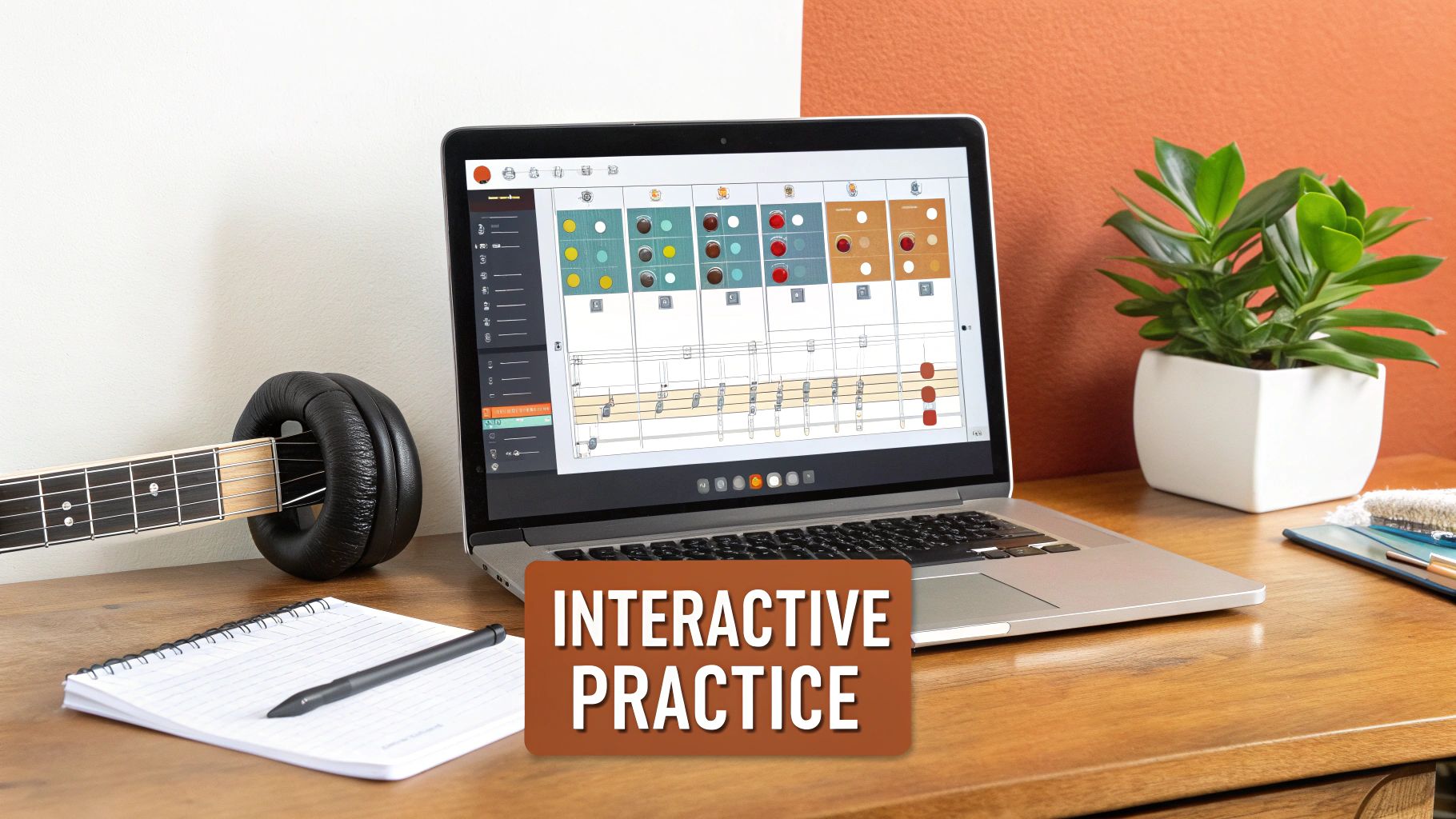
Here’s where TrueFire really separates itself from a simple video playlist. We turn passive watching into active, hands-on practice. These aren't just lessons; they're interactive workshops packed with tools designed to help you nail the tricky parts and make your practice time count.
Let's be honest: running drills is important, but playing actual music is why you picked up the guitar in the first place. Our lesson library is full of courses that teach you to play the songs you already know and love. When you apply a new chord or scale to a familiar tune, it clicks. You get that immediate reward and a powerful sense of accomplishment that keeps you coming back for more.
Since starting back in 1991, TrueFire has grown into a massive resource for guitarists of all levels. Today, the platform holds over 80,000 interactive video lessons from more than 600 world-class educators. There's a reason Guitar Player Magazine called it "the planet's largest and most comprehensive selection of online guitar lessons," with millions of players around the world counting on it to grow their skills.
Every piece of the platform is designed to make learning accessible, engaging, and effective for beginners. The best way to see it all for yourself is to grab a TrueFire All Access Trial and take it for a spin.
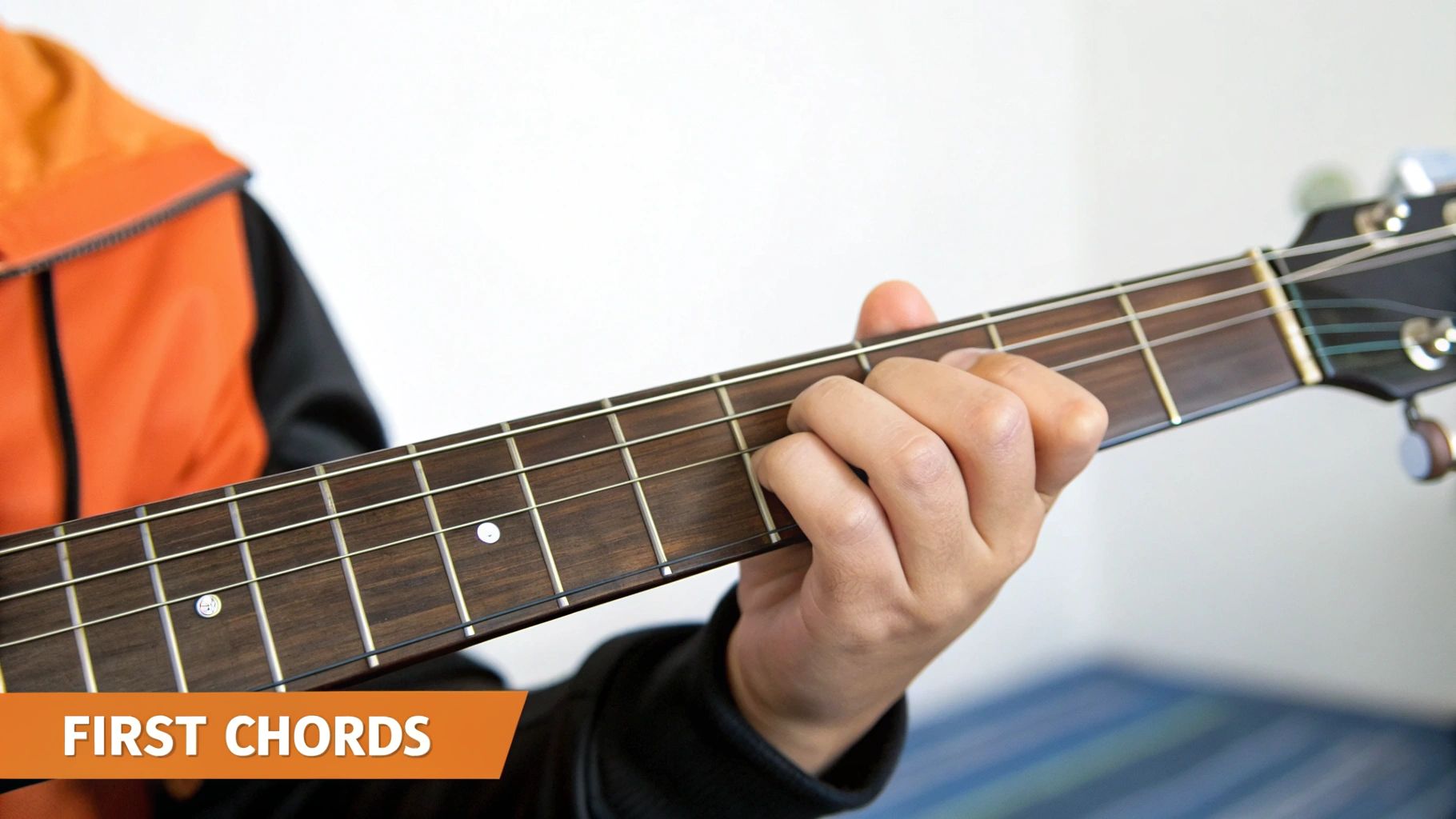
Alright, you've now got the complete playbook for picking the right guitar lessons and a clear road map to follow. The most important step isn't tomorrow or next week—it’s the one you take right now. Trust me on this: when it comes to learning an instrument, consistency is your superpower.
A focused 20-minute practice session every day is way more powerful than a marathon session once a week. It’s in those short, dedicated bursts that you build real muscle memory and make new skills stick. As a guitar educator, I’ve seen this principle work for thousands of students.
Momentum is everything. You have to celebrate the small victories along the way. Did you finally nail that tricky chord change from G to C without a buzz? That’s a huge win. Did you keep a steady strumming pattern going for a full minute? High-five yourself.
These moments build the confidence that keeps you coming back for more. They turn the learning process from a frustrating chore into the pure joy of making music. For a deeper look into what those first wins should be, our guide on the first things beginners learn on guitar will get you focused on what truly matters.
The goal isn't just to practice; it's to enjoy the process of creating sound. Every clean note and smooth transition is a step closer to expressing yourself musically.
The right learning environment can make all the difference, turning potential frustration into genuine progress. A structured platform with interactive tools isn't just a nice-to-have; it's a powerful accelerator for your playing. It gives you the roadmap and the resources to make sure every single practice session counts.
To really get what I'm talking about, you need to see it for yourself. You can experience everything we've covered in this guide—from structured learning paths to top-tier instruction and interactive practice tools—in action with a TrueFire All Access Trial.
Stepping into the world of guitar brings up a ton of questions. As a long-time player and teacher, I've heard just about all of them. Let's clear up some of the most common things new players wonder about when they're hunting for the best way to learn.
This is the big one, and the honest-to-goodness answer is: it really depends on how consistently you practice and the quality of your lessons. It's a lot like learning a new language. If you practice speaking for 20-30 minutes every single day, you'll get conversational way faster than someone who crams for a few hours just once a week.
With a good, structured plan and daily practice, most beginners can get comfortable with basic chords and strum their way through simple songs in about three months. Getting to that intermediate level—where you're tackling more interesting songs and maybe even improvising a little—usually takes somewhere between six and twelve months of dedicated playing.
The real secret isn't how long you practice, but how focused you are. A short session with a clear goal beats hours of aimless noodling every time. This is where a platform with progress tracking really shines, because you can actually see how far you've come, which is a huge motivator.
Simple answer: the best guitar to start with is the one that makes you want to play the music you love. Your passion is the fuel for this entire journey, so pick the instrument that gets you excited.
If you're dreaming of ripping rock solos like your heroes, grab an electric. If you're drawn to the sounds of singer-songwriters and campfire tunes, an acoustic is your best bet. People often say acoustic strings are tougher on the fingers at first, and while that's true, the initial soreness fades fast. Don't let a minor, temporary hurdle steer you away from the guitar that truly speaks to you.
Yes, absolutely. For a lot of people these days, they're actually more effective than the old-school way. The best online guitar lessons for beginners give you a powerful mix of features that a private teacher just can't compete with.
Here’s why they’re such a game-changer:
While having a teacher in the room gives you instant feedback, the combination of structure, deep resources, and sheer value you get from a top online platform makes it an incredible way to build a rock-solid foundation.
When you're just starting, you should be laser-focused on two things: clean chord changes and a steady rhythm. Seriously, these two skills are the engine that drives almost every song you've ever heard.
Getting your fingers to move smoothly between basic open chords like G, C, D, Em, and Am is what will unlock thousands of songs for you. Practice those changes slowly, aiming for clean notes, not speed. At the same time, get your strumming hand to develop a reliable sense of time. Nail these two fundamentals, and you'll be making real, satisfying music faster than you thought possible.
---
Learning guitar is one of the most rewarding things you can do, and having the right guideposts makes the journey a whole lot smoother. To see for yourself how a structured, expert-led platform can get you playing from day one, check out everything we've talked about with a TrueFire All Access Trial.
