The best way to teach yourself guitar is to start with a solid game plan and realistic goals. Seriously, forget trying to shred a solo in your first week. The real secret is stacking small, consistent wins—like mastering just a few essential chords and making them ring out clean and clear.
This is the approach that builds the confidence and good habits you need to stick with it, dodging the frustration that makes so many beginners give up.
Jumping into learning guitar is a huge thrill, but it's also where a lot of new players trip up right out of the gate. They set these massive, unrealistic expectations, hoping to sound like their heroes overnight. That mindset is a fast track to burnout.
As a guitar educator, I've seen it a thousand times: the initial spark of excitement gets smothered by a mountain of frustration. The best way to learn guitar by yourself doesn't start with speed or complexity. It starts with patience and a simple, achievable plan.
First thing's first: get to know your instrument. It doesn't matter if it's a sleek electric or a big-bodied acoustic; your guitar needs to feel like an extension of you. Take a minute to learn the basic anatomy.
Just knowing these parts helps demystify the instrument. It stops being this confusing wooden object and becomes a tool you can actually understand and control. For a deeper dive into these fundamentals, check out our guide on the first things a beginner should learn.
Your main goal for the first week isn't to play a song. It’s to make a single, clean sound.
That means pressing down on one string, right behind a fret, with just one fingertip, and hearing a clear note ring out—no buzzing. This tiny victory is way more important than fumbling through a dozen sloppy chords.
From there, you can move on to your first "cowboy chords," named because they're the foundation of countless folk, pop, and rock tunes.
Start with these three:
These chords are the absolute backbone of so much of the music you hear every day. Your mission is simple but challenging: get your fingers in the right shape for one chord, give it a strum, and make sure every single note rings out clearly. Don't even think about speed or changing between them yet. Just focus on clarity.
"The journey of a thousand songs begins with a single, clean chord. Focus on making one good sound before you try to make many."
This initial phase is all about building muscle memory in your hands and calluses on your fingertips. It’s a physical process as much as a mental one. You're literally teaching your hands to make new, awkward shapes. Be patient with yourself—your fingers are going to hurt, and some notes will buzz. That's a rite of passage for every guitarist.
To help you map out those crucial first weeks, I've put together a realistic timeline. Don't see this as a strict set of rules, but as a friendly guide to keep you on track and focused on what really matters.
This table breaks down achievable goals for your first month, helping you build a solid foundation and track progress without feeling overwhelmed.
| Week | Primary Focus | Key Skills to Develop | Target Outcome |
|---|---|---|---|
| Week 1 | Making Clean Notes | Proper finger placement, basic fretting, learning string names | Produce a clear, buzz-free note on each of the 6 strings |
| Week 2 | Your First Chord Shapes | Forming G, C, & D chords, basic down-strum | Hold each chord shape and strum it cleanly |
| Week 3 | Slow Chord Changes | Transitioning between G, C, & D without stopping | Move between two chords in time with a slow metronome |
| Week 4 | Basic Rhythm & Ear Training | Simple strumming patterns (e.g., down-down-up), tuning by ear | Play a simple G-C-D progression with a steady rhythm |
This roadmap isn't about rushing to the finish line. It's about taking deliberate, confident steps forward. Each small win listed here is a building block for everything that comes next.
So, why is this slow-and-steady approach so important? Because the biggest hurdle isn't physical; it's psychological.
Most new players don't quit because the guitar is too hard. They quit because their expectations are totally out of sync with reality, which kills their motivation. A study by Fender found that a staggering 90% of new guitar players quit within the first year. The truth is, learning guitar is maybe 20% skill and 80% mindset.
When you celebrate the small wins—like nailing a perfectly clear G chord or a smooth change to C—you create a positive feedback loop. Each success builds your confidence and makes you want to pick up the guitar again tomorrow. This is how you build a sustainable habit that separates lifelong musicians from people whose guitars end up collecting dust in a corner.
The foundation you're building isn't just about chords; it's about developing the resilience and passion to stick with it for the long haul.
So you've learned your first few chords and wrestled with the fretboard a bit. What's next? This is where the real work—and the real progress—begins: building a practice routine that you can actually stick with.
Forget the vague advice to just "practice more." That's a recipe for burnout. The key isn't logging endless, mindless hours. It's about making every minute you do have count. A solid routine is your roadmap, guiding you from fumbling with random notes to confidently playing actual music. It's what keeps you from getting stuck in that rut of playing the same three chords over and over again.
This is the bridge between simply owning a guitar and truly making music with it.
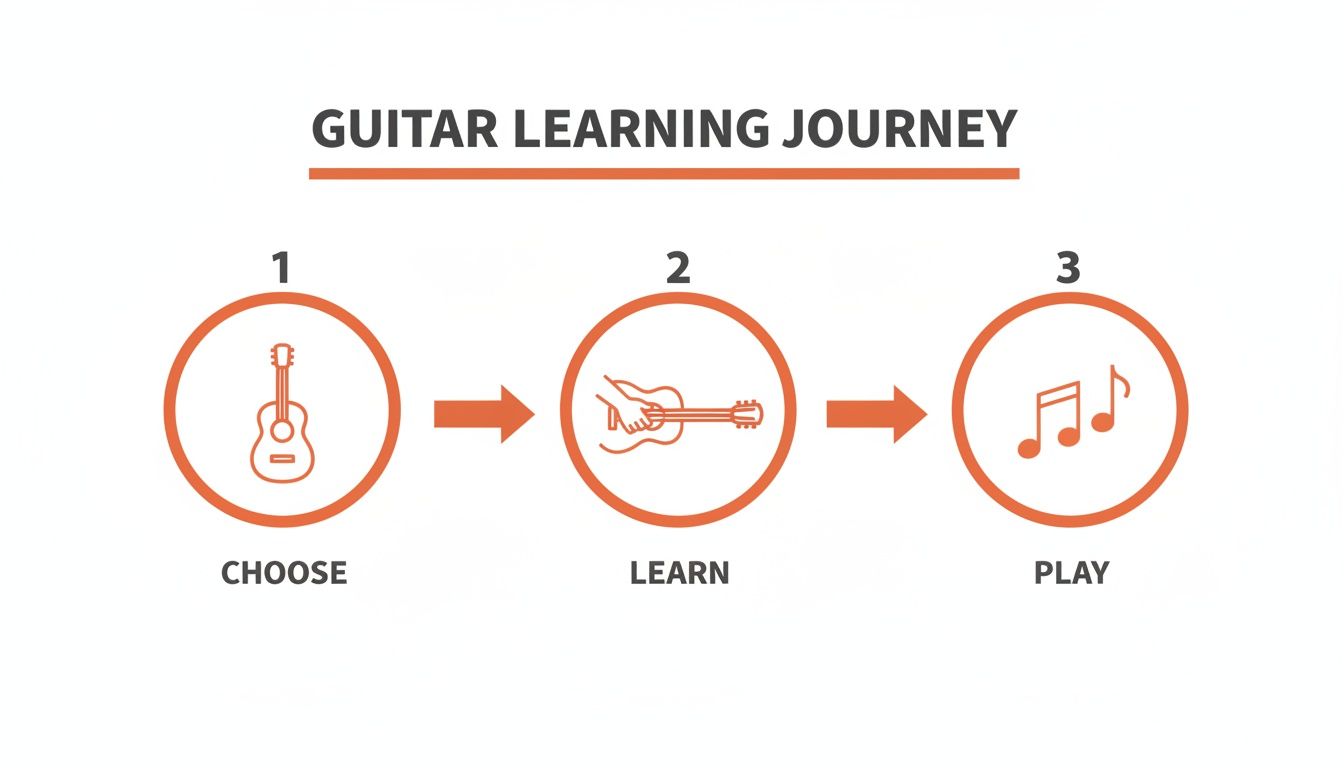
A productive practice session needs to cover five core areas. Think of these as the essential food groups for your guitar-playing diet. If you neglect one, your overall musical health will start to suffer. Try to hit each one in every session, even if it's just for a couple of minutes.
You don't need to clear your calendar for hours on end to see real results. A focused 30-minute session can be shockingly effective if you know how to structure it. It's all about quality, not quantity.
Here’s a sample schedule you can steal and adapt. The idea is to work on different skills to stay engaged and avoid burning out on any one thing.
| Time Block | Activity | Purpose |
|---|---|---|
| 0-5 Mins | Warm-up: Finger Exercises | Wake up your fingers, get the blood flowing, and improve dexterity (e.g., spider walks). |
| 5-15 Mins | Skill Focus: Chord Changes & Strumming | Time to get technical. Work on a new chord or a tricky transition with a metronome. |
| 15-20 Mins | Melody Work: Simple Scale or Riff | Train your ear and practice hitting single notes cleanly and precisely. |
| 20-30 Mins | Fun Time: Play a Song (or part of one) | Apply what you've learned! This keeps you motivated and reminds you why you started. |
This structure ensures you’re building your technical chops while also remembering the whole point of this journey—to play music you actually love.
As a music educator, I always tell my students: Your routine should feel like a workout, not a chore. It should be challenging enough to produce growth but enjoyable enough that you want to come back tomorrow.
And remember, be flexible. If you’re really struggling with that F chord, spend a little more time in the "Skill Focus" block. If you just nailed a riff you've been working on for days, by all means, extend your "Fun Time" by a few minutes. This structure is a guide, not a prison.
The most important thing is to pick up the guitar consistently and practice with intention. This mindful approach is the absolute fastest and best way to learn guitar by yourself. To get started with world-class instruction and a clear path forward, I highly recommend checking out a TrueFire All Access Trial.
Learning guitar on your own is a totally different game than it was a decade ago. Gone are the days of rewinding a cassette tape a dozen times or dropping a record needle over and over, just trying to figure out a tricky riff by ear. You’ve got a whole arsenal of digital tools that can be your personal teacher, your backing band, and your practice journal all rolled into one.
Making these resources part of your routine is central to the best way to learn guitar by yourself today. It’s not about finding shortcuts; it's about practicing smarter, staying engaged, and getting instant feedback that used to require a private lesson. This approach turns a solitary hobby into a genuinely interactive experience.
And this isn't just a small shift—it’s a massive one. An estimated 16 million Americans picked up the guitar in just the last couple of years. Fender's research found that a whopping 58% of these new players hit up TikTok for inspiration, with nearly half diving into online guitar content every single week. The old model of weekly in-person lessons is no longer the only path forward. You can see the full breakdown in Fender's new guitar player landscape analysis.
Before you even worry about fancy techniques, you’ve got to get the fundamentals down pat. Your smartphone is the perfect place to start. Forget buying a bunch of clunky, single-purpose gadgets. A few high-quality apps can cover all the basics, often for free.
Here are the absolute must-haves for your digital toolkit:
These three apps are the bedrock of your practice rig. Having them on your phone means your core tools are always in your pocket, ready for a quick session whenever you find a spare ten minutes.
Once you have the basics handled, it's time to bring in the tools that can seriously speed up your learning curve. This is where dedicated online learning platforms become invaluable, offering features that solve the biggest headaches for self-taught players.
As a music educator, I've seen that the biggest leaps in progress happen when students can dissect and internalize music at their own pace. Modern tools make this process incredibly efficient and remove much of the guesswork.
The real game-changers are features that give you total control over the music you're learning. It’s the closest you can get to having a patient teacher sitting next to you, ready to break down a tough part as many times as you need.
Let’s be honest—the new way of doing things blows the old methods out of the water. Building an effective practice setup is all about mixing the best of the old school with the power of the new.
A comparison of essential analog tools versus their modern digital counterparts, helping you build an effective and affordable practice setup.
| Tool Category | Traditional (Analog) Option | Modern (Digital/App) Alternative | Why It's a Game-Changer |
|---|---|---|---|
| Lesson Playback | Rewinding a CD/Tape | Slo-mo & Looping Video | Isolate a tricky riff and repeat it at 50% speed until you nail it, all without losing pitch. |
| Learning Songs | Static Tablature Book | Synced Tablature & Notation | The tab scrolls in real-time with the lesson video, showing you exactly which note to play. |
| Rhythm Practice | Metronome Only | Interactive Jam Tracks | Play along with a full backing band, making rhythm practice feel like a real jam session. |
| Structured Learning | Following a Book Chapter | Guided Learning Paths | A curated curriculum ensures you learn skills in a logical order, from total beginner to pro. |
These interactive features are what turn passive watching into active, hands-on learning. When you can slow down a solo, loop a difficult chord change, and play along with a full band, you’re not just learning a song—you’re internalizing the music.
This kind of structured, tool-assisted approach gives you the roadmap and support system that self-taught players have always needed. To see these features in action, a TrueFire All Access Trial is a risk-free way to explore a massive library of lessons equipped with all the modern tools you need to succeed.
This is the moment every new guitarist has been waiting for. It’s when all those isolated drills and sore fingertips finally start to sound like actual music. Making the leap from just practicing chords to playing real songs is hands-down the most rewarding part of the journey. It's what gives context to all your hard work and keeps you coming back for more.
The secret? Stop seeing songs as these huge, untouchable pieces of music. Instead, think of them as simple puzzles built from the very same blocks you've already been working on. This approach, often called song-based learning, is probably the best way to teach yourself guitar because it keeps things fun and gives you those quick wins that fuel your motivation.
You don't have to wait until your skills are "perfect." You start putting them to use right away, and that shift in mindset makes all the difference.
Most of the songs you hear on the radio—especially in pop, folk, and classic rock—follow a pretty predictable formula. Once you understand this basic structure, it's like having a map. It shows you where you're going and stops you from getting lost in a sea of chords and lyrics.
Almost any song can be broken down into these key parts:
When you can spot these sections, a three-minute song doesn't feel so scary anymore. You start to realize you might only need to learn two or three short parts that just repeat. It makes the whole process feel way more manageable.
Let's put this into action. A perfect first song is a simple three-chord tune that uses G, C, and D—chords you've probably already met. "Sweet Home Alabama" by Lynyrd Skynyrd is a classic example, as the main riff and verse just cycle through D, C, and G.
Forget about the fancy lead guitar or the exact strumming pattern for now. Our goal is to just get the song's skeleton down.
As a music educator, I always tell my students the same thing: nail the chord changes first, even if you're just strumming once per chord. You can always layer on complex rhythms later, but a clean, confident chord change is the bedrock you build everything else on.
Once that progression feels comfortable, go back and listen to the original recording. Try to mimic the rhythm a bit more closely. You'll be amazed at how quickly that simple three-chord loop starts sounding like the real deal.
And here's the best part: once you master a progression like D-C-G, you've unlocked the door to hundreds of other songs that use the same chords. If you want to see just how far a few shapes can take you, it's worth checking out how to play thousands of songs with just 4 easy guitar chords.
This method of breaking things down changes everything. You start with the structure, get the chords down, lock in a simple rhythm, and build it up piece by piece. It's a system that turns a feeling of overwhelm into a series of small, satisfying wins.
Every single guitarist hits a wall. It doesn't matter if you're a total beginner or a seasoned pro—it’s just part of the journey. One day you’re flying, everything feels new and exciting, and the next you feel like you’re stuck in mud, making the same frustrating mistakes over and over.
The first step to breaking through is simply recognizing that you're on a plateau. Learning guitar on your own isn't just about the hours you put in; it's about learning to be your own teacher, diagnosing the problem, and finding the right fix. This is where your creativity and discipline really come into play.
Plateaus usually pop up around very specific technical hurdles. Maybe your open chords are sounding great, but the second you have to play an F barre chord, the whole song grinds to a halt. Or maybe you can rip through a scale by yourself, but your timing completely falls apart when you try to play along with a real song or a backing track.
Just "trying harder" rarely solves these kinds of problems. You need a more targeted, almost surgical approach.
As a music educator, I often find that plateaus are more mental than physical. Your brain needs new challenges to stay engaged. Simply changing your practice environment or the style of music you're working on can be enough to reset your focus and kickstart progress again.
When you practice every day, it's really hard to see the tiny, incremental improvements you're making. This can be a huge motivation killer. If you don't have some kind of tangible proof that you're getting better, it’s easy to feel like you're just spinning your wheels—and that's a fast track to giving up.
This is why tracking your progress isn't just a neat little trick; it's a critical tool for staying motivated long-term. Seeing how far you've come is often the exact push you need to keep going.
You don't need fancy software to do this. A couple of simple habits can give you powerful insights and keep your motivation tank full.
By combining targeted problem-solving with consistent progress tracking, you build a powerful feedback loop for yourself. You won't just smash through your current plateau; you'll build the resilience and strategic mindset you need to conquer the next one. This structured approach is what makes self-teaching sustainable and, ultimately, successful.
You've officially got the road map. You know what it takes to teach yourself guitar—building a solid foundation, sticking to a routine, using the right tools, and keeping a tough mindset when things get tricky. From here on out, it’s all about putting in the reps and finding what keeps you fired up to play.
As someone who's spent years in music education, I can tell you that the students who really take off are the ones who plug into a high-quality, structured learning system. Having a clear path is often the single biggest thing separating those who succeed from those who eventually quit. It takes away the constant question of "what's next?" so you can just focus on playing.
That’s why a trusted guide is worth its weight in gold. A well-designed curriculum gets rid of the guesswork. It makes sure you're always building skills in the right order, so you don't end up with frustrating gaps in your playing down the line.
The secret to learning guitar by yourself is to not go it completely alone. Lean on resources built by experts to steer your practice, keep you going, and turn all that hard work into actual, honest-to-goodness musical skill.
To make sure you have world-class instruction at your fingertips every step of the way, I can't recommend a comprehensive platform enough. You can see the difference for yourself with a free TrueFire All Access Trial, which unlocks thousands of lessons to guide you from that very first chord all the way to your first solo.
Jumping into the world of guitar always brings up a few questions. Let's tackle some of the most common ones I hear from players who are just starting out on their own.
You bet it is. With the resources we have today, learning guitar on your own is more doable than ever. The key is to blend structured online courses, helpful apps, and a practice routine you can actually stick to.
Sure, an in-person teacher gives you instant feedback, which is great. But going the self-taught route offers a ton of flexibility. Plenty of legendary guitarists were self-taught, which proves it's a path that can lead to incredible places if you stay consistent and use quality materials.
Ah, the million-dollar question. The honest answer? It depends.
You can probably get to a point where you're strumming simple songs with basic open chords in about two to four months, assuming you're practicing consistently (think 30 minutes a day). Getting comfortable enough to handle barre chords, play some simple solos, and jam with confidence? That might take you closer to six months or a year.
The real secret isn't about logging hours. It's about the quality of those hours. A focused 30 minutes every single day will beat a random three-hour marathon once a week, every time.
Hands down, the biggest trap is having no structure. So many new players bounce around randomly between YouTube videos and guitar tabs. They learn a cool riff here and a piece of a song there, but they never nail the fundamentals.
This "shotgun approach" almost always leads to big gaps in your knowledge, sneaky bad habits that are hard to break later, and a whole lot of frustration.
Following a logical, step-by-step path is crucial. It ensures you build skills in the right order—from just holding the pick correctly all the way to making clean, fast chord changes. That solid foundation is what everything else is built on.
The journey of a self-taught guitarist is one of the most rewarding things you can do. To make sure you have a clear path with guidance from real experts, I can't recommend a comprehensive platform enough. As a music educator, I've seen firsthand how having a system with interactive tools and professional instructors can shave months, or even years, off the learning curve.
Stop guessing what to practice next. Give TrueFire a shot with their All Access Trial. You'll get instant access to thousands of lessons from world-class artists ready to guide you every step of the way.
