So, what exactly is a blues chord progression? Think of it as the musical DNA that gives the blues its signature sound. From a guitarist's perspective, it's a roadmap, usually built on just three core chords known as the I, IV, and V. This simple but powerful structure, famously laid out in the 12-bar blues form, creates that familiar cycle of tension and release that is the heart and soul of the genre.
At its core, a blues progression tells a story. It's less about getting bogged down in music theory and more about taking the listener on an emotional ride. The three main chords are like characters in a short, powerful tale:
This push-and-pull relationship between the I, IV, and V chords is the engine that drives countless blues, rock, and country songs. Before you can start playing them, it helps to know what you're working with. If you need a refresher on the basic shapes, check out our ultimate guitar chord chart.
The structure we all know and love today wasn't cooked up in a studio; it evolved from a rich, deep history. The 12-bar progression, centered on those I, IV, and V chords, started taking shape in the late 1800s from African American folk traditions in the American South. Then, in 1912, W.C. Handy published "Memphis Blues," which helped solidify this structure and launch it onto the world stage, selling over 1 million copies by 1917.
The real beauty of the blues progression is its predictability. It provides a reliable framework that gives every musician—from the singer to the lead guitarist—the freedom to improvise and express themselves without ever getting lost.
This foundational structure is your ticket into a massive world of music. By getting this simple sequence under your fingers, you're not just learning a few chords; you're learning the language of the blues.
If you want to get a real handle on blues progressions, you have to start with the granddaddy of them all: the 12-bar blues. Think of it as a short story told in twelve measures, broken down into three, distinct four-bar phrases. This structure is the absolute bedrock of the blues, giving us a predictable yet incredibly flexible canvas that thousands upon thousands of songs are built on.
The magic of this 12-bar form is all about how it builds and releases tension using just three chords: the I, the IV, and the V. Each four-bar section has a job to do. The first phrase sets up our home base, the second creates a little tension by moving away, and the final phrase circles right back home for a satisfying finish.
But here's what really gives the blues its signature sound: dominant 7th chords. Instead of playing a standard A major chord, a blues player will almost always reach for an A7. That simple change adds one single note—a flattened 7th—that creates a gritty, unresolved feeling. It's this constant, subtle tension that makes the whole progression feel like it's always pushing forward, just begging for the next chord change.
This simple diagram shows the core movement from the stable I chord to the tension-building IV and V chords.
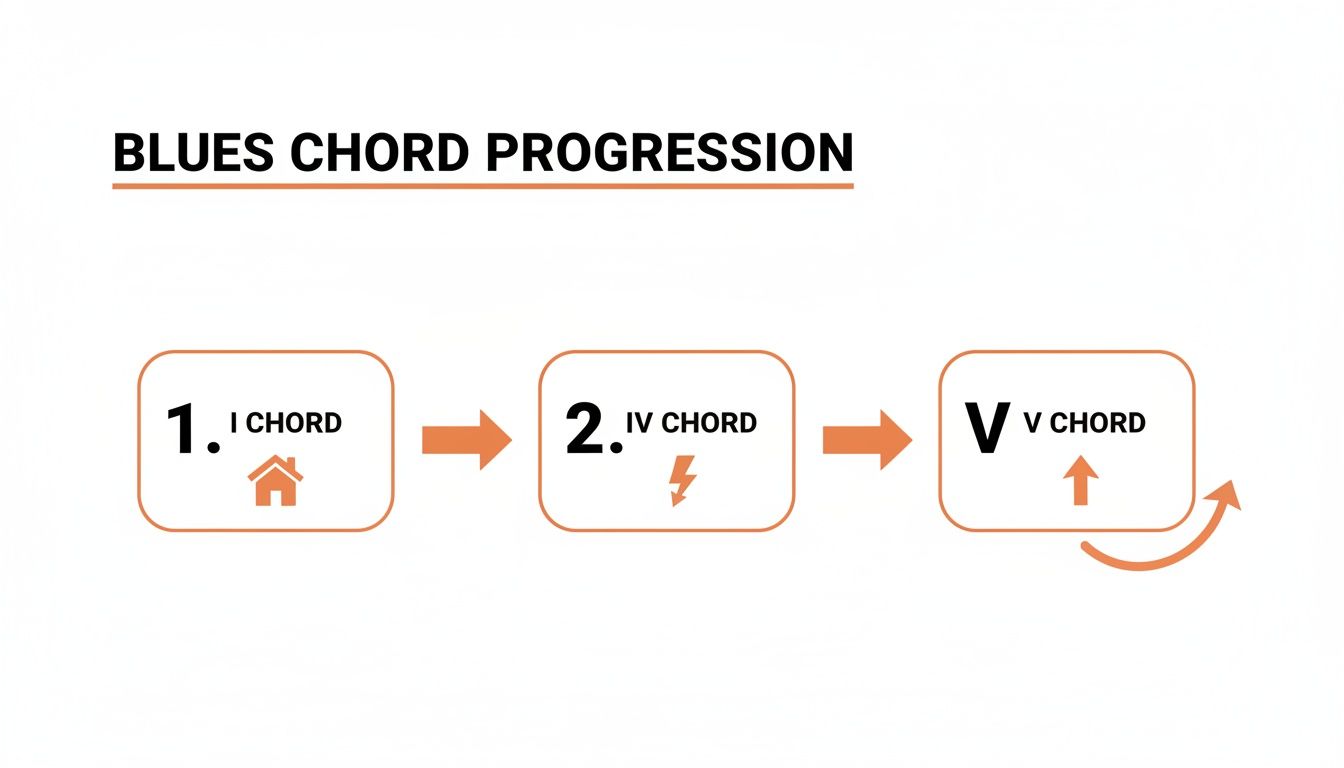
This visual flow—from home, to tension, and then release—is the fundamental journey every 12-bar blues takes.
Let's map this out. Below, you'll find the standard progression laid out in the most common, guitar-friendly keys. Pay attention to how the pattern of I, IV, and V chords stays exactly the same; only the chord names themselves change depending on what key you're in. Once you know the form, you know it in every key.
| Bar | Key of A | Key of E | Key of G |
|---|---|---|---|
| 1 | A7 | E7 | G7 |
| 2 | A7 | E7 | G7 |
| 3 | A7 | E7 | G7 |
| 4 | A7 | E7 | G7 |
| 5 | D7 | A7 | C7 |
| 6 | D7 | A7 | C7 |
| 7 | A7 | E7 | G7 |
| 8 | A7 | E7 | G7 |
| 9 | E7 | B7 | D7 |
| 10 | D7 | A7 | C7 |
| 11 | A7 | E7 | G7 |
| 12 | E7 | B7 | D7 |
This table is your roadmap. My advice? Get the progression down cold in the key of A first, as it's an absolute staple. From there, translating it to other keys becomes second nature. And when you're ready to start soloing over this exact form, you can find some fantastic guidance in these free guitar lessons on how to solo over the 12-bar blues.
At first, counting the bars feels mechanical. But after a few repetitions, your ear starts to anticipate the changes. That's when you're truly internalizing the language of the blues.
This isn't just an intellectual exercise; it's about getting the feel of the form into your hands and ears. Once this structure is second nature, you're ready to play rhythm on thousands of blues tunes.

Knowing the right chords for a 12-bar blues is a huge first step, but it's only half the story. The real magic happens when you make those chords feel like the blues. This is where we stop just changing chords and start playing with groove, and the absolute heartbeat of that groove is the shuffle.
Think of the difference between walking with a stiff, robotic march and a relaxed, bouncy stroll. That bounce is exactly what the shuffle rhythm brings to a blues chord progression. It turns a static sequence of chords into a living, breathing piece of music that makes people want to move.
The shuffle feel isn't just about what notes you play; it's about how you play them. It's the rhythmic engine that separates sterile, academic playing from a raw, authentic blues groove that connects with the listener.
We're going to move beyond just strumming and dive into the essential comping patterns that give the blues its true identity.
The most iconic blues rhythm you'll ever learn is the power chord shuffle. It's simple, powerful, and instantly recognizable. Instead of playing a full A7 chord, for instance, you'll strip it back to just the root (A) and the fifth (E) to create a power chord. Then, you'll add the sixth (F#) to create that classic "chugging" sound.
Here's what a basic shuffle pattern looks like over an A chord in TAB:
This simple back-and-forth movement, repeated with a swing feel, is the foundation. You apply this same rhythmic idea to the IV chord (D) and the V chord (E) when they pop up in the progression. The real key is locking into a consistent, driving rhythm with your picking hand.
Once you're comfortable with the basic power chord shuffle, you can start adding a little more melodic flavor with the root-sixth pattern. This approach is a bit more involved but adds a layer of cool you've heard on countless classic blues records.
Instead of just adding the sixth, you'll create a walking bassline feel by moving between the fifth, sixth, and even the flat seventh of each chord. This makes your rhythm playing more dynamic and interactive. For a deeper dive into these ideas, you can learn about 6 authentic blues grooves you must know to expand your rhythmic vocabulary.
Mastering these rhythms takes practice, but it's what turns a simple blues chord progression into real, soulful music.
Once you've got the standard 12-bar blues under your fingers, the real fun begins. This is the moment you shift from just playing the changes to truly speaking the language of the blues. You'll find that seasoned players rarely stick to the basic form note-for-note. Instead, they sprinkle in small but powerful variations that inject personality and drive into the music.
Don't worry, we're not talking about complex re-harmonizations here. These are the essential bits of vocabulary every blues guitarist needs to know.
Think of the standard progression as a reliable skeleton. These variations are the muscle and style you layer on top, making the music feel alive, breathing, and dynamic. By learning just a few key moves, you can transform a repetitive progression into a compelling musical statement that keeps listeners hooked from the first bar to the last.
One of the most common and effective variations is the "quick change." This simple move adds a little harmonic surprise right at the beginning of the progression, waking up the listener's ear immediately.
Instead of hanging out on the I chord for the first four measures, you'll jump to the IV chord in the second bar before heading right back to the I chord in bar three. This creates a quick jolt of tension and release, giving the progression an immediate sense of forward motion.
Here's how it looks in the key of A:
This small tweak is a hallmark of gritty Chicago-style blues and is used by countless players to add a bit of urgency to their rhythm playing. It just feels right.
The turnaround is arguably the most important piece of the blues chord progression puzzle. It's that two-bar phrase at the very end (bars 11 and 12) that masterfully signals the end of the form and sets up the big return to the top.
A good turnaround is like a musical punctuation mark—it provides a satisfying conclusion while building anticipation for what's coming next.
A great turnaround does more than just fill space; it's a signature, a personal stamp that a player puts on the end of a blues chorus. It's a mini-solo that bridges the gap and keeps the groove rolling.
While the possibilities are endless, most turnarounds are built on a simple V-IV-I movement or a chromatic walkdown that leads the ear back home to the root. They often mix chords and single-note melody lines, giving you a perfect spot to get creative.
Learning a handful of classic turnaround licks is essential for sounding authentic. To get a whole toolbox of these crucial phrases under your fingers, exploring a guide on 12 essential blues turnarounds is a fantastic next step.
By mastering the quick change and a few classic turnarounds, you elevate your playing from simply following a chart to making real musical choices. These variations are fundamental tools for crafting a more professional and engaging blues sound.
The basic blues chord progression is a fantastic starting point, but it's also a ridiculously flexible canvas. Think of it like a sturdy tree trunk; it can support countless branches, each representing a different style. Musicians in jazz and rock have been grafting their own harmonic ideas onto the blues for decades, creating richer, more complex sounds.
A common mistake guitarists make is thinking of the blues as a rigid set of rules. It's much better to see it as a conversation. Jazz players, for instance, started asking, "What if we made these chord changes a little smoother?" This simple question led to one of the most important additions to the blues vocabulary: the ii-V-I progression.
This one little substitution adds a whole new level of harmonic depth, creating a beautiful sense of tension and release that pulls the listener's ear more gracefully through the changes.
The most common place to drop in this jazzy flavor is in the turnaround, specifically in bars 9 and 10 of the 12-bar form. In a standard blues in C, bar 9 is a G7 (the V chord) which is gunning to resolve back to C7. The jazz approach breaks this down.
Instead of just camping on that G7, jazz players insert its related ii chord, Dm7, creating a Dm7 to G7 movement. This ii-V sequence is the absolute cornerstone of jazz harmony, and it creates a much stronger pull back to the I chord. It's everywhere. A Berklee College analysis of 300 charts found this type of substitution in a whopping 60% of post-1940 jazz standards, including Miles Davis's iconic 'All Blues'.
Rock guitarists took a different path, but an equally creative one. Players like Stevie Ray Vaughan and B.B. King were masters at infusing the standard progression with minor chords and diminished passing chords to add emotional depth and grit.
A blues progression is a story, and every new chord you introduce is like a plot twist. A well-placed minor chord can add a touch of melancholy, while a quick diminished chord can create a moment of intense, fleeting drama.
Here are a couple of ways rock players spice things up:
These ideas open up a whole new world on the fretboard. If you're interested in blending these styles, there are some great lessons that can help you jazz up your blues playing with fresh ideas.
By borrowing from jazz and rock, you can take a simple blues chord progression and truly make it your own.
Alright, let's get down to brass tacks. Knowing the theory is one thing, but making it sing on the fretboard is a whole different beast. This is your roadmap for taking those blues chord progression shapes and making them second nature. The real goal here is to internalize these sounds and changes so you can stop thinking and start feeling the music.
The best way to start is by camping out in one key for a while. Don't try to conquer every key at once. Instead, really get the 12-bar form under your fingers in the key of A. Fire up a metronome, set it to a slow, comfortable tempo, and just focus on making your chord changes clean and keeping the rhythm steady. Once A feels like home, then you can move on to E, then G, and you'll find that I-IV-V relationship starts to click in a much deeper way.
To get the most out of your time, you need a plan. Winging it rarely works. Here's a simple weekly schedule to make your practice sessions count:
This is where the magic really happens. Practicing with jam tracks is the closest you can get to having a pro band on call 24/7. It's a game-changer because it forces you to lock in your timing, hear the chord changes in a real musical context, and gives you the space to start experimenting with your own ideas.
Playing along with a backing track is the bridge between practicing in your room and jamming with other musicians. It's where your timing, feel, and improvisational ideas truly come to life.
Stick with this plan, and you'll be building the muscle memory and the sharp ears you need to play the blues with genuine authority.
Every guitarist has questions when they first start digging into the blues. It's part of the process! Let's clear up a few of the most common ones so you can get back to playing with confidence.
It all comes down to the mood, and that mood comes from just a couple of chord changes.
A standard, upbeat blues uses all dominant 7th chords for the I, IV, and V — think A7, D7, and E7. But when you want that darker, more somber vibe, you switch to a minor blues. Here, you'll typically use minor 7th chords for the i and iv chords (like Am7 and Dm7) but keep that V chord as a dominant 7th (E7) to pull you back home. That one little tweak makes all the difference.
Not a chance! That classic I-IV-V formula is your passport to play the blues in all 12 keys.
Sure, most of us start out in guitar-friendly keys like E, A, or G because the open strings and common chord shapes make it easier. But pushing yourself to play a 12-bar blues in a key like Bb is an incredible workout for your fretboard knowledge. Plus, it gets you ready to jam with horn players or anyone else who calls out a tune.
Your new best friend is the minor pentatonic scale. Seriously.
For a blues in the key of A, you can play the A minor pentatonic scale right over all three chords (A7, D7, and E7), and it will sound absolutely perfect. This scale is the bedrock of countless legendary blues solos for a reason—it just works.
Ready to stop just reading about it and actually play it? To explore thousands of blues lessons, jam tracks, and world-class instructors covering everything we discussed here and more, start a TrueFire All Access Trial.
