The F barre chord on guitar. For many of my students, those words alone are enough to cause a mild panic. It's often the first major roadblock you'll hit, but it's also the single most important gateway from just strumming open chords to really playing the guitar. Nail this one, and you unlock a whole new world of music and build the foundational hand strength for every other barre chord that comes your way.

If you've spent any time learning guitar, you've probably heard the whispers about the dreaded F chord. For so many, it’s the first real challenge that separates those who stick with the instrument from those who let it gather dust in a corner. But I want to reframe that thought process entirely. The F barre chord isn't a wall; it's a doorway.
Every beginner hits this point and has to decide how to tackle it. It's incredibly tempting to use easier "cheat" versions or just skip any song that has one. But there's a reason every seasoned guitarist can play an F barre chord without thinking—they pushed through because they understood how critical it is.
Learning the F barre chord does way more than just add one more shape to your arsenal. It fundamentally changes how you see the fretboard. You see, it's built on the same shape as an open E major chord. Once you get this down, you can simply slide that exact same shape up the neck to play every other major chord imaginable.
Think about it:
This single shape opens up the whole neck, freeing you from the tyranny of the capo. You're no longer just memorizing disconnected shapes; you're starting to understand the powerful, movable logic of the guitar. This concept is a cornerstone for moving beyond the basics, which you can see in action in our ultimate guitar chord chart.
When I'm teaching, I always tell my students to think of the F chord as a physical investment. The effort you put in now to build that finger strength and dexterity pays off for the rest of your playing career. Every single barre chord you learn after this will feel significantly easier.
This isn't some obscure, academic chord you'll rarely use. The F major chord is a workhorse in pop, rock, folk, and country music. It’s easily one of the top 10 most common chords in popular guitar-based music, period. This is especially true for songs written in the key of C Major, where F is a cornerstone of the most common progressions. Without it, you’re locked out of a massive catalog of classic songs.
To see just how foundational it is, let's look at its function in a few common keys.
This table shows how the F major chord functions within three of the most popular keys in music, highlighting its importance.
| Key | F Chord Function | Common Chord Progression Example |
|---|---|---|
| C Major | The IV chord (Subdominant) | C - G - Am - F |
| F Major | The I chord (Tonic) | F - C - Dm - Bb |
| Bb Major | The V chord (Dominant) | Bb - Eb - F - Gm |
As you can see, whether it's providing the stable home base (tonic), the classic setup (subdominant), or the powerful resolution (dominant), the F chord is everywhere.
Mastering the F barre chord on guitar is a non-negotiable step if you're serious about playing. It builds your technique, explodes your song library, and deepens your understanding of how music actually works. It's tough, but it's worth it.
Let's pull apart the full six-string F barre chord, piece by piece. So many players make the mistake of trying to clamp down with all their fingers at once. That's usually a fast track to a mess of muted strings and a whole lot of frustration. A much smarter way to go about it is to build the chord methodically, starting with the hardest part: the barre itself.
Your index finger is the anchor here. Its job is to press down cleanly across all six strings at the first fret. The secret isn't just brute force; it's all about technique. Instead of laying your finger flat, try rolling it just a bit onto its side, toward your thumb. This little adjustment lets you use the bonier, harder edge of your finger, which applies much more direct and even pressure.
Make sure your finger is tucked right up behind the metal fret wire—as close as you can get without actually being on top of it. This spot is the sweet spot, requiring the least amount of pressure to get a clear note.
This is a huge one. A classic beginner mistake is trying to generate all the pressure by squeezing with the thumb. This will lead to hand cramps and fatigue almost immediately.
Instead, think of your fretting hand and arm as a single, connected unit. The real power comes from gently pulling back with your entire fretting arm, using the larger muscles in your arm and back to create leverage. Your thumb should just be a stable pivot point on the back of the neck, not the primary source of the clamping force. This subtle shift in mechanics is the difference between struggling for minutes and playing for hours.
Professional guitarists don't rely on a death grip. They use physics to their advantage, applying focused pressure exactly where it's needed. By using your arm for leverage, you conserve energy and build sustainable technique for every barre chord you'll ever play.
Once you can get a clear sound from all six strings with just your index finger barre, it's time to bring in the rest of the shape. You’ll probably notice the other fingers form a familiar E major open chord shape, just shifted up the neck.
Here’s the finger-by-finger placement:
Now, strum each string individually to check for clarity. If you hear a buzz or a dead note, isolate the problem. Is your barre firm enough? Are your other fingertips properly arched so they aren't accidentally touching adjacent strings? This diagnostic approach is absolutely key to building clean muscle memory from day one.
By mastering this shape, you're also learning the fundamental building block for countless other chords. Exploring how these shapes move around is a huge part of understanding the guitar fretboard more deeply.
Building the full F barre chord on guitar this way—barre first, then the shape—is a methodical process that really pays off. It trains your hand to be efficient and precise.
Ready to put this into practice and see how it fits into a larger musical context? You can explore thousands of lessons from world-class instructors with a TrueFire All Access trial.
Going for the full, six-string F barre chord right out of the gate is a classic rookie move. It’s like trying to run a marathon without ever jogging around the block first. A much smarter—and less frustrating—path is to work your way up with a few simpler "stepping-stone" versions.
These variations get you playing songs that use an F chord almost immediately, all while you build the hand strength and coordination you need for the real deal.
This gradual approach makes the full f barre chord on guitar feel like the next logical step, not some impossible wall. The F chord is such a well-known hurdle that it has shaped how guitar has been taught for generations. Many of us instructors introduce several alternate fingerings before ever attempting the full barre; some methods even break it down into at least six different ways to play an F.
No matter which F chord you're playing, the basic mechanics are always the same. You can see it broken down here.
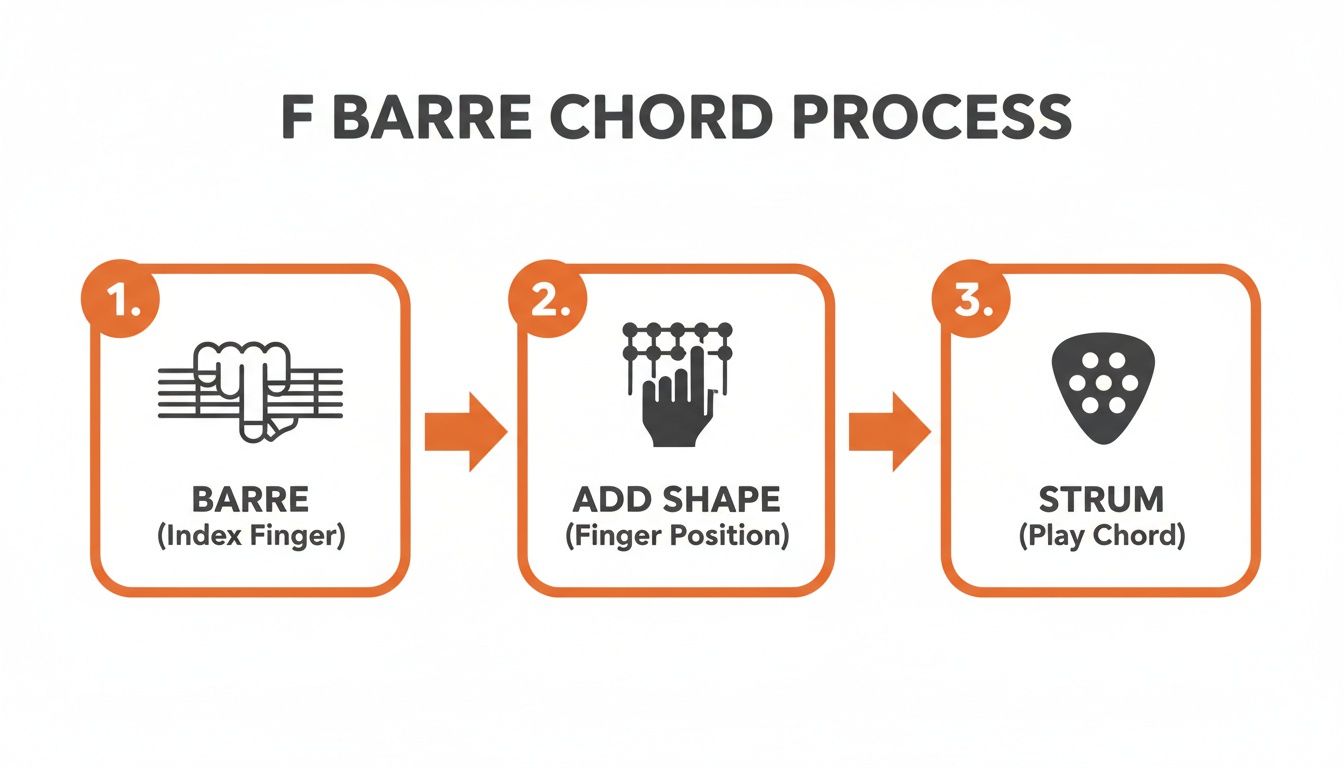
This boils it down to three stages: set the barre, add the rest of the chord shape, and then strum. We can apply this exact same logic to the easier versions, too.
This is the version I almost always teach my students first. It gives you the essential sound of an F major chord without needing the hand-crushing strength of the full six-string barre.
To play it, you just need to focus on the four skinniest strings (D, G, B, and high E).
Strum only those four strings and try to avoid hitting the two thickest ones (low E and A). This little chord sounds fantastic on an acoustic and works as a substitute in pretty much any song calling for an F.
If you need an even simpler starting point, you can dial it back to a basic three-string triad. This version is perfect for absolute beginners or for those moments when you need a lightning-fast change in an upbeat song.
Just strum those three strings. Sure, it sounds a little thinner, but it contains the core DNA of an F major chord (the notes F, A, and C) and gets the job done, especially if you’re playing with a band where a bass player is filling out the low end.
Using these easier versions isn't "cheating." It's smart training. You’re actively building the muscle memory and finger independence that will translate directly to nailing the full barre chord when you're ready.
Each of these variations helps you zero in on specific parts of your left-hand technique. For a deeper look at building up that foundational strength, check out our guide on developing your left-hand form.
By practicing these easier voicings, you’re not just learning chords; you’re building confidence and conditioning your hand for the work ahead.
Even with what feels like perfect form, you're going to hit some snags learning the F barre chord. Every single guitarist does. Buzzing strings, dead notes, and an aching hand are practically rites of passage.
The trick is to stop seeing them as failures and start treating them as feedback. A buzzing string isn't a mistake; it's your guitar telling you exactly where the problem is. Your job is to listen up and make a small adjustment. Let's break down the most common issues I see with students and give you the real-world fixes to get that F chord ringing loud and clear.
A nasty buzz is almost always caused by one of two things: not enough pressure in the right spot, or your finger being too far from the fret.
When you hear a buzz, resist the urge to just clamp down harder with your whole hand. That's a waste of energy. Instead, play each string of the chord one at a time to pinpoint the exact culprit.
Once you’ve found the problem string, check your index finger. Is it snuggled up right behind the fret wire? Shifting it just a tiny bit closer often solves the issue instantly. If the placement is solid, then apply a little more focused pressure only on that spot. Remember to use the weight of your arm for leverage, not just a death grip from your thumb.
The most common source of buzzing on an F barre chord is the G string (the 3rd string). This happens because your middle finger, pressing down on the 2nd fret of the G string, can sometimes pull your index finger's barre just slightly off the 1st fret. Make a conscious effort to press down with the part of your index finger that's covering that specific string.
If a string is totally silent or just makes a dull "thud," it’s almost certainly being touched by a finger that shouldn't be there. The usual offenders are the G string being muted by the fleshy underside of your middle finger, or the high E string being dampened by the crease of your index finger's knuckle.
The fix here is all about improving the arch in your fretting fingers. You want to press down on the strings with the very tips of your fingers, coming down on the fretboard from a more vertical angle. This creates crucial space under your fingers, preventing them from laying flat and accidentally touching neighboring strings.
This will probably feel a bit awkward at first and might even make your fingertips a little sore. For some great advice on managing that, check out these tips for reducing fingertip pain when learning guitar.
Pain is your body's bright red stop sign. If you feel any sharp pain in your wrist or thumb, stop what you're doing and reassess your technique immediately. This is usually caused by bending your wrist at a sharp angle or relying on a "death grip" powered by your thumb.
Your wrist should be as straight as possible, creating a clean line from your elbow down to your knuckles. Think of your thumb as a pivot point, not a vise grip. It should rest comfortably on the back of the neck, roughly opposite your middle finger.
When you feel fatigue setting in—and you will—take a break. Shake out your hand for a minute, then come back to it with a renewed focus on using relaxed, efficient pressure.
Navigating the F chord can feel like a maze of buzzing strings and sore fingers. This table is your quick-reference map to identify the most common issues and get you back on track.
| Common Problem | Likely Cause | How to Fix It |
|---|---|---|
| Buzzing on one or more strings | Not enough pressure, or your finger is too far behind the fret. | Isolate the buzzing string. Move your index finger closer to the fret wire. Apply focused pressure to just that spot. |
| G string is muted or buzzing | The middle finger is pulling the index finger's barre up slightly. | Consciously apply more pressure with the part of your index finger that is covering the G string. |
| High E string is muted | The fleshy part or knuckle-crease of your index finger is dampening the string. | Roll your index finger slightly onto its side, using the bonier edge to fret the strings. |
| Notes are muted or "thuddy" | Fingers are too flat, touching adjacent strings. | Arch your fingers more. Fret with the very tips of your fingers, coming down more vertically onto the fretboard. |
| Sharp pain in your wrist | Wrist is bent at a severe angle. | Straighten your wrist. Adjust your guitar's position or your elbow to maintain a straighter line. |
| Thumb or hand gets sore quickly | Relying on a "death grip" and squeezing too hard. | Relax! Use your arm's weight for leverage. Your thumb should be a relaxed pivot point, not a clamp. |
Think of this table not as a list of failures, but as a diagnostic toolkit. Every player goes through these steps, and learning how to self-correct is a massive part of getting better.
Tackling these issues is a core part of the process of mastering the f barre chord on guitar. The troubleshooting skills you build here will serve you for the rest of your guitar-playing journey.
Knowing the F chord shape is one thing. Being able to switch to it cleanly in the middle of a song? That’s a whole different ballgame. This is where dedicated, smart practice makes all the difference.
The real goal isn't just forming the chord—it's to make the transition so smooth and automatic that you don't even have to think about it.
Forget just holding the shape for minutes on end. Effective practice is all about movement. It's about building how to learn guitar chords quickly with muscle memory through repeating the transitions. Your fingers need to learn the path from other common chords to the F chord and back again.
This is an exercise I give every single one of my students struggling with the F barre chord on guitar. It’s simple, it’s effective, and it gives you a real, tangible way to measure your progress.
Don't sweat it if your first attempt is only 10 or 15 changes. The whole point is steady improvement. Once C to F feels more comfortable, move on to other common pairs like G to F and Am to F.
Drills are essential, but you also have to apply what you're learning in a musical context. Playing simple progressions makes practice feel less like work and more like, well, playing music.
Here’s a simple, classic progression that puts the F chord right where you need it:
C | G | Am | F
Set a metronome to a slow tempo—something like 60 BPM—and play each chord for a full measure (four beats). Your main focus should be on getting your fingers ready for the F chord before the beat it's supposed to land on. Anticipate the change.
The secret to fast chord changes is moving your fingers as one unified shape. Instead of placing them one by one, practice lifting and landing all your fingers simultaneously. It will feel clumsy at first, but this is the key to true fluency.
This focus on transitions is so critical because of how often you'll see these chords together. In fact, one analysis of hit songs found that F major, G major, and C major were the three most frequently used chords of all. That’s why practicing these specific changes is vital for any guitarist.
Ready to apply these skills in real songs and guided lessons? Explore thousands of courses with a TrueFire All Access Trial.
Finally nailing the F barre chord is a huge milestone for any guitarist. It’s that moment when you feel the fretboard truly start to open up. Suddenly, countless songs that seemed impossible are within your grasp, and you're moving from just playing notes to really making music.
Don’t let your progress stall out in a cycle of frustration and guesswork. With the right roadmap, you can turn those tricky concepts into skills you can actually use, making the complex feel surprisingly simple.
That's exactly what we do at TrueFire. Our structured Learning Paths are built by world-class educators to guide you through these exact breakthroughs—from mastering that first tough chord to diving deep into blues, rock, and jazz. Imagine getting step-by-step guidance from GRAMMY-winning artists who break everything down for you.
See for yourself how our platform can transform your playing. You can check out our massive library of lessons and find your next breakthrough when you start a TrueFire All Access free trial today.
Let's wrap up by tackling a few of the questions I hear all the time from players wrestling with the F barre chord. If you've been wondering about these, you're definitely not alone.
Every player's journey is different, but I see a pretty consistent pattern. If you can put in a focused 15 minutes a day, most guitarists start getting a clean, dependable F chord within two to four weeks.
The secret here is consistency, not brute force. Trying to grind it out for an hour straight is a recipe for a sore hand and bad habits. You'll get there much faster by working through the easier versions first, building up your strength and muscle memory piece by piece.
You can dodge it for a while with mini-versions or by slapping a capo on your guitar, but eventually, you're going to hit a wall. That F barre chord shape is the key that unlocks every other major and minor barre chord up and down the neck—think B major, G minor, C# minor, you name it.
Dodging the F barre chord is like deciding to only use half the words in the dictionary. It’s a challenge, for sure, but pushing through it pays off for your entire life as a guitarist. It's a skill that just keeps on giving.
I can say with about 99.9% certainty that no, they are not. In all my years of teaching, I've seen players of all shapes and sizes—from little kids to big guys with sausage fingers—master this chord. Hand size is almost never the real culprit. It's all about technique.
A proper guitar setup (especially getting the string action low), getting your wrist and thumb in the right position, and using the natural leverage of your arm—not just squeezing with your fingers—is what makes it all click. Spend your energy refining your technique, not worrying about the size of your hands.
Ready to conquer the F chord and see what's next? A TrueFire All Access trial gives you a clear path forward with thousands of lessons from the world's best instructors. Start your free trial today.
