A solid guitar practice routine for beginners is what separates real progress from just random noodling. As a music educator, I can tell you it's the secret to building muscle memory, sharpening your technique, and stacking up those small, achievable wins that keep you fired up to play.
So, you're starting one of the most rewarding journeys you'll ever take. The one thing that separates players who succeed from those who get frustrated and quit isn't talent—it's having a plan.
It's fun to just pick up the guitar and play whatever comes to mind, I get it. But that's a fast track to hitting a wall where you feel like you aren't getting any better.
A structured routine is your secret weapon. It makes sure you're not just practicing, but practicing with purpose. Think of it like building a house: you wouldn't just grab a hammer and start nailing boards together. You need a blueprint that covers the foundation, the framing, and all the finishing touches.
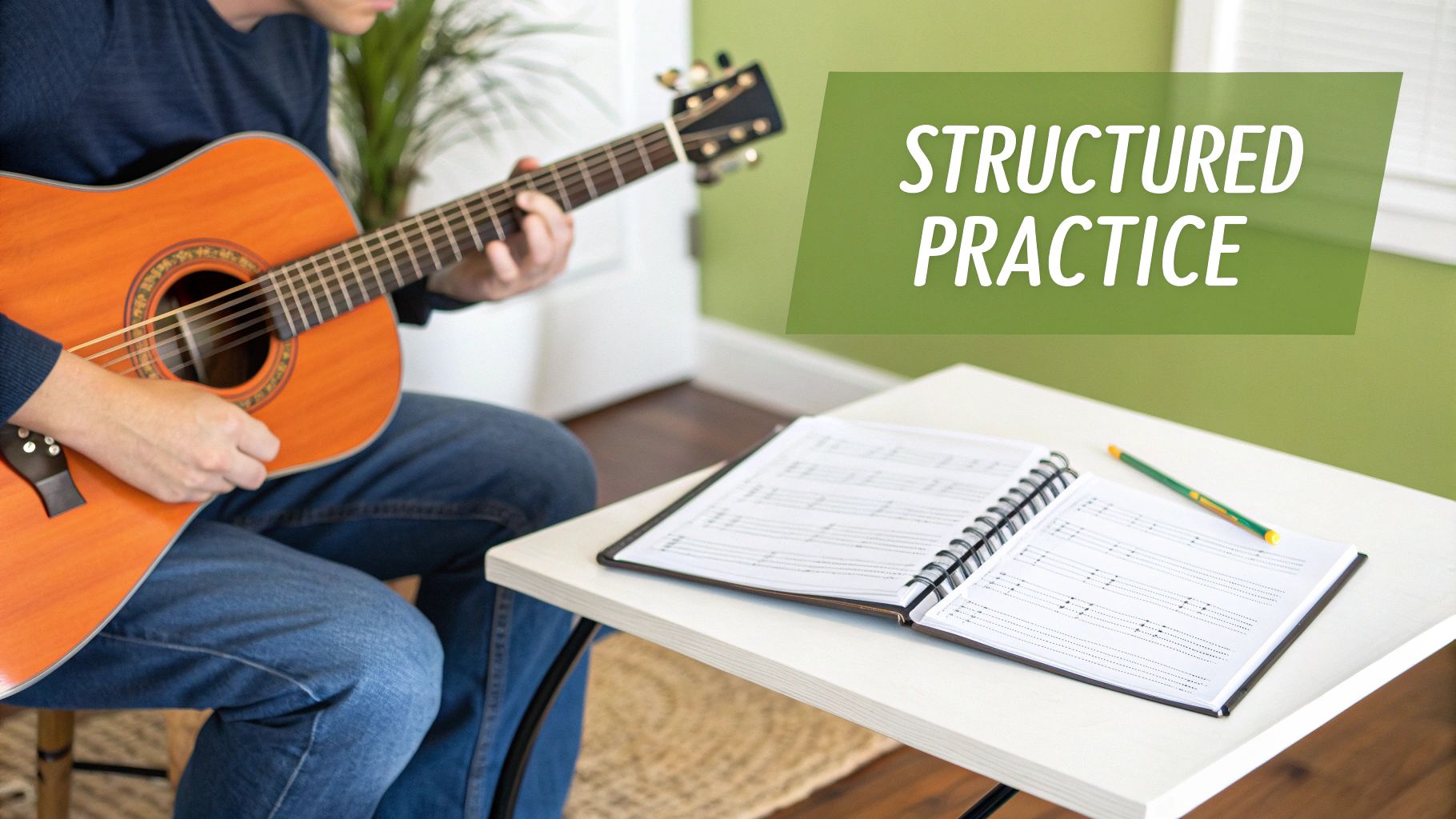
This planned approach breaks the massive goal of "learning guitar" down into small, manageable daily tasks. Instead of feeling overwhelmed, you get to focus on one small piece at a time, knowing it all connects to a bigger picture.
This systematic approach is more important than ever. In the two years leading up to October 2021, a jaw-dropping 16 million Americans started learning guitar, with many pointing to newfound free time as the spark. That initial excitement is amazing, but a solid routine is what turns that spark into a lasting skill.
A great practice routine is built on a few key pillars, each with a specific job to do. Neglecting one can hold back your progress in all the others.
Every solid practice session needs four core components to be truly effective. Think of these as the building blocks that ensure you're developing all the skills you need to become a well-rounded player.
| Component | Purpose and Goal | Typical Time Allocation |
|---|---|---|
| Warm-Ups | Prepare your hands and fingers, reduce the risk of strain, and get your mind focused for the session ahead. | ~5% |
| Technique Drills | Build the 'athletic' side of playing—dexterity, speed, and accuracy with exercises like scales or finger patterns. | ~25% |
| Chord & Rhythm Work | Develop the foundational skills for playing actual songs, like clean chord changes and steady strumming. | ~30% |
| Song Application | The fun part! This is where you put everything together and apply your new skills to learning and playing real music. | ~40% |
By dedicating a little time to each of these areas every time you play, you guarantee balanced development. For example, even if your chord changes are getting clean, weak rhythm skills will hold back your ability to play a song smoothly.
This is the 'why' that keeps you going. When you understand how each drill directly contributes to your ability to play your favorite songs, practice stops feeling like a chore. It starts feeling like real, tangible progress.
Ready to build a routine that actually gets results? A TrueFire All Access Trial gives you thousands of lessons from world-class instructors to guide you every step of the way.
Before you can shred your favorite solos or nail that tricky chord progression, you have to get your fingers on board. A great practice routine for any beginner is built on one simple idea: physical conditioning. We're literally teaching our hands and fingers a whole new set of coordinated movements, and it's critical to get this right from the start to avoid building bad habits.
Think of it like an athlete prepping for a game. You wouldn't just sprint onto the field without stretching, right? The same goes for guitar. These initial exercises are what build the strength, dexterity, and muscle memory that will eventually make playing chords and scales feel second nature.
Skipping your warm-up is easily one of the biggest mistakes a new guitarist can make. When you play with cold, stiff fingers, you're setting yourself up for sloppy playing, buzzing notes, and even potential strain or injury down the line. Just a few minutes of dedicated warm-ups can make your entire practice session more effective.
For a deeper dive, check out our guide on the importance of a proper guitar warm-up routine.
But to get started right now, try these simple moves:
These small actions wake up your hands and get them ready for the real work, ensuring your fingers are limber and ready to go.
Once your hands feel warm, it's time to work on finger independence. This is where the classic "spider walk" exercise comes in—it's perfect for training each finger to move on its own, a skill you absolutely need for clean chords and fluid scales.
Here's the drill:
The secret here is slow and deliberate practice. Fire up a metronome and set it to a crawl—something like 60 BPM. The goal isn't speed. It's clean, precise, and evenly-played notes.
Last but not least, we need to get your fretting hand and your picking hand working together as a team. Alternate picking—using a constant down-up motion with your pick—is the single most efficient way to play just about anything on the guitar.
Start simple. Just pick any open string and play it with a downstroke, then an upstroke. Keep a steady rhythm with your metronome and focus on making your downstrokes and upstrokes sound equal in volume.
Once that feels comfortable, combine it with the spider walk. Now, you'll play each fretted note using that down-up, down-up picking motion. This simple combination builds the hand synchronization that is the bedrock of nearly everything you'll ever play.
These fundamental drills are the heart of a great guitar practice routine for beginners. Get these down, and you'll be building a powerful foundation for whatever comes next. If you want expert, step-by-step guidance on these exercises and thousands more, a TrueFire All Access Trial connects you with world-class instructors to help you perfect your technique from day one.
Let's be honest—life is packed. Between work, family, and everything else, finding time to practice can feel impossible. But here's the good news: consistency matters way more than long sessions. Even a focused 15-20 minute daily practice is more valuable than sporadic marathon sessions. Trust me, this is doable.
The key is to tailor your practice to your schedule. It doesn't have to be perfect, it just has to be consistent.
You've got 15 minutes? Great. That's all you need to make serious progress.
Here's a super efficient routine broken down to fit into those small pockets of time you have. Even 15 focused minutes every day beats a random hour-long session once a week, hands down.
| Activity | Time | What You're Doing |
|---|---|---|
| Warm-Up | 2 Minutes | Simple finger stretches and a quick scale run to wake up your hands. |
| Technique Drill | 5 Minutes | Pick one exercise, like the spider walk or alternate picking, and focus only on that. |
| Chord Work | 3 Minutes | Practice switching between two chords. Set a timer and aim to do it cleanly, with no pauses. |
| Song Segment | 5 Minutes | Work on just a small chunk of a song you're learning—maybe a verse or a chorus. This is your reward! |
That's it. Simple, focused, and totally manageable. You can do this before work, on your lunch break, or before bed. The important thing is showing up consistently.
If you can carve out 30 minutes, you've got some breathing room to go a little deeper. This allows you to hit all the pillars of a solid practice session without feeling rushed.
| Component | Duration | Focus |
|---|---|---|
| Warm-Up | 3 Minutes | Stretching and easy scales to prep your fingers. |
| Technique Drills | 8 Minutes | Dedicate time to a couple of different exercises—spider walk, alternate picking, maybe throw in a simple scale. |
| Chord & Rhythm | 9 Minutes | Work on switching between multiple chords smoothly (aim for 3-4 different chords) and practice a simple strumming pattern. |
| Song Application | 10 Minutes | Play through a full song (or a big chunk of it), focusing on putting everything you've practiced together. |
With this kind of time, you're not just drilling—you're actively *playing*. This is where the magic starts to happen, and playing guitar stops feeling like work and starts feeling like fun.
Got a full hour? Perfect. This is where you can really sink your teeth into challenging material and see serious growth. An hour gives you time to explore, refine, and polish your skills.
| Section | Time | Activities |
|---|---|---|
| Warm-Up | 5 Minutes | Hand stretches, light scales, get those fingers loose and ready for action. |
| Technique | 15 Minutes | Deep work on multiple exercises. Try a few different scales, work on picking techniques, and focus on coordination. |
| Chords & Rhythm | 15 Minutes | Master several chord changes and add more complex strumming or fingerpicking patterns. This is where you refine. |
| Songs & Application | 20 Minutes | Play through a couple of full songs, experiment with new riffs, or try improvising a bit over a backing track. |
| Cool Down/Review | 5 Minutes | Play something you already know really well. This ends your session on a high note and reinforces what you've already learned. |
An hour of focused practice like this can feel like a full workout, but it's incredibly satisfying. You'll notice improvement fast when you put in this kind of dedicated time.
The key to all of these routines is balance. No matter how much time you have, you want to touch on all the key areas: warming up, building technique, working on chords, and applying it all to real songs. This approach keeps you well-rounded and prevents you from developing weaknesses in your playing.
If you want expert guidance to help structure your practice time and get the most out of every minute, diving into a platform like TrueFire is a smart move. Thousands of lessons from world-class instructors are designed to fit perfectly into routines just like these.
Alright, we've covered the technical side of things. Now let's talk about what might be the single most frustrating thing for beginners: smooth chord changes. I know—those first few weeks can feel like your fingers are made of wood. But here's the truth: this is the skill that unlocks everything. Once you get this down, you'll be able to play thousands of songs.
Most beginners underestimate how much focused effort it takes to build clean chord transitions. But with a smart approach and a bit of patience, this becomes second nature faster than you think.
If you only learn three chords, make it these three: G, C, and D. These are the building blocks of a huge portion of popular music, from classic rock to modern pop. Seriously, this combo alone will open up hundreds of songs.
Here's a focused drill you can use to nail the switch between these chords:
The secret is to focus on the transition, not the chord itself. You already know what a G chord looks like. The challenge is moving from G to C without fumbling. Isolate that specific movement and drill it until it's smooth.
Want a simple way to measure your progress and keep yourself motivated? Try the one-minute challenge. It's a fun little game that forces you to focus on accuracy and speed at the same time.
Here's how it works:
This turns a boring drill into a mini-game you can track. For a deeper dive, check out guides on how to learn guitar chords quickly by building muscle memory. The endgame is to make the movement so automatic you don't even have to think about it anymore.
Now for the fun part: playing an actual song! Once you can switch between G, C, and D without those long, awkward pauses, you're ready to go.
Pick a simple three-chord song and just use a basic down-strum rhythm. Try strumming each chord four times before you change. This is the moment you bridge the gap between mechanical exercises and making music. Hearing yourself play something you recognize is the best fuel for your fire in any guitar practice routine for beginners.
Working hard is important, but working smart is what really gets you places on the guitar. Let's talk about the tools and simple mindset shifts that will make every minute you spend practicing count. This is how you take a good beginner routine and make it truly great.
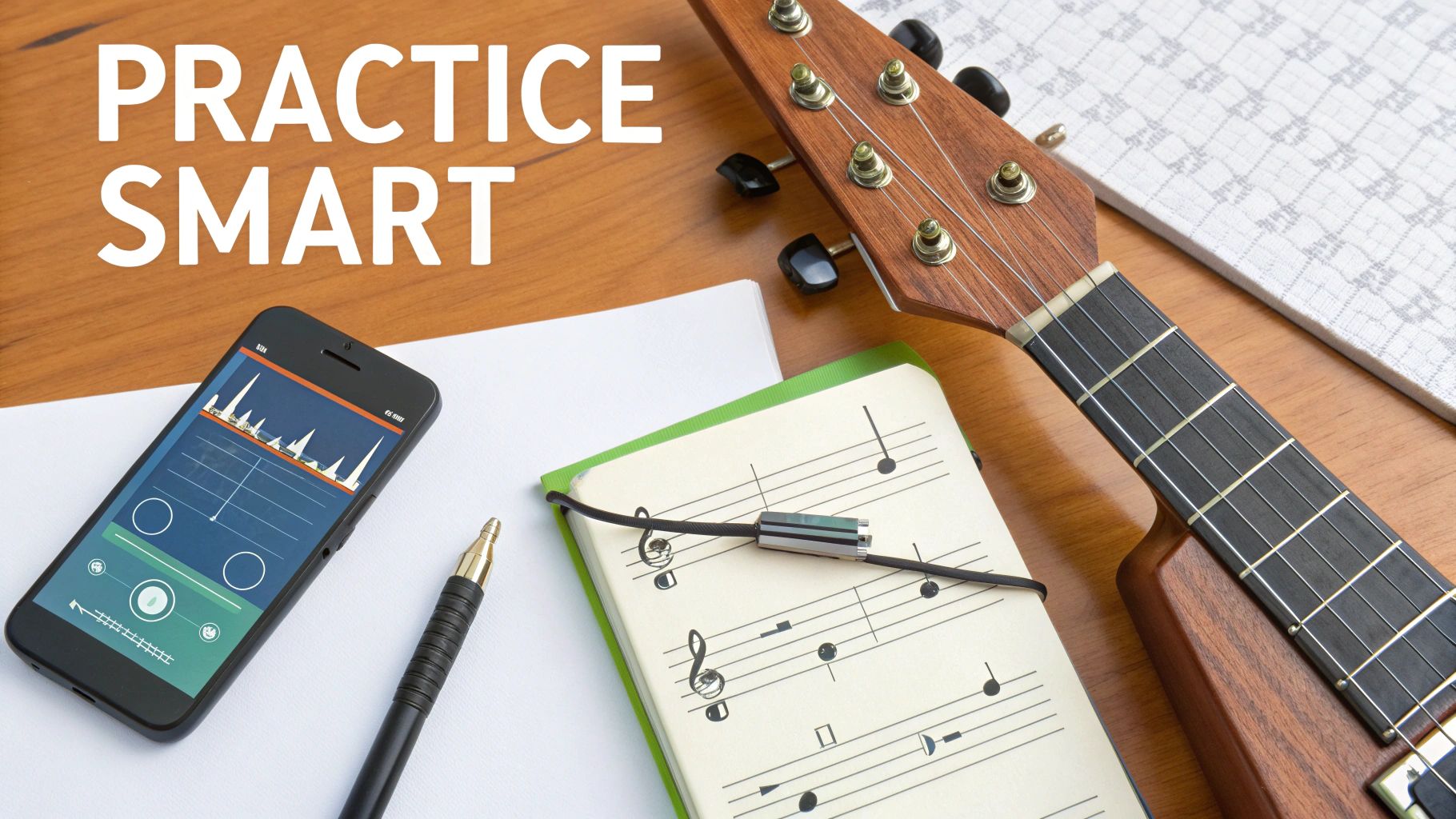
From your very first day, a metronome needs to be your best friend. Seriously, it's non-negotiable if you want to develop a rock-solid sense of rhythm. I've seen so many beginners skip it because that steady click feels a little stiff at first. But trust me, that click is what trains your internal clock, making sure your chords and scales have precision and groove.
You don't need to buy anything fancy, either. Free metronome apps are a dime a dozen and are one of the most powerful tools you can have.
A few modern tools can make your practice sessions way more engaging and effective. For example, if you're trying to learn a song from a video, just use YouTube's playback speed feature to slow things down to 0.75x or 0.5x. It's a game-changer, letting you catch every little detail without feeling totally overwhelmed.
Another great trick? Search for something like "easy rock backing track in E minor." Instantly, you've got a simple musical bed to practice your scales over. This makes it feel less like a mechanical drill and a whole lot more like you're actually jamming.
Beyond the digital stuff, one of the best habits you can ever build is keeping a simple practice journal. A basic notebook is all you need.
After years of teaching, I've seen a few physical mistakes hold beginners back more than anything else. If you can catch these early, you'll save yourself the headache of fixing ingrained bad habits down the road.
One of the biggest culprits is the "death grip"—squeezing the guitar neck for dear life. It just tires your hand out and actually makes your notes sound worse. Your thumb should rest lightly on the back of the neck, acting as a pivot point, not a vise grip. Try easing up until the notes just barely ring out cleanly.
Poor posture is another progress killer. Slouching over your guitar puts a ton of strain on your back, neck, and shoulders. This leads to discomfort and will definitely cut your practice sessions short. Always try to sit up straight, with the guitar resting comfortably on your leg.
Structured daily practice of 15-30 minutes is the gold standard for beginners working on the fundamentals. Many players report huge gains in finger strength and coordination after just a few weeks of this kind of consistency. It's all about building that muscle memory.
These are just a few ways to refine your approach. You can also explore other smart practice tips for guitar players to make your sessions even more productive.
Alright, you've made it this far. You've got the roadmap, the exercises, and the mindset to build a guitar practice routine that actually works.
If you take anything away from this guide, let it be this: It's all about consistency, not cramming. A little focused practice every day beats a long, aimless session once a week, every time. And remember, every single guitar player you look up to started out exactly where you are now—fumbling with chords and trying to make sense of the fretboard.
The real secret is just showing up. Embrace the process, get stoked about the small wins, and make playing your guitar a part of your day you actually look forward to. You get there one focused session at a time, not all at once.
If you're ready to get some expert guidance to make every one of those sessions count, I can't recommend enough diving into the massive lesson library from world-class instructors. A great way to start is with a TrueFire All Access Trial, where you can unlock thousands of lessons to plug right into your new routine.
I get a ton of questions from new students trying to figure out the best way to practice. Let's tackle some of the most common ones I hear.
Here's the truth: consistency is king. It's far better to practice for a focused 15-20 minutes every single day than to cram in a two-hour marathon once a week.
That daily repetition is what really builds muscle memory and locks in new skills. Once you get in the groove and your schedule allows, aiming for 30-60 minutes a day is a fantastic goal.
When you're brand new, it's a dead heat between two things: clean chord changes and basic rhythm.
Your first mission should be to get a handful of essential open chords like G, C, D, and Em under your fingers. Practice switching between them smoothly—no long pauses! Then, pair those changes with a simple, steady strumming pattern.
This is the foundation that lets you start playing actual songs, and trust me, nothing keeps you more motivated than that. It's the whole point of a good guitar practice routine for beginners.
Why choose? A balanced approach works best and keeps things interesting.
Dive into some basic chords and super easy songs right away. This makes practice fun and gives you an immediate musical reward for your effort. At the same time, start working on a simple scale like the minor pentatonic.
The songs give you a reason to play, while the scale quietly builds your finger dexterity and lays the groundwork for understanding theory and even improvising down the road.
Ready to get expert guidance for every single practice session? TrueFire has over 80,000 video lessons from world-class instructors. Start making real progress with a TrueFire All Access Trial.
