.jpg?width=1312&height=736&name=article-image-df610e91-c213-4081-8df7-056a45606be9%20(1).jpg "Guitar Warm Up")
A solid guitar warm up is easily the most important part of any practice session, yet it's the first thing most players ditch when they're short on time. As a guitar educator, I can't stress this enough: think of it less like a chore and more like a strategic ritual that gets your hands, mind, and ears ready to actually make music.
This isn't just about avoiding injury—though that's a huge part of it. A dedicated warm-up routine directly wires your neural pathways for better speed, accuracy, and control over the instrument.
Let's be real for a second. Most of us see warming up as the boring bit we have to suffer through before getting to the fun stuff, like learning songs or ripping solos. But after decades of teaching, I can tell you this: the players who make the fastest, most consistent progress are always the ones who treat their warm-up with respect.
It's about so much more than just wiggling your fingers to get the blood flowing. When done correctly, it's a powerful tool with significant physical and mental benefits.
From a physical standpoint, a structured routine is all about preventing injury and prepping your muscles for the work ahead. When you jump straight into playing with cold hands, your muscles, tendons, and ligaments are stiff and far less responsive. That's practically an open invitation for repetitive strain injuries like tendonitis.
A good guitar warm up hits several key physical goals:
The secret behind every great guitarist isn't just raw talent—it's discipline. Carving out the first 10-15 minutes of your practice for this ritual isn't just a "nice-to-have." It's the bedrock for a lifetime of healthy, fluid playing.
The benefits don't stop at the physical, either. A warm up serves as a critical mental transition, shifting your brain from the chaos of daily life into a state of deep musical focus. It's your chance to silence the outside noise and truly connect with your instrument. You can dive deeper into this foundational concept right here in our detailed guide to warming up.
This mental prep helps you practice far more effectively. Instead of spending the first ten minutes fighting for focus, you start your session locked in and ready to learn.
If you're just starting out, the absolute key to a good warm-up is consistency, not complexity. Seriously, forget trying to tackle a dozen crazy exercises at once. This simple 10-minute routine is all about building the right habits from day one, without ever feeling like a chore.
Our goal here is to lay a solid groundwork for control, timing, and getting your hands ready to play. We'll actually start off the guitar for a moment, then dive into two core exercises that every single guitarist—from total beginners to seasoned pros—still leans on. This isn't about shredding; it's about making every single note count.
Before you even grab the neck, take two minutes for some light stretches. Extend your arms, gently flex your wrists up and down, then side to side. Open and close your hands into loose fists a few times. This simple step gets the blood flowing and preps your muscles and tendons for what's to come.
Now, pick up your guitar and let's focus on that picking hand. Set a metronome to a nice, relaxed tempo—something like 60 BPM is perfect. Practice clean alternate picking on each open string. Go down, then up, four times on the low E string, then move to the A, and so on down the line. Really listen. Is each note clear? Is the volume consistent? This drill is building the fundamental engine of your playing.
Okay, time to get the fretting hand into the game with the classic "Spider Walk." It's a simple 1-2-3-4 chromatic run that's fantastic for building finger independence and getting your hands to work together.
Here's the breakdown:
Play each note one at a time, keeping that metronome clicking away at 60 BPM. Once you've played all four notes, move to the next string and do the whole pattern again. The focus here is 100% on clean notes and rock-solid rhythm. Don't rush it.
This routine isn't just a set of mechanical movements; it's the beginning of a conversation between your hands. The discipline you build right here—listening for clarity, staying locked in with the beat—is the foundation for every other technique you'll ever learn.
Making a solid warm-up a real habit can also dramatically cut down your risk of injury. In fact, studies show that musicians who skip warm-ups face up to a 65% higher chance of repetitive strain injuries. For a deeper dive into smart practice habits, check out these 5 smart practice tips for guitar players. These principles will help you get the most out of every minute you spend with the instrument.
To really nail these foundational drills, try using the tools inside a TrueFire All Access Trial. Having an integrated metronome, slow-motion video, and progress tracking can make a huge difference in mastering something like the Spider Walk with perfect form and timing.
So, you've got the basics down. That 1-2-3-4 spider walk feels like old news, and your fingers are moving. But maybe they're not moving as fast or as cleanly as you want. It's a classic plateau, and it's exactly where your guitar warm up needs to evolve from a simple routine into a targeted power session.
This 20-minute workout isn't just about playing longer; it's about playing smarter. We're going to shift your focus from basic mechanics to exercises that build real-world musicality, smash through speed barriers, and forge that rock-solid connection between your fretting and picking hands. It's time to turn those mechanical drills into fluid, expressive playing.
First things first, let's level up your exercises. We're moving beyond simple chromatic runs to patterns that actually mirror what you'll find in solos and complex riffs. This means adding drills that challenge your dexterity and accuracy in totally new ways.
Here are a few staples every intermediate player should have in their back pocket:
To see how we're building on the fundamentals, think of the beginner stage as the foundation.
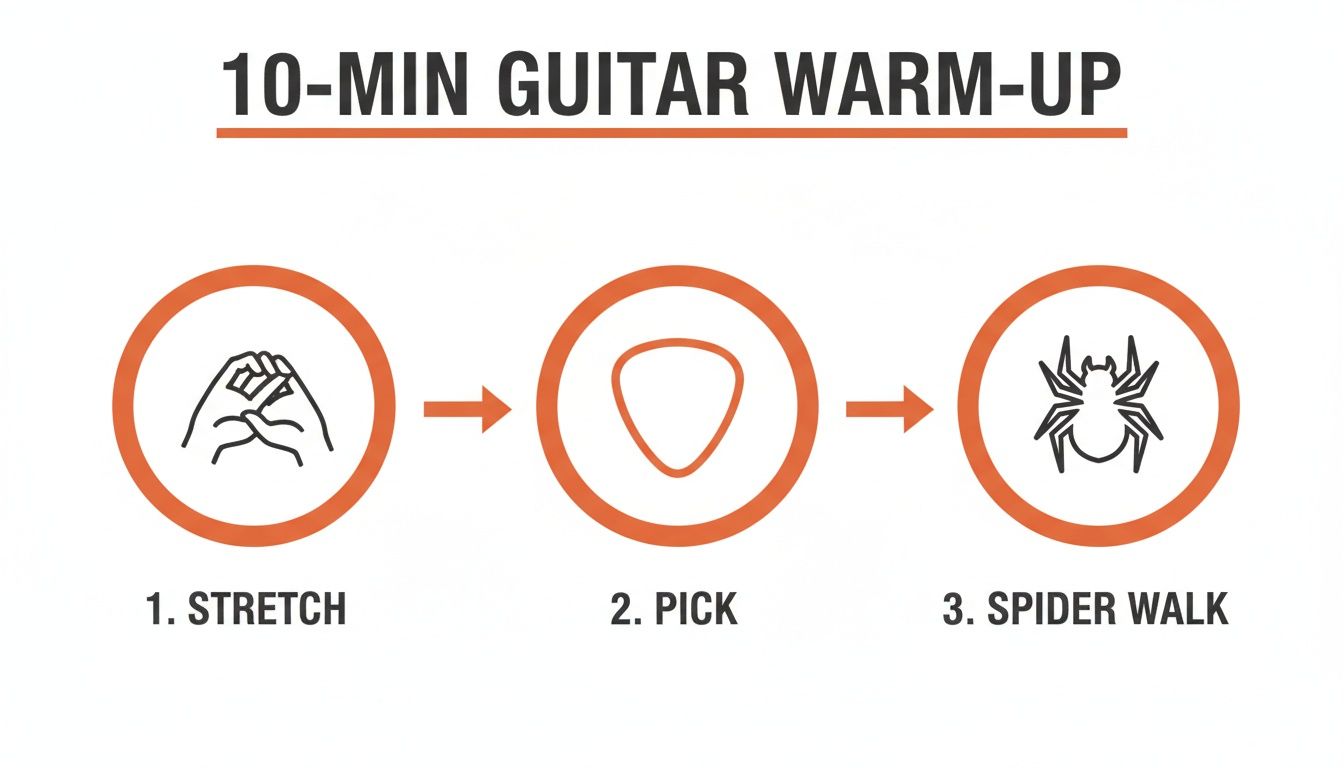
This graphic shows the building blocks—stretching, picking, basic fretting—that our intermediate session now supercharges with more complex and demanding exercises.
For most intermediate players, the biggest hurdle is getting the picking and fretting hands perfectly in sync. You know that annoying, sloppy sound where a note is picked just a fraction too early or fretted a hair too late? Your warm-up is the perfect time to zero in on that.
The secret to clean, fast playing isn't just about moving your fingers quickly. It's about absolute synchronization. Every pick stroke must align perfectly with every fretted note. Use your warm up to listen with intense focus, ensuring there is zero slop between your two hands.
A fantastic way to isolate and conquer tricky passages is with a looper. Whether it's a pedal or a software tool, record a short, tough phrase from a song you're learning. Then, loop it endlessly and just play along, focusing entirely on cleaning it up. If you're looking for more ideas on this, TrueFire has a great article with three easy tricks for building speed and stamina that can really supercharge your practice sessions.
Finally, make your warm-up musical. Don't just run scales in a vacuum. Pull up a jam track and apply those three-note-per-string patterns over a real chord progression. This is how you build essential musical context and train your ear to connect the patterns you're practicing to actual music.
Here's a structured plan to put it all together. This routine is designed to methodically build technique, synchronization, and musicality in just 20 minutes.
| Time Allotment | Exercise | Target Tempo (BPM) | Core Focus |
|---|---|---|---|
| 5 Mins | Finger Stretches & Chromatic Runs | 60-80 | Dexterity & Warming Up Muscles |
| 5 Mins | Three-Note-Per-String Scales (Major/Minor) | 80-100 | Fretboard Navigation & Picking Economy |
| 5 Mins | String-Skipping Arpeggios | 70-90 | Picking Hand Accuracy & Hand Synchronization |
| 5 Mins | Musical Application (Improv over Jam Track) | Varies | Applying Drills in a Musical Context & Ear Training |
This routine ensures you cover all the bases—from pure mechanics to creative application—setting you up for a focused and productive practice session every single time.
Once you hit an advanced level, your warm-up isn't just about getting your fingers to cooperate anymore. It's a complete system check. Think of it as a high-performance tune-up—a targeted, 30-minute deep dive that sharpens your physical edge while actively pushing the limits of your technique.
This isn't just a longer intermediate routine. It's a total shift in mindset. The real goal here is to bake sophisticated concepts right into your muscle memory, prepping you for the intense demands of high-level performance, improv, and studio sessions.
Your warm-up should now be a miniature version of your most ambitious playing. That means you've gotta move beyond just running scales and start programming hyper-specific skills.
Try weaving these advanced mechanics into your daily routine:
The exercises themselves need to feel more musical and immediately useful. Instead of mindlessly running a scale, you should be navigating tricky chord changes with arpeggios or flowing through different modal patterns. This gets your mind and fingers locked in for real-world improvisation. You can find more on this in our guide to developing your left-hand form.
This is where a platform like TrueFire becomes your secret weapon. The advanced warm-up is all about context, and you need the right tools to build that context.
Ditch the boring metronome click. Instead, pull up a jam track in a key you're not comfortable with or in a weird time signature. This forces you to adapt on the fly, sharpening your ear and improvisational instincts from the first minute you pick up the guitar.
At this level, every warm-up exercise needs a direct musical purpose. You're not just practicing a scale; you're rehearsing the physical and mental chops to nail that scale flawlessly over a ii-V-I at 200 BPM.
Think this is overkill? History says otherwise. Back in the '70s rock explosion, pros like Eddie Van Halen who had dedicated warm-up habits had 50% fewer performance errors in live shows. Modern stats back this up: a 2023 Guitar World poll of 10,000 players revealed that 72% credit structured warm-ups for better tone control and speed.
Here's another powerful trick: steal from the best. Use slow-motion video features to dissect a gnarly lick from one of your heroes. Break it down, isolate the mechanics, and then work that lick into your warm-up. This is how you methodically turn their vocabulary into your own.
This 30-minute deep dive is your lab for technical perfection. Make it a non-negotiable part of your daily practice, and you'll always be ready to play at your absolute peak.
A good intention can go sideways fast and become a bad habit if you're not careful. Nowhere is that truer than in a guitar warm up. As an instructor, I've seen the same handful of mistakes derail progress time and again.
Let's get those common pitfalls sorted out. The goal here is to make sure every minute you spend warming up is actually pushing you forward, not setting you back.
One of the biggest mistakes I see is jumping in way too fast. We're all eager to get to the "real" practice, but cranking up the metronome and forcing cold hands to fly across the fretboard is a recipe for disaster. It doesn't just lead to sloppy playing; it's a fast track to injury.
Rushing your warm-up is like trying to sprint a hundred-yard dash without a single stretch—you're just asking for a pulled muscle. Your hands need a gradual ramp-up to get the muscles and tendons pliable and responsive. When you push too hard right away, you just build tension, not technique.
The fix? It's simple: start painfully slow.
If your goal is to nail a scale at 120 BPM, dial that metronome way back to 60 BPM for your warm-up. Put all your focus on perfect timing, clean notes, and keeping your hands relaxed. Only bump the speed up when you can play the exercise flawlessly multiple times in a row. This builds a rock-solid foundation of precision that you can then build speed on top of.
The point of a warm-up isn't to show off speed; it's to build the capacity for it. Treat the first five minutes as a gentle wake-up call for your hands, not a race to the finish line.
Here's another classic mistake: practicing on autopilot. You might be running through your spider walk exercise, but your mind is a million miles away thinking about what's for dinner. This kind of mindless repetition does next to nothing for your playing because there's no focus, no intent.
To fix this, give every single exercise a specific "micro-goal." Don't just "play chromatic scales." Instead, make your goal for that run to achieve perfect note clarity with zero fret buzz. Or, focus entirely on the consistency of your picking hand's attack. By setting a tiny, achievable mission for each drill, you force your brain to stay engaged. This turns a boring mechanical exercise into a mindful one.
Getting this right is also key to preventing discomfort. You can learn more by checking out these five tips for reducing fingertip pain when learning guitar.
It's so easy to get obsessed with the fretting hand—all that flashy finger dexterity—while the picking hand just kind of tags along for the ride. This creates a serious disconnect. When your hands can't work together seamlessly, you get sloppy, unsynchronized playing. A truly great warm-up has to treat both hands as equal partners in crime.
To correct this imbalance, you need to build exercises into your routine that specifically target the picking hand.
To ensure your form is correct from the start, check out the HD multi-angle videos synced to tabs inside a TrueFire All Access Trial. These tools help you build good habits and avoid these common mistakes.
As a guitar teacher, I hear the same questions about warming up pop up all the time. Let's get them answered so you can build a routine that really works for you.
For most of us, the sweet spot is somewhere around 10–15 minutes. If you're just starting out, even a focused 10 minutes a day builds incredible habits. On the flip side, if you're an advanced player getting ready for a three-hour gig, you might stretch that out to 20 or even 30 minutes.
What's most important isn't the clock, though—it's the consistency. A daily 10-minute warm-up will do far more for your playing and your health than one marathon session once a week.
Yep. No exceptions. Think of a guitarist's hands like a runner's legs; you wouldn't just jump off the couch and sprint a 100-yard dash without stretching first. Same idea here.
Even if you only have 20 minutes to play, use the first five for some gentle stretches and a few slow chromatic runs. It's the single best thing you can do to prevent injury and makes that short practice session way more productive from the very first note you play.
Warming up isn't some optional step you can skip on busy days. It's the professional standard for protecting your hands and making sure every minute of practice actually counts.
While noodling through a slow, familiar song is definitely better than doing nothing at all, it's not a true substitute for a dedicated warm-up. A proper routine is built with specific exercises designed to isolate and wake up particular muscles and techniques.
Playing a song might not systematically target things like finger independence, alternate picking precision, or getting both hands perfectly in sync. That can leave gaps in your technical foundation and, more importantly, in your injury prevention. A structured routine is like a pre-flight check—it ensures all systems are firing correctly before you take off.
If you're looking for a massive library of exercises and jam tracks to build the perfect routine, I always recommend grabbing a TrueFire All Access Trial to see what's in there.
Alright, we've laid out the "why" and the "how." Now it's your turn to grab your guitar and make it happen. A solid, consistent warm-up isn't just a suggestion—it's the bedrock for every bit of progress you'll make from here on out.
Think of the routines we've outlined as starting templates, not rigid rules. The real magic happens when you start customizing them. Is your string skipping still a bit clumsy? Carve out more time for those exercises. That one scale shape still tripping you up? Make it the star of your warm-up until it feels natural. This is your practice time, so tailor it to your needs.
If you really want to lock these skills in and see tangible improvement, you've got to use the right tools for the job.
I can't stress this enough: using a metronome, looping tricky sections, and playing over jam tracks are what separates noodling from focused practice. Tools like the ones built into TrueFire are designed specifically for this, helping you nail your timing and apply these concepts in a musical way.
This is the next step in your journey. It's about shifting your mindset and turning your warm-up from a chore into a focused session that gets real, measurable results.
Ready to get serious? Start your TrueFire All Access free trial to unlock all the tools and lessons you need to completely transform your playing. Get started at https://truefire.com with a TrueFire All Access Trial.
