As a guitar educator, I can't stress this enough: guitar warm-ups are the crucial first step before you even think about plugging in for a real practice session. They're all about getting your fingers, hands, and even your brain ready to play. This short, focused routine uses specific exercises to get the blood flowing, build up your dexterity, and—most importantly—prevent injury. It makes the rest of your practice time far more productive.

Let's be real: most of us have been guilty of seeing warm-ups as a chore we can just skip. But what if those first 5-10 minutes could actually be the most game-changing part of your practice? A structured warm-up isn't just mindless noodling; it's what primes you for a session where you actually make progress.
This goes way beyond just getting your fingers moving. We're talking about preparing your entire system—both physical and mental—for the demands of playing guitar. A good routine is your secret weapon against sloppy playing, hitting a wall with frustration, and even sidelining yourself with an injury.
There's a common myth that any old playing, like the classic "spider exercise," counts as a warm-up. And sure, that gets your fingers on the fretboard, but it’s completely aimless. A smart warm-up is a deliberate process with clear goals that set the stage for a breakthrough session.
The real benefits go way deeper than just feeling "warmed up":
A great warm-up isn't a delay to your practice; it's an accelerator. It ensures that when you dive into learning a new song or tackling a tricky solo, your hands and mind are already firing on all cylinders.
The physical benefits here are backed by actual science. Guitarists who skip a proper warm-up aren't just risking a sloppy practice session; they're risking serious injuries. It’s no surprise that up to 40% of intermediate guitarists in the US and Europe report dealing with hand or wrist pain every year. Often, it’s linked to jumping straight into intense playing without getting the blood flowing first.
Just 5 minutes of targeted exercises can boost blood flow by 25-30%, which significantly reduces tendon strain. This physical prep translates directly into better playing. When your hands are ready to go, you can execute techniques more cleanly and efficiently, making your practice time count for so much more. For more ideas on getting the most out of your sessions, check out these 5 smart practice tips for guitar players.
Ultimately, when you start seeing your warm-up as a non-negotiable part of your development, everything changes. It turns a boring task into a powerful tool for building skill and consistency. It’s the foundation you build every great practice session on. To see how these principles apply in a broader context, consider a TrueFire All Access Trial.
If you're just starting out on guitar, the name of the game is building solid, repeatable habits. A consistent warm-up is easily one of the most powerful habits you can lock in, and it sets the tone for every single practice session that follows. Don't worry about complicated drills—this simple 5-minute routine is designed to be effective, easy to remember, and get you ready to play.
Think of this quick sequence as more than just a physical thing. It’s a mental reset. It's the signal to your brain and body that it's time to focus on the guitar, helping build that crucial mind-muscle connection that eventually makes playing feel second nature.
Before you even pick up the instrument, take a full sixty seconds to wake up your hands, wrists, and forearms. This isn't about yanking on your fingers; it's about gentle movements to get the blood flowing and prepare all those small muscle groups for what's to come.
This first step is your insurance policy against strain. Prepping your muscles before you play drastically cuts down the risk of frustrating things like hand cramps and tired forearms, which means you can practice longer and more comfortably.
Alright, grab your guitar. The goal here is pure synchronization and getting a clean sound from every note. We'll use a classic 1-2-3-4 chromatic pattern, which just means playing the first four frets on one string, using one finger for each fret.
Get your metronome clicking at a slow, manageable tempo—60 BPM is the perfect place to start.
The key here is alternate picking—a strict down-up-down-up motion. Make sure every note rings out clearly with no buzzing. After you've done the low E, move to the A string and do it again. Work your way across all six strings, then come back down. Of course, getting comfortable just holding the guitar and finding your way around is step one. For more on that, our article on the first things beginners should learn on guitar is a fantastic place to start.
This next drill is all about getting your two hands to talk to each other. We’re taking fretting out of the equation so you can put 100% of your focus on timing and coordination.
Keep the metronome at 60 BPM. You’re just going to play each open string four times using that same alternate picking pattern.
Really listen. Is every pick stroke the same volume? Is every single note landing squarely on the beat? This incredibly simple exercise builds the rhythmic foundation for everything you will ever play.
To finish up, let's wake up the muscle memory for your chord changes. We’ll stick with two of the most common beginner chords: G and C.
Speed is not the goal here; smoothness is. Set your metronome way down, maybe to 50 BPM, and switch chords on beat one of every measure.
Pay close attention to how your fingers are moving. Instead of placing one finger at a time, try to get them to lift off the G shape and land in the C shape in one fluid motion. This is the secret to making your chord transitions sound clean and confident when you're playing actual songs.
This whole 5-minute sequence primes your hands, sharpens your timing, and locks in the core skills you need. Make it a non-negotiable part of your daily routine, and you will absolutely see real, lasting progress. To take your playing even further with structured lessons and thousands of jam tracks, check out a TrueFire All Access Trial.
Once you’ve got the basics down, it’s time for your warm-up to evolve. Think of it less like simple stretching and more like a targeted mini-workout for your fingers. For intermediate players, this is where you stop just warming up the engine and start fine-tuning it for performance.
This 10-minute routine is built to forge real technique—we're talking dexterity, precision, and a better command of the fretboard—every single time you pick up your guitar. We're ditching aimless noodling for purposeful drills that translate directly into cleaner, faster, and more musical playing. It's a small investment that pays huge dividends, not just today, but for your entire journey as a guitarist.
Let’s be honest, it’s easy to fall into bad habits. Imagine wasting the first precious minutes of your practice time on something that doesn't actually help, like the infamous 'spider exercise.' This chromatic finger crawl, a staple of online forums since the early 2000s, does very little to warm up your hands or engage your brain musically.
According to practice optimization studies, guitarists who stick to these kinds of outdated routines can lose up to 33% of their daily practice effectiveness. That's a huge loss that compounds over time. A structured routine swaps these inefficient habits for exercises that build skills you'll actually use on stage or in the studio.
This simple flowchart nails the fundamental flow of a solid warm-up, moving from physical readiness to technical patterns and finally to musical application.
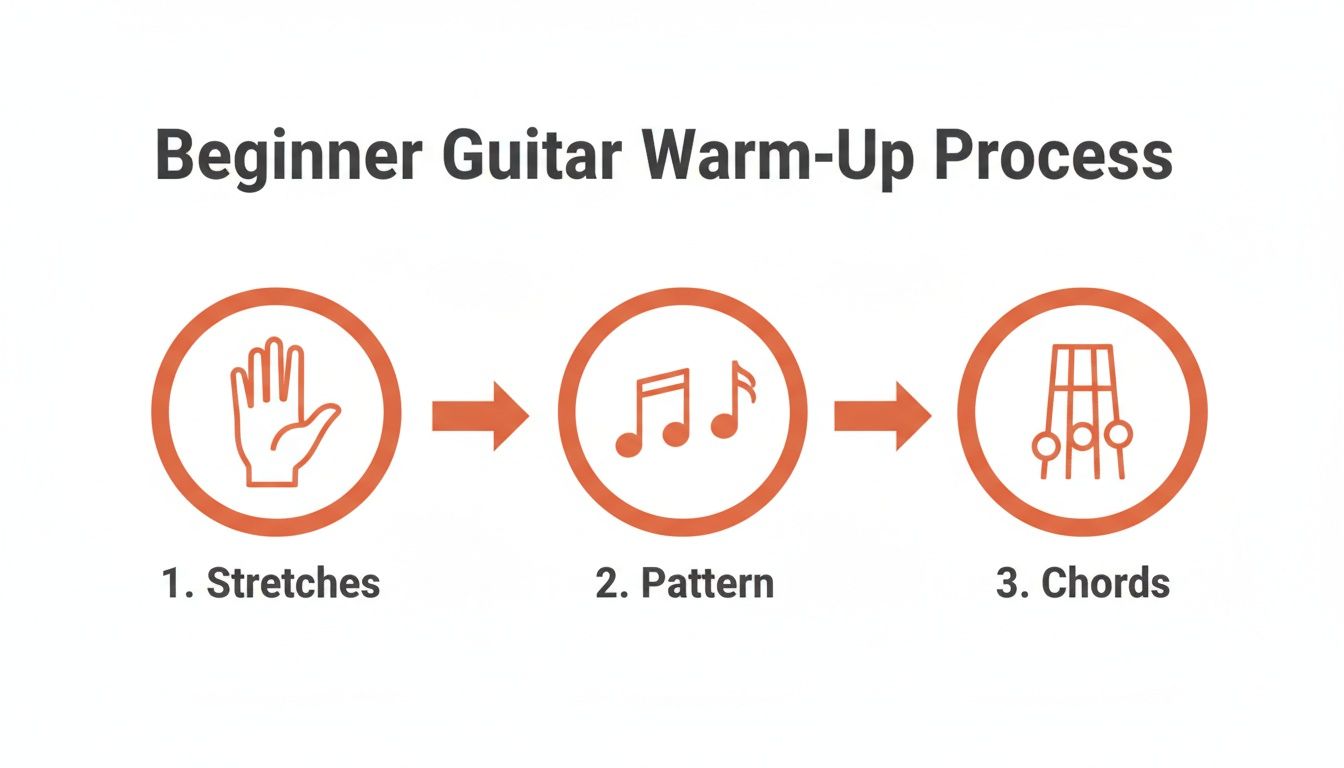
As you can see, a complete warm-up hits the physical (stretches), the mechanical (patterns), and the musical (chords) sides of playing. It's a holistic approach that truly prepares you to play.
Alright, let's get to it. This routine is designed to be a quick but intense technique builder. Grab your metronome and find a tempo where you can play every note perfectly—somewhere around 80-100 BPM is a good starting point. Remember, clean execution is king. Speed will come later.
Here's the breakdown of your new 10-minute warm-up, designed to build specific, usable skills.
| Time | Exercise | Focus Area | Starting Tempo (BPM) |
|---|---|---|---|
| 3 Mins | Three-Note-Per-String Scales | Fretboard Navigation & Dexterity | 80-100 |
| 3 Mins | Fundamental Arpeggio Shapes | Harmonic Knowledge & Accuracy | 80-100 |
| 2 Mins | String-Skipping Drills | Picking Hand Control | 80-100 |
| 2 Mins | Rhythmic Chord Changes | Transition Speed & Rhythm | 80-100 |
Stick to this schedule, and you'll be amazed at how much progress you can make in just 10 minutes a day.
This is a cornerstone exercise for developing that smooth, fluid lead playing we all crave. Unlike standard box patterns, these shapes force your fretting hand to stretch and navigate the neck more efficiently.
Arpeggios are just chords played one note at a time. Practicing them is one of the fastest ways to connect harmony and melody on the fretboard. We’ll stick with major and minor triads for this drill.
This isn't just a finger-twister; it's ear training in disguise. By drilling arpeggios, you're hardwiring the connection between chord shapes and their melodic notes—an absolutely essential skill for improvisation.
Lots of players can fly up and down a single string but stumble when they have to cross to a non-adjacent one. This drill tackles that problem head-on.
This exercise will do wonders for your picking hand’s spatial awareness and control. If you want to dive deeper into this kind of focused practice, there are some great lessons out there to help you supercharge your chops with targeted exercises.
To wrap things up, we’re going to make simple chord changes more demanding by injecting some rhythmic complexity. This builds muscle memory for your fretting hand under pressure.
These exercises are designed to build real-world skills. To see them applied in countless musical styles, a TrueFire All Access Trial is an invaluable resource.
When you get to an advanced level, your warm-up stops being a simple pre-flight check and turns into a high-performance calibration. It's not just about getting your fingers moving anymore; it's about honing a razor's edge on your technique before you even play a single note of real music.
This 4-minute routine is a concentrated shot of technical refinement. It’s designed to push your boundaries and solidify your command over the fretboard. We’re moving beyond just maintenance and into active improvement, targeting precision at speed, total dynamic control, and the kind of fluidity that makes ridiculously hard passages feel effortless.
For seasoned players, the metronome can start to feel a bit like a straitjacket. While it's absolutely essential for building a rock-solid foundation, real music is way more dynamic. That's why this routine ditches the clicks in favor of drum loops and backing tracks.
This one change immediately throws your playing into a musical context. It forces you to lock in with a groove and feel the rhythm, not just count it out. This is how you develop a killer internal clock—the very thing that separates the good players from the truly great ones.
Here’s what this high-level warm-up is built on:
Grab a drum loop or backing track and set it to a comfortable tempo, somewhere in the 90-120 BPM range. Remember, the goal here is flawless execution. Speed is just a byproduct of perfect precision.
Legato and Tapping Drills (5 Minutes)
Kick things off with three-note-per-string legato runs. Pick a single scale shape and ascend and descend across all six strings. Your main focus? Making your hammered and pulled notes sound just as loud and clear as your picked notes. Then, up the ante by adding a tapped note on each string to extend the pattern, which really challenges your hand synchronization.
Sweep Picking Extended Arpeggios (5 Minutes)
Let's work through a classic ii-V-I chord progression, like Dm7 - G7 - Cmaj7. For each chord, you'll play a five-string sweep arpeggio that outlines the harmony. You're aiming for a seamless, liquid motion where each note is perfectly articulated. Think of it like a single strummed chord where you can hear every individual note ring out.
This exercise does way more than just build speed. It trains your ear to hear the harmonic function of each note in the chord and connects that knowledge directly to a physical technique on the fretboard.
Modal String-Skipping Sequences (5 Minutes)
Pick a mode—let's say A Dorian—and create patterns that jump over strings. For instance, play a three-note pattern on the 6th string, then leap to the 4th string for the next three notes, then maybe over to the 5th, then the 3rd. This breaks you out of lazy, linear playing and dramatically improves your picking hand's ability to track string changes at high speed. For more ideas on developing this kind of control, our guide on 3 easy tricks for building speed and stamina is a fantastic resource.
This advanced routine isn't just about warming up your hands; it's about sharpening your mind and reinforcing the highest levels of technique. Make this a part of your daily practice, and you'll be ready for any musical challenge that comes your way. To explore these advanced concepts with world-class instructors and a massive library of jam tracks, a TrueFire All Access Trial is the perfect next step.
Having a killer routine on paper is one thing, but actually doing it right is what separates a decent practice session from a great one. The right tools and mindset can turn your guitar warm ups from a mechanical chore into a period of focused, rapid improvement. It’s all about working smarter, not just harder.
The single most important tool in your arsenal isn't a boutique pedal or a vintage guitar—it's a simple metronome. Seriously. Think of it as your brutally honest best friend for building unshakable timing. It gives you immediate, no-nonsense feedback on your rhythm, forcing you to play with precision and control.
Starting your exercises at a slow tempo with a metronome and gradually nudging the speed up is the most effective way I know to build clean, solid technique.
Your physical relationship with the guitar plays a huge part in your ability to play cleanly and without pain. Two of the most overlooked aspects are posture and finger pressure. Hunching over your guitar restricts your breathing and puts a ton of unnecessary strain on your back, shoulders, and wrists.
So, sit up straight, whether you're on a stool or a chair, and make sure the guitar is balanced comfortably. This relaxed posture lets your arms and hands move freely.
Along those same lines, a lot of players use a "death grip" on the fretboard, pressing down way harder than they need to. This just leads to fatigue and can even cause injury down the road.
The goal is to use the absolute minimum amount of finger pressure required to produce a clean, buzz-free note. Play around with this; you’ll be shocked at how little force you actually need. This one small change can dramatically boost your playing stamina.
Modern tools offer some incredible ways to supercharge your warm-ups. For instance, the looping features you'll find in platforms like TrueFire are perfect for isolating and conquering those stubborn passages. Instead of slogging through an entire scale exercise just to stumble over one tricky part, you can loop that little two-second phrase and drill it until it's second nature.
This kind of focused repetition is way more efficient than just playing the whole exercise over and over. It lets you zero in on your specific weaknesses and turn them into strengths.
Here are a couple of common hiccups and how to fix them:
Finally, one of the best ways to stay locked in with your guitar warm ups is to make them feel less like a chore and more like making music. While a metronome is your go-to for building precision, jamming over a backing track or even a simple drum loop can make the whole process way more fun and practical.
Playing your scales, arpeggios, and chord changes over a track forces you to apply them in a real musical context. It bridges that gap between dry, mechanical exercises and actual improvisation or songwriting. This approach sharpens your technique while also training your ear and your sense of phrasing.
By weaving these tools and tips into your routine, you transform your warm-up from a simple prerequisite into a powerful, skill-building part of your day. To get your hands on a massive library of jam tracks, looping tools, and lessons from world-class instructors, be sure to check out a TrueFire All Access Trial.
Alright, you've got the blueprint. Now comes the most important part: actually doing it. Consistency is the secret sauce that turns these exercises from a simple list into real, tangible skill.
Think of your warm-up as a non-negotiable part of your practice time. It's an investment in your playing, preparing your hands and mind to make every minute that follows way more effective. And remember, this isn't a static routine—it should grow and change right along with your playing.
The core idea is simple: a purposeful warm-up prepares your hands and mind, making every minute that follows more effective.
If you're ready to take these concepts and really run with them, I can't recommend a TrueFire All Access Trial enough. It’s the perfect place to apply these warm-ups, with guided lessons and a massive library of jam tracks to really put your new skills to the test.
Let's dig into some of the most common questions I hear from students about warming up. Getting these sorted out will help you build a smarter, more effective routine that actually gets you somewhere.
This is the big one, and the real answer is: it depends on where you're at and what you're about to tackle. For most of us, though, the sweet spot is somewhere between 5 and 15 minutes.
Think of it this way: a warm-up isn't a delay to your practice; it's an accelerator. You're not trying to wear yourself out. You're just priming your hands and mind so you can play your best from the very first note.
We've all been there. You're slammed, but you've got a tiny window to pick up the guitar. It's so tempting to just skip the warm-up and jump right in.
Don't do it. Seriously. Even a lightning-fast 2-3 minute warm-up is worlds better than nothing at all.
When time is tight, you just have to be efficient. Run a simple chromatic exercise up and down all six strings, then spend a minute switching between two chords you know inside and out. That quick burst gets the blood flowing, reconnects your brain to your fingers, and helps you avoid that awful "cold hands" fumbling. More importantly, it helps keep you from getting hurt.
Look, any playing is better than no playing, but let's be real: aimless noodling is probably the least effective way to get ready for a focused practice session. A proper warm-up is all about purposeful movement.
Every drill is designed to target something specific, whether it's finger independence, picking accuracy, or getting your hands to sync up perfectly.
Noodling just doesn't have that focus. It won't systematically prepare your muscles or get your brain in the zone to learn something new. Sticking to a consistent set of exercises means you're reinforcing good habits every single time. It's the difference between building a solid foundation and just treading water. If you're looking for purposeful drills from the pros, a TrueFire All Access Trial is your best bet.
Ready to truly transform your playing? A TrueFire All Access Trial unlocks a massive library of structured lessons, killer exercises, and jam tracks from world-class instructors.
