Every guitarist I’ve ever met wants to play faster, cleaner, and with more feeling. The secret? It’s not some magic pedal or a vintage guitar. It's dedicated hand exercise guitar routines. Think of these not as boring drills, but as the physical conditioning that lets your musical ideas flow without hitting a wall.
As a guitar educator, I can tell you this is the foundational work for building real strength, dexterity, and the endurance you need for both your fretting and picking hands. Let's dig in.

Your hands are the engine of your guitar playing. Simple as that. If you don't maintain that engine, it’s going to sputter and stall out, probably right in the middle of a great solo. The best players don't just have innate talent; they have conditioned, intelligent hands that can execute ideas without physical roadblocks. This is exactly why a consistent hand exercise routine is non-negotiable for any serious student of the instrument.
More importantly, this practice is your best defense against playing-related injuries like tendonitis or carpal tunnel syndrome, which can sideline you for weeks or even months. Trust me, I've seen it happen. A few minutes of targeted exercises each day is a tiny price to pay for a lifetime of pain-free playing.
It's easy to write off exercises as just mechanical movements with no soul, but their impact on your actual music is huge. These aren't just abstract drills; the benefits show up in everything you play.
We saw this need for physical conditioning explode during the recent lockdowns. The guitar market saw a massive spike in growth, projected to jump from USD 4.93 billion in 2022 to USD 7.31 billion by 2028, as tons of new players picked up the instrument. Many of them quickly discovered what seasoned players already know: consistent finger independence drills can boost fretting hand speed by up to 30% in just a few weeks.
The table below breaks down exactly how a small daily investment in hand health pays off big time in your playing.
| Benefit | Impact on Playing | Recommended Focus |
|---|---|---|
| Increased Dexterity | Faster, cleaner, and more accurate scale runs and solos. | Finger independence drills like "spider walks" and chromatic exercises. |
| Enhanced Strength | Clearer notes, better bends, and less buzzing from weak fretting. | Grip strengtheners and finger-lifting exercises. |
| Improved Endurance | Play longer sets and more complex pieces without fatigue or cramping. | Stamina-building routines with a metronome, gradually increasing duration. |
| Better Coordination | Tighter sync between your picking and fretting hands for fluid lines. | Ascending and descending patterns that cross multiple strings. |
| Injury Prevention | Reduced risk of tendonitis, carpal tunnel, and other repetitive strain injuries. | Gentle pre-session warm-ups and post-session stretches. |
These benefits aren't just theoretical—they are tangible improvements you will hear and feel every time you pick up your guitar. It’s about building a physical foundation that can support your musical ambitions.
Ultimately, a dedicated hand exercise routine is an investment in your musical future. It's the physical groundwork that allows your creativity to flow without being held back by your body.
Jumping straight into a tough practice session with cold hands is just asking for trouble. Think about it: an athlete would never sprint without stretching first. The same logic applies to guitar. A quick warm-up pushes blood flow to the muscles and tendons in your fingers, wrists, and forearms, making them way more flexible and less likely to get injured.
This simple, five-minute routine is something I've dialed in over decades of playing and teaching. It’s designed to gently wake up your hands and get them firing on all cylinders for the real work ahead.
Before you even think about picking up your guitar, start with your body. These movements need to be slow and deliberate—and totally pain-free. If you feel any sharp twinges, ease up immediately.
These first few moves are so important for prepping those tiny, intricate muscles you rely on for every single note you play.
A great warm-up isn't about intensity; it's about intention. The goal is to gently increase circulation and flexibility, signaling to your hands that it's time to play. This mindful approach can dramatically reduce the risk of repetitive strain injuries.
Okay, now you can grab your guitar. This last part of the warm-up is all about getting both hands talking to each other. The key here is slowness and precision, not speed.
Fire up your metronome and set it to a crawl, somewhere around 60 BPM. Starting on the low E string, play a basic chromatic pattern using one finger per fret (1-2-3-4), making sure every note rings out clean. Climb up the neck to the 12th fret, and then make your way back down.
Now, do the exact same thing on the other five strings. Concentrate on using the least amount of finger pressure possible—just enough to get a clear tone. Really pay attention to how your picking and fretting hands are locking in together. This deliberate hand exercise guitar drill forges a rock-solid mind-muscle connection.
This isn’t about shredding; it’s about control. By the time these five minutes are up, your hands will feel warm, coordinated, and ready for whatever you throw at them in your main practice session. To see some other great routines, you might be interested in learning more about the importance of warming up for any style of playing.
Once you’re properly warmed up, it’s time to dig into the exercises that really build muscle memory. This is where we forge true finger independence—the skill that allows each finger to move with its own power and precision. Fluid, articulate playing doesn't just happen by magic; it’s built through focused, intentional practice.
The mission here isn't just to wiggle your fingers around. It's about training them to act as four distinct, reliable tools. I like to think of the fretting hand as a team where every member has a specific job. If one finger is lazy or weak, the whole team suffers. These next exercises are the core workout that gets everyone pulling their weight.
The bedrock of dexterity is the simple chromatic pattern, but we can supercharge it by introducing permutations. Instead of just running up the frets 1-2-3-4 in order, we’re going to scramble the sequence to challenge your brain and fingers in new ways.
Fire up your metronome and set it to a painfully slow tempo, somewhere around 50-60 BPM. The goal is perfect execution, not speed. Using your index (1), middle (2), ring (3), and pinky (4) fingers, play these patterns up and down a single string.
Concentrate on pressing just hard enough to get a clean note. Critically, keep your unused fingers relaxed and hovering close to the fretboard. This is a detail that players often overlook, but it’s the secret to efficient movement. For a deeper dive into this, check out our post on how to refine your left-hand technique.
The "Spider Walk" is a classic for a reason: it flat-out works. This exercise is all about building coordination by forcing each finger to move on its own while the others stay planted.
Get started by placing your index finger on the 5th fret of the low E string. Then, place your middle finger on the 6th fret, ring on the 7th, and pinky on the 8th. Now, you’re going to "walk" each finger, one at a time, to the next string while the others remain perfectly still.
Start by moving your index finger to the 5th fret of the A string. Next, move your middle finger to the 6th fret of the A string. Continue this methodical pattern across all six strings, then reverse the process and walk back up.
The most common mistake I see is players lifting their other fingers when one moves. The entire point of this drill is to isolate movement. It will feel awkward and incredibly difficult at first—but that’s a good sign. It means you're building new neural pathways.
Here’s a quick-reference table for some of the most effective drills to get you started.
| Exercise | Primary Goal | Pro Tip |
|---|---|---|
| Chromatic Permutations | Building finger-to-brain connection | Start painfully slow (50-60 BPM). Focus on clean notes and minimal finger pressure. Don't let unused fingers fly away from the fretboard. |
| The Spider Walk | Finger isolation and string-crossing | Keep your non-moving fingers planted. This is the hardest part but yields the biggest rewards. Think of it as finger yoga. |
| Trill Drills | Strength and endurance | Practice hammering-on and pulling-off between every finger pairing (1-2, 1-3, 1-4, 2-3, 2-4, 3-4). This builds stamina fast. |
| Single-String Scales | Fretboard knowledge & position shifting | Play a major scale on one string. This forces you to be deliberate with your finger placement and shifts. |
Don't just go through the motions with these exercises. Be mindful, listen to every note, and you'll see a massive improvement in your playing.
The pinky is almost always the weakest link in the chain. For intermediate players, dedicated metronome work can seriously accelerate pinky strength. We've seen it time and time again—it's the finger that lags for about 60% of players when they start getting serious. But with targeted drills, you can boost its independence by 40% in just a couple of months.
These drills are the heart of a powerful practice routine. By making them a consistent part of your playing, you move beyond just hitting notes and start commanding the instrument with real precision and confidence.
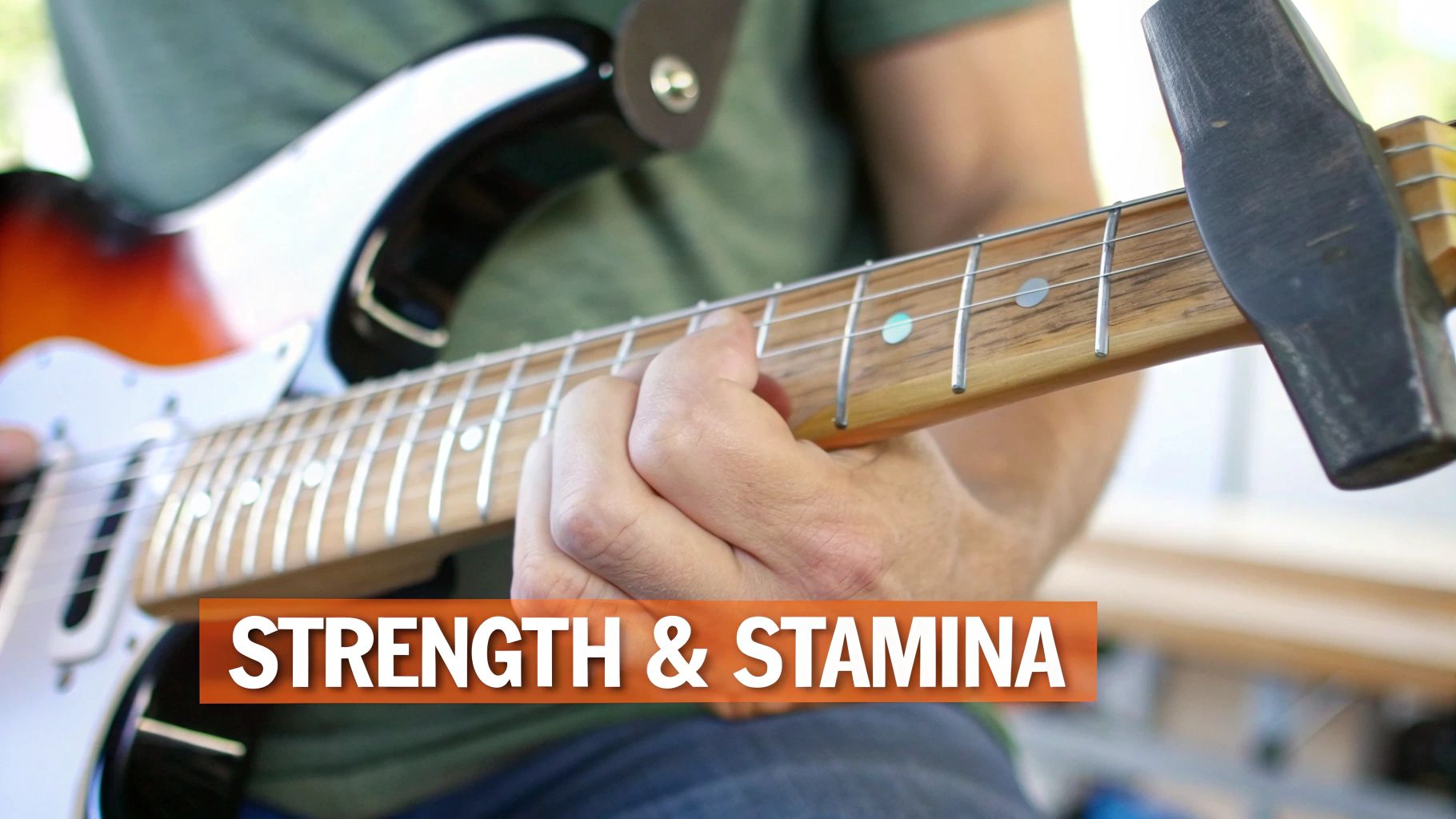
Okay, you've got the basic finger wiggles down. Now it's time to build the kind of muscle that lets you really command the instrument. We're talking about the power and endurance you need to play with genuine expression.
This is where you forge the stamina to rip through long, demanding solos without your hands cramping up and quitting on you. The goal is simple: make physical limitations a total non-issue so your musical ideas can fly free.
Legato techniques like hammer-ons, pull-offs, and trills are pure strength training for your fretting hand. They force your fingers to generate clean, articulate notes without any help from the pick. This is how you build both raw power and serious efficiency in your playing.
A killer exercise for this is the multi-finger trill. Grab your metronome, set it to a slow, manageable tempo, and try these combinations on the G string:
The real goal here is to make the volume of your hammer-ons and pull-offs perfectly even. Consistency is everything. This kind of targeted work is a game-changer for building speed and stamina on the guitar.
Those soulful, expressive bends and vocal-like vibrato? That's all about controlled finger strength. Holding a full-step bend perfectly in tune for a few beats takes some serious muscle, especially from your ring and pinky fingers.
Here's a great way to build that strength. On the B string at the 10th fret, bend the note up a full step. Hold it right there for four full beats. Listen carefully—you don't want that pitch to sag even a little. Release it, and then do it again. Think of it as doing reps at the gym, but for your fretting hand.
Vibrato is controlled strength, not just wild shaking. To practice, push the string up and down in a slow, wide, rhythmic motion. You're aiming for a consistent, musical pulse, which only happens when you have the endurance to keep it going without tensing up.
Stamina isn't just a fretting-hand issue. Your picking hand needs the endurance to stay accurate, especially when you're jumping across wide intervals. String-skipping exercises are the perfect workout for this.
Start with a simple G major arpeggio, but force yourself to play it across strings that aren't next to each other. For example, play the root note on the low E string, then jump all the way to the third on the D string, and finish by hopping to the fifth on the B string.
This drill forces your picking hand to make big, precise movements without bumping into the strings you're trying to skip. As you slowly crank up the tempo on your metronome, you’ll build the muscle memory and control to nail any interval cleanly, no matter how fast or wide it is.
All the speed and dexterity in the world won't mean a thing if you injure yourself. The secret to playing guitar for decades isn't some complex technique—it's building sustainable habits right now. This is about more than just exercises; it's about developing the awareness to play smart for the long haul.
The single most important skill you can ever develop is learning to listen to your body. There's a world of difference between healthy muscle fatigue—that satisfying burn after a great practice session—and actual pain. Pain is a stop sign. It's not a suggestion.
Any sharp, stabbing, or persistent ache is your body screaming that something is wrong.
Ignoring those signals is the fastest way to develop a repetitive strain injury (RSI), which can sideline you for weeks, months, or even longer. If you feel genuine pain during a hand exercise or while playing, stop immediately. Seriously. Never "play through the pain."
Take a break for a day or two. If the pain sticks around, it's time to take a hard look at your technique, your posture, or even chat with a professional.
This isn't just for hobbyists; it's a non-negotiable for career musicians. In the high-stakes world of pro guitar, smart routines are the secret weapon against career-ending injuries. Some data even suggests that proper preventative care can slash the risk of injury by as much as 50%.
However, you have to use the right exercises. A 2017 analysis warned that many common hand exercises can do more harm than good by focusing too much on brute strength instead of mobility and flexibility.
"The goal is to be a guitarist for life, not just for the next six months. Smart, mindful practice and paying attention to your body's signals are the best tools you have to ensure your longevity with the instrument."
Just like a warm-up gets your hands ready to play, a cool-down helps them recover. It only takes a couple of minutes. After you finish practicing, give these gentle stretches a try.
Beyond stretching, always be mindful of your posture and how you're holding the guitar. Ditch the dreaded "death grip"—use only the minimum amount of pressure needed to fret a clean note. Your fretting-hand wrist should be as straight as you can comfortably keep it to avoid unnecessary strain.
And if you're dealing with the classic sore fingertips that come with practice, we've got some great tips for reducing fingertip pain when learning guitar.
Building these simple habits is the smartest investment any serious guitarist can make.
Let's dive into some of the questions I get asked all the time by students about hand exercises. Getting the right information is just as critical as doing the drills themselves, so let's clear up any confusion with some straight-up, practical advice from my years on the fretboard and in the teaching studio.
Here's the deal: consistency beats intensity every single time. A focused 10-15 minute routine every day before you play will do more for you than a brutal, hour-long session once a week. In fact, those marathon sessions can do more harm than good, leading straight to strain.
Think of it as your daily conditioning routine:
This little daily habit is a massive investment in your playing. It compounds over time and builds a rock-solid foundation that will support you for years.
I see these things marketed everywhere, but honestly, they’re not a magic bullet. While a grip strengthener can build raw squeezing force, that's not what guitar playing is about. We need dexterity, nuance, and coordination—skills you can only truly build on the guitar itself.
Relying too much on off-instrument gadgets can even be counterproductive. You might build up the wrong muscles or create the kind of tension that actively fights against fluid playing. My advice? Stick to on-guitar exercises as your main focus. If you really want to use a gripper, think of it as a small supplement and concentrate on controlled, light repetitions, not crushing it with maximum force.
Stop. Immediately. That's the number one, non-negotiable rule.
Pain is your body's alarm bell, and you have to listen to it. There's a huge difference between the satisfying "burn" of muscle fatigue and a sharp, stabbing, or nagging ache. Learn to recognize that difference.
Never, ever 'play through the pain.' You’re risking turning a small, temporary annoyance into a chronic injury that could put you on the sidelines for weeks or even months. If you feel that kind of pain, give it a rest. If it’s still there after a day or two, it might be the start of a repetitive strain injury (RSI), and it's time to see a doctor.
Simple: think of your hand exercises as the warm-up for the main event. They’re the conditioning that makes you a better musical athlete. Always do your warm-ups and drills before you get into the fun stuff like learning songs or tackling new techniques. This gets your hands primed and ready to perform their best.
Then, start looking for ways to apply these skills directly to the music you're playing. Struggling with a fast chord change in a song? Isolate it. Slow it down. Drill it just like you would a hand exercise. You're using the very dexterity and independence you've been building to conquer the real-world challenges in the music you love. This is how you bridge the gap between abstract drills and actual playing.
To see thousands of examples of how to apply these principles in real musical situations, I highly recommend exploring the lessons available with a TrueFire All Access Trial.
