Learning how to improvise on guitar is all about turning scales and dusty theory into your own musical voice. The whole process really boils down to a simple loop: Listen to the music you can't get enough of, Copy the licks and phrases that grab your ear, and then Create your own spin on them over a backing track.
That's it. Improvisation is a skill you build with deliberate practice, not some mysterious talent you’re born with.
The idea of making up music on the spot can feel pretty daunting, but it doesn't have to be. Improvisation isn't about memorizing a thousand licks or having a PhD in music theory right out of the gate.
Think of it like learning a language. You don't start by reading Shakespeare. You start by mimicking sounds, forming simple words, and eventually stringing them together into sentences. This approach takes all the pressure off trying to be a genius from day one and puts the focus back on the fun of just making music.
The minor pentatonic scale is the secret handshake for pretty much every rock, blues, and pop guitarist on the planet. Its five-note structure is incredibly versatile and sounds instantly "right" over most common chord progressions. You don't need to know why it works yet—you just need to know its most common shape.
This first pattern, which everyone calls "Box 1," is your golden ticket. It's a comfortable, memorable shape that sits perfectly under your fingers. By learning just this one pattern, you have every note you need to create a killer solo over a standard blues or rock jam.
The biggest mistake I see beginners make is waiting until they "know enough" theory to start improvising. The truth is, you learn to improvise by doing it. The theory makes a whole lot more sense once you have some real, hands-on context for it.
Before we dive into your first session, let's break down the absolute essentials for getting started.
This table outlines the three core pillars you need to focus on right now. Don't worry about anything else until you've got a handle on these.
| Core Pillar | What It Means | First Action Step |
|---|---|---|
| The Scale | Your "alphabet" of notes that will sound good over the music. | Learn Box 1 of the A minor pentatonic scale. |
| The Track | The musical canvas you'll be "painting" your solo on. | Find a simple A minor blues backing track on YouTube. |
| The Mindset | Permission to explore without judgment. No right or wrong notes. | Just play the scale notes in any order and listen. |
Think of these three things as your complete starter kit. With them, you have everything you need to make music right now.
Ready to put this into practice? Let's do it.
This first exercise is all about breaking the ice. It’s proof that you can create music on the fly without years of training. For more foundational advice, check out our beginner's guide to starting guitar for other essential tips.
This simple act of playing over a track builds instant confidence and lays the groundwork for everything else to come. To get expert guidance and thousands of jam tracks to practice over, start a TrueFire All Access Trial.
Once you've had that first taste of improvising a solo, you'll naturally want more words to express your musical ideas. This is where scales and arpeggios come in. Think of them as your personal dictionary—they’re not just sterile exercises but the fundamental building blocks of every melody you've ever loved.
Learning these tools isn't about memorizing endless diagrams. It's about understanding why they work, giving you the power to pick the right notes at the right time. The desire for this kind of deep, expressive playing is growing. The global guitar market is projected to hit USD 12.04 billion with 7.56% annual growth, and a huge chunk of that—45.5% of players—are beginners looking for structured ways to master these core skills.
At its heart, improvisation is a simple loop: you listen, you copy, and then you create something new.
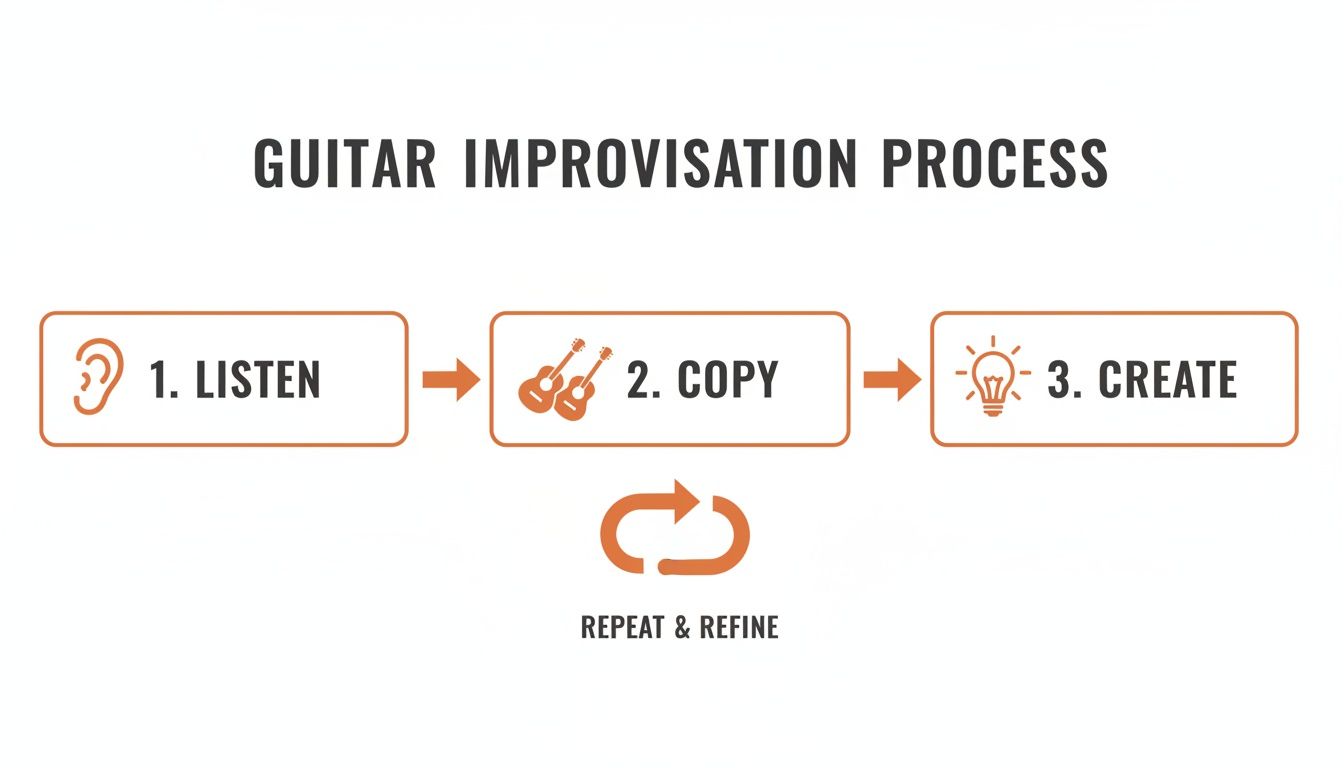
This shows that improvisation isn't random. It's a cycle of absorbing musical information and then reinterpreting it through your own creative filter.
Ah, the minor pentatonic scale. It's the rock and blues workhorse for a reason, but so many players get trapped in that first "box" position and never leave. To truly improvise, you need to see the entire fretboard as one big, connected scale. Each of the five pentatonic positions is just a different window looking out at the same landscape of notes.
Practice is the key to breaking free. Try this: play a lick in one position, then slide your hand up or down the neck and play that exact same lick in the next position. This simple exercise trains your fingers and, more importantly, your mind to stop seeing boxes and start seeing a seamless fretboard.
Of course, the major pentatonic scale is the other side of the coin. Where the minor pentatonic is all bluesy, soulful tension, the major pentatonic has a sweeter, more upbeat sound that’s perfect for country, pop, and classic rock. Learning its shapes will instantly double your expressive range.
Ever wonder why some solos sound so melodic and perfectly glued to the song, while others just sound like… well, like someone running up and down a scale? The secret is almost always chord tones.
Chord tones are simply the individual notes that make up the chord being played in the background. When your solo lands on these notes, it sounds deliberate, musical, and locked-in with the harmony. An arpeggio is just that—a chord played one note at a time. It’s your road map to the most powerful notes you can play over any chord.
The moment you stop thinking, "What scale can I play over this?" and start thinking, "What chord tone can I land on?" is the moment your improvising will take a giant leap forward in maturity and musicality.
Let's take a standard I-IV-V blues progression in A (A7, D7, E7) as an example.
You can still use your A minor pentatonic scale over the whole thing, but try to land on one of these target notes right as the chord changes. It’s a simple trick that makes your solos sound incredibly pro. For a deeper look at this powerful concept, check out this guide on using arpeggios for guitar.
Once you're comfortable navigating scales and targeting chord tones, you can start exploring modes. Don't let the name intimidate you. Modes are just different "flavors" of the major scale, each with its own unique mood. You don't need to learn all seven at once.
Start with these two:
Think of modes as spices in your musical kitchen. A sprinkle of Dorian or Mixolydian can add a whole new dimension to your playing, pushing you beyond standard pentatonic sounds and into more colorful melodic territory. A TrueFire All Access Trial can give you guided lessons on these concepts.
Knowing the right notes to play is just the starting point. The real magic—the stuff that separates a good guitarist from a truly great one—is making those notes sing. Phrasing is the soul of your solo. It’s not what you play, but how you play it. This is where you learn to tell a story instead of just running up and down a scale.
Imagine trying to have a conversation by speaking every single word with the exact same tone, speed, and volume. It would sound robotic and totally uninteresting, right? Phrasing on the guitar is the same idea. It's the art of giving your notes personality, emotion, and life.
To stop sounding like you're just practicing scales over a backing track, you need to get a handle on a few essential expressive techniques. These are the tools that let you inject human-like vocal qualities into your playing, making the guitar cry, sing, or scream on command.
Here's your starting toolkit for killer phrasing:
The real secret sauce is realizing that the space between the notes is just as important as the notes themselves. Sometimes, a moment of silence can build more tension and have a bigger emotional punch than a blistering flurry of sixteenth notes.
A solo that sticks in your head has structure and rhythm. It feels more like a conversation than a monologue. To get there, you need to start thinking rhythmically and melodically, using the same concepts the pros rely on to build compelling musical statements.
First thing's first: internalize a rock-solid sense of time. Practicing with a metronome or a simple drum loop is non-negotiable. Seriously. It trains your internal clock, making sure your rhythmic ideas land exactly where you want them to.
Once your timing is tight, you can start weaving in more advanced concepts:
Think about David Gilmour’s solo in "Comfortably Numb." He doesn’t blow you away with speed. Instead, he uses perfectly pitched bends, a slow, deliberate vibrato, and long, sustained notes to build an incredible sense of emotion and drama. That's the power of world-class phrasing. For a deeper dive into how these ideas work across the neck, you can explore concepts around phrasing on the guitar.
Learning to improvise is a journey of turning technical skill into pure artistic expression, and phrasing is the bridge that connects the two. To get hands-on lessons from world-class instructors on these techniques and thousands of jam tracks to practice over, start a TrueFire All Access Trial.
Here's where the real magic happens. The ultimate goal for any improviser is to play the melodies they hear in their head, instantly and without thinking. This isn't some mystical gift reserved for the chosen few; it's a skill you build, brick by brick.
This skill rests on two core pillars: a well-trained musical ear and an intimate, almost subconscious, knowledge of your fretboard. This section is all about bridging the gap between what you can imagine and what you can actually play. It’s about moving past memorized shapes and into the world of pure sound.
Before you can play what you hear, you have to get better at hearing it accurately. This is what we call ear training, and it’s like taking your musical mind to the gym. You’re literally strengthening the connection between hearing a pitch and knowing what it is.
A simple but incredibly powerful exercise is singing scale degrees. Play a C major scale, but do it slowly. As you play each note, sing its number: "one, two, three, four, five, six, seven, one." This exercise forges a rock-solid link between a note's sound and its role within the key, which is absolutely fundamental for improvisation.
Next, start recognizing intervals—the distance between any two notes. Play a C, then a G. Hear that sound? That’s a perfect fifth. The trick is to associate these sounds with melodies you already know. For instance, the first two notes of "Twinkle, Twinkle, Little Star" are a perfect fifth. This gives you a mental hook to hang the sound on.
The connection between your ears, your voice, and your fingers is a three-way street. If you can sing a simple melody, you're halfway to being able to play it on the guitar. Your voice is the most direct link to your musical mind.
A great ear is only half the equation. You also need to know exactly where those notes live on the fretboard, without having to stop and think about it. This goes way beyond just memorizing scale patterns; it's about building a complete mental map of the entire neck.
Here's an effective way to start: Pick one note and find it everywhere. For example, find every single "G" on your guitar, from the open G string all the way up to the 15th fret of the high E. Do this for a few minutes every day, but with a different note each time. This forces you out of those comfortable "box" patterns and helps you see the fretboard as a whole.
This is where your ear training and fretboard knowledge finally come together. Transcription is simply the process of figuring out a piece of music—like a solo or a melody—just by listening to it. Honestly, this is probably the single most powerful exercise for any aspiring improviser.
The global guitar market has rocketed to USD 19.70 billion, and a huge 45.5% of that is individual amateurs. A lot of that growth comes from self-taught players using online tools to sharpen skills just like this. In fact, educational studies show that looping short musical phrases at slower speeds can boost a player's retention by up to 40%—a technique that's the absolute cornerstone of good transcription.
Ready to try it? Here's how to transcribe your first lick without pulling your hair out:
This process not only trains your ear to recognize common melodic patterns but also builds your personal vocabulary of licks. For more on this, check out these simple techniques to improve your musical ear.
Mastering this connection is your ticket to real creative freedom on the guitar. To get personalized feedback and access thousands of lessons focused on these skills, check out a TrueFire All Access Trial.
Alright, we've talked theory, scales, and all that good stuff. But knowing the alphabet doesn't make you a storyteller. To turn that knowledge into actual music that flows from your fingers, you need a plan. This is where we stop noodling and start practicing with a purpose.
Think of it this way: a structured daily routine is the engine that will actually drive your progress. Without one, you're just spinning your wheels. The goal is to build a balanced "workout" that hits all the essential skills, forcing new connections between your ears, your brain, and your hands every single time you pick up the guitar.
A real practice session for improv isn't just throwing on a backing track for an hour and hoping for the best. It’s a smart blend of different exercises, each designed to strengthen a specific musical muscle.
Every time you practice, you should be touching on these four pillars:
I’ve seen it a thousand times: the single biggest difference between players who get better and those who stay stuck is the shift from just "playing" to "practicing." Playing is for fun; practicing is for growth. A good routine makes sure you're always growing.
Listen, consistency beats intensity every single time. A focused 30 minutes a day is way more powerful than a frantic four-hour jam session once a week. Here are a couple of templates you can steal and tweak to fit your life.
The 30-Minute "Daily Dose"
The 60-Minute "Deep Dive"
With over 50 million guitar players out there, the demand for learning methods that actually work is huge. Player data shows that following guided routines can slash learning plateaus by as much as 25%. It's all about having a map.
For more ideas on how to get the most out of your time, check out these five smart practice tips for guitar players. A little structure goes a long way in turning what you know into what you can do.
Learning to improvise is one of the most incredible journeys you can take on the guitar. It's the difference between just playing notes and actually making music. It’s how you go from following the dots to finding your own voice on the instrument. This is where self-expression truly begins.
So far, we've laid out all the essential pieces of the puzzle. We started with the bedrock of scales, then dug into the art of phrasing, worked on bridging the gap between your ear and the fretboard, and finally, put it all together into a daily practice plan that actually builds momentum. These aren't just separate drills; they're all connected, each one feeding and strengthening the others.
Here’s something to keep in mind: improvisation is a lifelong exploration. There's no finish line. You'll definitely have days where you feel stuck in a rut, just playing the same old licks on repeat. Every single guitarist deals with this, from absolute beginners to the pros you look up to. It's just part of the process.
The secret is to just embrace the journey itself. Be patient when you're struggling, and make sure to celebrate the small wins—like when you finally nail a lick by ear or play a phrase that sounds 100% like you. And above all, have some fun with it. That's why we started playing in the first place, right?
Think of the tools in this guide as your map and compass. They can point you in the right direction, but you're the one who has to walk the path. The goal isn't just to memorize licks; it's to uncover the music that's already inside you, just waiting to come out.
The more you soak it all in—listening, practicing, and just playing—the more second-nature this will all become. Your fingers will start finding the notes your mind is hearing, almost on their own, and your solos will start to tell a real story. That's the heart of creative freedom on guitar.
If you're ready to really accelerate your progress with expert guidance, thousands of jam tracks, and interactive lessons that make all these concepts click, I can't recommend a TrueFire All Access Trial enough. It’s the perfect next step to transform your hard work in the practice room into compelling, expressive playing and truly set the improviser inside you free.
Even with the best roadmap, you're going to have questions as you start learning to improvise. It's just part of the process. Let's tackle some of the most common hurdles I see players run into when they first start creating music on the fly.
This is the big one, isn't it? The honest answer is that it really comes down to how consistently you practice. If you can carve out a dedicated 30-60 minutes every day for a focused routine like the ones we've been talking about, you'll probably feel pretty comfortable jamming over a simple backing track within a few months.
True mastery is a lifelong pursuit, of course. But those big, exciting creative breakthroughs can happen surprisingly fast when you put in focused work on your scales, phrasing, and ear training.
If you're into rock, blues, or pop, your first stop should absolutely be the minor pentatonic scale. There's a reason you hear it everywhere—its simple, five-note pattern just sounds good over a huge range of chords. Countless legendary guitarists have built entire careers on it.
Your first major goal should be mastering its five positions all over the neck. Once you do that, you'll have a powerful, versatile tool for soloing in most of the music you hear on the radio.
The key is to see the five pentatonic shapes not as separate boxes, but as interconnected windows that all look out onto the same fretboard. Once you can move seamlessly between them, you're truly free.
Don't worry, this is probably the most common frustration for any developing improviser. The secret is to shift your brain from thinking about notes to thinking about phrasing. You need to make the notes sing.
Start by consciously using phrasing techniques like these:
Instead of playing long, continuous streams of notes, try creating short melodic ideas—often called motifs—and then repeat them with small changes. Most importantly, listen to what the band is doing and leave some space! Think of it less like a speech and more like a conversation. You don't have to talk the whole time.
Here's a great little trick: try singing a line before you attempt to play it on the guitar. It almost forces you to create melodies that are less robotic and more musical.
Ready to turn these answers into action? TrueFire has thousands of lessons from world-class instructors covering every aspect of improvisation, from phrasing to fretboard visualization. Start your journey with a TrueFire All Access Trial today.
