Learning guitar from home is all about laying down a solid foundation first. This means getting the essentials right from day one: choosing the right guitar for you, creating a dedicated practice space, and nailing the absolute basics like tuning before you even think about playing a chord.
Getting these simple things right from the get-go is the difference between smooth sailing and quitting in frustration. It prevents bad habits from forming and makes your entire musical journey a whole lot more fun.
Welcome to what might be the most rewarding journey you can take, right from the comfort of your own home. I know you're itching to play your first song, but just like building a house, a strong foundation is everything. Skipping these first crucial steps is the number one reason I see aspiring players give up. We're here to make sure that doesn't happen to you.
You're not alone on this path, either. Learning online has exploded in popularity. A recent study showed that over 40% of players in the US now lean on online tutorials to learn. That's a huge shift, and it saw a 30% spike during the lockdowns which basically created a new generation of bedroom guitarists.
The demand for accessible music education is booming, with the North American market alone projected to hit $356.3 million by 2025. It's clear that learning at home is here to stay.
The first big decision you'll make is picking your weapon of choice: acoustic or electric? There's no "right" answer here. It all comes down to the kind of music you love and dream of playing.
My advice as a music educator is simple: pick the guitar that makes you want to play. If you love the warm, resonant sound of an acoustic, you'll be more motivated to pick it up every day. If the idea of a crunchy electric riff gets your heart racing, start there. Inspiration is what fuels consistency.
For a deeper dive, check out our guide on how to choose the best acoustic guitar.
You don't need a fancy studio, but having a dedicated spot for your guitar makes a huge psychological difference. It tells your brain, "Okay, it's music time."
Find a quiet corner where you can leave your guitar out on a stand. This makes it ridiculously easy to just grab and play. A comfortable chair without arms is also a game-changer for maintaining good posture. This small act of creating a "guitar corner" removes the friction of unpacking your gear every time, making you far more likely to practice.
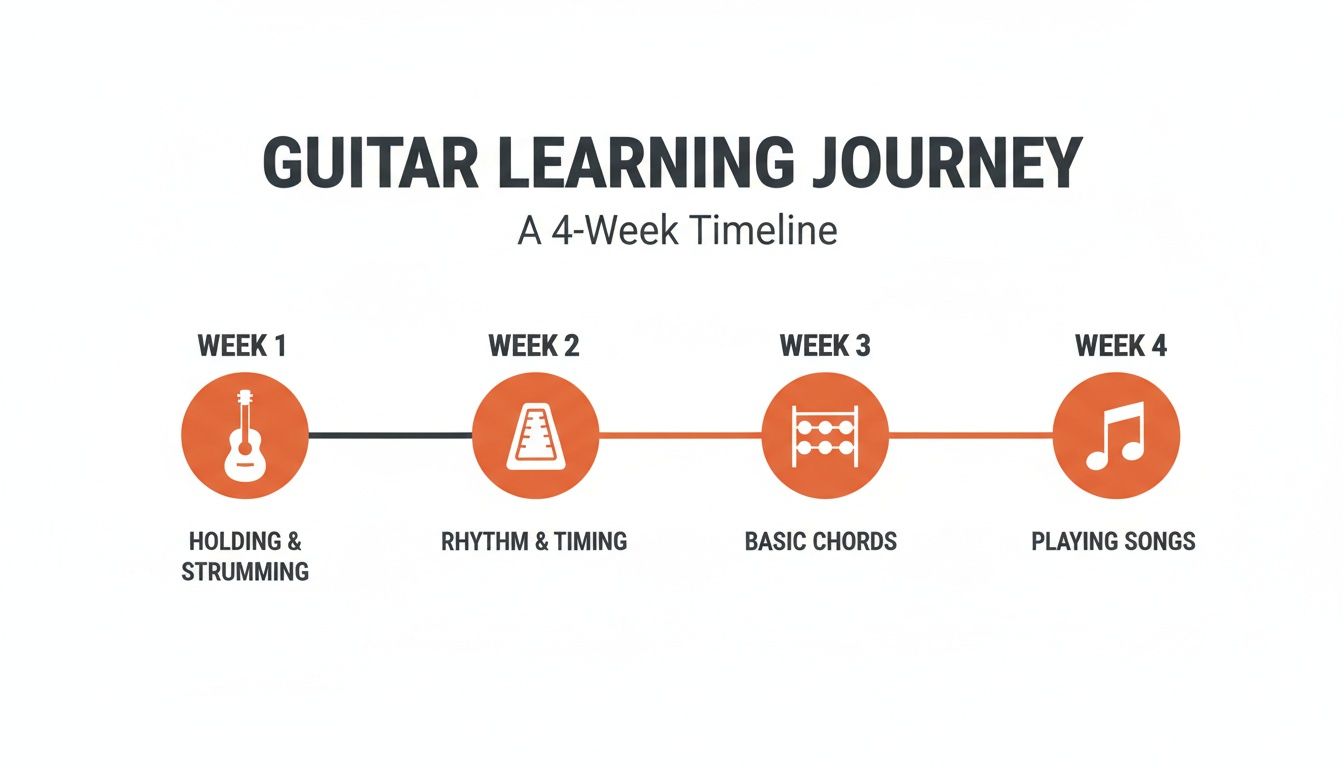
To help you get started, here's a realistic roadmap for your first month. This isn't a race; it's about building solid, repeatable habits that will serve you for years to come. The goal is small, consistent wins.
| Week | Primary Focus | Key Technique | Realistic Goal |
|---|---|---|---|
| 1 | Getting Comfortable with the Guitar | Proper Holding & Basic Strumming | Hold the guitar correctly and strum open strings. |
| 2 | Your First Chords | The E minor & G major chords | Switch between two chords cleanly, one at a time. |
| 3 | Building Rhythm & Chord Changes | Down-Up Strumming Patterns | Play a simple 4-beat strum pattern with your chords. |
| 4 | Playing Your First Song | Combining Chords & Rhythm | Play a simple 2- or 3-chord song from start to finish. |
This timeline is designed to build one skill on top of the next, so you're never overwhelmed. Master one thing, then move to the next.
Before you even attempt that first chord, lock in these three fundamentals. Seriously, don't skip these.
Nailing these fundamentals from day one is the fastest way to make real progress you can actually hear.
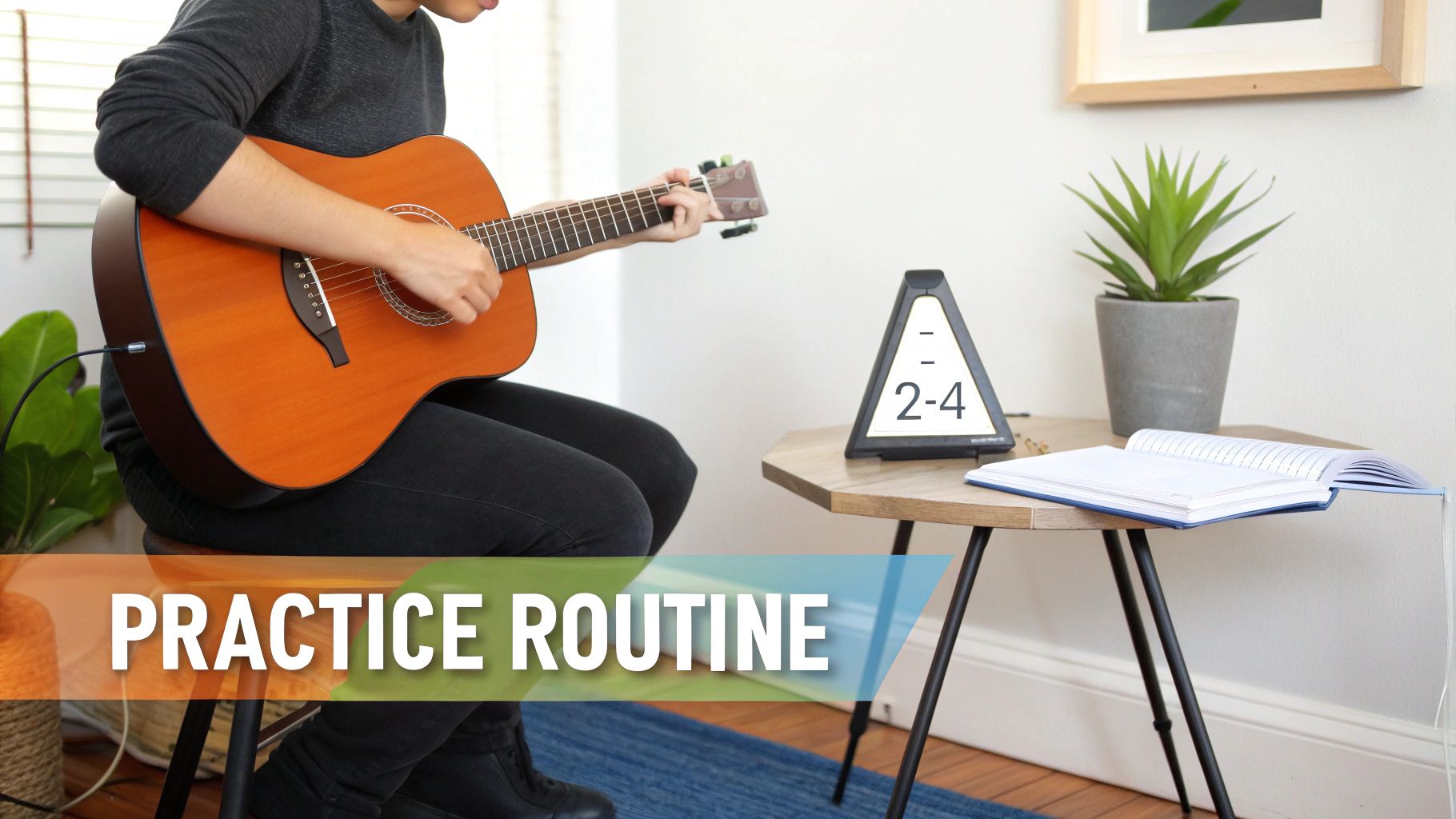
Let's talk about the single biggest thing that separates players who stick with it from those who flame out: consistency. But "just practice" is probably the worst advice you could get. When you're learning guitar at home, the real secret is building a realistic routine that actually fits into your life—not some fantasy version of it.
Forget about marathon sessions that leave your fingers sore and your motivation shot. We're talking about building a powerful habit through short, focused bursts of effort. And the data backs this up. A staggering 70% of home learners who commit to just 20 minutes a day stick with the guitar beyond their first year. For those who play sporadically? That number plummets to 25%.
So, what does that look like? You could start with a simple 10-week plan: spend the first couple of weeks on open chords like E, A, and D, then move into basic strumming with a metronome clicking away at a mellow 60 BPM. The power of habit is real.
Thinking about practice as one giant, intimidating block of time is a surefire way to procrastinate. Let's slice it into a simple, three-part structure that makes every minute count. A balanced session ensures you're building technique, actually learning music, and, most importantly, having fun.
This approach keeps you from burning out and makes every moment with your guitar a win.
Structuring your practice like this keeps you focused, prevents burnout, and makes sure you're always progressing toward the thing you actually care about: making music. This is how you become a guitarist for life, not just for a few months.
Once you've got the basics locked down, it's time to bring in the tools that can supercharge your progress at home. These aren't about replacing focused practice—they're about making it more effective.
Metronomes: This is the single most valuable practice tool you can use, and they're free. A metronome trains your internal sense of rhythm, which is what separates a sloppy player from a tight one. Start ridiculously slow. Play your chord changes at 40 BPM if you have to. The goal is clean, rhythmic accuracy. Speed is just a byproduct of time and consistency.
Recording Yourself: Here's a humbling but incredibly powerful habit: hit record on your phone and play for 30 seconds. Then listen back. You'll hear mistakes you never noticed in real time. Your phone's voice memo app is all you need to start building self-awareness, and that's when the real growth kicks in.
Structured Online Lessons: While YouTube is great for quick inspiration, it's tough to build a cohesive path when you're jumping around video to video. Platforms like TrueFire offer a clear, step-by-step curriculum with professional instructors, covering everything from beginner basics to advanced techniques. If you're learning guitar at home seriously, it's worth checking out.
Okay, now we're getting into the fun stuff—actual playing. These are the core skills that every guitarist needs, no matter what style you're into. Once you nail these, entire songs become accessible to you almost overnight.
Let me be straight with you: if you can master just five basic chords, you'll be able to play literally hundreds of popular songs. That's not hype, it's a fact. Most hit songs across rock, pop, country, and folk are built on simple open chord progressions. These are the foundation stones of modern guitar playing.
Let's start with the most beginner-friendly chords:
When I'm teaching beginners, I tell them this: don't expect perfection on day one. When you press down on a new chord, some strings will buzz. Your fingers will feel cramped. You might even think, "This is impossible." It's not. It's just unfamiliar. Your brain and fingers are building new pathways. Give it time, and suddenly, one day, it'll just work.
Pro tip: focus on changing between just two chords at a time. Practice the switch from Em to G, back and forth, until you can do it smoothly. Then add a third chord. Building your repertoire this way is way less overwhelming than trying to juggle all five at once.
Chords are only half the equation. If you want to bring a song to life, you need rhythm. A solid strumming pattern is what makes a chord progression feel like real music instead of just a boring exercise.
Here's a simple, universal pattern to get you started:
Down, Down-Up, Up-Down-Up
This pattern works for thousands of songs. Really. Try it out with any combination of the chords you've learned. Start slow—play it at 60 BPM on a metronome, making sure every strum is deliberate. Speed is the last thing you add. Accuracy and rhythm come first, always.
Once you've got that down, here's another classic that works for almost any folk or pop tune:
Down, Down, Down-Up, Down-Up
The beauty of these patterns is their versatility. You can apply them to basically any chord progression and instantly sound like you're playing a real song.
Tablature, or "tabs," is a guitarist's best friend. It's way simpler than traditional sheet music and it's how 90% of guitar players learn new songs. Unlike standard notation, tabs show you exactly where to place your fingers on the fretboard.
Here's how they work:
Tabs are made up of six horizontal lines, each representing one of the six strings on your guitar. The bottom line is your thickest string (low E), and the top line is your thinnest (high E). Numbers on the lines tell you which fret to press down.
For example:
e|---0---
B|---1---
G|---0---
D|---2---
A|---3---
E|-------
This tab is showing you a C major chord. The numbers tell you exactly which fret to press on each string. If there's a "0," that means play the string open (don't press any fret). If there's nothing on a line, don't play that string.
Tabs are usually read from left to right, and once you understand this system, you can learn virtually any song you want. Sites like Ultimate Guitar have millions of tabs for free, covering everything from classic rock to modern pop.
Let me be real with you. Every single guitarist—yes, every one—hits the same frustrating roadblocks when they're starting out. Your fingers won't cooperate. Chords sound muted. You feel clumsy and awkward. I promise you, this is not a sign that you're bad at guitar. It's a sign that you're learning.
The key difference between people who quit and people who push through is simply knowing that these challenges are normal and solvable. Let's break down the most common issues and, more importantly, how to fix them.
This is the number one complaint I hear from beginners, and the good news is it's almost always a simple fix. When your chords sound dead or buzzy, it's usually because your fingers aren't pressing down hard enough, or they're not positioned correctly.
Test each string individually by plucking them one at a time. If a string sounds muted or buzzes, adjust that finger until it rings out clearly. This kind of troubleshooting is tedious at first, but it builds an insane amount of awareness that pays off long-term.
Here's the deal: your fingertips are going to hurt for the first couple of weeks. This is a completely normal and unavoidable part of learning guitar. Your skin is soft right now, and pressing down on thin metal strings is tough on your fingers. But here's the thing—it doesn't last.
Within 2-3 weeks of consistent practice, your fingertips will develop calluses, which are just toughened layers of skin. Once you've got calluses, playing guitar becomes painless. Until then, here's how to manage the discomfort:
I always tell my students: fingertip soreness is your body adapting to something new. It's like the first day at the gym. You're sore, but you're also building strength. The pain is temporary, but the calluses—and the skills—are permanent.
Smooth chord changes are one of the hardest skills for beginners to master, and there's no shortcut here. It's purely a matter of muscle memory, which only comes from repetition. But there are some smart ways to speed up the process.
The ultimate goal is for your fingers to "remember" where they need to go without you thinking about it. This is called muscle memory, and it only develops through consistent, deliberate repetition. Trust the process.
Learning guitar at home is an incredible journey, but let's be honest—it's also easy to get stuck. You hit a wall, you're not sure what to learn next, and YouTube starts feeling like a confusing mess of conflicting advice. That's where structured resources come in.
Here's the truth: you don't need a ton of fancy tools or subscriptions to get good. But having a few high-quality resources in your corner can make the difference between grinding aimlessly and actually progressing with purpose.
Self-teaching is great, but it's easy to develop blind spots when you don't have a roadmap. Structured online platforms are designed to take you from beginner basics to advanced techniques in a logical, progressive order. You're not left wondering, "What should I learn next?"
TrueFire is the gold standard here. With thousands of lessons from world-class instructors, it's like having a personal guitar teacher available 24/7. Whether you're into blues, rock, jazz, or country, there's a learning path for you. Plus, the tab system and jam tracks make practicing interactive and fun.
You don't need a ton of gear, but a few key items will seriously level up your practice sessions:
These aren't luxury items—they're essentials that will make your practice time more effective and enjoyable.
You don't have to spend a dime to get good at guitar. There's a ton of legitimately great free content out there if you know where to look.
The catch with free resources? They lack structure. You'll need to be disciplined about following a clear learning path instead of bouncing around aimlessly.
Here's the brutal truth: most people who pick up a guitar quit within the first three months. Not because they lack talent or potential, but because they lose motivation. They hit a frustrating plateau, life gets busy, and the guitar ends up gathering dust in the corner.
Staying motivated isn't about willpower. It's about building systems and habits that keep you engaged, even when progress feels slow. Let's talk about how to do that.
Vague goals like "get better at guitar" don't work. Your brain needs something concrete to latch onto. Instead, set clear, measurable milestones:
These kinds of goals give you a target to hit and a sense of accomplishment when you nail them. Celebrate the small wins—they add up to big progress over time.
This should be obvious, but so many beginners get stuck practicing exercises and drills without ever playing real music. That's a fast track to burnout.
Learning songs you're obsessed with keeps the fire lit. Yeah, they might be tough at first, but there's something incredibly motivating about hearing yourself play a song you love. Even if it's rough at first, it's still music, and that's what you signed up for.
Don't be afraid to simplify songs, either. If a song is too complex, find an easier version or just play the basic chords and rhythm. The point is to have fun and stay engaged.
It's easy to feel like you're not improving when you're in the thick of it every day. That's where tracking comes in. Record yourself playing the same song or exercise once a week. When you listen back a month later, you'll be shocked at how much better you've gotten.
Progress in guitar is slow and incremental. You don't go to bed one night and wake up shredding. But when you document your journey, those incremental improvements become visible and incredibly motivating.
Learning guitar at home can feel isolating, but it doesn't have to be. Connecting with other players—whether online or in person—adds accountability and inspiration.
Join a subreddit like r/Guitar or r/LearnGuitar, where you can ask questions, share progress, and get feedback. Platforms like TrueFire also have active communities where students support each other.
You don't need to be in a band or jamming with people in person (though that's great too). Just knowing that other people are on the same journey as you can be surprisingly powerful.
At the end of the day, remember that learning guitar is a marathon, not a sprint. You'll have good days and bad days. The secret is just to keep showing up, enjoy the process of making music, and try not to get discouraged by the bumps in the road.
When you're ready to find a structured path packed with thousands of songs and exercises to keep you inspired, a TrueFire All Access Trial has everything you need to bust through any plateau and build a lifelong passion for the instrument.
You've put in the work. You've built a solid foundation, your practice routine is locked in, and your fingers finally feel at home forming those first crucial chords. Now it's all about keeping that fire lit and pushing your musical boundaries. This is where you go from just playing the guitar to really understanding it.
The next phase of learning guitar at home means moving beyond the basic mechanics. We're going to start exploring new musical territories, dip our toes into some practical music theory, and kick off the vital process of training your ear. These are the skills that truly unlock the entire fretboard, turning memorized shapes into genuine musical expression.
Up to this point, you've probably been zeroed in on chords and rhythms from a specific style, like rock or folk. Perfect. But now's the time to throw yourself a curveball and step into a different genre. This is one of the absolute fastest ways to pick up new techniques and see the guitar in a totally new light.
This kind of cross-pollination stops you from getting stuck in a rut and, trust me, it makes you a much more interesting and versatile musician in the long run.
I see it all the time with self-taught players—they hit a wall because they only learn one style. Stepping outside your comfort zone, even for just one song, forces your brain and your fingers to adapt. That's where the real creative breakthroughs happen.
Don't let the words "music theory" scare you off. For a guitarist, practical theory isn't about reading complex scores; it's about knowing the "why" behind what you're playing. A fantastic starting point is simply learning the notes on the two thickest strings (the low E and A strings).
Seriously, this is a game-changer. Why? Because those are the root notes for most of your barre chords. All of a sudden, that F barre chord shape you've been wrestling with can become a G, A, or B chord just by sliding it up the neck. This single piece of knowledge transforms one memorized shape into dozens of new chords, effectively giving you a map of the fretboard.
One of the most valuable skills you'll ever develop is the ability to hear a piece of music and figure out how to play it. That's ear training, and you can start doing it right now.
Begin with a simple exercise. Hum a single note, then hunt for that same note on your guitar. At first, it'll feel like searching in the dark, but over time your brain will start making the connection between the sounds you hear and the physical locations on the fretboard. Consistent, guided practice is the most direct path from a beginner to an intermediate player.
To seriously fast-track your progress and get on a structured path with thousands of lessons from world-class players, I can't recommend a TrueFire All Access Trial enough.
Jumping into the world of guitar on your own can feel like navigating a maze. As a long-time teacher, I've heard just about every question you can imagine. Here are some straight-up answers to the most common things that come up for aspiring players learning at home.
This is the big one, isn't it? The honest answer is that it really depends on what you mean by "learn." Can you get a simple three-chord song under your fingers? With a little bit of daily effort, most people can pull that off within a month.
But becoming a really proficient player is a journey that never truly ends. A better way to think about it is in milestones. A solid, realistic goal is to play your first full song cleanly within 2-3 months. Feeling confident with trickier stuff like barre chords and basic solos? Give yourself 6-9 months of consistent work.
There's no single "better" option, but there's definitely one that's better for you. The absolute best first guitar is the one that inspires you to play the music you're obsessed with.
My advice is always the same: pick the instrument that matches the sound in your head. Inspiration is your most powerful tool for staying consistent when you're learning guitar at home.
The most common trap I see beginners fall into is inconsistent practice. So many new players try to cram a whole week's worth of playing into one long, painful session on a Saturday. That's a fast track to burnout and sore fingers, not real progress.
The secret to success is simply remembering what you want. If your goal is to play guitar, then the priority must be playing guitar—not just practicing until you're perfect. Make it easy and enjoyable to pick up the instrument.
Short, focused daily sessions are infinitely more powerful. Just 15-20 minutes of dedicated practice every day will build muscle memory and keep your motivation high. A two-hour grind on a Sunday just can't compete with that. It's all about building a habit, not running a marathon.
Honestly? No, you don't need a deep dive into formal theory to start playing songs. Countless incredible guitar players get by entirely on their ear. But, learning even a little bit of practical theory can be a massive shortcut.
For example, just taking the time to learn the notes on your two thickest strings (the E and A strings) is a total game-changer. Suddenly, that one barre chord shape you learned can become a dozen different chords all over the neck. It gives you a map of the fretboard. Think of theory less as a bunch of boring rules and more as the language that helps you understand why things sound good together.
Ready to go deeper with a structured, expert-led path? TrueFire has thousands of lessons for every skill level, helping you build a solid foundation and keep that fire lit. Check out the massive library of courses, tabs, and jam tracks with a TrueFire All Access Trial.
