
How to Learn Guitar Faster: Proven Techniques to Speed Your Progress
Want to learn guitar faster? The secret isn't about logging more hours—it's about making the hours you log actually count. As a guitar educator, I can tell you the key is shifting your focus from how long you practice to how smart you practice.
A focused, 30-minute session targeting specific skills is infinitely more powerful than two hours of just noodling around. This is how you build real muscle memory, a rock-solid internal clock, and genuine musicality in a fraction of the time.
Your Roadmap for Accelerated Guitar Progress
Feeling like your progress is stuck in slow motion? You're not alone. I've seen countless players spend months, even years, picking up a few chords and a riff here or there, but they never quite connect the dots into playing actual, fluid music. This guide is your way out of that frustrating cycle.
The whole idea is simple: stop just "playing" and start "practicing." That means trading mindless repetition for targeted, goal-oriented sessions. Instead of running that one song into the ground, we're going to build a balanced routine that systematically hits all the critical areas of your development as a musician.
The Pillars of Smart Practice
To really put the pedal down on your learning, you need a balanced attack. We're going to zero in on three key areas that work together to make you a well-rounded player.
- Technique and Dexterity: This is all about the physical stuff—getting your fingers to move cleanly and efficiently across the fretboard without tripping over themselves.
- Rhythm and Timing: This is the soul of your playing. We'll work on developing that internal clock that makes everything you play sound confident and professional.
- Musical Application: Skills are useless if you can't use them. This is where we learn to apply everything in the context of real songs and musical ideas.
From my experience, the biggest hurdle for most guitarists isn't a lack of talent; it's a lack of direction. A clear, structured plan is what turns effort into tangible skill and keeps you from burning out.
This guide gives you that structure. If you're just starting out, our beginner's guide to starting guitar offers 10 foundational tips that go hand-in-hand with the strategies we'll cover here. Combine that solid foundation with the practice methods in this guide, and you'll build momentum and see real, measurable progress.
To get a feel for how these concepts fit together, here's a quick overview of the core principles we'll be building on.
The Three Pillars of Rapid Guitar Learning
| Pillar | Core Concept | Why It Accelerates Learning |
|---|---|---|
| Technique & Dexterity | Building the physical ability to play cleanly and efficiently. | Frees up your mind to focus on music, not finger placement. Clean technique makes everything sound better, boosting motivation. |
| Rhythm & Timing | Developing a strong internal sense of time and groove. | Makes your playing sound professional and confident. Good timing is the foundation of all great music, no matter the genre. |
| Musical Application | Applying skills directly to songs, riffs, and improvisation. | Connects drills to real-world music, making practice more engaging and immediately rewarding. It answers the "why" behind every exercise. |
These pillars aren't separate goals; they're interconnected parts of a single, powerful practice strategy. By working on all three consistently, you create a feedback loop where improvement in one area fuels progress in the others.
Ready to shift your mindset from "practicing more" to "practicing better"? The journey starts now, with the understanding that every minute you spend with your guitar can be a meaningful step forward. Let's make every single one of them count.
Building a High-Impact Practice Routine
What separates a guitarist who makes huge leaps from one who stays stuck? It's not the hours they log—it's the quality of those hours. A high-impact routine isn't just about noodling until something clicks; it's a focused, systematic plan that goes straight for your weaknesses and builds a complete skill set. Instead of just fumbling through songs, we're going to build a balanced session that makes every single minute count.
The first step is to ditch the whole idea of aimless strumming. You'll get a much bigger return from a well-designed 30-45 minute daily habit than you ever would from hours of unfocused playing. The goal here is simple: develop every part of your musicianship at the same time, so no single weakness can hold you back.
This is all about shifting from just "playing" to deliberate practice. That focused effort is what really builds skills that stick.
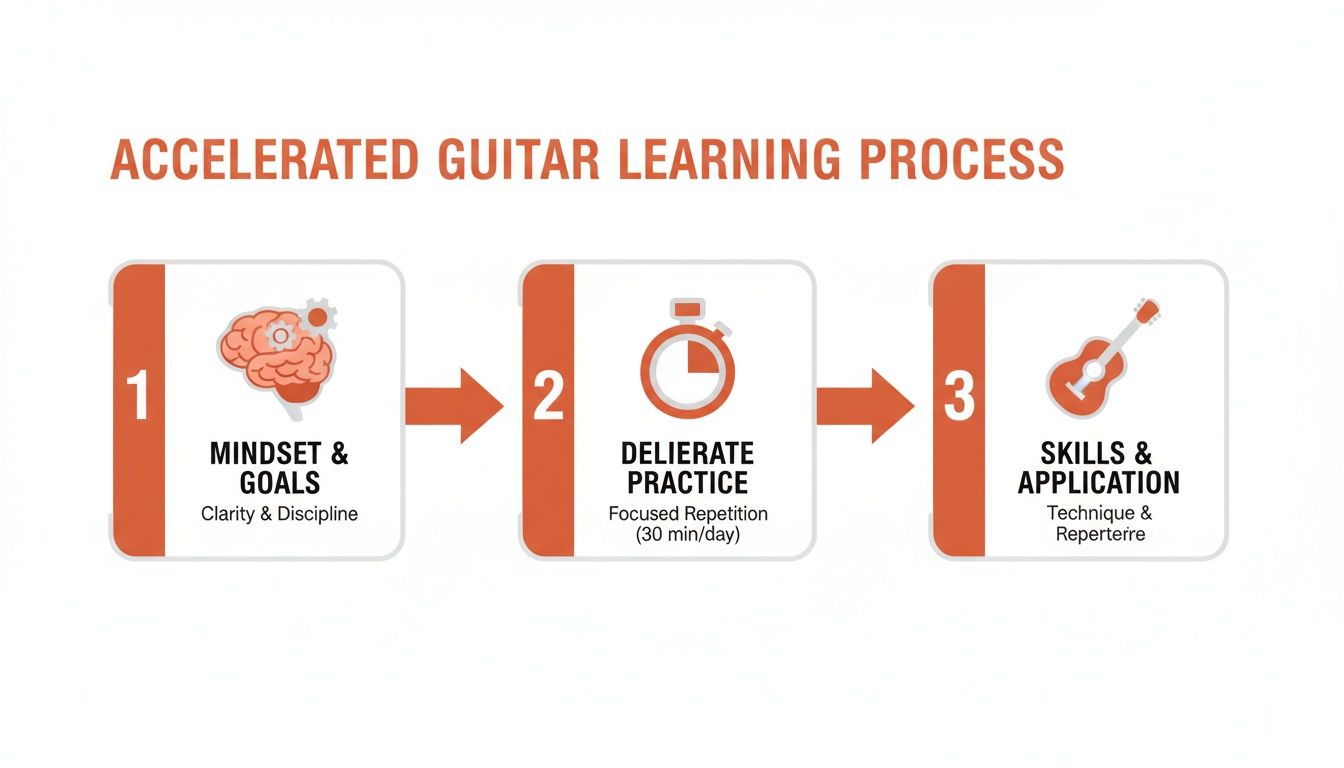
This flowchart nails the process. It's a three-stage journey: get your head in the right space, lock in on focused practice, and then immediately apply what you've learned.
The Four Pillars of an Effective Session
A killer practice routine is balanced across four critical areas. Hitting each one every day, even for just a few minutes, ensures you grow as a complete musician and avoid those frustrating plateaus down the road.
- Dexterity and Technique: This is just physical conditioning for your fingers. These exercises build the strength, independence, and clean precision you need to play well.
- Rhythm and Timing: This is the absolute heartbeat of your music. Working with a metronome is non-negotiable; it forges your internal clock, making everything you play sound solid and professional.
- Musicality (Theory and Ear Training): This is what connects your hands to your brain. A little theory and ear training helps you understand why things sound good and, eventually, play what you hear in your head.
- Application (Songs and Riffs): This is the fun part where it all comes together. Taking new skills and using them in real music is what makes practice feel rewarding and cements what you've learned.
When you touch on each of these pillars in every session, you create a powerful synergy. Your technique gets better, which makes playing songs easier. Your timing improves, which makes everything you play sound more musical. It all feeds itself.
Your First Month's Weekly Practice Plan
Here's a concrete, actionable schedule to get you started. This plan lays out a 40-minute daily routine that systematically builds your foundation. The only rule? Be consistent. Aim to stick with this at least five days a week.
| Week | Technique (10 mins) | Timing/Rhythm (10 mins) | Theory/Ear Training (5 mins) | Song Application (15 mins) |
|---|---|---|---|---|
| Week 1 | Chromatic "spider walk" exercise (frets 1-4) at 60 BPM | Strum G, C, D chords with a metronome—one downstroke per beat. | Use an ear training app to identify if a second note is higher or lower. | Work on the verse of a simple three-chord song (e.g., "Horse with No Name"). |
| Week 2 | Increase spider walk to 70 BPM. Add alternate picking. | Practice down-up strumming on open chords at 60 BPM (1 & 2 & 3 & 4 &). | Identify major vs. minor chords by ear. Play G major then G minor to hear the difference. | Learn the chorus of your song and connect it to the verse. |
| Week 3 | Introduce a simple pentatonic scale pattern. Play it up and down at 60 BPM. | Strum a common pattern (D, DU, U, DU) over chord changes. | Hum a simple melody ("Twinkle, Twinkle") and find the notes on one string. | Focus on smoothing out the chord transitions in your song. Aim for clean changes. |
| Week 4 | Spider walk at 80 BPM. Focus on keeping your fingers close to the strings. | Play a D-A-G-A chord progression, changing on each beat at 80 BPM. | Play the notes of a C major chord (C-E-G) and identify them by ear using an app. | Play the entire song through from start to finish, even if it's not perfect yet. |
This structure gives you balance. You're not just drilling scales mindlessly, and you're not just fumbling through songs. Every single day, you're working on the building blocks and applying them to music you actually care about. That's how you build real, usable skills fast.
Leveraging Technology to Maximize Practice Efficiency
Look, the tools available to modern guitarists are borderline insane compared to what was available even 20 years ago. Ignoring these resources is like insisting on using a flip phone when everyone else has a smartphone. These aren't shortcuts; they're power-ups.
The right apps and tools can compress months of trial-and-error into a few focused weeks. Think of these as cheat codes for your guitar journey.
- Metronomes and Drum Apps: You need a steady pulse. Period. Free options like Soundbrenner or Time Guru don't just keep time; they can make the metronome drop beats randomly, forcing you to develop your internal clock. It's a brutal but wildly effective way to stay on tempo without over-relying on external clicks.
- Slow-Down Software: Apps like Transcribe! or Amazing Slow Downer let you slow down songs to half-speed without changing the pitch. This is how you learn that super-fast solo or that tricky rhythm part without frustration. Just slow it down, nail each note, then speed it back up gradually. This is the secret sauce for learning complex passages quickly.
- Recording Tools: Record yourself. Seriously. Your phone's voice memo is enough. Listening back to your practice is like having a brutally honest coach who'll tell you exactly where you're messing up. Your perception of your own playing in the moment is always wildly off.
- Online Lesson Platforms: A structured course from a pro is invaluable. Platforms like TrueFire or JustinGuitar give you a clear curriculum, backing tracks, and the insight of people who've been teaching this stuff for decades. It cuts through the YouTube rabbit hole and gives you a proven path.
Using these tools isn't about replacing your teacher or taking the easy way out. It's about working smarter, not just harder. These resources give you instant feedback and clarity that would've taken years to figure out on your own.
Overcoming Plateaus and Staying Motivated
Here's a hard truth: at some point, you're going to feel stuck. It might happen in the first month, or after a few years, but it's coming. A plateau is just a sign that your current approach has maxed out its usefulness. Your brain has learned what you've been practicing, and now it's bored. The solution? Deliberately inject some challenge back into your routine.
The guitarists who make it past the beginner phase aren't the ones who never feel stuck; they're the ones who know how to shake things up when the momentum stalls. They're the ones who treat obstacles as puzzles, not dead ends.
Tackling the Most Common Frustrations Head-On
Every guitarist hits the same roadblocks. The difference between the ones who quit and the ones who push through is pretty simple: they expect these problems and have a game plan to deal with them.
- Sore Fingers and Weak Hands: This is the first boss battle. Your fingertips just aren't used to pressing down on steel strings. The answer is simple: consistent, short practice sessions. Don't play until it's agonizing. Play until it's uncomfortable, then stop for the day. That's how you build calluses. You can also work on grip strength away from the guitar by squeezing a stress ball.
- Clumsy, Slow Chord Changes: This is where rhythm goes to die for most beginners. The secret is to isolate the movement itself. Forget strumming for a minute. Just practice switching between two chords, like G and C, over and over. Focus entirely on your fretting hand's economy of motion. You want the movement to be so small and efficient that it becomes automatic.
- Annoying Fret Buzz: That buzzing sound can make you want to throw your guitar out the window. It's almost always caused by one of two things: your finger is too far back from the fret wire, or you aren't pressing down hard enough. Aim to place your fingertip just behind the fret, and make sure you're using the very tip of your finger, not the fleshy pad.
A plateau isn't a sign that you've reached your limit. It's a sign that you're ready to learn something new. It's a signal to change your approach, not to give up.
Setting Micro-Goals to Build Momentum
The goal "get better at guitar" is a recipe for failure because it's too vague. Your brain doesn't know what to do with it. If you really want to learn guitar faster, you need small, specific, and measurable targets. This creates a chain reaction of small wins that keeps you motivated.
This approach shifts your focus from some fuzzy, far-off destination to a clear, immediate action you can take right now.
From Vague to Actionable Goals
| Instead Of This... | Try This Specific Micro-Goal... |
|---|---|
| "I want to get better at chords." | "I will change between G and C cleanly 10 times in a row at 60 BPM." |
| "I need to learn my scales." | "I will play the A minor pentatonic scale up and down without mistakes." |
| "My rhythm is sloppy." | "I will strum a simple D-DU-U-DU pattern on one chord for two full minutes with a metronome, without losing the beat." |
Every time you nail one of these micro-goals, you get a little dopamine hit that makes you want to tackle the next one. This is how you build an unstoppable habit. This kind of structured, guided practice is at the heart of what makes online learning platforms so effective. If you want to see it in action, a TrueFire All Access Trial is a great way to experience it firsthand.
Your Path Forward to Playing with Confidence
You now have the strategies, the mindset, and the tools to learn guitar faster than you ever thought possible. The whole journey from fumbling with your first chord to playing with real confidence is built on smart, consistent work—not just the sheer number of hours you log. True speed comes from efficiency, not force.
Let's quickly run through the big ideas that will keep you on the right track:
- Prioritize consistent, focused practice over long, meandering sessions. Trust me, a targeted 30 minutes a day is way more powerful than two unfocused hours on a Saturday.
- Actively work on your weaknesses instead of just noodling on things you already play well. This is where the real growth happens.
- Use modern tools to your advantage. A metronome, slow-down software, and recording yourself are non-negotiable for getting good, fast.
Turning Knowledge into Action
When you start applying these principles, you create this awesome feedback loop where seeing tangible progress fuels your motivation, making it that much easier to pick up the guitar each day. You've learned how to bust through the plateaus where 90% of beginners quit by setting tiny, achievable goals and tackling those common frustrations head-on.
The most important thing to remember is that learning is just a process of small, daily wins. Celebrate your ability to finally play a chord change cleanly, to nail a riff at a new tempo, or to hear a melody and actually find it on the fretboard. Those moments are huge.
If you're serious about speeding up your journey, a structured learning platform can be an absolute game-changer, giving you a clear path to follow. A resource like TrueFire gives you access to a massive library of lessons from world-class instructors covering pretty much every style and technique you can imagine.
Ready to stop feeling stuck and start truly playing? You can explore thousands of guided lessons and see what it's all about with a TrueFire All Access Trial.
Got Questions About Learning Guitar Faster?
You're not alone. When you're fired up about making real, noticeable progress on the guitar, a lot of questions pop up. Let's tackle some of the most common ones I hear from students who are serious about speeding up their learning curve.
How Long Should I Practice Each Day?
This is the classic question, but the answer isn't what most people expect. It's not about logging more hours; it's about consistency.
A focused 20-30 minute session, six days a week, will absolutely smoke a single three-hour marathon on a Sunday. Why? Because shorter, daily sessions are perfect for building muscle memory and calluses without leading to burnout. The goal is to get in there, do the work, and get out.
What Is the Single Biggest Mistake I Should Avoid?
Easy. Practicing without a plan. Just picking up the guitar and noodling around with songs you already know feels good, but it's a fast track to a plateau. You end up just polishing what you're already good at while your weaknesses get completely ignored.
The players who improve the fastest are the ones who systematically find their weak points and attack them head-on. If your chord changes are sloppy, dedicate ten minutes just to that. If your rhythm is shaky, it's time to make friends with a metronome. Purposeful practice is the ultimate shortcut.
Do I Really Need to Learn Music Theory?
Look, you don't need a degree from Berklee, but completely ignoring theory is like trying to navigate a new city without a map. It's a huge mistake.
Learning just a few basic concepts—like how chords in a key relate to each other—gives you that mental map of the fretboard. It helps you understand why things sound good together, which makes everything from learning songs by ear to writing your own stuff happen so much faster. A little theory goes a very long way.
Ready to stop guessing and start following a structured path laid out by the pros? TrueFire has thousands of lessons from world-class instructors, plus all the tools you need to put these ideas into practice. Ditch the aimless noodling and start building real skills today with a TrueFire All Access Trial.