So, you've decided to learn guitar. Welcome. This is easily one of the most rewarding things you can do, and I'm here to make sure you get started on the right foot, with the confidence and tools you need for what I hope becomes a lifelong passion.
As an educator who has guided thousands of players, I've learned that the first real challenge is learning how to learn. It all boils down to two things: finding a clear, step-by-step path and actually showing up to practice. The most effective way I've seen countless new players succeed is by using a structured online platform—something that guides you from just holding the instrument to playing your first real songs.

That initial learning curve can feel steep, I get it. But the good news is that the game has completely changed for beginners. Gone are the days of trying to decipher confusing old lesson books or shelling out for expensive weekly lessons that move at someone else's pace.
Today, millions of new guitarists are starting their journey right from their living rooms, using high-quality online learning platforms. I'm not talking about randomly clicking through videos on YouTube; I'm talking about following a real curriculum designed by expert educators who know exactly what you need to learn and when.
Your motivation is everything. Whether you dream of playing songs around a campfire, writing your own tunes, or shredding like your heroes, that spark is your fuel. But inspiration without a roadmap almost always leads to frustration. Eventually, most people quit.
This is exactly where a well-designed digital platform comes in. It provides the structure that keeps you from getting lost. It takes the massive, intimidating goal of "learning guitar" and breaks it down into small, manageable wins. Think of it less like a textbook and more like a personal coach walking you through every single step.
The best platforms are built to solve the biggest problems beginners face:
A huge misconception is that learning online is somehow less effective or more isolating. The reality? A guided digital curriculum often provides more focused, on-demand instruction than a traditional 30-minute lesson once a week. You can rewind, re-watch, and drill a single concept until it finally clicks.
To make sure you get off to a solid start, here’s a quick checklist of the absolute essentials. Getting these right from day one will save you a ton of frustration down the road.
This table sums up the foundational steps every new player should take.
| Action Item | Why It's Important | Recommended Tool or Method |
|---|---|---|
| Get a Proper Setup | A guitar with high action (strings far from the fretboard) is physically hard to play and will hurt your fingers. A professional setup makes it much easier. | Take your guitar to a local music shop for a professional setup. It's a small investment that pays off big time. |
| Learn to Tune | Playing an out-of-tune guitar sounds terrible and trains your ear incorrectly. Tuning should be the very first thing you do every time you play. | A clip-on electronic tuner (like a Snark) or a free tuning app on your phone (like Fender Tune or GuitarTuna). |
| Master Good Posture | Slouching or holding the guitar awkwardly leads to bad habits, physical discomfort, and makes playing harder than it needs to be. | Sit up straight in a chair without arms. Use a strap, even when sitting, to keep the guitar in a consistent, comfortable position. |
| Follow a Curriculum | Random videos create huge gaps in your knowledge. A structured learning path ensures you build skills logically, one on top of the other. | A dedicated online platform like TrueFire provides a step-by-step beginner learning path. |
Completing these simple actions sets a solid foundation, allowing you to focus on what really matters: playing music.
If you're just starting out, you're in very good company. A landmark study by Fender found that around 16 million people in the U.S. started learning guitar over just a two-year period. What's really interesting is that a whopping 72% of these new players were between 13 and 34, proving this is a digitally-native generation of musicians.
The data confirms that the modern approach is overwhelmingly online. The same analysis showed that 48% of beginners use online guitar content every week. This is precisely why a structured, video-based learning path has become the new standard—it gives you a focused, reliable alternative to trying to piece it all together yourself.
For more essential advice, check out our guide on 10 crucial tips for starting guitar.
With a good guitar in your hands and a proven learning path in front of you, you're ready to turn that initial excitement into real skill and muscle memory. A great way to see how this works is to explore a TrueFire All Access Trial and experience a structured curriculum firsthand.
Alright, you've got the right mindset, you know what to expect, and now it's time to actually make some noise. This is where we build your physical relationship with the instrument. How you hold it, how you fret a note, how you strike the strings—these are the things that separate frustrating noise from actual music.
Getting these fundamentals right from day one is everything. Why? Because bad habits are a nightmare to unlearn later. Our goal here is comfort, control, and creating a clean, clear sound right from the start.
Before you play a single note, you have to get comfortable. Grab a chair without arms, sit up straight, and rest the guitar's waist on your right thigh (assuming you're right-handed). You want the neck angled up slightly. This gives your fretting hand easy access to the whole fretboard without having to crane your wrist into some awkward, painful position.
Now, the pick. So many beginners death-grip the pick with their whole fist, killing any chance of fluid movement. Don't do that. Instead, make a loose fist, rest the pick on the side of your index finger, and bring your thumb down on top. Just a little bit of the tip should be showing. This grip is the sweet spot between control and flexibility.
As a longtime instructor, I can tell you this: your posture and pick grip are the two things that will either accelerate or hinder your progress most in the first month. Fix them now, and you'll avoid months of frustration trying to figure out why your playing sounds clunky or your wrist hurts.
It's like learning to type. Proper hand position feels weird at first, but it's the only way to eventually get fast and accurate. For now, just focus on relaxed, deliberate motion.
You don't need to be a guitar builder, but knowing your way around the instrument makes following lessons way easier. It demystifies the whole thing.
Here are the parts that will come up constantly in tutorials:
Get familiar with these terms. It'll make you feel less like a stranger in a strange land when you're watching a lesson.
These next two things are completely non-negotiable. You have to learn them. Now.
First, tuning your guitar. An out-of-tune guitar is the fastest way to get discouraged because absolutely nothing you play will sound right. Buy a cheap clip-on tuner or download a free app like GuitarTuna. Tune your guitar every single time you pick it up. Make it a habit.
Second, reading tablature (TAB). Guitar TAB is a simple map of the guitar. It's six lines representing the six strings, with numbers on them telling you which fret to press. It’s an incredibly intuitive system that lets you start playing pieces of real songs almost immediately, way before you ever need to think about standard music notation. Seriously, understanding TAB is one of the most important first steps in learning how to play guitar for beginners.
Time to make some actual music. Chords are the foundation of almost every song you’ve ever heard. We're starting with the holy trinity of beginner chords: G Major, C Major, and D Major. Just these three unlock thousands of songs.
Here’s how to press them down:
The biggest challenge at first is making every note ring out clearly. You'll probably find that one finger is accidentally touching and muting the string next to it. The fix is to arch your fingers like you're holding a ball and press down with your very fingertips, not the flat pads. This takes practice to build muscle memory, so be patient with yourself.
For more guidance on these early steps, check out this helpful overview covering the first things beginners should learn on guitar.
As you work on these, go slow. Slow, deliberate movements are what build a solid foundation. If you want expert guidance to make sure you're getting it right, a TrueFire All Access Trial has step-by-step video lessons that are perfect for building good habits from your very first chord.
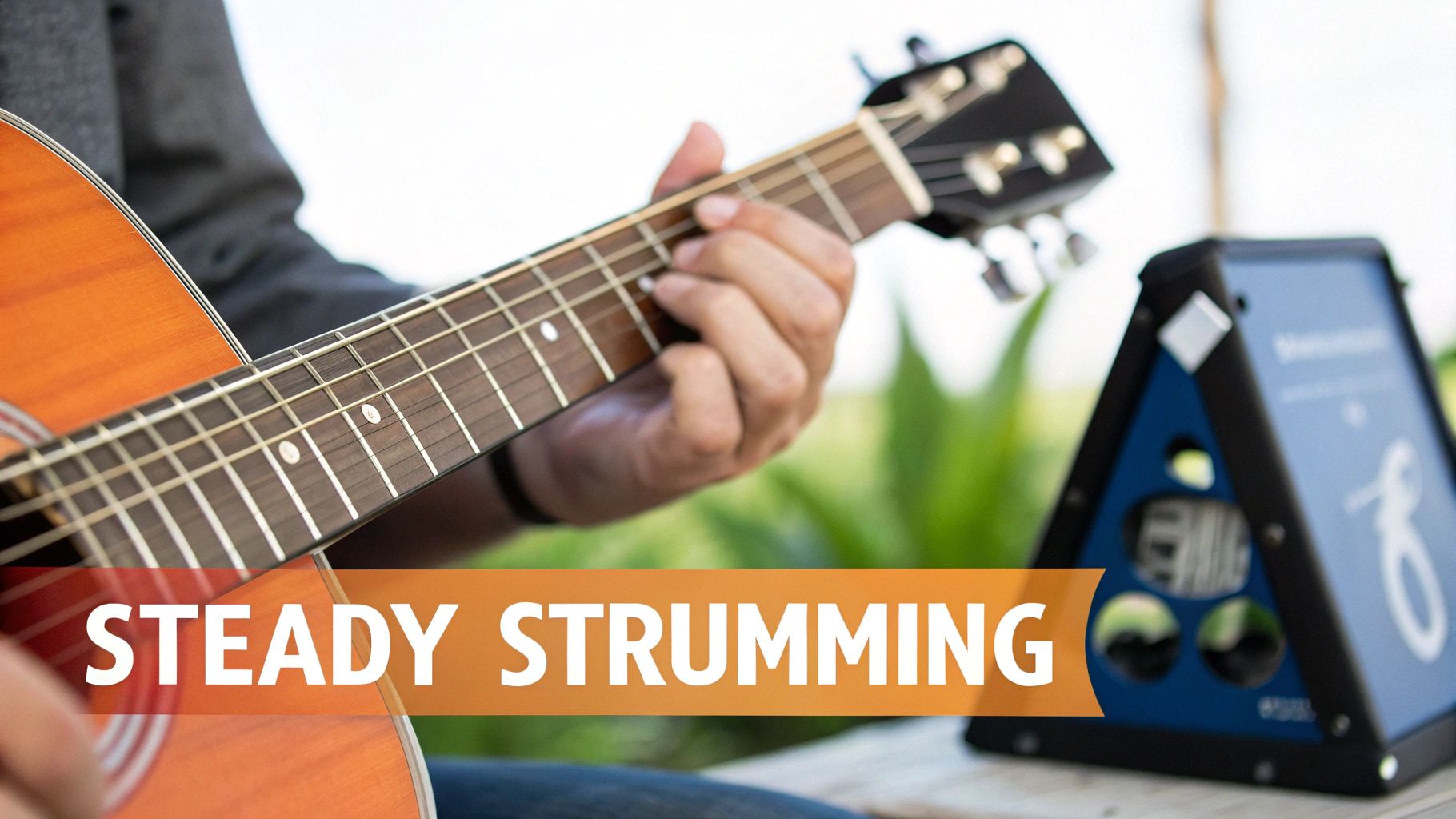
Knowing how to form a G, C, and D chord is a huge milestone, but it's only half the battle. Now we need to make them sound like actual music, and that all comes down to rhythm. Think of strumming as the engine that drives your playing, transforming those static hand shapes into the songs you love.
Without a steady rhythm, even perfectly fretted chords will sound disjointed and clunky. The real goal here is to develop a consistent, relaxed strumming motion that feels as natural as tapping your foot to a beat. This is where you start building your internal clock—a skill that’s honestly more important than knowing dozens of chords.
Before you even think about complex patterns, let's just build a steady hand. Grab your pick between your thumb and index finger, but keep your wrist and forearm loose. The motion should flow from a mix of your wrist and elbow, not from throwing your whole arm at the guitar.
Try fretting a simple G chord and just strum down across all the strings once per beat. It helps to count out loud: "One, two, three, four." Your strum should land exactly as you say each number. It will feel robotic at first, and that's okay. This is the bedrock of good timing.
The single biggest mistake I see beginners make is tensing up their strumming arm. They death-grip the pick and lock their wrist, which creates a harsh, choppy sound. Stay relaxed—the goal is fluidity, not force.
Once that feels somewhat comfortable, try changing chords. Play your G chord for four beats, then switch to a C for four beats, all while keeping that "one, two, three, four" count going. The key is to not stop strumming, even if your chord change is a little slow or messy. Right now, timing is way more important than perfect accuracy.
Got the down strums feeling steady? Great. Time to add the up strum. This is what fills the gaps between the main beats and makes your rhythm sound so much more fluid and musical. The up strum happens on the "&" between each number as you count: "One & Two & Three & Four &".
The motion is just the reverse of a down strum, but it should feel much lighter. You don't need to bash every string on the way up; often, just brushing the top three or four is enough to add that perfect rhythmic texture.
A fantastic little exercise is to simply alternate:
Keep that simple "Down-Up-Down-Up" pattern going while holding one chord. This simple drill trains your hand to maintain constant motion, which is the real secret to smooth, professional-sounding rhythm playing.
Okay, let's put these ideas together into one of the most common strumming patterns in all of popular music. I guarantee you've heard this in countless songs. The pattern is Down, Down-Up, Up, Down-Up.
Let's break that down with the count:
This pattern will feel awkward at first, especially the part where your hand moves down on beat 3 without actually hitting the strings. That "ghost strum" is crucial for keeping your timing locked in. For a deeper dive, exploring a variety of beginner strumming patterns will give you a much more versatile rhythmic toolbox.
Your absolute best friend for mastering rhythm is a metronome. Using one from day one is the fastest way to develop a rock-solid sense of time. Start slow—maybe around 60 beats per minute (BPM)—and only speed up once you can play the pattern perfectly and consistently.
Learning how to learn guitar means focusing on rhythm just as much as on chords. This is what separates someone who knows a few shapes from someone who can actually play a song. To see these concepts in action with expert guidance, a TrueFire All Access Trial offers thousands of video lessons covering everything from your very first strum to advanced rhythmic techniques.
So, you've got your first chords and a basic strumming pattern down. That's huge! You now have the raw materials to actually make music. But here’s the thing that separates the players who make it from those who don't: it isn't fancy gear or some innate talent. It's consistency.
This is where we build a practice routine that actually fits your life, keeps you going, and turns this early effort into something you'll love for years.
The biggest hurdle for any new player is just pushing through that initial friction—sore fingers, clunky chord changes, all of it. A widely cited study commissioned by Fender found that up to 90% of new guitar players quit in the first year. Only a stubborn 10% stick with it. The good news? With a smarter approach to practice, it's easier than ever to be in that 10%. Want to dive deeper? Check out the discussion about how many people play guitar on the JustinGuitar Community.
Forget the myth that you need to lock yourself away for hours every day. For a beginner, a focused 15-20 minutes of daily practice will do more for you than a single, two-hour slog on a Saturday. Your brain and muscles build skills through frequent repetition, not occasional marathons.
The goal isn't to be perfect tomorrow. It's just to be a tiny bit better than you were yesterday. Shifting your mindset this way is a game-changer. It takes the pressure off and turns practice into a low-stakes habit you can actually repeat.
A little structure goes a long way. It keeps you from just noodling on the one chord you know well and ensures you’re building all the essential skills. Even a short session needs balance. Don't just drill chords; make time for rhythm, smooth transitions, and playing actual music.
To get you started, here are a few sample practice schedules. Don't overthink it—just pick the one that feels doable for you right now. You can always add more time later on.
These structured plans are designed for different time commitments to ensure you're developing your skills in a balanced way.
| Time Allotment | 15-Minute Session | 30-Minute Session | 60-Minute Session |
|---|---|---|---|
| Warm-Up | 3 mins: Tuning & Warm-up (Simple scale or finger exercise) | 5 mins: Tuning & Warm-up (Scales and finger dexterity drills) | 10 mins: Tuning & Warm-up (Scales, finger exercises, and ear training) |
| Technique | 5 mins: Chord Practice (Focus on one difficult chord change, e.g., G to C) | 10 mins: Chord Changes (Practice transitioning between 3-4 chords using a metronome) | 15 mins: Chord & Rhythm (Drill multiple chord progressions with varied strumming patterns) |
| Application | 5 mins: Song Work (Play the verse of a simple song using your practiced chords) | 10 mins: Song Application (Work on a full verse and chorus of a song) | 20 mins: Song Mastery (Practice a full song, focusing on smooth transitions and dynamics) |
| Fun/Review | 2 mins: Fun & Review (Jam freely or play something you enjoy) | 5 mins: Fun & Improvisation (Jam over a backing track or try creating a simple melody) | 15 mins: Theory & Fun (Learn a new scale or concept, then apply it in a creative jam) |
Even if you only have 15 minutes, following a plan like this builds discipline and gives you those small, measurable wins that keep you motivated for the long haul.
A structured practice session, no matter how short, is a promise to yourself that you're taking this seriously. It builds discipline and provides the small, measurable wins that are essential for long-term motivation.
Let’s be real: motivation comes and goes. Habit is what carries you through on the days you just don't feel like it. The trick is to make practicing so easy and rewarding that it becomes second nature.
Here are a few simple mind tricks to keep yourself on track:
Building a solid routine is one of the smartest things you can do. For more great ideas, check out our article on 5 smart practice tips for guitar players.
At the end of the day, consistency is your superpower. By building a smart, sustainable habit, you're not just learning chords; you're becoming a musician.
So, you've put in the work. You’re getting comfortable with some chords, your rhythm is starting to feel solid, and you’ve even managed to stick to a practice routine. That's a huge win. Now, let's talk about what comes next—turning those initial sparks of progress into a lifelong fire.
This is where you start setting meaningful goals that actually keep you excited to pick up the guitar every day. Your journey from here on out is all about milestones. These aren't just fuzzy ideas; they're concrete achievements that show you, without a doubt, that you're getting better.
Instead of a vague goal like "I want to get good at guitar," you need to aim for tangible wins. It's a much smarter way to stay motivated and see real, measurable progress.
Here are three powerful milestones to set your sights on right now:
Nailing these goals is a game-changer. You stop being someone who is practicing guitar and become someone who is playing music.
Once you start hitting those first milestones, the path forward can get a little hazy. What should you learn next? This is exactly why following a structured curriculum is so important. Instead of just grabbing random licks and tricks from the internet, a well-designed learning path guides you logically from one skill to the next.
This simple loop is the secret to making practice an unbreakable habit.
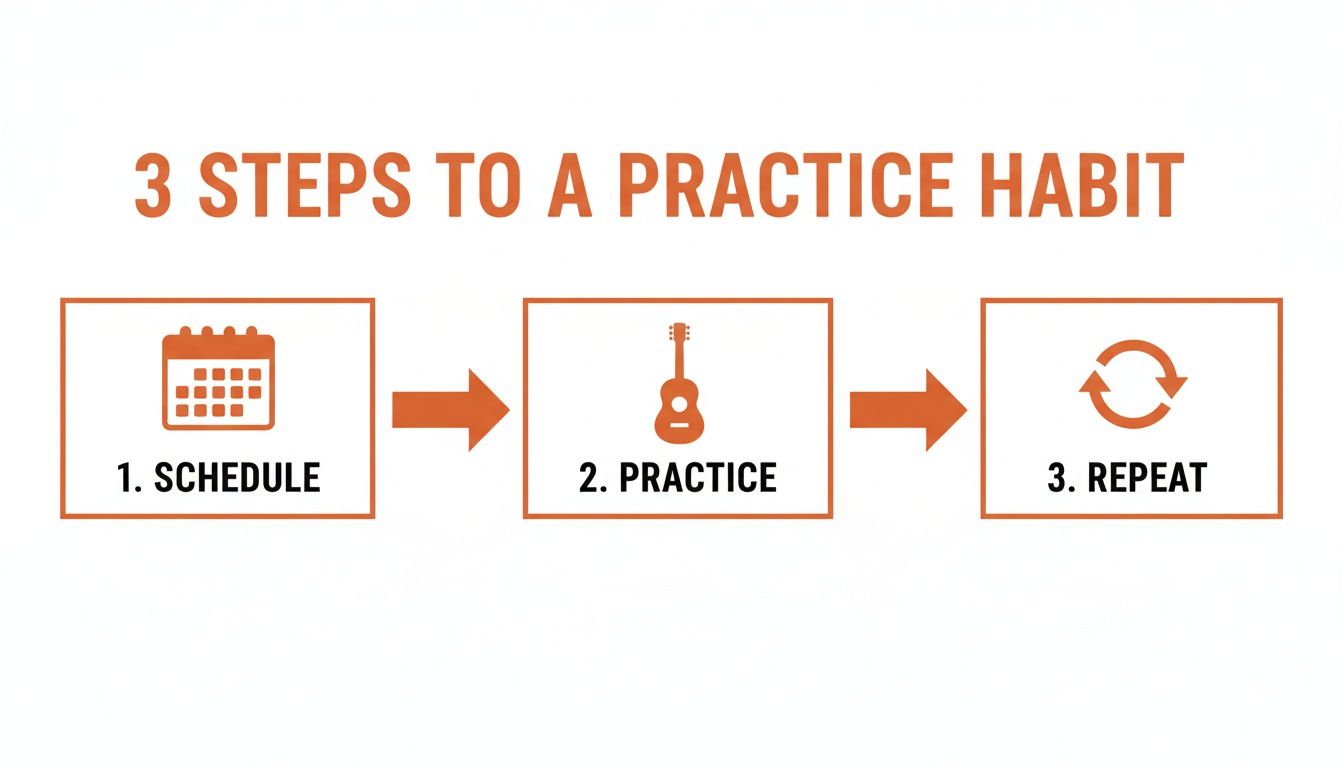
It’s not complicated. Success is born from the simple, repeatable cycle of scheduling time, doing the work, and then doing it again tomorrow.
Platforms like TrueFire offer Learning Paths built specifically for this. Whether you want to dive into blues, rock, or acoustic fingerstyle, these paths give you a complete, step-by-step roadmap designed by world-class players. You’ll never have to waste time wondering what to practice next.
As a longtime instructor, I've seen it time and time again: students who commit to a structured program just get better, faster. It takes the guesswork out of the equation and makes sure you're building skills on a solid foundation, which is the best defense against the frustration that makes so many beginners quit.
This approach lines up with how most people learn today. In fact, 65% of new players say their main motivation is personal enjoyment, and they're leaning on digital tools to get there. Things like slow-motion playback and integrated jam tracks make the tough spots easier and the whole process way less stressful.
Ultimately, the goal is to shift practice from a daily chore to a creative obsession. A big piece of that puzzle is finding the right teacher or platform that clicks with your style. If you need some help, check out our guide on how to find the right guitar teacher for you.
As you get started, you're going to have a million questions. That's totally normal. Every single guitarist who ever picked up the instrument has been right where you are now. Let's tackle some of the most common ones I hear from new players to clear things up and keep you on the right track.
This is always the first question, and the honest answer is that you never truly "finish" learning. That’s the fun of it! But you can get to a point where you feel like you can actually play much faster than you might think.
With some consistent practice—I’m talking a solid 20-30 minutes, maybe 3 to 5 times a week—most beginners can get their basic chords down, strum a few simple songs, and feel pretty comfortable holding the guitar in about 3 to 6 months.
The real key isn't locking yourself in a room for hours on a Saturday. It’s consistency. A little bit of focused time each day goes a long, long way. Following a good, structured learning path ensures you're not wasting that time, which can seriously speed up your progress.
Simple answer: The best guitar to start with is the one that makes you want to play music you're obsessed with. There's no right or wrong choice here, and the core skills—chords, scales, timing—are the same on both.
But there are some differences to consider:
Here's my advice: If you dream of playing classic rock riffs and solos, grab an electric. If you're more into folk, pop, or singer-songwriter stuff, an acoustic is probably calling your name. Go with the one that gets you excited.
As a teacher, I tell every new student the same thing: The "perfect" beginner guitar is a myth. The perfect one for you is the one you can't wait to pick up and play. Don't get stuck on the decision—just get one in your hands and make some noise.
Yes, one hundred percent. Sore fingertips are a rite of passage for every guitarist. Think of it as a good sign—it means you're putting in the time!
Your fingers are building up calluses, which are basically little tough patches of skin that will protect them. Soon enough, you'll be able to play for hours without feeling a thing.
To get through this phase, keep your practice sessions short and sweet, maybe 15-20 minutes at a time. Also, make sure your guitar's "action" (the height of the strings from the fretboard) isn't too high. High action makes you press down way harder than you need to. The soreness will fade in a couple of weeks, I promise.
If you take only one thing away from this, let it be this: consistency is everything.
Practicing for just 15 minutes every single day is infinitely more powerful than one marathon session once a week. It builds muscle memory and keeps the concepts fresh in your mind.
After that, the next most important thing is rhythm. I'm serious. A guitarist who only knows three chords but has rock-solid timing will always sound better than someone who knows a hundred chords but can't stay in the pocket. Get a metronome, use it from day one, and focus on making your strumming feel smooth and confident.
---
Ready to fast-track your progress and get clear, expert answers to every question you'll have? With TrueFire, you get a massive library of step-by-step lessons from world-class instructors. Start your TrueFire All Access Trial and get all the tools you need to sound like the guitarist you want to be.
