Ever feel stuck in a loop, endlessly scrolling through tabs just to learn the next few notes of a song? It’s a common trap for guitar players. While tabs are a fantastic starting point, relying on them forever is like using a phrasebook to speak a new language—you can repeat what you see, but you can’t really hold a conversation.
Learning to play by ear is the skill that breaks you out of that cycle for good.
The big myth about playing by ear is that it's some innate talent you’re either born with or not. As a music educator, I can tell you that couldn't be further from the truth. It's a skill you can build, just like learning your scales or mastering a barre chord.
This process fundamentally changes your relationship with the guitar. You stop being a passive follower of instructions and become an active participant in the music. Imagine hearing a cool riff on the radio and being able to pick it out on your fretboard within minutes. That’s the freedom we’re talking about.
Learning songs by ear is a systematic process, and it all boils down to four foundational pillars:
By training your ears to recognize these elements, you start to hear music in a completely different way. You’ll begin to identify common chord progressions, predict where a melody is headed, and lock into a groove more intuitively. For us guitarists, this means your fingers will start to find the right notes on the fretboard almost on their own.
Here’s a quick look at how learning to play by ear directly impacts your guitar playing for the better.
| Benefit | Impact on Your Guitar Playing |
|---|---|
| Increased Speed & Efficiency | Learn songs much faster without waiting for tabs or tutorials to be published. |
| Improved Improvisation | Confidently create solos and jam with others because you can hear and react in real-time. |
| Enhanced Songwriting | Easily translate the musical ideas in your head onto the fretboard, making writing feel natural. |
| Deeper Musical Understanding | Move beyond memorizing shapes and start understanding why certain chords and notes work together. |
| Greater Fretboard Freedom | Break free from relying on specific positions and patterns, navigating the entire neck with confidence. |
Essentially, you build a stronger connection between what you hear and what you play.
The goal isn't just to replicate songs but to internalize the musical logic behind them. When you can do that, you unlock the ability to improvise with confidence, write your own music, and jam with other musicians seamlessly.
Ultimately, learning by ear is about developing true musical fluency. It deepens your connection to the instrument and helps you understand the why behind the music theory you’ve already spent time learning. You’ll find that everything from your phrasing to your sense of timing gets a major boost.
It all starts when you learn how to listen with intent and translate those sounds to your guitar.
Throughout this guide, we'll break down practical, guitar-centric exercises to build these skills from the ground up. This journey is one of the most rewarding you can take as a guitarist. Ready to get started?
Alright, let's get practical. If learning songs by ear is a workout for your musical muscles, this is your gym. We're starting with the heavy lifting first—training your ears to recognize the core components of music. For a guitarist, this isn't just some abstract theory; it's about connecting what you hear directly to the fretboard under your fingers.
The most fundamental skill you can develop is recognizing intervals, which are simply the distance between any two notes. Seriously, every riff, melody, and chord you've ever loved is just a collection of intervals. Learning to identify them is like learning the alphabet before you try to read a book.
The fastest way to get the sound of an interval stuck in your head is to connect it to a melody you already know by heart. This trick creates a powerful mental shortcut you can pull up instantly.
Here are a few common intervals and the iconic tunes that kick off with them—perfect anchors for a guitarist:
To practice, just play a root note—say, your open A string—and sing the first few notes of the song you've associated with an interval. Then, hunt for that second note on the fretboard. Before you know it, you’ll have built a rock-solid link between the sound and the shape on your guitar.
One of the biggest mistakes I see is players trying to memorize every single interval at once. Don't do that. Just focus on two or three at a time—like the Major Third and Perfect Fifth—until their sounds are completely unmistakable. A focused approach builds a much stronger and more permanent foundation.
Once intervals start to click, you can start tracing out simple melodies. Now, don't jump straight into transcribing an entire Steve Vai solo. Start with something you can hum, like a nursery rhyme or a basic vocal line from a pop song.
Here’s a simple process to get you going:
This method trains your ear to hear the relationship between notes, which is way more useful than having perfect pitch. It’s all about recognizing patterns and shapes, something we guitarists are already wired to do.
Harmony is just what happens when multiple notes are played at the same time. For us, that usually means chords. Learning to hear the difference between a major chord (bright, happy) and a minor chord (sad, mellow) is the first big step toward figuring out chord progressions by ear.
A fantastic way to start is by locking onto the bass line. When you're learning a song by ear, the bass player is your new best friend. Why? Because they almost always play the root note of the chord right on the downbeat.
Actionable Exercise: Hum the Bass Line
Once you’ve mapped out the bass notes, you’ve basically created a cheat sheet for the entire chord progression. If the bass is playing a G, odds are the chord is some kind of G—major, minor, or something else. From there, all you have to do is use your ear to figure out its quality. This approach makes the whole process so much simpler and gives you a solid harmonic road map to follow.
Building these aural skills takes time and patience, but it's hands-down the most rewarding investment you can make in your musicianship. Start with these foundational exercises, and you'll be well on your way.
So, you’ve started tuning your ears to the basic building blocks of music. Awesome. Now it's time to assemble those skills into a reliable system for figuring out songs by ear.
Having a repeatable workflow is what separates the pros from the frustrated amateurs. It’s not about following a rigid set of rules, but about having a game plan. This roadmap will guide you through any piece of music, whether it's a simple three-chord folk tune or a shred-heavy rock anthem.
This approach turns transcription from a wild guessing game into a logical, solvable puzzle. You'll lean on your core skills—identifying intervals, tracing melodies, and understanding harmony—in a structured way.
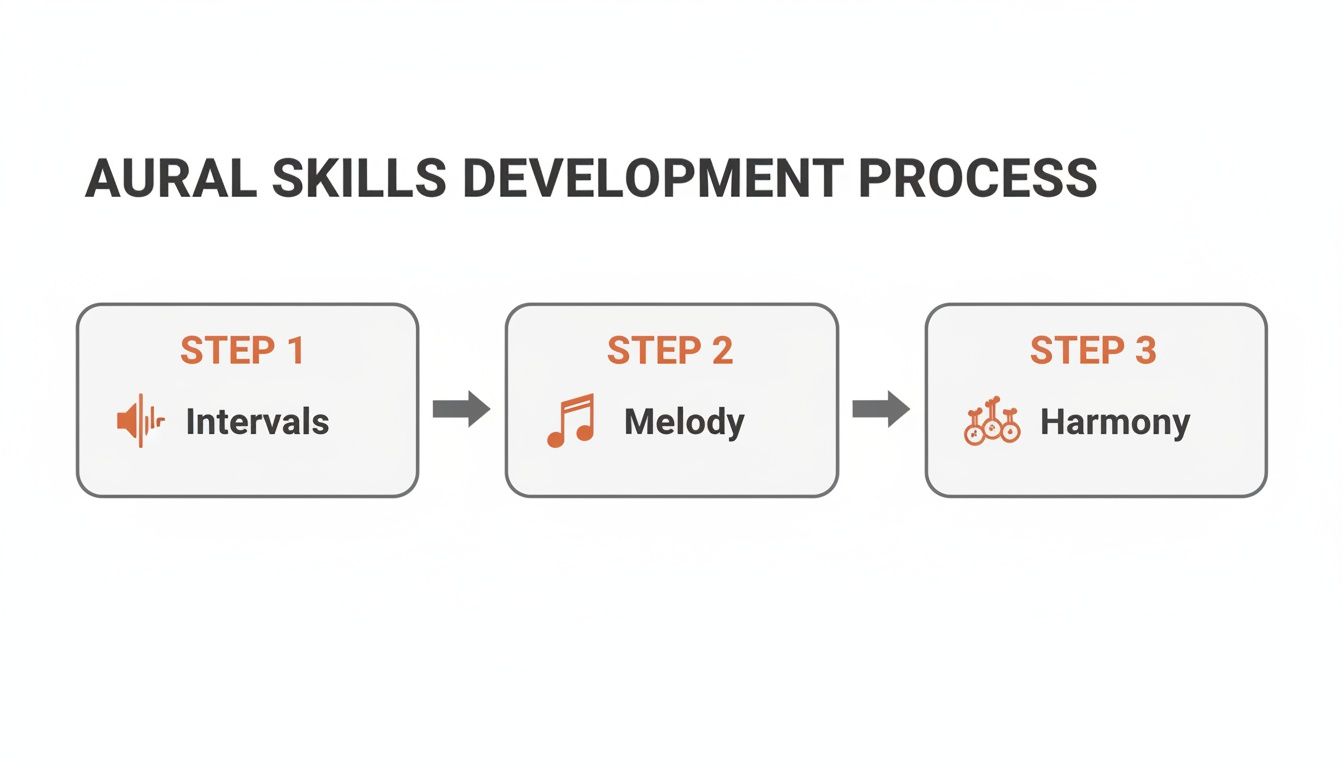
As you can see, mastering one skill, like nailing your intervals, feeds directly into the next, making it way easier to pick out a melody.
Before you even think about picking up your guitar, the most important first step is active listening. I’m not talking about having music on in the background; I mean really dissecting it. Throw on a good pair of headphones and listen to the track a couple of times with a clear mission.
Your first job is to map out the song's structure. Almost every song is built from a handful of sections. You just need to spot them.
Grab a notepad and sketch it out (e.g., Intro, Verse 1, Chorus, Verse 2, Chorus, Solo, Bridge, Chorus, Outro). This simple map keeps you from getting lost and gives you a clear plan of attack. You’ve just created your transcription roadmap.
With your map laid out, your next mission is to find the song's key, or what we call its tonal center. This is the note that feels like "home"—the place where the song feels totally resolved and at rest.
Here’s a great trick: hum the note that feels most stable, then hunt for it on your guitar's low E and A strings. Play that note along with the end of a chorus or the very last chord of the song. If it clicks and sounds complete, you've almost certainly found the root.
Knowing the key is a massive shortcut. It instantly narrows down the likely notes and chords, making the whole process way less intimidating.
Here's a piece of advice that will save you countless hours of frustration: start with the bass line. Think of the bass player as your secret guide to the song's harmony. More often than not, the bass outlines the root notes of the chords, giving you a solid foundation to build on.
Listen to a section, like the first verse, and tune everything else out except for the lowest notes. Hum that bass part, then find those notes on your guitar.
Once you have the root notes figured out, identifying the full chords becomes a simple process of elimination. If the bass is hanging on a C, you just have to figure out if the chord is C Major, C minor, or maybe a C7. This bottom-up approach is a total game-changer.
If you get stuck, remember that most pop and rock songs recycle the same handful of common chord progressions. Once your ear learns to recognize the sound of a I-IV-V or a vi-IV-I-V progression, you’ll start hearing them everywhere. This kind of pattern recognition is your ultimate cheat code.
Working by ear doesn't mean you have to do it the old-school way, wearing out the rewind button on a cassette player. Modern tools can make your life so much easier, especially when you're just starting.
The looping and slow-down features built into platforms like TrueFire are indispensable. If you're wrestling with a lightning-fast guitar solo or a tricky chord change, you don't have to guess.
Using these tools isn't cheating; it's smart training. They help you confirm what your ears are telling you, which builds both your confidence and your accuracy over time.
This systematic approach—map the structure, find the key, follow the bass, and use tools to help—is your repeatable formula for success. It builds your skills logically and turns a daunting task into a series of achievable steps.
Every guitarist trying to play by ear hits a wall sooner or later. It’s that frustrating moment when the sound you’re hearing on a record just doesn't seem to exist anywhere on your fretboard. This is a totally normal part of the process, but pushing through these roadblocks is what separates the players who develop a great ear from those who just give up.
Our challenges as guitar players are unique. Unlike a piano where every C note is the same, we have multiple spots to play the exact same pitch. This can make figuring out chord voicings and melodies especially tricky. Throw in bends, slides, and fast legato runs, and it’s easy to see why so many of us get stuck.
We’ve all been there. You’ve nailed the bass note and the basic progression, but there's this one chord that just sounds… wrong. You try a standard major shape, then a minor, but neither one is hitting the mark. This is where a systematic process of elimination becomes your best friend.
Here’s the approach I always take:
This isn't about wild guessing; it's about listening intently. Your ear will tell you when you're getting warmer. More often than not, that "impossible" chord is just a common shape with one added or altered note you weren't expecting.
Feeling steamrolled by a rapid-fire solo is another classic hurdle. The trick is to stop thinking of it as one long, intimidating blur of notes. You have to break it down into small, digestible musical phrases—just like breaking a long sentence down into individual words.
Use a tool with looping and slow-down features. Isolate just one or two seconds of the solo—that first little lick—and loop it over and over. Slow it down to 50% speed if you need to. Your goal isn't to learn the whole solo at once; it's to accurately figure out that one single phrase. Once you’ve got it, move on to the next one. Stitching these little pieces together is far more manageable than trying to swallow the entire solo whole.
A deep understanding of the fretboard is a massive help here. Knowing where notes are all over the neck will help you identify the most likely positions a guitarist would use for a particular phrase. To get this skill locked in, check out our guide on essential fretboard knowledge for guitar players.
So what about those sounds that don't have a clear pitch, like a string bend or a quick hammer-on? This is where your guitarist's intuition has to kick in.
This kind of detailed listening is a skill that only comes with practice. Interestingly, modern learning habits seem to favor this focused approach. Research into how musicians use digital tools found that many players gravitate toward shorter, more focused learning sessions, with one study noting that half of YouTube demonstration videos were under 15 minutes. Breaking down complex skills into smaller chunks just works.
Learning songs by ear is a journey, and every problem you hit has a solution. By using a logical approach and the right tools, you can systematically solve any musical puzzle that comes your way.
What separates the guitarists who develop a great ear from those who just wish they had one? It’s all about consistency. Building a practice plan you can actually stick to—and backing it up with the right tools—is way more effective than any marathon cram session.
Sure, your most important tools will always be your guitar and your own two ears. But let’s be real, a little modern tech can be a huge help.
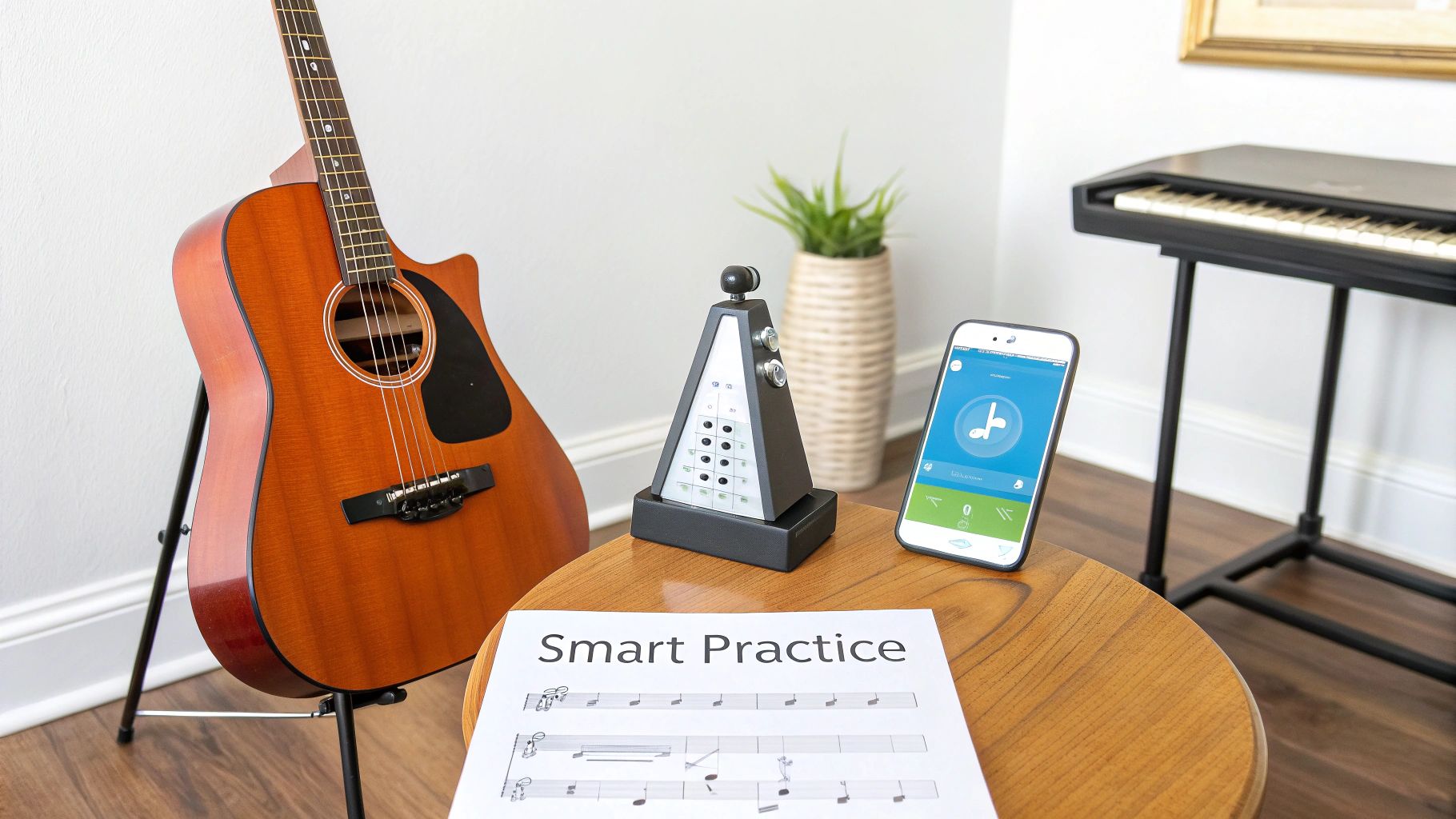
Digital tools that can slow down audio, loop specific sections, and shift the pitch are an absolute godsend for transcription. These are the kinds of features we built directly into the TrueFire platform because we know they turn a frustrating, lightning-fast solo into a series of clear, manageable notes you can actually figure out.
Listen, how you practice is way more important than how long you practice. Short, focused sessions are scientifically proven to be better for locking in new skills than cramming it all in once a week. Here's how to build a routine that fits your real life.
To get even more out of your time, think about using apps designed specifically for ear training. There are some great ones out there that are perfect for sharpening your skills on the go.
As you start spending more time in deep listening mode, you have to protect your hearing. This isn't just a minor point; it's a huge deal for musicians. The very headphones and speakers that help us learn can also cause permanent damage if we're not careful.
According to 2022 data from the World Health Organization, over 1 billion young people are at risk of permanent hearing loss from unsafe listening. A massive analysis found that 24% of people using personal audio devices are cranking it up to dangerous levels.
That puts a big responsibility on us as musicians. Always, always practice and listen at a safe volume. If your ears are ringing after a session, that’s your body sending you a massive warning sign: turn it down. Learning by ear is a lifelong journey, and you're going to need your hearing in top shape for the whole ride.
A smart routine and the right tools will make all the difference.
So, let's bring it all home. Learning songs by ear isn't some unobtainable superpower. It’s a skill, just like bending a string or nailing a chord change, and it all starts with drilling the fundamentals like intervals. Practice is the only thing that separates the players who can from the players who can't.
This journey is easily one of the most satisfying things you can do as a musician. It’s how you truly connect with your instrument on a much deeper level, opening up a whole universe of music that exists beyond the pages of a tab book.
The single most important thing to remember is this: learning by ear isn't magic, it's a muscle. The moment you start training it with focus is the moment you start getting better.
Alright, enough talk. It's time to put all this into practice. The absolute best way to make these concepts stick is to jump into a learning environment that gives you clear direction and lets you know when you're on the right track.
I can't recommend enough taking the next step with a massive library of songs and lessons at your fingertips. You can apply the exact transcription workflow we talked about to thousands of tunes, using interactive tools that make practice feel less like work and more like playing. This is how you close the gap between knowing the theory and actually doing it, locking in your skills with every single song you figure out.
Ready to really master this? TrueFire has all the lessons and tools you'll ever need. Give it a shot and start your free TrueFire All Access Trial today.
