Memorizing the guitar fretboard is about building a mental GPS for your instrument. It's the essential skill that translates the music buzzing in your head directly onto the strings, without getting lost along the way. This skill moves you beyond those familiar "box" shapes and unlocks the entire neck for total creative freedom. Frankly, it's one of the most powerful abilities you can ever develop as a guitarist.
Let's be direct—the idea of memorizing every single note on the guitar can sound incredibly tedious. For many players, it feels like homework. A dry, theoretical exercise that just gets in the way of actually playing music. This is a huge misconception, and it holds countless guitarists back from hitting their true potential.
Thinking of this as rote memorization is the biggest mistake you can make. The goal isn't to pass a pop quiz on note names. It's about developing an intuitive, deep-seated understanding of your instrument that fundamentally changes how you play, create, and jam with other musicians.
Most of us start out by learning scales and chords inside comfortable little "box" patterns. They're useful, for sure, but they can trap you in one small section of the neck. True fretboard knowledge liberates you from these invisible walls.
Imagine a world where you don't have to make that awkward, clumsy leap up the neck to continue a solo. Instead, you just flow effortlessly from one position to the next because you see the notes, not just the shapes.
This is the real difference between a good guitarist and a great one. A great player sees the fretboard not as a series of disconnected positions but as one continuous musical map. This opens up a whole new world of creative possibilities:
Fretboard mastery isn't about reciting notes; it's about seeing the musical relationships between them. It's the ability to find any interval, from any starting point, without a moment's hesitation. That is the true superpower.
Ultimately, knowing your fretboard is about closing the gap between the music in your head and the sounds you create. It gives you the power to hear a melody and instantly know exactly where to find those notes on the strings.
This skill accelerates your learning, sharpens your ear, and gives you the confidence to express yourself without technical limitations holding you back. This guide is here to reframe this journey from a chore into an exciting path toward total musical freedom.
This whole process is made a lot easier with the right tools. To see these concepts in action with interactive diagrams and practice with thousands of jam tracks, you should start a TrueFire All Access free trial.
The path to truly knowing your fretboard starts with a simple, uncluttered first step. Before we even think about sharps (#) and flats (♭), we need to build a rock-solid foundation. We'll do that by focusing only on the seven natural notes: A, B, C, D, E, F, and G.
Think of these notes as the main highways on your fretboard map. Once you know them like the back of your hand, adding the smaller side streets—the sharps and flats—becomes incredibly simple. This approach cuts through the initial overwhelm that trips up so many guitarists, preventing them from trying to learn 12 different notes all at once.
Instead, you're creating clear, reliable anchor points all over the neck that you can always come back to.
The most logical place to begin this journey is on your two thickest strings: the low E and the A. Why start there? Because these two strings are the absolute bedrock of modern guitar. The root notes for countless barre chords, power chords, and scales all live right there.
Mastering these first gives you an immediate, practical payoff in your everyday playing. You're not just memorizing notes in a vacuum; you're learning the fundamental geography that underpins the chords and riffs you probably already know. That context is what makes the information stick.
The process is simple. We'll move horizontally, one string at a time, mapping out just these seven natural notes. This methodical practice is crucial for building a clear mental picture of the fretboard. To make it stick, commit to a short, focused session each day. Believe me, even 10 minutes of dedicated practice is far more powerful than a long, infrequent cram session.
The key to unlocking all the natural notes lies in one dead-simple rule. Across the entire musical alphabet, there are only two spots where notes are a half-step (just one fret) apart:
That's it. Every other natural note pairing (A to B, C to D, D to E, F to G, G to A) is a whole-step (two frets) apart. This is your master key. Once you burn this simple pattern into your brain, you can find any natural note starting from any other.
Pro Tip: Don't just play the notes—say them out loud. As your finger lands on the fret, vocalizing the note's name forges a much stronger neural connection. You're engaging your visual, auditory, and physical senses all at once, which dramatically speeds up how quickly you'll remember them.
Let's try a quick drill on the low E string to see this in action.
Run through that little exercise, going up and down, until it feels automatic. Then, apply the exact same logic to the A string. This kind of targeted practice builds the initial framework you need for genuine starting your journey with fretboard knowledge.
To turn this into a sustainable habit, try focusing on just one note per day. Monday could be "Find All the C's Day." Your mission for that 10-minute session is simply to hunt down every single C on all six strings. Tuesday, you go after all the G's. This approach transforms a huge, daunting task into a series of small, achievable daily wins.
This horizontal, note-by-note strategy is one of the most effective ways to memorize the fretboard because it immediately forces you out of that vertical "box" thinking. Right from the start, you're training your brain to see the neck as one continuous, connected instrument.
By dedicating just a little bit of time each day to mastering these seven natural notes, you're laying down an unshakable groundwork. This foundation will make every single thing that comes next—from learning scales to understanding music theory—feel way more intuitive and logical.
Ready to apply these concepts with interactive tools and jam tracks? Start a TrueFire All Access free trial to accelerate your progress with guided lessons and powerful practice features.
Trying to memorize all 132 notes on the fretboard one by one is a classic beginner's trap. Honestly, it's a surefire way to get frustrated and quit. The guitar isn't just a random grid of notes; it's a beautifully logical instrument built on repeating patterns. Getting this concept is the real secret to unlocking the neck quickly.
This is where we stop hunting for individual notes and start seeing the web of connections that ties them all together. When you think in patterns and intervals, you're not just memorizing spots—you're learning the language of the guitar.
The single most important pattern to burn into your brain is the octave. An octave is simply the same note, just a higher or lower version of it. Once you can instantly spot a note's octave, the fretboard suddenly feels half its original size. It becomes a much less intimidating place to navigate.
Let's look at the most common octave shapes. If you find any note on the thickest two strings (low E and A), there's a simple visual trick to find its octave.
Why the change? It's all because of how the B string is tuned differently from the rest. Getting these simple, repeatable shapes down is a game-changer for any player serious about learning the fretboard.
The goal here isn't just to know where the octaves are; it's to make finding them an automatic reflex. When your finger lands on any note, your brain should immediately visualize its octaves without you even having to think about it. This is the first huge step toward connecting the entire neck.
This foundational method is all about setting up these core anchor points and then using a little bit of daily practice to build out your mental map.
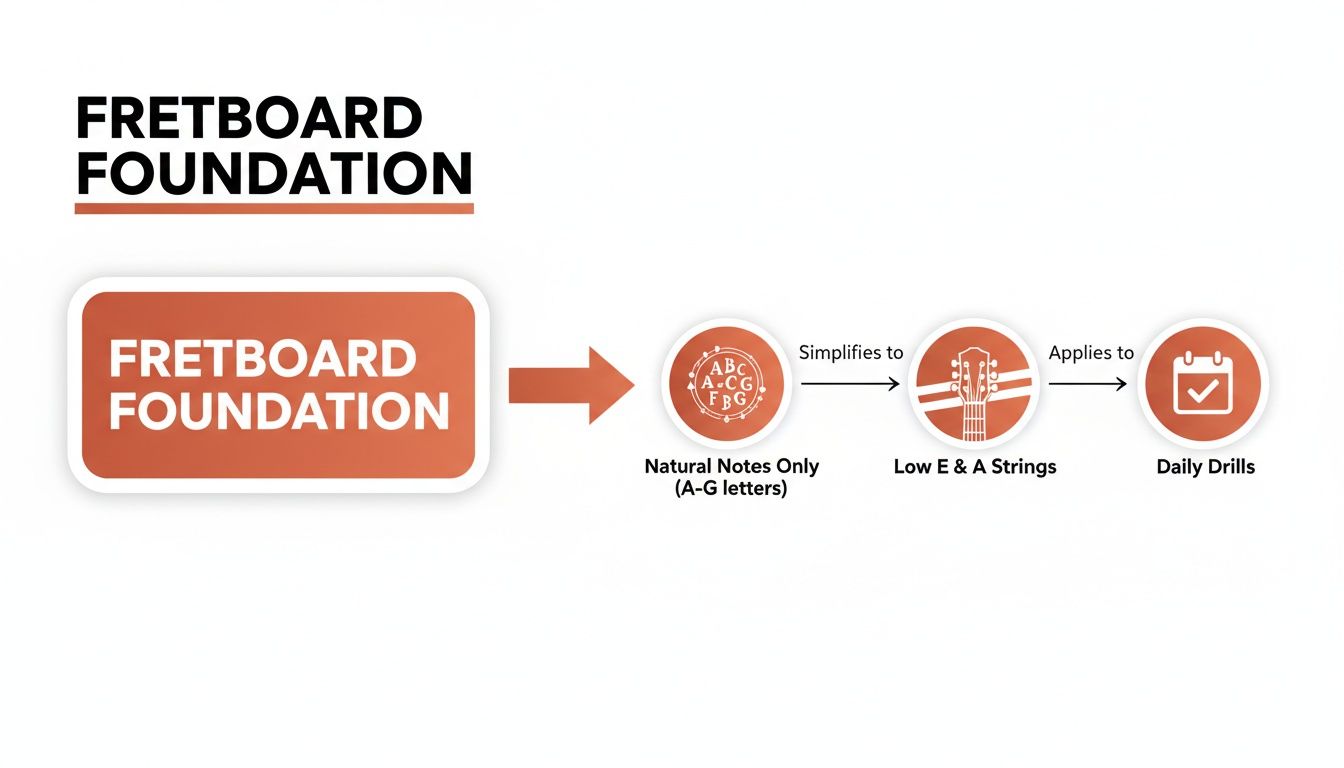
As you can see, by starting with the easiest notes on the most important strings, your daily drills become way more effective.
This pattern-based approach isn't just a neat party trick; it's a massive cognitive shortcut. Your brain is wired to recognize patterns, and using techniques like this fundamentally changes how you process the fretboard.
Instead of trying to brute-force memorize 72 different notes (that's just the first 12 frets!), players who use octave shapes can cut their unique memory targets by roughly two-thirds. In fact, studies show that guitarists who master pattern-based maps can find notes 40–70% faster during improvisation compared to those stuck on rote memorization. You can find more great insights on pattern-based learning over at LearnJazzStandards.com.
What this means for you is simple: you learn faster, and you can actually use what you know in real musical situations much sooner.
These visual patterns are your key to navigating the fretboard. Once you find a note, you can use these shapes to find the same note elsewhere on the neck.
| Essential Fretboard Octave Patterns | ||
|---|---|---|
| Starting String | Octave Location (Same Note) | Fretboard Rule of Thumb |
| Low E (6th) | 2 strings over, 2 frets up (on D string) | The "Two-Two" Rule |
| A (5th) | 2 strings over, 2 frets up (on G string) | The "Two-Two" Rule |
| D (4th) | 2 strings over, 3 frets up (on B string) | The "Two-Three" Rule (for the B string) |
| G (3rd) | 2 strings over, 3 frets up (on high E string) | The "Two-Three" Rule (for the B string) |
| G (3rd) | Same fret, 2 strings down (on low E string) | Vertical Octave |
| B (2nd) | 1 string over, 5 frets down (on G string) | Less common, but useful |
Internalizing these shapes turns the fretboard from a mystery into a familiar map.
Once octaves start to feel second nature, you can apply the exact same thinking to other vital intervals, like the perfect fifth. That classic "power chord" shape you probably already know is a perfect example of a consistent, movable pattern for a fifth.
From any root note on the low E or A strings, its fifth is always located one string over and two frets up. That shape works like a charm across the bottom five strings.
Now, by combining your knowledge of octaves and fifths, you can build a seriously powerful navigation system.
Just like that, from one single note, you have immediate access to three core anchor points spanning multiple strings. This is how you start to see the fretboard as one interconnected system, not a grid of isolated dots. It's the difference between blindly following turn-by-turn directions and just knowing your way around the city.
To really lock these patterns in with interactive diagrams and jam along to backing tracks, you can explore all the tools that come with a TrueFire All Access free trial.
Physical practice and recognizing patterns on the neck will get you pretty far. But if you really want to put your progress on the fast track, it's time to borrow some powerful tools from cognitive science. This whole approach is about training your brain to lock in and recall information more efficiently, turning that abstract grid of frets and strings into something you can actually feel and remember.
We can start with the basics. Most of us first learned the names of the open strings using a simple phrase like Every Amateur Does Get Better Eventually. This little trick proves a huge point: our brains are just plain better at remembering stories and phrases than random sets of letters. So, why should we stop there? We can use that same logic for the entire fretboard.
One of the most powerful techniques out there is the memory palace, sometimes called the Method of Loci. The idea is to associate the notes you want to remember with a physical place you know like the back of your hand—your house, your daily commute, whatever. Instead of seeing frets as just lines and numbers, you start seeing them as rooms, landmarks, and objects.
Let's say your guitar neck is your childhood street.
Now, you can start "placing" notes in these spots. If you're trying to nail down the G note on the low E string (3rd fret), you could picture a giant Gorilla climbing that oak tree. It sounds a little nuts, but that's precisely why it sticks. The crazier and more vivid the image, the stronger the mental hook. You're not just recalling a fact anymore; you're remembering a little story.
This technique completely flips the script on memorization. It stops being a dry, analytical exercise and becomes a creative adventure. You're literally building a world on your fretboard, and finding your way around becomes an act of imagination, not just calculation.
I know this might feel a bit weird at first, but when you pair your physical practice with this kind of mental mapping, you create memories that are incredibly tough to forget. Experts in memory techniques report that guitarists using imagery-based encoding can slash their time-to-fluency by an estimated 30–60% compared to those just grinding it out with practice alone. Some proponents have even shared stories of players memorizing the entire neck in a matter of days instead of months, all because they built a rich mental map first.
This whole method of engaging your imagination is a type of visualization—a skill that all great musicians have in their back pocket.
You don't have to use a memory palace if it doesn't click for you. The main idea is simply to connect abstract notes to concrete things you can picture. You could create a running story for each string or link different notes to characters from your favorite movie. The system itself doesn't matter nearly as much as how much it resonates with you.
The goal is to get past seeing "the 8th fret on the A string" and instead immediately think, "Oh, that's C, where the Cat is chasing the mouse." By giving every note a place and a personality, you weave a dense network of connections in your brain. That's what makes recall instant and effortless, dramatically shortening the road to total fretboard mastery.
These mental models are incredible accelerators. To see them in action with structured lessons, interactive diagrams, and jam tracks that will cement your knowledge, start your TrueFire All Access free trial today.
All the theory, patterns, and mental models in the world won't get you far without one crucial ingredient: application. Knowledge only becomes a real skill when you put it into practice, consistently and deliberately. This is where we build a sustainable habit that turns navigating the fretboard from a conscious chore into pure, musical instinct.
The secret isn't grinding away for hours until your fingers are sore. It's all about short, focused, and intelligent practice. We're going to build a routine that systematically strengthens your internal fretboard map until you can't imagine not knowing where every note lives.
Here's a practical, progressive daily workout you can knock out in about 20 minutes. The goal is to weave together all the concepts we've covered—from basic note finding to interval recognition—in a way that builds on itself day after day. This isn't mindless noodling; every single minute has a purpose.
This structured approach is designed to get you real, measurable results. A focused daily routine of just 15–30 minutes concentrating on these kinds of drills can lead to near-complete recall of the first 12 frets within about 25–90 days. Cognitive research actually shows that when new information is introduced only after previous items are mastered, retention rates skyrocket.
The secret to success is not the duration of your practice, but its frequency. A focused 20 minutes every single day will always beat a three-hour cram session once a week. You are building a habit, strengthening neural pathways, and making fretboard knowledge a part of your musical DNA.
Don't be afraid to pull in some tools that can make your practice more engaging and effective. There are some excellent apps out there designed specifically for this. For instance, the TrueFire's ear training and fretboard recognition courses can ease the process and help you track your progress, which is a great way to stay motivated.
Ultimately, this daily routine is a commitment to yourself as a musician. It's the bridge between knowing the fretboard in theory and truly owning it in your playing. Stick with it, and soon you'll be navigating the neck with a confidence and freedom you never thought possible.
To get the most out of your practice time with interactive lessons and thousands of jam tracks to apply your knowledge, I highly recommend starting a TrueFire All Access free trial.
You've put in the hours, done the drills, and built a solid mental map of the fretboard. So, what's next? It's time to stop thinking about the notes and start using them to make real music. This is the bridge you've been building towards, the one that takes you from conscious effort to effortless expression.
True musicality isn't about reciting a grid of notes. It's about seeing the neck as a living, breathing landscape of sonic possibilities. All that knowledge you've crammed into your brain is about to become your creative fuel.
This is where the real fun begins. Let's start plugging your mental map into actual musical situations:
The ultimate goal is for your fretboard knowledge to become so automatic that it's invisible. You're no longer "finding" the notes; you're just playing the music you hear in your head, and your fingers know exactly where to go.
This is where dedicated practice tools can really accelerate things. Working with interactive fretboard diagrams reinforces your visual map, while throwing on a jam track forces you to apply it all in real time, under pressure.
To really cement your command of the fretboard and start using it musically, I can't recommend a TrueFire All Access free trial enough. It's the perfect environment to make that final leap.
Even with the best game plan, you're bound to have questions as you start digging into the fretboard. As a guitar teacher, I've heard just about all of them. Let's tackle some of the most common ones that pop up when players finally decide to learn the neck for good.
This is always the first question, and the honest-to-goodness answer is: it all comes down to how consistently you practice.
If you can carve out just 15-20 minutes a day to really focus on the methods we're talking about, most players start feeling a real sense of command over the natural notes within the first 1 to 3 months. The goal isn't to cram for hours on a Saturday afternoon. It's about that consistent, daily reinforcement that builds a rock-solid mental map of the fretboard.
Great question. The best way to think about this is that you need to do both, because they build two different, but equally crucial, skills.
I always recommend starting horizontally—that is, learning the notes all the way up a single string. The low E and A strings are your best starting points here. This is how you really internalize the musical alphabet as a linear sequence on the guitar.
But once you've got a few of those notes locked in, you need to start thinking vertically. Challenge yourself to find every single 'C' on the fretboard, from the lowest to the highest. This vertical approach is what really drills in your octave shapes and helps you see how notes relate across the strings. It's the key to breaking free from just playing up and down one string at a time.
Think of it this way: Horizontal practice teaches you the sequence of notes, while vertical practice teaches you the relationships between them. You need both to build a true three-dimensional map of the neck in your mind.
Nope. In fact, I actively tell my students not to.
Your first mission is to get completely comfortable with the seven natural notes: A, B, C, D, E, F, and G. Build that foundation first. Make it so you can find any of those notes without even thinking about it.
Once that's second nature, adding sharps and flats is incredibly easy. A sharp is just one fret higher. A flat is just one fret lower. By mastering the naturals first, you avoid getting overwhelmed and make the "in-between" notes feel like a simple, logical next step instead of a huge new thing to memorize.
Ready to turn these answers into action? Having structured lessons and interactive tools makes all the difference. The path to mastering the fretboard gets a whole lot clearer and faster with the right support. Start your TrueFire All Access Trial today and get access to thousands of lessons from world-class instructors. You'll be glad you did, and a TrueFire All Access Trial is the best way to get started.
