
Ready to make some music? To play a note on your guitar, you just need to coordinate two simple actions at once: press a string down on a metal fret with one hand, and strike that same string with the other.
As a guitar educator, I can tell you this simple combination of pressing and picking is the root of every single sound you'll ever make on the instrument.
Welcome to the most important moment in any guitarist's journey. Getting a single, clean note to ring out isn't just a beginner exercise; it's the fundamental building block for every chord, riff, and solo you'll ever play. Forget that feeling of being overwhelmed—we're about to demystify the entire process.
You're in good company, by the way. Fender reported that a whopping 16 million people in the U.S. started learning guitar in the two years after 2020. That's millions of new players all tackling this exact first step, proving it's the universal starting line for anyone picking up the instrument.
Playing your first clear note is an achievable goal you can accomplish today. It all boils down to coordinating a few key actions. A great way to start is by focusing only on your picking hand, just striking the open strings without worrying about fretting anything yet. This lets you get a feel for one half of the equation before putting it all together.
Here's a quick summary of the essential components you'll learn to master in this guide to play your first note successfully.
| Four Core Elements for a Perfect Note | ||
|---|---|---|
| Component | What It Is | Why It's Critical |
| Posture and Grip | How you sit and hold the guitar. | Creates stability and prevents bad habits that cause strain down the road. |
| Fretting Hand Technique | Pressing the string firmly behind a fret. | The secret to getting a clear, buzz-free note instead of a dull thud. |
| Picking Hand Motion | Striking the string with a pick or your fingers. | Controls the note's volume, tone, and overall character. |
| Hand Coordination | Timing the fretting and picking actions together. | Ensures the note rings out at the exact moment you intend it to. |
Getting these four things to work together is your first major win on the guitar.
As a guitar educator, I see so many students rush past these basics. But trust me, nailing a single, perfect note builds the confidence and muscle memory you need for everything that comes after. It's your launchpad.
Ready to dive deeper and build on these fundamentals? TrueFire has thousands of lessons from world-class instructors to guide you every step of the way.
Before you even think about playing a note, let's get one thing straight: how you hold the guitar is everything. I've seen it countless times with new students—they jump right in, contort their bodies into some awkward shape, and then wonder why their back hurts and their fingers feel clumsy.
Good posture isn't just about avoiding aches and pains. It's about building a solid foundation that lets your hands move freely and do their jobs without fighting the instrument. Think of it this way: you can't write a letter if you're hunched over the table, right? Same deal here. A relaxed body is the key to letting your hands learn the delicate dance of playing guitar.
Whether you're sitting down or standing up, the goal is the same: the guitar should rest against your body so comfortably that you don't feel like you're holding it up with your hands.
If you're sitting, grab a straight-backed chair without armrests. For right-handed players, rest the curve of the guitar's body—the "waist"—on your right thigh. It should feel stable, letting your arms just naturally drape over the top.
A lot of players, myself included, use a strap even when sitting. It adds a bit of extra security and keeps the guitar at a consistent angle, which really helps. Give it a try and see what works for you.
A relaxed musician is an effective musician. If you're fighting your instrument's position, you're wasting energy that should be going into the music. Find a neutral, comfortable posture, and your playing will improve immediately.
Once you're comfortable, it's time to give your hands their job descriptions. They're a team, but each one has a very specific and critical role to play.
Getting a clear handle on these separate jobs is the first step to making them work together later. For a deeper dive, there are some fantastic pointers on holding the guitar that will get you started on the right foot from day one.
Ready to explore thousands of video lessons covering everything from posture to advanced techniques? Start your TrueFire All Access Trial today.
Alright, now for the fun part. With the guitar sitting comfortably, it's time to bring in your fretting hand—that's the left hand for most right-handed players. This hand does the delicate work of turning an open string into a specific musical note. Getting the technique right is the secret to a clean, buzz-free sound from day one.
If there's one secret I could share with every new player, it's about fingertip placement. To get a note to ring out, you have to press the string down until it makes solid contact with the metal fret wire. But here's the trick: you don't press directly on top of the metal. The sweet spot is actually just behind the fret, a little closer to the headstock. Landing there gives you a clear, ringing tone with the least amount of effort.
This little infographic breaks down the simple flow from sitting down to getting your hands ready to play.
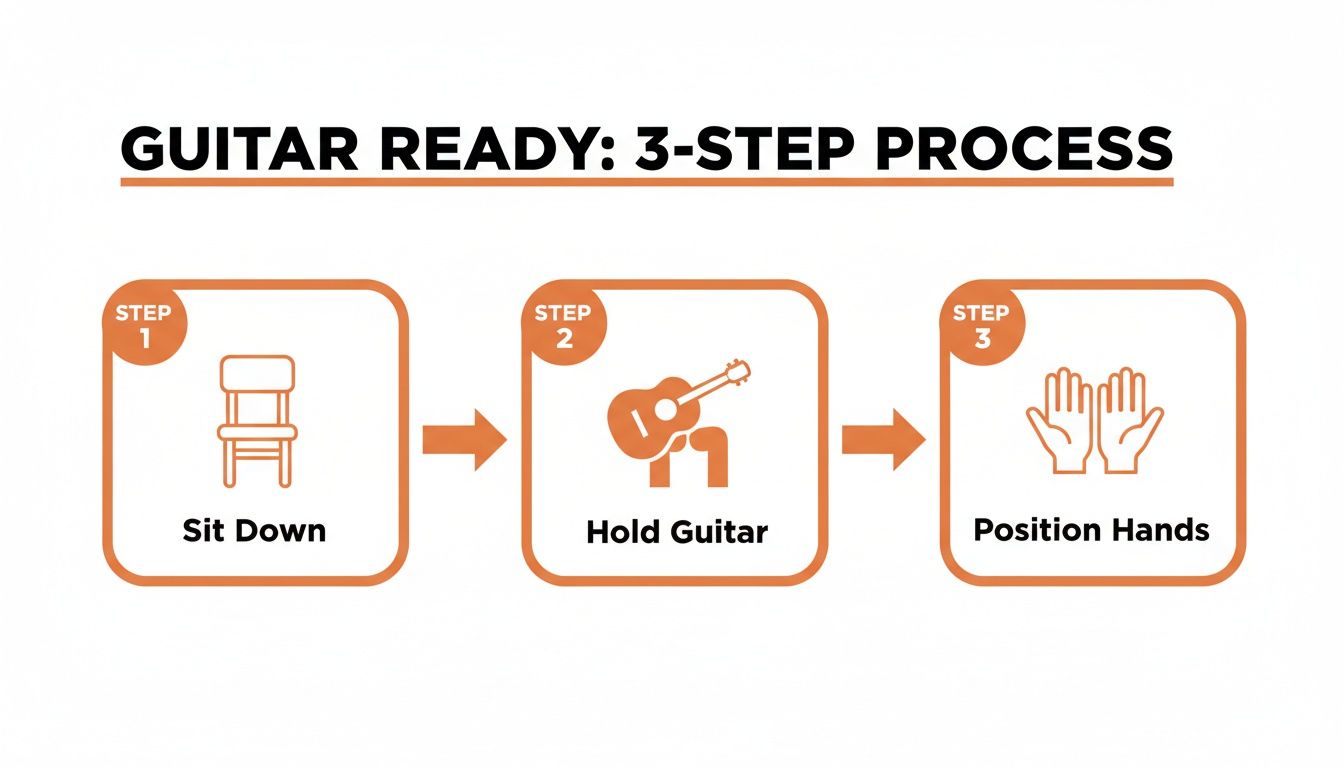
Each step naturally builds on the one before it, making sure your body is stable and relaxed by the time you actually place your fingers on the fretboard.
Let's try a quick example. Go ahead and place your index finger on the high E string (the thinnest one) at the fifth fret. Now, pick the string while applying just enough pressure for the note to sound clear. If you hear a buzz, you need a bit more pressure. If your hand starts to ache, you're using a "death grip"—ease up!
Another classic beginner mistake is accidentally silencing the strings next to the one you're trying to play. The fix is to arch your fretting finger like you're making a little bridge over the fretboard. You want only the very tip of your finger to touch the string, coming down almost perpendicular to the neck. This habit is absolutely fundamental for everything from single notes to tricky chords later on. For more great exercises on this, you can dig deeper into proper left-hand position.
The goal is economy of motion and effort. You want the cleanest possible sound with the least amount of tension. If your hand is cramping, you're trying too hard. Relax and let the fingertip do the work.
Don't just take my word for it. Data shows that over 50% of successful beginners notice a real improvement in their single-note clarity within the first 2–6 weeks of consistent practice. It just goes to show how important it is to lock in this fundamental fretting technique from the get-go.
For guided video lessons that walk you through every aspect of fretting technique, start a TrueFire All Access Trial.

Alright, your fretting hand is in position. Now it's time to bring that note to life. This is where your other hand steps in, turning that silent, pressed string into actual music. Most people start with a guitar pick, and trust me, how you hold it matters more than you might think.
A solid grip is all about control. The best way I've found to teach this is to make a little platform with your index finger by laying it on its side. Place the pick right on top, then bring your thumb down to secure it. You want a connection that's firm but not tense. Just a small tip of the pick should be peeking out—that's your point of contact.
Now for the fun part: striking the string. The simplest, most effective starting point is the downstroke. Think of it as a confident, fluid motion where your pick moves straight down, striking the string cleanly. This movement should come from your wrist, not your whole arm. A smooth downstroke is the secret to getting a consistent, powerful sound.
But here's a pro tip that beginners often miss: where you pick along the string is just as important as how you pick. Play around with this a bit and you'll see just how much control you have over the note's character.
Think of your pick as your paintbrush. The strings are the canvas, and your placement determines the color of the sound. Getting a feel for this early on gives you a massive expressive advantage down the road.
Understanding these fundamentals is a huge first step. And you're not alone in this journey—the amateur segment makes up about 45.5% of the entire multi-billion-dollar guitar market, driven by millions of new players just like you. You can read more about the growth of the guitar market to see just how many people are starting out.
For a deeper dive into this, check out our guide on picking techniques.
And when you're ready to build on these core skills with thousands of lessons, a TrueFire All Access Trial is your best next step.
Don't get discouraged if your first few notes sound… well, a little rough. Every single guitarist has been right where you are. That annoying buzz, the dull thud where a note should be, or that sudden cramp in your hand? They're practically rites of passage. Think of this section as your first-aid kit for those early roadblocks.
The most common culprit is fret buzz. That grating, metallic rattle usually means one thing: your finger isn't close enough to the fret wire. You want to press down just behind the fret, not float in the middle of the space. Sometimes a little extra pressure is all it takes, but don't start a death grip.
Then there's the muted or "dead" note. You go to play the string, and all you get is a flat thwump. This almost always happens when another part of your fretting hand is accidentally touching a string it shouldn't be. The trick is to arch your fingers, creating a little bridge over the other strings. Only your fingertip should be making contact.
Figuring out what's going wrong is a skill in itself. It's how you train your ear and start building a real connection with your instrument. Once you can identify a problem and know how to fix it, your practice sessions become way more productive and a whole lot less frustrating.
As a guitar instructor, I see this as a critical learning phase. The moment a student learns to fix their own buzz or mute, they stop being a passive learner and start becoming a real musician who can solve problems on the fly.
Struggling to get a clean sound? This table will help you diagnose the issue, understand what's causing it, and get you back on track.
| Problem | Likely Cause | How to Fix It |
|---|---|---|
| Buzzing Sound | Finger is too far behind the fret or not pressing firmly. | Move your fingertip closer to the metal fret and apply steady pressure. |
| Muted or 'Dead' Note | Your fretting finger is lying flat, touching other strings. | Arch your finger like a bridge so only the tip touches the target string. |
| Sore Hand or Wrist | Applying too much pressure (a 'death grip'). | Relax your hand; use only enough pressure to make the note ring clearly. |
| Inconsistent Volume | Picking motion is not uniform. | Practice smooth, even downstrokes, aiming for the same spot on the string. |
Getting these quick fixes down builds a super solid foundation for everything that comes next.
For guided lessons that walk you through these techniques and thousands more, start your TrueFire All Access Trial.
You did it. You played a note! Give yourself a pat on the back. Now comes the real work: making it a habit.
Believe it or not, building solid muscle memory isn't about marathon practice sessions. It's all about short, focused, and consistent effort, day in and day out. This simple routine is your foundation for everything that comes next.
Before you start, grab a clip-on tuner and get your guitar in tune. Seriously, don't skip this. Trying to learn on an out-of-tune guitar is incredibly frustrating because nothing will sound right, and you'll just think you're doing it wrong. Next, find a metronome app for your phone. This little tool is about to become your best friend for building rock-solid timing.
As someone who has taught guitar for years, I can tell you that just 10 minutes of focused practice every single day will get you much further than noodling around for an hour once a week.
Here's a quick workout to get you going:
Look, this isn't just about hitting the right notes. You're training your hands and your ears to work as a team. This is the foundational stuff that makes or breaks a new player. Treat these ten minutes like they're the most important part of your day.
If you want to dig deeper into building a great practice habit, check out these smart practice tips for guitar players for more ideas on making your time count.
These are the skills you'll build on for the rest of your guitar journey. For thousands of structured lessons just like this from world-class instructors, I highly recommend starting a TrueFire All Access Trial. This will give you the guided, step-by-step instruction needed to turn these first notes into real music.
