So, you're ready to learn guitar. That first step—choosing an instrument that makes you want to play—is one of the most exciting moments in any musician's journey. Forget the dense technical specs for a minute. The best first guitar is the one that feels like a partner, not a puzzle.
Welcome to the fun part. Before you can strum that first chord, you need an instrument in your hands. If the sheer number of options feels a bit overwhelming, you're in good company. You've just joined a massive community of new players who felt the exact same way.
In fact, the desire to learn is exploding. During the 2020 lockdowns, a Fender survey found that a staggering 16 million Americans started playing guitar in just two years. That's about 7% of everyone aged 13-64 picking up the instrument for the first time.
That huge wave of new learners proves one thing: anyone can start this journey. Let's break down the choices to find the perfect fit for you.
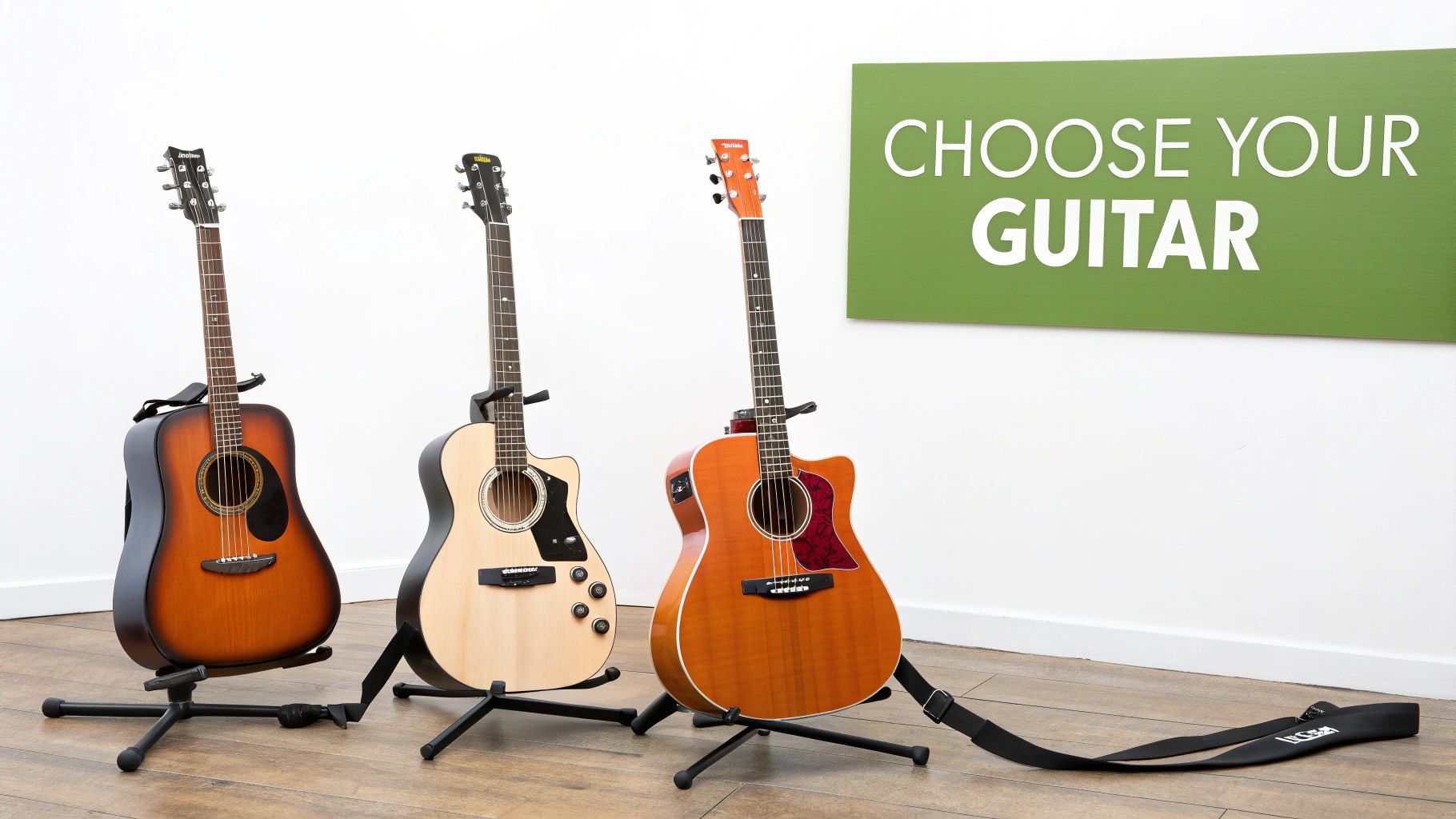
Your first big decision is what type of guitar to get. Each one has its own distinct personality, sound, and is built for different styles of music. And please, don't fall for that old myth that you must start on an acoustic guitar. The right choice is always the one that lets you play the music you already love.
The biggest mistake I see beginners make is picking a guitar based on what they think they should play, not what they want to play. If your goal is to shred like a rock star, get an electric guitar. Your excitement will power you right through the early learning curve.
Still on the fence? This quick comparison should help you decide which path to take based on the music you love and the feel you're after.
| Guitar Type | Best For Genres | Finger Feel | Beginner Friendliness |
|---|---|---|---|
| Acoustic Steel-String | Folk, Pop, Country, Rock | Firmer; builds calluses quickly | The classic starting point, but requires more finger strength initially. |
| Electric | Rock, Blues, Metal, Jazz | Lighter; easier to press strings down | Very beginner-friendly feel, but needs an amplifier to get the full sound. |
| Classical (Nylon) | Classical, Flamenco, Folk | Softest; very gentle on the fingers | The most comfortable option for brand-new fingertips. |
Ultimately, the "best" guitar is the one that inspires you to pick it up every single day. Go with your gut—you can always add another guitar to your collection later on. (Trust me, you will.)
Once you've got your guitar, you only need a few other things to get going. It's easy to get distracted by all the cool gadgets out there, but let's just focus on the absolute essentials for day one.
Essential Gear for Day One:
That's it. With your instrument and these three core accessories, you have everything you need to start making music. This simple setup is your launchpad for a lifetime of playing.
Alright, you've got your guitar. Now comes the stuff that separates the players who sound okay from the ones who sound genuinely good: how you hold the thing and how you tune it. Getting this right from the start is your foundation. A shaky foundation makes building anything else a real struggle.
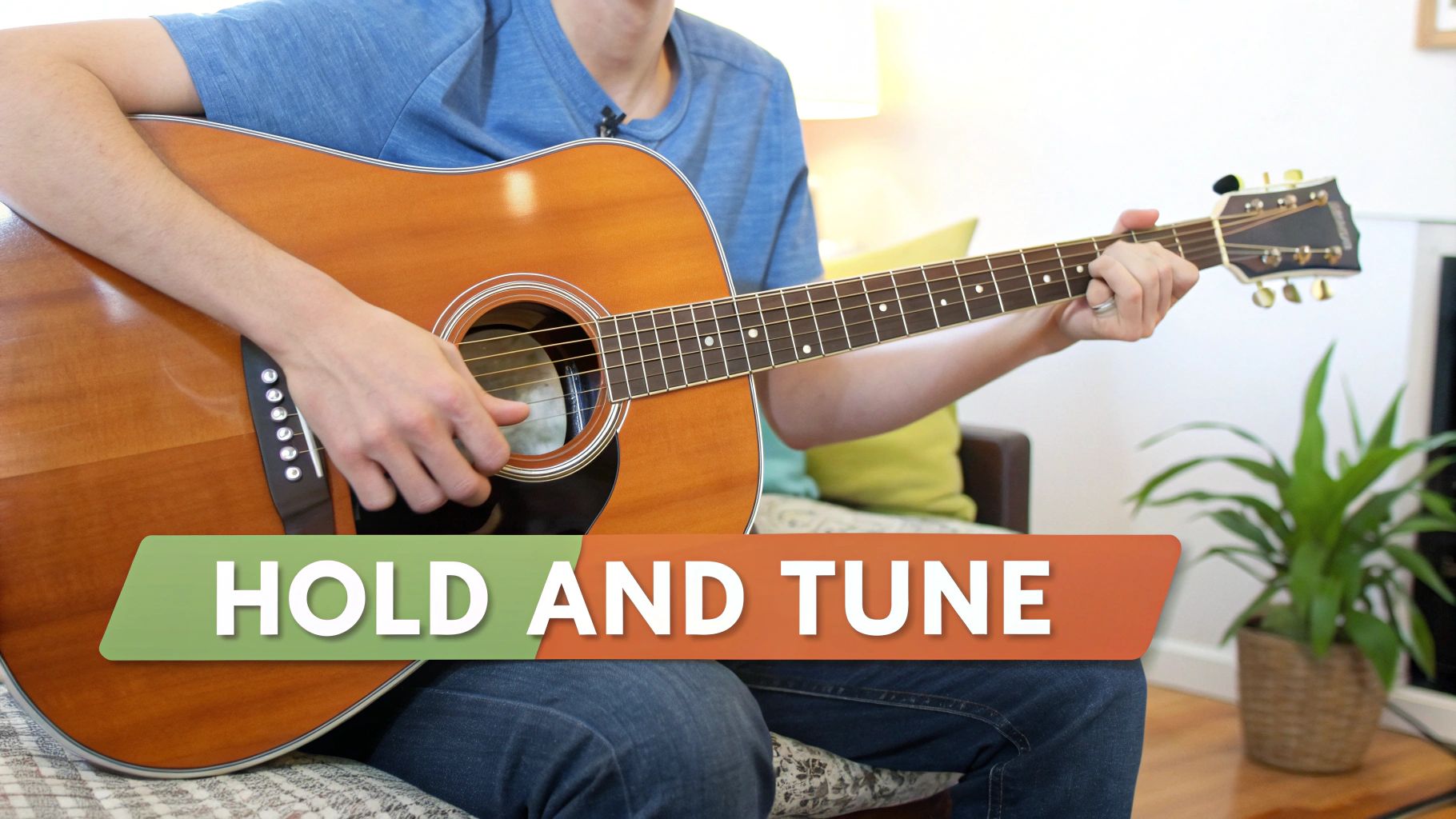
The classic beginner mistake? Hunching over the guitar to get a better look at your fingers. We've all been there, but it's a fast track to back pain and some seriously bad habits. The goal is to bring the guitar to your body, not the other way around.
Whether you're kicking back on the couch or plan to stand on a stage someday, the core principles of good posture don't change. It's all about stability and comfort, which frees up your hands to do their job without fighting a wobbly instrument.
When you're sitting, rest the guitar's waist on your right thigh (if you're a righty). The back of the guitar should sit snugly against your torso. Here's a pro tip: use a strap, even when you're sitting. It keeps the guitar from sliding around and helps maintain a consistent angle for the neck. It's a simple trick that adds a ton of stability.
If you plan on standing, just adjust your strap so the guitar hangs at roughly the same height as it does when you're seated. Consistency is the name of the game for building muscle memory. Try to avoid slinging it super low—it might look cool, but it forces your fretting hand into a really awkward and potentially painful angle. For a deeper dive, check out our guide on the fundamentals of holding the guitar to really nail this down.
A relaxed player is a better player. If you feel tension creeping into your shoulders, back, or wrists, stop and readjust. Your body is telling you something's not quite right with your position.
An out-of-tune guitar is probably the #1 reason beginners get frustrated and quit. You could have your fingers in the perfect spot for a chord, but if the strings are off, it's going to sound awful—and you'll blame yourself.
Tuning your guitar every single time you pick it up is non-negotiable. Seriously. It's the single most important habit you will ever build as a guitarist.
For a standard six-string guitar, the tuning goes from the thickest string (6th, closest to your face) to the thinnest (1st, closest to the floor). The notes are:
A lot of players remember this with a little mnemonic: Eddie Ate Dynamite, Good Bye Eddie. It's goofy, but it works.
The easiest way to get in tune is with a simple clip-on tuner or an online guitar tuner. Just pluck a string, and the tuner will show you what note you're playing and whether it's "flat" (too low) or "sharp" (too high).
Making this a five-minute habit before you play is your first big win. A perfectly tuned guitar means all the effort you're about to put into learning chords will actually pay off with a sound you can be proud of.
Forget everything you think you know about learning chords. You don't need to memorize a giant book of shapes to start playing real music. In fact, some of the most iconic songs ever written are built on just a handful of simple chords.
We're going to zero in on four powerhouse shapes that will instantly give you the keys to a massive library of songs.
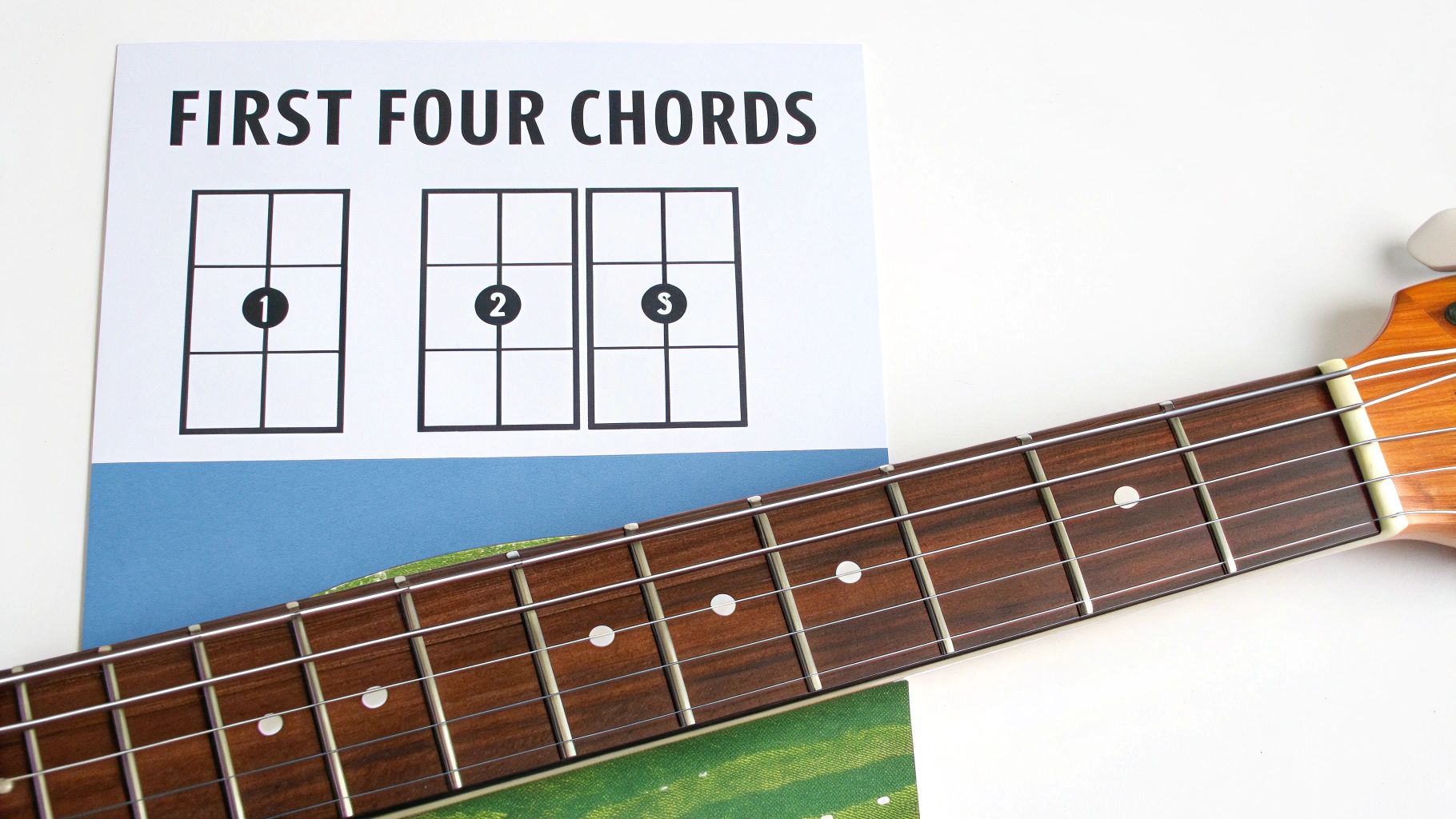
The goal here isn't to overwhelm you. It's to get these four chords sounding clean, confident, and second nature. Nailing this foundation makes the jump to playing actual songs feel less like a chore and more like the exciting journey it's supposed to be.
Let's meet your new best friends: G Major, C Major, D Major, and E minor. You'll hear these pop up everywhere, from folk and country to rock and pop. There's a reason they're so common—they just sound fantastic together.
The trick to a clean-sounding chord is pressing the strings down with the very tips of your fingers, right behind the metal fret wires. Keep your fingers arched, almost like you're holding a baseball. This is crucial because it stops your fingers from lying flat and accidentally muting the strings next to them.
As a teacher, the most common roadblock I see is players using flat fingers. Arch your fretting hand! It will feel completely unnatural at first, but it's the one habit that will make the biggest difference in getting every string to ring out clearly.
G Major is one of the most common chords in all of popular music. It has a full, happy sound that feels like a perfect "home base" for countless songs.
Here's a common way to play it:
Now, give all six strings a strum. Don't panic if it sounds buzzy or some notes are dead. That's totally normal. Just adjust your finger pressure and arch them a bit more until each note sings.
Next up are C Major and D Major. The C chord has a bright, open feel, while D is crisp and punchy. They're the perfect companions for G Major.
For C Major:
For D Major:
Finally, we have E minor (often written as 'Em'). This one adds a touch of moodiness or tension to the mix and, luckily, it's one of the easiest chords to learn.
You only need two fingers:
That's it! Strum all six strings for a rich, somber sound. Because this shape is so simple, it's a great one for practicing your transitions. Getting these changes smooth is all about building muscle memory. For a deeper dive, check out our guide on how to learn guitar chords quickly using muscle memory.
Once you have these four shapes under your fingers, you've officially unlocked the ability to play literally hundreds—if not thousands—of popular songs. Practice them slowly. Focus on making every note ring out before you worry about speed.
So, you've got your first few chord shapes under your fingers. That's a huge win—it's like learning the essential words in a new language. But to actually start speaking that language and making music, you need rhythm. Strumming is the engine that drives those chords forward, turning static shapes into songs you can feel.
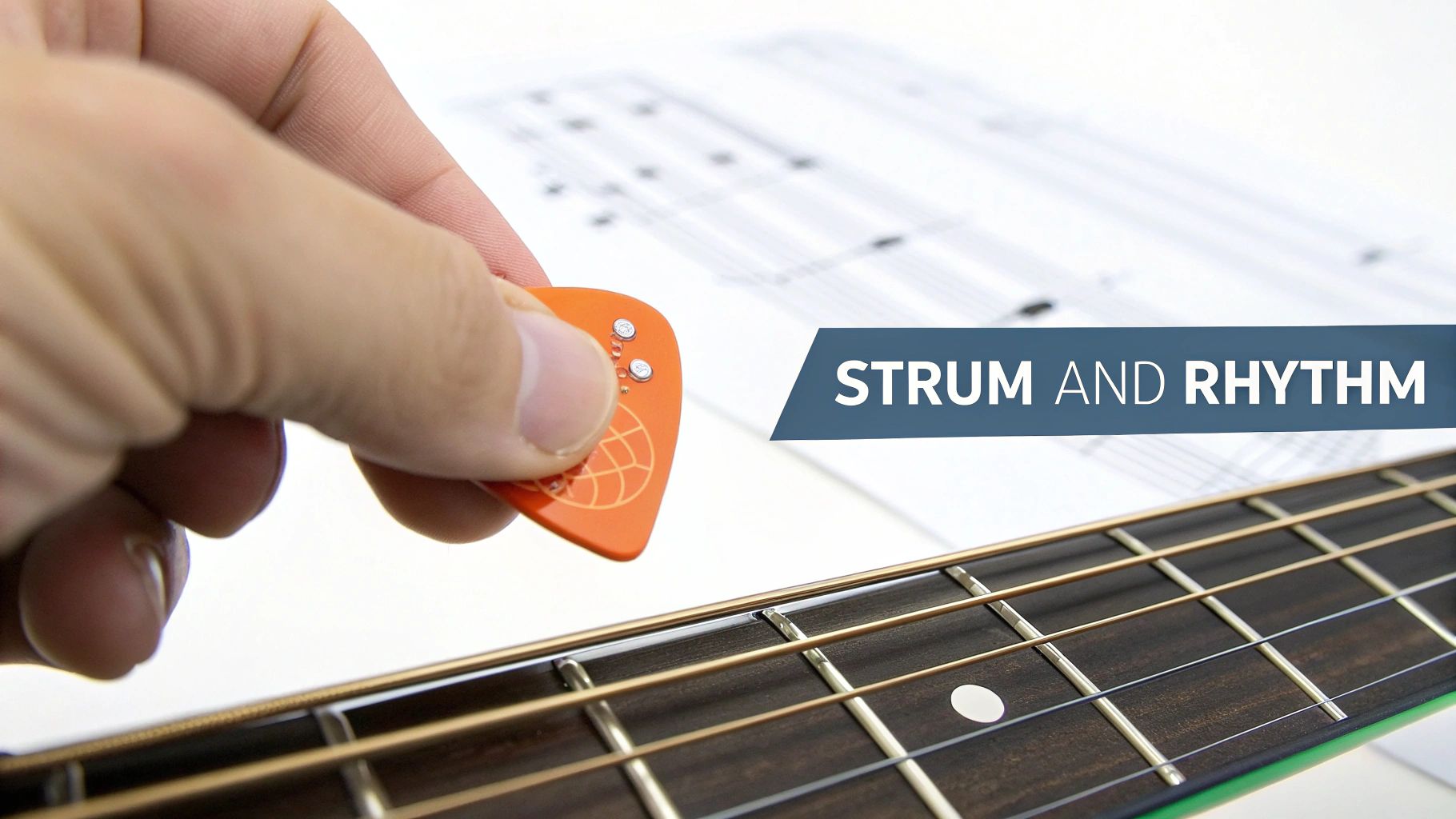
This is the point where practice stops feeling like a chore and starts sounding like real music. The goal isn't to tackle complex rhythms just yet. It's all about building a steady, confident hand that can hold a beat.
Before we get into any patterns, let's nail down how to strum properly. The most common mistake I see beginners make is locking up their entire arm and trying to strum from the elbow or shoulder. That's a fast track to a stiff, robotic sound and a tired arm.
The secret to a smooth, flowing sound is all in the wrist. Hold your pick firmly, but don't choke it—think of it as a natural extension of your hand. Your wrist needs to be loose and relaxed, almost like you're flicking water off your fingertips. It's a fluid, paintbrush-like motion across the strings.
It's a simple rotational movement that will feel natural and effortless once you stop overthinking it. A great way to get the feel is to just practice this motion on muted strings without even holding a chord.
The absolute bedrock of all rhythm is the simple quarter-note strum. It doesn't get more fundamental than this: one down-strum for every beat. If you count out loud, "1, 2, 3, 4," you'll play a single, even down-strum on each number.
Go ahead and grab your guitar and fret a G chord. Now, fire up a metronome and set it to a nice, slow tempo, like 60 beats per minute (BPM). Strum down once for every single click.
Down - Down - Down - Down
(1 - 2 - 3 - 4)
Focus on hitting all the strings cleanly, but your main job here is keeping your timing locked in with that click. It sounds almost too basic, but this is the single most important rhythmic exercise for any guitarist. Consistency in timing is far more important than complexity.
The metronome is your best friend. It's brutally honest and gives you the instant feedback you need to build a rock-solid internal clock. Starting slow and being precise is actually the fastest path to playing faster later on.
Once you feel solid with steady down-strums, it's time to add up-strums. This is what fills in the gaps and creates those classic strumming sounds you hear in practically every song. An up-strum happens on the "and" between each beat.
If you count it out, it sounds like this: "1 and 2 and 3 and 4 and".
Let's try one of the most common and versatile patterns out there. Stick with your G chord and that slow metronome, and give this a shot:
This creates that classic "down, down, up, down, up" feel that works for thousands of songs. It's going to feel clumsy at first—that's totally normal. But with slow, deliberate practice, your hand will start to remember the pattern on its own. If you'd like to expand your rhythmic toolkit, you can explore some other essential beginner strumming patterns.
This foundational skill is your gateway to making real music. With just a handful of chords and a couple of steady strumming patterns, you have everything you need to start playing your favorite songs.
Related: Jeff Scheetz' Smart Practice for Guitar - check it out on TrueFire!
Let's get one thing straight: the biggest hurdle for any new guitarist isn't a gnarly chord shape or a blistering solo. It's the quiet, daily decision to actually pick up the instrument. Consistency is the secret sauce, not raw talent. So, let's ditch the fantasy of needing hours of grueling practice every day. The real key is building a smart, sustainable routine that actually fits into your life.
This isn't just a hunch; the numbers tell a stark story. Guitar is incredibly popular—some studies suggest that about 10% of the world's population plays. But here's the kicker: a staggering 90% of new players quit within the first year. Crazy, right? The culprit is rarely a lack of passion. It's burnout from aimless, overwhelming practice sessions. You can beat those odds by building a solid habit with short, focused effort right from the start.
A powerful and realistic routine only takes 20-30 minutes a day. Trust me, these consistent, short bursts are infinitely more effective for building muscle memory and staying motivated than those rare, multi-hour jam sessions you might cram into a weekend.
So, what should you actually do in those 20 minutes? A great session touches on a few key areas to keep your progress balanced. Think of this as a flexible framework, not a rigid checklist you have to follow to the letter.
A solid practice session can be broken down into four simple parts:
The goal isn't to be perfect overnight. It's about progress. Aim to be just 1% better than you were yesterday. If you can make that G-to-C change just a little cleaner today, that's a massive win.
To help you hit the ground running, here's a simple, structured guide for your first month. This plan takes the guesswork out of your daily sessions and ensures you're building your skills in a logical order, week by week.
This structured weekly guide will keep your practice sessions focused and productive, building skills progressively.
| Week | Daily Focus (20-30 mins) | Weekly Goal |
|---|---|---|
| 1 | 5 mins: Finger warm-ups. 15 mins: Practice forming G, C, D, and Em chords cleanly. Check each string. |
Get each of the four essential chords to ring out clearly without any muted strings. |
| 2 | 5 mins: One-minute chord changes (G to C, then C to D, etc.). 15 mins: Down-strums to a 60 BPM metronome. |
Change between any two of your first four chords in time with a slow beat, without stopping. |
| 3 | 5 mins: Warm-ups. 15 mins: Practice a basic "down-down-up-up-down-up" strumming pattern. |
Maintain a steady strumming pattern while switching between at least two chords in a simple progression. |
| 4 | 5 mins: Chord changes. 15 mins: Apply your chords and strumming to a simple two- or three-chord song. |
Play through the verse of a simple song using your new skills without major interruptions. |
Having a roadmap like this helps you build a rock-solid foundation without feeling lost. If you're ready to dive deeper into structuring your sessions for maximum results, our article on how to make your perfect guitar practice perfect is packed with more advanced strategies.
Think of this routine as your guide. Your journey as a guitarist is a marathon, not a sprint, and this framework is designed to keep you moving forward, steadily and with confidence.
You've put in the work and built a solid foundation. You know your essential chords, and you can hold a steady rhythm. This is the fun part—the point where your path starts to open up, moving beyond just copying shapes and into real, honest-to-goodness creative playing.
So many players get to this stage and wonder, "Okay, now what?" The logical next step is to expand your chord vocabulary and, just as importantly, start to understand a little bit about why certain chords work together. This is where you move from guesswork to making informed choices, which helps you learn songs faster and even start piecing together your own ideas.
The first big hurdle for most guitarists is staring down the barrel of barre chords. I get it, they look intimidating. But trust me, they are the absolute key to unlocking the rest of the fretboard. Think of them as moveable shapes that let you play any major or minor chord just by sliding your hand up or down the neck.
I've seen it time and time again as a teacher: a structured path is the fastest way to get good. Don't just learn random things you see online. Integrate new skills into your playing with a clear purpose.
At the same time, it's a great idea to start dipping your toes into basic scales. The minor pentatonic scale is your ticket to ride here. This simple five-note scale is the DNA of countless legendary guitar solos in blues, rock, and pop. Practicing it not only builds finger strength and coordination but also trains your ear to hear melodies.
Over the years, I've taught countless beginners, and I've noticed the same questions pop up time and time again. Let's be honest, starting out is full of unknowns and common struggles. Knowing what you're up against ahead of time can be the very thing that keeps you from giving up.
Here are my straight-up answers to the questions every new guitarist asks.
This is the big one, isn't it? The honest-to-goodness answer is that it's different for everyone, and there's no "finish line" in music. But I know you want a real benchmark.
With a focused practice habit of 20-30 minutes a day, most people can get comfortable with their first few open chords and play simple songs within two or three months. That's a huge milestone!
Getting to what most of us would call an "intermediate" level—where you can start learning songs by ear, finally tackle those dreaded barre chords, and just play with more confidence—usually takes a good one to two years of consistent playing. The trick is to fall in love with the process and get hyped about the small wins.
This question is everywhere, usually fueled by the old myth that you have to start on an acoustic guitar. Let me be perfectly clear: ignore that advice. The best guitar for you is the one that makes you want to pick it up and play the music you actually love.
If your dream is to play rock, blues, or metal, go get an electric guitar. Seriously. The necks are often thinner and the strings are lighter, which can actually be easier on your fingers when you're just starting.
On the other hand, if you're drawn to folk, pop, or singer-songwriter stuff, an acoustic is your perfect match. Your passion for the music will always be your single greatest motivator.
Yes! Sore fingertips are a rite of passage for every single guitarist. Think of it as a badge of honor—it means you're putting in the work. You're in the process of building up calluses, which are little pads of tough skin that will eventually make playing totally painless.
This phase is temporary, I promise. Every player you admire has been through it. Don't let it get you down; it's a physical sign of your progress. The discomfort usually fades away within a few weeks of regular practice.
Here's how to get through it:
Ready to get expert answers to all your questions and follow a structured path to success? A TrueFire All Access Trial connects you with world-class instructors and thousands of lessons to guide your journey.
