To play a harmonic, you just need to lightly touch an open string right over a specific point—what we call a node—and pluck it. That simple move creates a beautiful, clear, bell-like overtone that seems to hang in the air.
This one technique unlocks a whole hidden layer of notes on your guitar. You can get everything from the pure chimes of natural harmonics over certain frets to the aggressive, screaming squeals of pinch harmonics that define so many rock solos.
Ever wonder how guitarists pull off those stunning, bell-like tones or those high-pitched notes that just scream out of the amplifier? That's the magic of harmonics.
Think of them as secret notes living on each string, just waiting for you to find them. Instead of mashing the string down to the fret, you're gently isolating a specific overtone. This produces a sound that's pure, resonant, and usually an octave or more higher than the open string itself.
Learning to play harmonics is way more than just a cool party trick; it's a core skill that opens up a whole new dimension of expression. It's all about adding texture, color, and raw excitement to your music, whether you're fingerpicking an acoustic ballad or shredding a metal anthem. This guide will get you started with the three essential types every guitarist should know.
We'll dig into each of these in detail, but here's a quick flyover of what you'll be mastering:
As a guitar educator, I've always seen harmonics as a key that unlocks a much deeper understanding of the instrument. It's not just about hitting the right notes; it's about physically manipulating the string's vibration to create entirely new sounds.
Getting these techniques down will turn simple melodies into unforgettable hooks and your solos into sonic statements. Of course, a solid command of the neck is a must for this, and you can always sharpen that skill by exploring some core concepts of fretboard knowledge that will make you a better player.
Ready to make your guitar sing? Let's dive in.
Your journey into harmonics starts right here, with the most straightforward type: natural harmonics. These are the pure, bell-like chimes you can get from an open string once you know the secret spots to touch. Think of them as your gateway to understanding how this cool effect actually works on the guitar.
When you pluck an open string, it vibrates from the nut all the way to the saddle. But if you lightly touch that vibrating string at just the right point—a node—you cancel out the main note (the fundamental) and isolate one of its higher-pitched overtones. The key is an incredibly light touch. You're not fretting a note; you're just gently interrupting the string's vibration to coax out that chime.
This infographic gives you a quick visual on the basic mechanics for all three types of harmonics we're going to dig into.
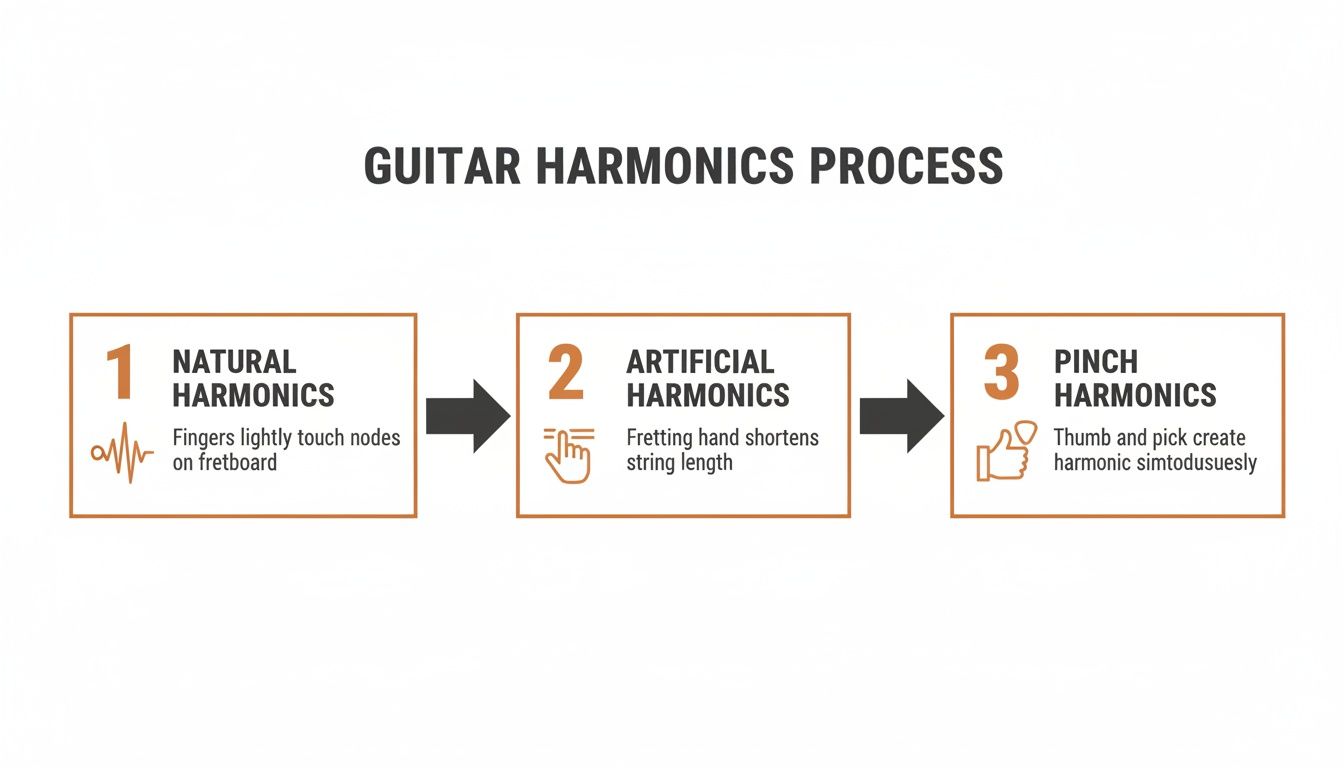
As you can see, every technique is really about finding and activating a specific node along the string.
The loudest, clearest, and easiest natural harmonics live directly over the metal fret wires at the 12th, 7th, and 5th frets. These spots represent simple fractions of the string's total length, which is why they produce such pure and strong overtones.
Let's start with the easiest one: the 12th fret.
You should hear a beautiful, ringing note—that's the harmonic. It's exactly one octave higher than your open E string. You've just isolated the string's first overtone.
As a guitar teacher, I always tell my students to imagine their finger is a butterfly landing on the string. It's just enough contact to be there, but light enough to fly away in an instant. That's the kind of touch you need.
Once you've got the 12th fret sounding clean and clear, it's time to hunt for the others. Try the same technique over the 7th fret wire. This one produces a note that's an octave and a perfect fifth above the open string. Then, move to the 5th fret, which will give you a harmonic that's a full two octaves higher.
You'll probably notice that the harmonics at the 7th and 5th frets are a bit more finicky. They demand an even lighter touch and more precise finger placement to really sing out.
To give you a quick reference, here are the most common natural harmonic locations on your fretboard.
This table is your cheat sheet for the clearest-sounding and most musically useful natural harmonics.
| Fret Location | String Division | Resulting Pitch (Relative to Open String) | Clarity/Ease |
|---|---|---|---|
| 12th Fret | 1/2 | One Octave Higher | Very Clear / Easiest |
| 7th Fret | 1/3 | One Octave + Perfect Fifth Higher | Clear / Intermediate |
| 5th Fret | 1/4 | Two Octaves Higher | Clear / Intermediate |
| 4th Fret | 1/5 | Two Octaves + Major Third Higher | Faint / Difficult |
| 3rd Fret | 1/6 | Two Octaves + Perfect Fifth Higher | Faint / Difficult |
Keep in mind that as you move away from the 12th, 7th, and 5th frets, the harmonics become much quieter and harder to produce cleanly. Stick with the "big three" for now.
This technique isn't new; players have been captivated by these sounds for centuries. But for a more modern—and iconic—example, just listen to the intro of "Roundabout" by Yes. Steve Howe uses a 12th-fret natural harmonic to create that unforgettable, ethereal opening. Harmonics are also a staple in other genres, like the unique harmonic calling cards of Western Swing guitarists.
The only way to get these down is through repetition. Practice jumping between the 12th, 7th, and 5th fret harmonics on a single string until it feels automatic. Then, challenge yourself to create simple melodies using harmonics across all six strings. This is how you build the muscle memory to nail them every time you need them.
Natural harmonics are a fantastic starting point, but they're stuck in place over the open strings. What happens when you want that same glassy chime from a note you're fretting, like the 8th fret on the B string? This is where artificial harmonics change the game, giving you the freedom to create a harmonic from any note, anywhere on the neck.

This technique requires some serious coordination from your picking hand, which has to both touch the string and pluck it at the same time. It feels like a bit of a juggling act at first, but once the muscle memory clicks, a whole new universe of melodic possibilities opens up. The idea is identical to natural harmonics; you're just using your fretting finger to create a new, temporary "nut."
The secret to playing artificial harmonics is mastering the "touch and pluck" motion. Your goal is to lightly touch the string exactly 12 frets higher than whatever note your fretting hand is holding down. This 12-fret jump splits your new, shorter string length perfectly in half, which creates the strongest, cleanest harmonic node—a crisp octave above your fretted note.
Here's how to set up your right hand:
This hand position is everything. Guitar legends like Chet Atkins and Lenny Breau absolutely mastered this, using it to play breathtaking, harp-like melodies that would be impossible with natural harmonics alone.
I always tell my students to focus on one thing: the distance. If you're fretting a note at the 3rd fret, your harmonic node is at the 15th fret (3 + 12). If you're at the 7th fret, that node is up at the 19th fret (7 + 12). It's simple math that unlocks the whole technique.
Alright, let's walk through an example to get this under your fingers. It feels a bit like patting your head and rubbing your stomach at the same time, but with a little patience, it becomes second nature.
The note you hear should be a clear, bell-like G, two octaves higher than the one you fretted. Artificial harmonics are a secret weapon for crafting pro-level lead lines. The technique has deep roots in the evolution of the instrument itself; by 1842, C.F. Martin Sr.'s X-bracing pattern was making guitar tops stronger, allowing them to handle heavier strings and sustain these delicate harmonics without buzzing.
This kind of right-hand dexterity has a lot in common with other advanced skills. If you're up for a similar coordination challenge, check out our guide on three distinct levels of guitar tapping.
To really lock this skill in, spend some practice time running simple scales on a single string, playing each note as an artificial harmonic. Start painfully slow, focusing only on clean execution, and then gradually bump up the speed. Before you know it, you'll be weaving these beautiful chimes into your own melodies and solos.
Alright, time to make this thing scream. If natural harmonics are pure and artificial harmonics are precise, pinch harmonics are just pure, raw attitude. Think of those high-pitched, aggressive squeals that punctuate countless iconic rock and metal solos—that's the visceral excitement we're talking about, the sound that can make a lead line absolutely unforgettable.

This technique is a totally different animal. It's an explosive action that blends your fretting and picking into one single motion. The real magic happens in that split-second where your pick and the fleshy part of your thumb hit the string almost simultaneously. You strike the string, and your thumb immediately grazes it, killing the fundamental note and letting a harmonic leap out.
It's an aggressive, lightning-fast move that takes some real practice to nail down, but the payoff is massive.
The secret to a great pinch harmonic is 100% in your picking hand. This is way less about what your fretting hand is doing and all about how you attack the string. The first step is adjusting your grip on the pick so only the tiniest tip is showing.
As an instructor, I often describe this as "letting your thumb get in the way." It's a controlled mistake. The pick provides the initial attack, and the thumb instantly creates the harmonic node that makes it squeal.
Unlike natural harmonics, which have very specific homes over certain frets, pinch harmonics can be found all over the place between your neck and bridge pickups. Where you pick the string completely changes the pitch of the squeal. Picking closer to the neck pickup tends to produce lower-pitched, growling harmonics, while moving toward the bridge will give you those piercing, high-end screams.
Try this: fret a note on the G or D string and just keep trying that pick-thumb motion. Start near the neck pickup and slowly move your picking hand toward the bridge. You'll hit multiple "sweet spots" where different harmonics just jump off the string. The masters of this stuff, like Billy Gibbons of ZZ Top and Zakk Wylde, know exactly where these spots are to get the specific squeal they want for a solo.
Of course, your gear setup plays a huge role. Pinch harmonics really need some gain to come to life.
For any guitarist looking to dial in the perfect sound, learning more about how to achieve great guitar tone is an absolutely essential part of the journey. It's not just about the technique; it's about making your amp and guitar work for you.
Hitting a dull thud instead of a clear, bell-like chime? Don't sweat it. Every single guitarist hits these same roadblocks when learning harmonics. Think of this section as your personal troubleshooter for the most common gremlins standing between you and that perfect harmonic tone.
The first culprit for weak natural harmonics is almost always your touch. A lot of players instinctively press down like they're fretting a note, but that completely chokes the vibration you're trying to isolate. Remember, you're aiming for a feather-light touch, not a push.
Another super common mistake is finger placement. You have to be directly over the metal fret wire, not just somewhere in the middle of the fret. Seriously, being even a millimeter off is the difference between a ringing harmonic and a dead string.
When artificial harmonics sound weak or don't speak at all, the problem almost always comes down to the timing and coordination of your picking hand. That "touch and pluck" motion has to be perfectly in sync. If your index finger touches too early or lingers too long, you'll just mute the note. If it's too late, you'll just hear the regular fretted note.
As a teacher, I see students wrestle with the thumb-pick motion for pinch harmonics constantly. The most frequent error? Not choking up enough on the pick. If too much of the pick is showing, your thumb just can't graze the string at the perfect moment.
With pinch harmonics, your gear setup can also be part of the problem. Those squeals really need some gain to come alive. If your amp is set too clean, the harmonic won't have the compression and sustain it needs to leap out and scream at the listener.
Here's a quick diagnostic checklist you can run through whenever things aren't sounding right:
Working through these points methodically will help you pinpoint the issue in your technique and make the small tweaks that lead to a clean, professional sound.
Alright, you've put in the work and have a solid handle on the mechanics of harmonics. Now comes the best part: actually using them to make music. The real goal is to move beyond just practicing the technique in isolation and start thinking of harmonics as another expressive tool in your arsenal—a new color on your musical palette.
Let's start by thinking about context. Natural harmonics are absolutely perfect for crafting those ethereal intros or building atmospheric bridges in a song. For a cool, harp-like effect, try swapping a standard open G chord for its corresponding harmonics at the 12th, 7th, and 5th frets. It can completely transform the mood of a chord progression.
To really make harmonics a part of your playing, start weaving them directly into your scales and arpeggios. For instance, try playing an A minor pentatonic run, but cap it off by popping an artificial harmonic on the very last note. It's a slick, professional-sounding way to punctuate your lick and catch the listener's ear.
Pinch harmonics, on the other hand, are all about raw impact. Sprinkle them into a rock or metal solo to make certain notes leap out, especially on a bent string. A well-placed squeal injects an energy and emotion that can make a solo unforgettable. The key is not to overdo it—think of them as exclamation points, not periods. For more ideas on building musical phrases, check out our guide on how to create interesting licks and phrases on guitar.
Whenever I'm teaching, I always push my students to think like composers. Ask yourself, "What does this part of the song need?" An artificial harmonic can add a touch of delicacy, while a pinch harmonic brings the aggression. Choosing the right tool for the job is a huge part of the art.
Once you're feeling comfortable with the basics, there's a whole other level to explore.
Tapped harmonics are a classic. This is where you fret a note with your left hand, then use a finger from your right hand to sharply tap the string directly over the corresponding harmonic node—usually 12 frets higher than the fretted note. It produces a super clear, percussive chime that players like Eddie Van Halen made famous.
Another really fun one is slap harmonics, which you'll hear a lot in acoustic and funk playing. This involves slapping an open string with your thumb right over the 5th or 7th fret wire. You get a percussive slap and a harmonic chime all at once. These advanced methods just go to show how deep the world of harmonics really is. To dig deeper into these techniques and thousands of others, a TrueFire All Access Trial offers expert-led lessons that can show you the ropes.
