Learning to play lead guitar really boils down to three core pillars: mastering fretboard navigation with scales, learning to make your notes sing with expressive phrasing, and finally, building the technical facility to play what you're hearing in your head.
As a teacher, I see it like this: Scales are your alphabet, phrasing is how you form words and sentences, and technique is what lets you speak fluently and with conviction. Let's break down how you can master each of these areas.
Before you can even think about playing a memorable solo, you need a map of the fretboard. This is your foundation. Without it, you're just guessing, and great lead guitar isn't about randomly stabbing at notes—it's about making conscious, melodic choices that serve the music.
That journey begins with scales. Scales are the raw material for all your melodies and solos, giving you a framework of notes that are guaranteed to sound "correct" over a specific chord progression. They're the language of music, and it's time to build your vocabulary.
The first scale every aspiring lead guitarist should learn is the Minor Pentatonic scale. Period. This five-note powerhouse is the sonic signature of countless solos in blues, rock, classic rock, and even modern pop. Its simple, open-sounding structure makes it incredibly versatile and, frankly, very playable.
So, why start here? The Minor Pentatonic is famously forgiving. It's hard to hit a truly "wrong" note when you're using it in the right context, which is a massive confidence booster when you're starting out. This is the sound you've heard your whole life, from legends like B.B. King to Jimmy Page and Slash.
The real goal isn't just memorizing patterns on a fretboard diagram. You need to internalize the sound of the scale. You want to get to the point where your fingers automatically find the notes your ear is hearing.
Instead of getting stuck in one little box, the key is to learn the five interlocking shapes of the Minor Pentatonic scale. This is what unlocks the entire fretboard, letting you move fluidly up and down the neck and connect your melodic ideas without getting trapped.
This chart shows how all these concepts—pentatonics, major scales, and modes—fit together to give you total fretboard command.
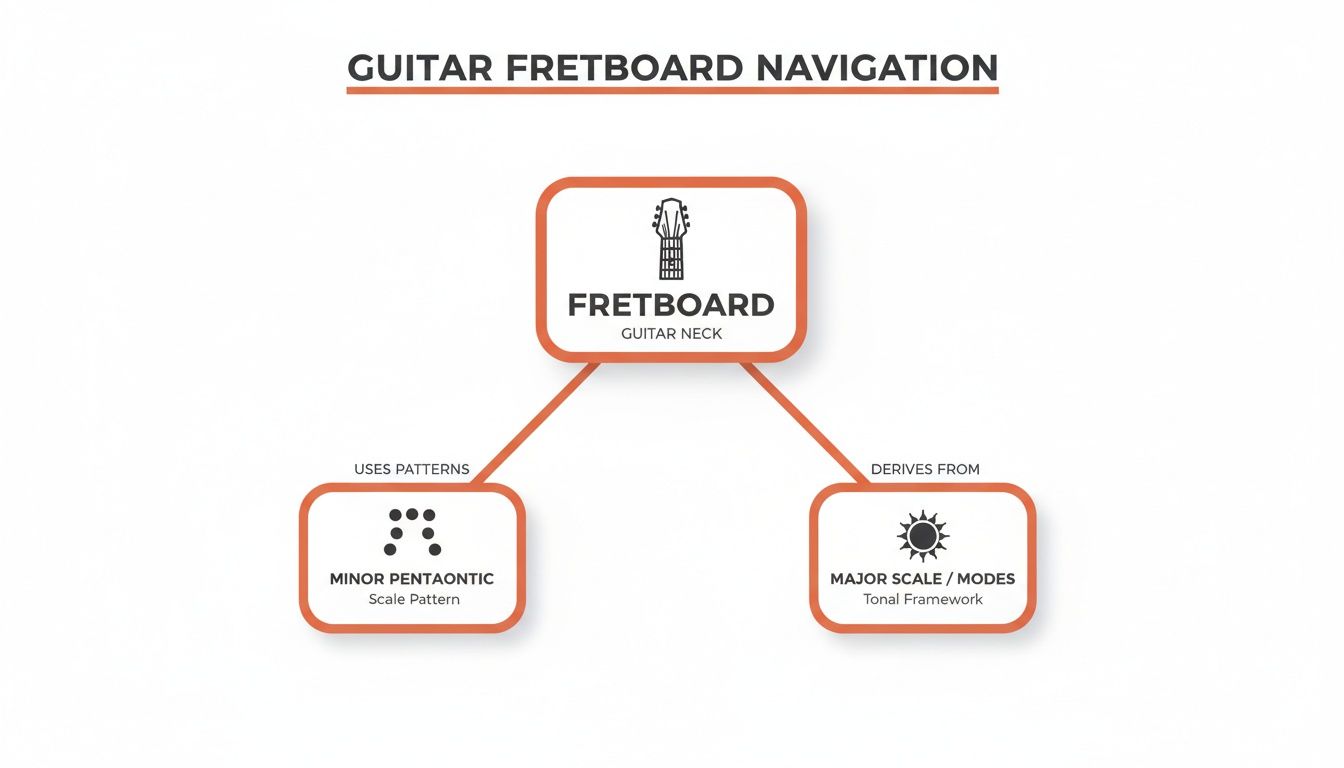
As you can see, true fretboard mastery isn't just about one scale. It's about combining the raw, bluesy power of the pentatonics with the melodic depth of major scales.
Here's a quick rundown of the essential building blocks we're talking about. Think of this as your starting toolkit for crafting memorable solos.
| Concept | Why It Matters for Solos | Your First Step Today |
|---|---|---|
| Minor Pentatonic Scale | The absolute foundation of rock and blues soloing. It's versatile and easy to start with. | Learn the first "box" shape of the A Minor Pentatonic scale starting at the 5th fret. |
| Major Scale | The source of brighter, more melodic sounds and the parent scale for all modes. | Play a C Major scale in the open position to get the sound in your ear. |
| Modes | Different "flavors" of the major scale, each with a unique emotional character (e.g., happy, sad, funky). | Learn the sound of the Mixolydian mode—it's the go-to for a blues-rock vibe. |
| Fretboard Visualization | The skill of seeing the neck not as random notes, but as a connected map of scales and patterns. | Practice connecting two different Minor Pentatonic shapes up and down the neck. |
Getting a handle on these concepts is the first major step toward playing solos that sound intentional and musical, not random.
Once you're feeling comfortable with the Minor Pentatonic, it's time to add more colors to your musical palette. The Major scale is the bedrock of Western music theory and the source of a whole universe of new sounds. Where the Minor Pentatonic is raw and bluesy, the Major scale brings a brighter, more melodic character to your playing.
From the Major scale, we get "modes." Don't let the name intimidate you. Just think of modes as different flavors or moods you can create from the same seven notes.
Learning how these shapes connect across the neck is what separates the novices from the players who can truly navigate the fretboard. When you understand this system, you stop seeing random frets and start seeing a coherent musical landscape, ready for you to explore.
To really nail this down, it helps to see how all these patterns connect into one unified map. Having a solid grasp of fretboard knowledge is essential for any guitaristlooking to break out of basic patterns.
Once you've got a map of the fretboard, the real work begins: breathing life into those notes. A scale is just a collection of pitches, but a great lead guitarist can make those same pitches tell a story. This is the art of phrasing, and it is the single biggest thing that separates a sterile, robotic solo from one that feels deeply human.
Phrasing is all about articulation—how you attack, sustain, and connect notes to create something that sounds almost like a voice. It's not just what you play, but how you play it. This is where you learn to make your guitar weep, scream, and sing.
The string bend is arguably the most expressive tool in the lead guitarist's entire arsenal. It directly mimics the human voice, letting you slide into a note from below to build tension and then release it. Mastering this is absolutely essential if you want to play lead with any kind of authentic feeling.
A proper bend isn't just brute force; it takes a combination of strength and ear training. You're not just yanking the string up randomly. You're targeting a specific pitch, usually a half step (one fret) or a whole step (two frets) higher.
Want to build control? Grab your tuner. Fret a note—let's say the G at the 15th fret of the B string. Now, bend that note up while watching the tuner. Your goal is to consistently hit the target pitch of A (a whole step) without overshooting or falling flat.
Vibrato is that gentle, pulsating shimmer that makes a held note sustain and come alive. Think of a vocalist holding a long note; that natural waver in their voice is vibrato. On guitar, it adds warmth, personality, and emotion, keeping your notes from sounding flat and dead.
There are a few ways to do it, but the most common is wrist-based vibrato. Anchor your thumb over the top of the neck for leverage and use a subtle, rhythmic rotation of your wrist to bend and release the string ever so slightly.
A great solo is like a conversation. It needs punctuation, pauses, and dynamics. Vibrato is the emotional inflection in your voice, while bends are the powerful statements that grab the listener's attention.
The key to good vibrato is control. It has to be intentional. Sometimes you want it wide and aggressive for a rock solo, other times narrow and fast for a more subtle, soulful effect. Practice applying it to single notes, holding them for as long as you can while keeping the pitch fluctuation even and controlled. A deep dive into the nuances of blues-rock phraseology can really help you understand how the legends use these techniques.
Legato is an Italian musical term that literally means "tied together." For guitar players, it means creating smooth, fluid lines using hammer-ons, pull-offs, and slides. These techniques let you play a string of notes without having to pick every single one, which creates a more flowing, connected sound.
This vocal approach is a huge reason why lead guitar resonates with so many people. In fact, a post-pandemic boom saw a staggering 16 million Americans pick up the instrument in just two years. With electric guitar sales alone valued at over $3 billion in 2022, this global passion has solidified the guitar's place as the world's top instrument.
By combining these expressive tools—bends, vibrato, and legato—you can transform simple scale patterns into memorable, vocal-like melodies. Your goal is to move beyond the mechanics and start thinking like a singer, using your guitar to convey real emotion.
Alright, so you've got the phrasing down—you can make a note cry, shout, and sing. That's a huge milestone. Now it's time to build the engine that drives those solos: speed, precision, and the flash that makes people take notice.
Think of it like this: phrasing is about knowing what to say, and technique is about being able to say it clearly and fluently. We're moving beyond what makes solos emotional and into what makes them sound polished, professional, and downright impressive.
Let's start with the absolute bedrock of fluid lead playing: alternate picking. The concept is brilliantly simple but the impact is massive. Your pick moves in a strict down-up-down-up motion, no matter what. Changing strings? Doesn't matter. Playing an odd number of notes? Stick to the pattern.
This consistent motion is your ticket to clean, evenly spaced notes at high speeds. It basically turns your picking hand into a human metronome, killing the bad habit of using all downstrokes for fast runs, which simply doesn't work. Start slow on a single string with a metronome. Just get that down-up motion feeling like breathing before you even think about applying it to scales.
The goal of great technique isn't just speed for its own sake. It's control. Having the technical facility to play fast means you also have the control to play slowly with intention and precision. Speed is simply a byproduct of total control.
While alternate picking is your foundation, economy picking is a clever trick for when you're moving between adjacent strings. Instead of strictly following the down-up pattern when you switch strings, you let the pick's momentum carry you.
For example, say you finish a run on the G string with a downstroke and your next note is on the B string. Instead of coming back up for an upstroke, you just continue that downward motion and "sweep" right into the note on the B string. It saves a ton of movement and feels incredibly smooth for certain licks, especially those slick three-note-per-string scale patterns. For more ideas, check out our guide on five essential soloing techniques that build on these core skills.
We've already talked about hammer-ons and pull-offs in phrasing, but when you string them together, you get legato. This is the art of creating smooth, flowing lines using almost entirely your fretting hand, with very little picking. It sounds completely different from picked notes—it's more connected, like a human voice, and can feel incredibly fast.
This fascination with shredding and technique is part of a huge, growing community. The guitar market is set to explode from $10.3 billion in 2022 to a staggering $18.44 billion by 2030, supported by over 250,000 instrument makers worldwide. It's all thanks to the 50 million players out there, with nearly half of all new learners being female.
Looking for that modern, high-energy sound? It's time to explore two-hand tapping. Made famous by Eddie Van Halen, the idea is to use a finger from your picking hand to "tap" a note on the fretboard, just like a super-powered hammer-on.
When you mix tapped notes with legato from your fretting hand, you can create these insane-sounding arpeggios and wide interval leaps that are almost impossible to play with a pick alone. A great way to start is by simply tapping a high note (say, the 12th fret) and pulling off to a lower note held by your fretting hand. This little exercise is the key to building the coordination you need for the wild stuff.
Each of these techniques—alternate picking, economy picking, legato, and tapping—brings something unique to the table. Get a solid handle on each one, and you'll have a versatile toolbox that lets you play anything you can hear in your head with total confidence.
Your tone is your voice on the guitar. It's that sonic fingerprint that makes you, you—just as important as the notes you play. Getting a handle on your gear isn't about chasing expensive toys; it's about figuring out how to pull the sound that's in your head out into the real world. And that whole process starts at the source: your guitar.
The core character of any electric guitar really comes down to two things: its pickups and its tonewoods. These two components work together to create the guitar's fundamental voice before it ever even sees an amplifier.
Pickups are the heart of an electric guitar. They're basically just magnets wrapped in wire that magically turn your string vibrations into an electrical signal. You'll mostly run into two main flavors: single-coils and humbuckers, and they have completely different personalities.
Tonewoods also play a part, though it's often more subtle. A guitar with an alder body (like a Strat) is going to have a different resonant character than one made from mahogany (like a Les Paul). The tonewood debate can get heated, but there's no denying it contributes to the instrument's overall feel, resonance, and sustain.
Your amp is where the real magic happens. It's where you take that raw signal from your guitar and shape it into a powerful musical statement. Different types of amps offer wildly different textures and feel under your fingers.
Tube amps are the holy grail for a lot of players, and for good reason. They're prized for their warm, organic sound and the natural compression they add when you dig in. Solid-state amps are the reliable workhorses—consistent, often more affordable, and known for great clean tones. Then you have modeling amps, which are digital chameleons that can convincingly mimic dozens of classic amps and effects all in one box. For any guitarist, learning the art of dialing in a classic amp tone is a massive step forward in finding your sound.
Don't be the player who just sets the EQ knobs to noon and calls it a day. Those bass, middle, and treble controls are interactive and powerful. Scooping the mids can get you a killer metal tone, while giving them a little boost is the secret to cutting through the mix in a live band.
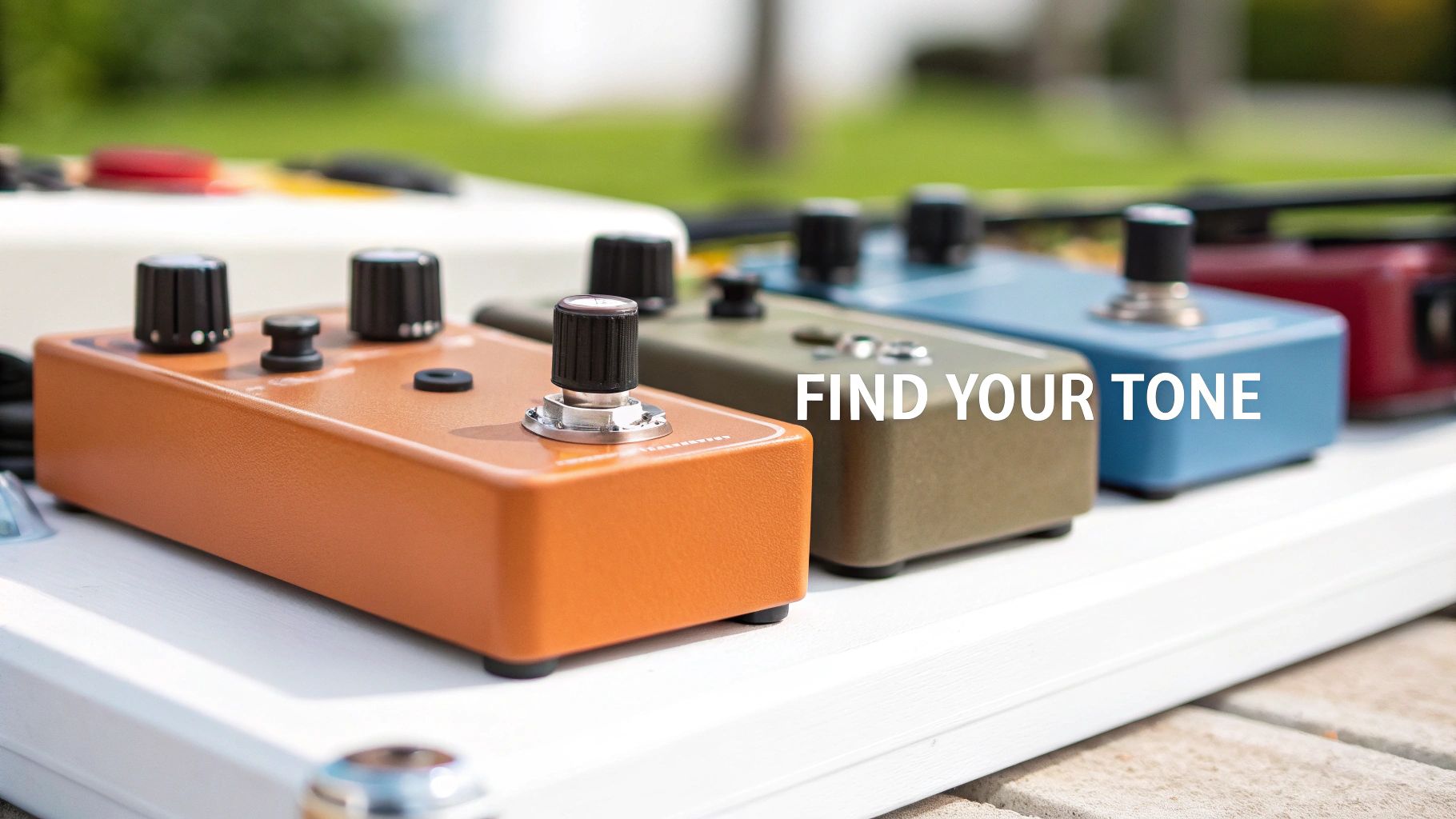
If your guitar and amp are the main course, effects pedals are the spices. They add texture, depth, and personality to your core sound. The key is to arrange them in a logical signal chain—the path your signal travels from the guitar to the amp.
Here are the essential pedal categories every lead guitarist should know:
Finding your tone is a personal journey of discovery. The fun is in the experimentation, so plug things in, twist some knobs, and start sculpting a sound that is uniquely yours.
Knowing your scales and techniques is like having a workshop full of professional-grade tools. That's a great start, but just owning a hammer doesn't make you a carpenter. The real craft begins when you learn how to use those tools together to build something that feels alive. This is where we stop running drills and start making music.
The secret isn't just about putting in more hours; it's about making those hours count. A smart, structured routine is what turns isolated exercises into an instinctive musical vocabulary. You're building a workflow that sharpens your technique, trains your ear, and sparks your creativity—all at the same time.
A great practice session is more than just noodling or running through random licks. Think of it as a balanced workout for your playing, hitting the three core pillars of lead guitar: technical chops, musical application, and creative exploration. A scattershot approach will get you stuck on plateaus, but a focused plan builds real momentum.
Here's a simple framework you can steal and make your own:
Look, the single most important thing you can do is be consistent. Even 20 minutes of focused, daily practice will do more for you than a four-hour cram session once a week. You're building neural pathways, and repetition is what makes them stick.
If there's one tool that will launch you from a bedroom player to a confident soloist, it's the jam track. These are basically pre-recorded bands-in-a-box—usually just drums, bass, and some rhythm guitar—that give you a musical canvas to solo over. They are an absolute game-changer.
Playing along to a jam track forces you to do several critical things at once:
This real-time application makes jam tracks incredibly powerful. You stop thinking about scale shapes and start thinking about crafting melodies that actually fit the song. For some great ideas on how to get the most out of your practice time, check out these five smart practice tips for guitar players.
Learning solos note-for-note from your heroes is one of the single best ways to absorb new musical language. It's like a young writer studying the great novels to understand sentence structure and storytelling. When you transcribe a solo, you're not just copying notes; you're reverse-engineering the thought process of a master.
Start small. Don't try to tackle a three-minute Eddie Van Halen masterpiece on day one. Instead, pick one four-bar phrase that really speaks to you. Use software to slow it down without changing the pitch and loop it over and over. Figure out the notes, but pay even closer attention to how they're played. Is there a half-step bend? A quick slide into a note? That signature vibrato?
By dissecting these little musical "sentences," you add them to your own vocabulary. Before you know it, you'll find yourself naturally weaving these ideas into your own improvisations, blending them with your own style, and creating something completely new. This process of listening, learning, and integrating is what will ultimately shape your unique voice on the guitar.
You've put in the work and built an incredible foundation. That's a huge accomplishment. But as any seasoned player will tell you, the path of a lead guitarist is a lifelong journey. What comes next is pushing beyond those familiar patterns and diving into the concepts that keep your playing fresh and prevent you from hitting that dreaded plateau. This is where the real fun begins, and you start unlocking your unique voice on the fretboard.
To really elevate your solos, you need to start weaving in more advanced musical ideas. We're talking about concepts that specifically outline the chord changes happening underneath you, adding a whole new layer of sophistication to your playing.
Here's where to start:
The most important thing is to stay curious, keep your ears open, and never, ever stop learning. Your skills as a lead guitarist are a direct reflection of your dedication to exploring new musical territory.
This commitment to continued learning is what separates the good guitarists from the truly great ones. A structured learning path with expert guidance is the fastest way to progress.
When you're first diving into the world of lead guitar, a few questions always seem to pop up. Trust me, we've all been there. Getting straight answers can be the difference between sticking with it and letting your guitar gather dust in the corner.
Let's tackle some of the most common ones I hear from students.
This is the big one, isn't it? The honest answer is... it depends. But what I can tell you is that consistency beats intensity every single time. You don't need to practice for hours on end, but you do need to pick up the guitar every day.
Most players I've worked with start to feel a real sense of confidence—nailing scales, playing simple solos, and improvising a bit—within six to twelve months of dedicated daily practice. It's a marathon, not a sprint.
It's so easy to get bogged down by the endless gear options out there. The good news? You don't need a wall of amps or a pedalboard that looks like a spaceship cockpit.
All you really need is a setup that makes you want to play. A comfortable electric guitar and a small practice amp, preferably one with a built-in gain or overdrive channel, are more than enough to get you started on every single technique we've covered.
Remember, some of the most legendary guitarists in history made timeless music with ridiculously simple rigs. Your focus should always be on what your hands and ears are doing. The gear is just there to make it louder.
Look, you can absolutely learn solos by watching YouTube videos or using tabs. Plenty of people do. But knowing a little music theory is like being handed a map to a city you've only been navigating by memory.
It's the difference between memorizing a few phrases in another language and actually knowing how to speak it. Understanding keys and how scales fit over chords is what will ultimately allow you to improvise freely and make musical choices on the fly, instead of just guessing and hoping for the best. It's a skill that pays off for your entire musical life.
Finally, a lot of players wonder if they should learn solos first or get their chords down. My advice? Do both. Rhythm and chords are the foundation of the music. A great lead guitarist always knows what's happening harmonically underneath their solo. Practicing both from the get-go will make you a much stronger, more complete musician in the long run.
Ready to stop guessing and start following a clear, structured path? The expert instructors and interactive tools at TrueFire are built to get you where you want to go, faster. Grab your TrueFire All Access Trial today and unlock thousands of lessons to keep your lead guitar journey moving forward.
