So you want to start playing guitar? Excellent choice. The path is as simple as choosing a good starter instrument, learning how to hold it, and getting a few basic chords under your fingers. That’s it. After that, it’s all about consistent, focused practice—the real secret to playing your first songs and actually having fun with it.
Welcome to the beginning of a seriously rewarding musical adventure. Just by being here, you’ve already cleared the biggest hurdle in learning guitar: you decided to start. That initial spark is everything, and as your guide, I'm here to help you channel that energy into real, tangible progress.
First, let's bust a huge myth. You don't need "natural talent" to play guitar. I've seen it time and time again in my students—passion and a little bit of daily practice will beat raw talent every single time. The goal isn't to become a guitar hero overnight. It's about finding the joy in making music, one chord at a time.
The world of music education has been completely transformed. You're joining a massive global community of people learning to play online. Think about it: that moment you pick up a guitar for the first time is an experience shared by millions. The global market for guitar lessons hit an incredible USD 2.42 billion in 2024, mostly because online platforms have made it so much easier for anyone to get started with world-class instructors.
This modern approach puts you in the driver's seat with tools that just weren't available to beginners a decade ago. We’re talking about things like:
To help you get going, here’s a quick checklist of the first few milestones you’ll want to hit.
This table breaks down the essential first steps for any new player. Think of it as your immediate action plan to get the ball rolling and build momentum from day one.
| Milestone | Why It Matters | Key Action |
|---|---|---|
| Choose Your Guitar | An instrument you love is one you'll want to pick up every day. | Decide between acoustic or electric based on your favorite music. |
| Learn Basic Anatomy | Knowing the parts helps you understand instructions and set up your gear. | Identify the headstock, neck, body, bridge, and tuning pegs. |
| Tune Your Guitar | An out-of-tune guitar sounds bad, no matter how well you play. | Use a clip-on tuner or a tuning app to get your strings to E-A-D-G-B-E. |
| Master Good Posture | Proper posture prevents bad habits and physical strain down the road. | Sit up straight, rest the guitar comfortably on your leg, and keep your wrist relaxed. |
| Learn 3 Basic Chords | These are the building blocks for thousands of popular songs. | Start with G, C, and D major. Focus on clean-sounding notes. |
Following these steps will give you a solid foundation and a sense of accomplishment right from the start, which is crucial for staying motivated.
The number one reason people quit guitar is getting frustrated by a lack of clear direction. A structured plan turns small daily efforts into real progress you can actually hear and feel.
This guide will give you that structure. We'll walk you through picking your first axe, nailing those essential chords, building a solid practice habit, and pushing through the hurdles every single new player faces. Before you know it, you'll be jamming on your favorite tunes.
For a little more insight on what to expect, check out our guide on the 7 things they didn’t tell me when I started guitar.
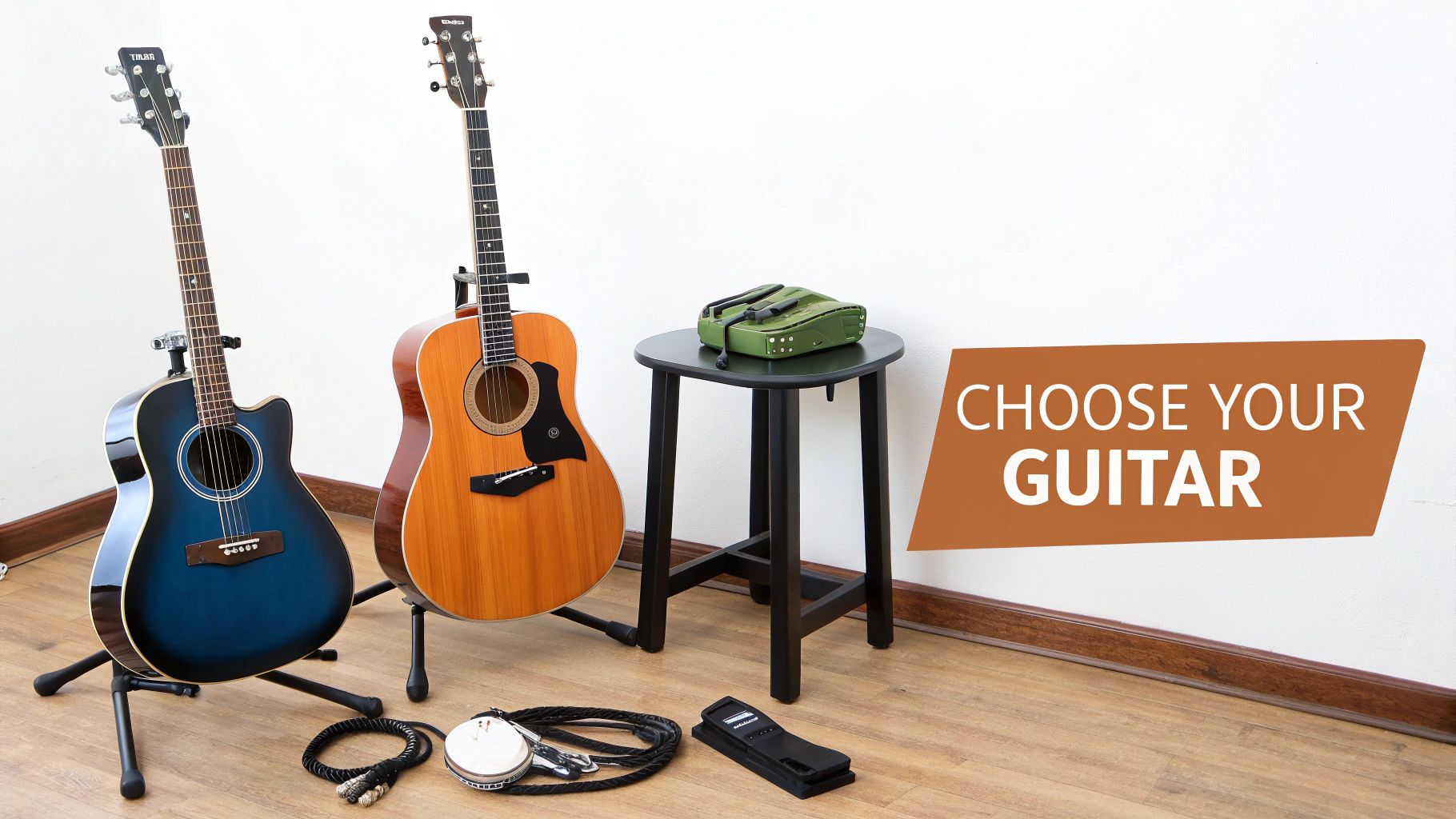
Alright, let's talk about the most exciting—and sometimes nerve-wracking—part of starting your guitar journey: picking out your very first instrument. This is a big deal. The right guitar feels like a friend, practically begging you to pick it up and play. The wrong one? It can feel like a frustrating chore.
Ultimately, your choice will come down to one of three main types: the steel-string acoustic, the nylon-string classical, or the electric guitar. There’s no secret "best" option here. It all comes down to the kind of music you're dying to play and the sounds that get you fired up.
For a lot of new players, the acoustic guitar is the go-to starting point. It's a completely self-contained instrument—no amps, no cables, no fuss. You can play it anywhere. Its classic, full-bodied tone is the sound of countless folk, pop, and country songs.
The steel strings do require a bit more finger pressure, which is great for building hand strength but can be a little tough on your fingertips when you're just starting out. It's a rite of passage for every guitarist.
On the flip side, you have the electric guitar. Many beginners find its slim neck and lighter-gauge strings much easier on the hands at first. Of course, you’ll need an amplifier to hear it properly, but that opens up a massive world of sounds, from sparkling clean tones to heavy, distorted rock power. If your heroes are Slash, Hendrix, or Joan Jett, this is probably your path.
As a teacher for years, my advice is always the same: choose the guitar that plays the music you love. If you’re dreaming of cranking out classic rock riffs, an acoustic is going to feel like a letdown. If your goal is to strum chords around a campfire, lugging an electric and an amp is just impractical. Your passion for the music is the single biggest motivator you have.
This decision is part of a huge industry. The global guitar market hit USD 19.70 billion in 2024 and is expected to grow to USD 29.29 billion by 2032. While electrics get a lot of love, the acoustic market is a beast, especially for beginners, which means there are more great, affordable starter options than ever before.
To really get into the weeds on this, check out our complete guide on what kind of guitar you should buy. It'll walk you through all the nuances to help you make a choice you feel great about.
Once you've got your guitar, you'll need a few other things to get going. A word of advice from experience: don't get suckered into those giant "beginner packs" that are stuffed with low-quality gear you'll never touch. Just focus on the essentials that actually make a difference on day one.
Here’s what you absolutely need:
Getting these core items right sets you up for a much smoother learning curve. It’s all about removing those little frustrations that can trip up a new player.
Okay, your guitar is tuned up and ready to go. This is where the real fun begins. You're about to take that wooden box and make it speak a language everyone understands, and it all starts with the building blocks of nearly every song you love: chords and strums.
Don't get hung up on sounding perfect right out of the gate. Every single guitarist—from the legends plastered on your wall to the person playing at your local open mic night—started exactly where you are, fumbling with weird finger positions and just trying to get a clean sound. The secret is patience and building good habits from the very first note.
They call these "cowboy chords" for a reason—they're the simple, open-position shapes that are the backbone of countless folk, country, rock, and pop tunes. Nailing just a few of these will unlock a huge catalog of songs you can actually play. We'll start with five absolute essentials: G, C, D, Em (E minor), and Am (A minor).
Let's kick things off with a G Major chord. This one can feel like a bit of a stretch at first, but it's everywhere in popular music. Place your middle finger on the 3rd fret of the low E string (the thickest one), your index finger on the 2nd fret of the A string, and your ring finger on the 3rd fret of the high E string (the thinnest one).
Now, give all six strings a strum. How does it sound? If you hear some buzzing or a few dead notes, don't sweat it. That's completely normal. The usual culprit is a finger accidentally laying flat and touching a string it shouldn't be.
Pro Tip: Try arching your fretting hand fingers like you’re holding a baseball. Creating this "claw" shape helps your fingertips press straight down, keeping them from leaning over and muting the neighboring strings. It’s a tiny adjustment that makes a massive difference.
Once you’re getting a mostly clean G chord, it's time to tackle C Major and D Major. These three chords (G, C, and D) form a powerhouse trio that shows up in thousands of hits, from classic rock anthems to today's chart-toppers.
Here’s a quick rundown of the other must-know beginner chords:
Focus on one shape at a time. Press down, strum, release, and repeat. You're training your fingers to remember where to go without you having to think about it. This is muscle memory, and it's just like learning to type—at first you hunt for every key, but pretty soon your fingers just know the way.
A chord by itself is just a static sound. Strumming is what injects the rhythm, energy, and life into your playing. The absolute simplest strum is a steady downstroke on every beat. If you have a metronome (or an app), set it to a slow tempo and just strum down on every single click: "1, 2, 3, 4."
That basic pulse is the bedrock of all rhythm. Once that feels solid, you can add upstrokes. A classic pattern that works for almost anything is Down, Down-Up, Down, Down-Up. This immediately creates a more dynamic feel and is used all over the place in modern music.
Here’s a little secret from a seasoned teacher: solid rhythm is more important than perfect chords when you’re starting. It sounds much better to play a slightly buzzy chord right on the beat than it does to pause the entire song just to get a flawless finger placement. Your timing is what makes music feel like music.
For a deeper dive into this crucial skill, our course on strumming patterns you must know is a fantastic resource to help build your rhythmic confidence.
The goal here is a relaxed, fluid motion. Your strumming hand should move from the wrist and elbow, not your whole arm. Think of it like waving—a smooth, consistent movement that keeps the rhythm steady.
This early phase is all about repetition and being patient with yourself. Your fingertips will get sore, and some chords will feel impossible at first, but just stick with it. Every practice session, even just 15 minutes, is building calluses and locking in that muscle memory. Before you know it, you won't even have to think about it.
So, you’ve got your guitar, you know a couple of chords, and you can sort of manage a strum. Awesome. This is where the real work begins, but it’s also the exact spot where most people hit a wall and give up.
Here’s the secret nobody tells you: learning guitar isn’t about heroic, multi-hour practice sessions. It’s about consistency. A focused 20 minutes every single day will smoke a frustrating three-hour cram session once a week. Every time.
Let’s be real, it can feel like a mountain to climb at first. But you're not alone—far from it. The guitar instruction world has exploded from $936.15 million in 2021 and hit $1.2 billion in 2025. What's driving that? An incredible 65% of new players are picking up the guitar just for the sheer joy of it. Online tools have made it easier than ever to get on a structured path that actually gets results.
Forget the guesswork. This is your 90-day roadmap to build muscle memory, lock in your rhythm, and finally start playing actual music.
The mission for your first month is simple: get your chords to sound clean and your transitions between them to be smooth and in time. This isn't a race. It’s about building a solid base. Your fingers need to develop calluses and learn the chord shapes by feel, so just be patient with them.
Here’s what a solid practice week looks like for the first month:
A muted string played in time sounds a million times better than a perfect chord played out of time. Rhythm is the glue. Nail your timing, and the clean chords will come with repetition.
This whole process follows a pretty logical path, from just holding the instrument to actually making music with it.
Alright, you've got a handle on the absolute basics. Now it’s time to start sounding like a real guitar player. This month is all about adding new chords, learning more interesting strumming patterns, and tackling your first honest-to-goodness songs. This is when it stops feeling like an exercise and starts feeling like music.
Here’s how to level up your practice routine:
By the end of month three, the goal is to play a few full songs with confidence. Your transitions should be getting smoother, and you should have a solid internal sense of rhythm. Now we're integrating everything and starting to think about musicality.
Your practice sessions can become a lot more fun and dynamic:
For some deeper strategies on getting the most out of every minute you practice, check out our guide on 5 smart practice tips for guitar players.
This kind of structured plan takes away the anxiety of not knowing what to practice next. It gives you small, achievable wins that build on each other, creating the momentum you need to stick with it.
Let’s get one thing straight: every single new guitarist struggles. It’s a universal rite of passage. If your fingertips are screaming, your chords sound like a muffled mess, and you feel like you're moving in slow motion, congratulations—you're doing it right.
These aren't signs of failure; they're proof that you're putting in the work. From years of teaching, I can tell you the difference between someone who quits and someone who thrives isn't talent. It’s all about learning how to push through these predictable roadblocks.
Think of this as your troubleshooting guide for the most common frustrations you're about to face.
The number one complaint from every beginner is finger pain. It's inevitable. Your fingertips are soft, and a steel guitar string is basically a thin wire. Pressing them together is going to be uncomfortable at first, but this is a temporary phase.
You're building up calluses—toughened patches of skin that will soon make playing completely painless. Think of it like breaking in a new pair of shoes. It's rough at first, but it gets better with consistent, short-term use.
So you’ve got your fingers in the perfect chord shape, but when you strum, all you hear is a collection of buzzes and thuds. This is usually caused by two things: not pressing close enough to the fret, or another finger accidentally touching an adjacent string.
To fix this, get surgical with your finger placement. Your fingertip should press down just behind the metal fret wire, not way back in the middle of the fret. This is the sweet spot that requires the least amount of pressure to produce a clean note.
As a teacher, I stress this constantly: proper hand posture is the key to clean chords. Try to arch your fingers like you’re holding a ball. This creates a "claw" shape that lets your fingertips press straight down, preventing them from leaning over and killing the strings next to them.
Switching from a G chord to a C chord can feel like a clumsy, disjointed mess at first. Your fingers seem to have a mind of their own, moving one at a time. This is completely normal. You haven't built the muscle memory yet.
The secret to faster chord changes is to practice them painfully slow. Seriously. Don't even strum. Just focus on lifting all your fingers at once and landing them in the next chord shape simultaneously.
It's also crucial to realize that timing is more important than perfection in the beginning. It's far better to play a slightly muffled chord that's on the beat than to pause the song to form a perfect one. Rhythm is king. To get a better handle on this, you can read more about the 7 mistakes every beginner guitarist makes and how to sidestep them.
By anticipating these common issues, you'll be prepared to tackle them head-on without getting discouraged. Remember, these hurdles are temporary checkpoints on your journey, not permanent walls.
So, you made it. You’ve put in the work, built up those calluses, and your fingers actually remember where to go for those first few chords. Take a second to appreciate that—it’s a huge milestone.
The journey from here is all about turning those foundational skills into real, expressive music. We're about to shift from just playing chords to understanding why certain chords sound so good together. This is where the real musicality begins.
The road ahead means expanding your musical vocabulary in a few key areas. You’ll finally move beyond those basic open chords (sometimes called "cowboy chords") and start tackling new shapes, including the infamous barre chords that seem to unlock the entire fretboard at once. This is also the perfect time to dip your toes into your first scales, which are the building blocks of every melody and solo you’ve ever loved.
This transition from beginner to intermediate is exactly where so many self-taught players hit a wall. They can strum through a handful of songs but feel stuck, unsure of how to connect the dots and move forward. A structured learning path is the fastest way to bridge that gap, making sure every new skill builds logically on the last.
Your next phase of learning should be all about three core components. Think of them as legs on a stool—they all work together to make you a more versatile and confident musician. We're not just collecting more stuff; we're learning how it all fits together.
The moment you realize a simple scale can create a powerful solo over a chord progression you already know is a true light-bulb experience. It’s when the fretboard stops being a collection of random notes and starts looking like a map.
This integrated approach is precisely where a platform like TrueFire shines. Their Learning Paths are expertly designed to guide you from one skill to the next, so you never have to wonder "what's next?" With multi-angle videos, you can see exactly how a pro frets a tricky chord, while the massive library of song lessons provides a fun, real-world context for applying everything you're learning.
Every new player has questions. It’s part of the process! Getting solid answers from people who’ve been there helps cut through the noise and gets you playing faster. Let's tackle a couple of the most common ones I hear.
This is the big one, isn't it? The honest answer is that with consistent, daily practice of around 20-30 minutes, most folks can get the basic chords down and strum through some simple songs within 2-3 months.
The key isn't how long you practice, but how often. Short, focused sessions every day are way more powerful for building muscle memory than one marathon session on a Saturday. Everyone's journey is different, so don't compare yourself to others—just focus on picking up the guitar today.
Honestly, the best guitar is the one that makes you want to pick it up and play. If you're dreaming of cranking out rock riffs, get an electric. If you see yourself strumming by a campfire, an acoustic is your best bet.
An acoustic's heavier strings will definitely build up your finger strength, but an electric is often a bit kinder on beginner fingertips. There's no wrong answer here. Go with the instrument that plays the kind of music you love.
Ready to stop wondering and start playing? TrueFire gives you a clear, structured path with lessons from the world's best educators. Kickstart your journey with a TrueFire All Access Trial.
