To get started, you first need a guitar. The big decision is whether to go with an acoustic or an electric, and you’ll also want to grab a few key accessories—think a tuner, some picks, and a strap. After that, it's all about getting comfortable with your instrument, learning how to hold it, and then diving into your first chords and strums. As a music educator, my goal is to give you a clear, practical path that avoids common frustrations and gets you playing music as quickly as possible.
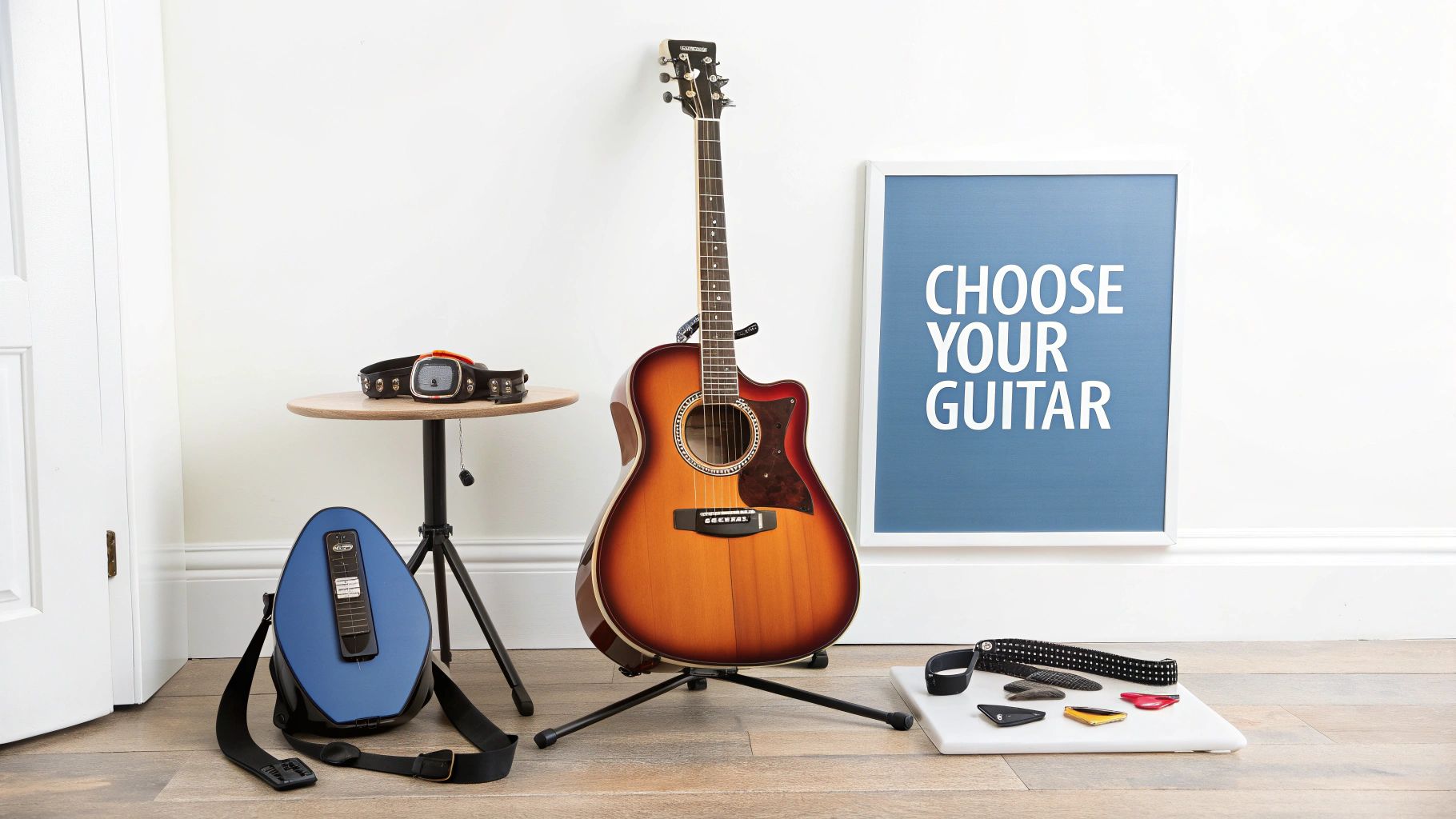
Alright, this is the fun part—picking out your very first guitar. It feels like a huge, make-or-break decision, but honestly, it all boils down to one simple question: What kind of music gets you excited to play?
Let your musical taste be your guide here. If you're all about the vibe of singer-songwriters like Ed Sheeran or Taylor Swift, or you just love the straightforward sound of folk and country, an acoustic guitar is going to be your best friend. It’s the most direct route to playing those styles.
But if you're dreaming of cranking out rock anthems, bending notes in a blues solo, or chugging heavy metal riffs, you'll want an electric guitar. Don't listen to that old myth that you have to start on an acoustic. The best guitar for you is the one that makes you want to pick it up and practice every single day.
The choice between an acoustic and an electric isn't just about the sound. They feel different to play, come with different price tags, and have unique requirements that will shape your first few months of learning.
An acoustic guitar is a self-contained unit. You can literally play it anywhere, anytime. An electric, on the other hand, is a bit more of a production—it needs an amplifier and a cable just to make a sound.
The best beginner guitar is the one that makes you want to play. If you love rock music, get an electric. If you love folk, get an acoustic. Inspiration is the most powerful tool a new musician has.
To help you figure out what makes the most sense for your goals and your life, here’s a quick rundown of how they stack up.
This table breaks down the key differences to help you choose the right type of guitar when you're just starting out.
| Feature | Acoustic Guitar | Electric Guitar |
|---|---|---|
| Playability | Higher action and thicker strings can be tougher on beginner fingers. | Lighter strings and lower action are generally easier to press down. |
| Sound | Produces a rich, natural sound on its own without amplification. | Requires an amplifier to produce its sound; offers a wide range of tones. |
| Cost | A decent beginner acoustic package is often more affordable upfront. | Initial cost is higher due to the need for an amplifier and cable. |
| Best For | Folk, country, pop, singer-songwriter styles, and unplugged playing. | Rock, blues, metal, jazz, and genres requiring sound effects or volume. |
| Portability | Highly portable; you can take it anywhere and play immediately. | Less portable due to the need for an amp and power source. |
At the end of the day, there’s no wrong answer. If you want to get into the nitty-gritty of different models and features, check out our guide on what kind of guitar to buy to help you make a more informed choice.
Walk into any music store, and you'll be hit with a wall of gadgets and accessories. It's overwhelming. The good news? You only need three things to get going. Everything else is optional for now.
Keeping it simple helps you stay focused on what matters: playing. You’re not alone on this journey; the global guitar instruction market was valued at $936.15 million in 2021 and is still growing, thanks to a huge wave of new players. Online lessons spiked by 25% in 2023, and a lot of that growth is fueled by beginners starting out on affordable acoustic guitars, which average around $200.
Picking your gear is your first win. By choosing an instrument that genuinely excites you and grabbing only the essential tools, you're setting yourself up for success.
Holding a guitar for the first time feels weird. Let’s just get that out of the way. It’s this oddly-shaped wooden thing, and figuring out how to wrangle it into a comfortable position is your first real challenge. Don’t worry—every single guitarist has been there.
But getting comfortable from the jump is a really big deal. It helps you avoid picking up bad habits that can lead to soreness or strain later on.
Before we get into posture, let's quickly go over a few key parts of the guitar. Knowing what to call these things makes it much easier to follow along with lessons and videos.
Think of these as your main points of contact. How you interact with them is the difference between feeling clumsy and feeling in control.
Before you even think about playing a note, you have to tune your guitar. An out-of-tune instrument makes even perfectly-played chords sound awful, which is a surefire way to get discouraged.
This is a non-negotiable step. Get in the habit of tuning up every single time you pick up your guitar.
The standard tuning for a six-string guitar is, from the thickest string (closest to your face) to the thinnest: E - A - D - G - B - E.
Need a way to remember that? Try this classic mnemonic: Eddie Ate Dynamite, Good Bye Eddie.
Grab a clip-on tuner or download a tuner app on your phone. Clip-on tuners are usually a bit more accurate since they feel the vibrations right from the wood, but an app will absolutely get the job done.
Tuning your guitar every time you play is the single best thing you can do for your ear. It constantly reminds your brain what the correct pitches sound like, which is a fundamental skill for any musician.
Alright, you're in tune. Now, let's get you sitting comfortably. Good posture isn't about looking cool; it's about playing efficiently and staying pain-free. Slouching can lead to back pain, wrist strain, and shoulder tension, all of which will cut your practice time short.
Whether you sit or stand, the goal is the same: keep the guitar stable and your body relaxed.
If you’re sitting down, grab a chair without armrests and sit up straight. Rest the curved part of the guitar's body on your right thigh (assuming you're right-handed). Your right arm should drape comfortably over the body, letting your hand hang naturally over the strings.
Your left hand should support the neck—not strangle it. Keep your thumb resting lightly on the back of the neck for support. You should feel relaxed, not tense.
Getting these fundamentals right—tuning and posture—sets the stage for everything that comes next. Nail these simple things, and you’ll have a much easier time learning chords, strumming, and eventually, your favorite songs.
Alright, you've got your guitar in hand, it’s tuned up, and you’re holding it right. This is where the magic starts to happen—turning random noises into actual music.
We’re about to put your fingers to work on the fretboard with four simple chords. Forget about memorizing scales or heavy music theory for now. The goal here is to get you playing something that sounds like a song, fast. We'll be focusing on G, C, D, and E minor (Em), often called "campfire chords" because once you've got them down, you can play literally thousands of tunes.
The trick to a clean-sounding chord is pressing the strings down firmly, just behind the metal fret wire—not right on top of it. Your fingertips need to be curled, kind of like you're holding a small ball. This arch is crucial because it stops your fingers from accidentally touching and muting the strings next to them.
Fair warning: it’s going to feel awkward at first. Your fingertips will get sore. Don't worry, that's completely normal. Every single guitarist has gone through this phase. Stick with it for a week or two, and you’ll start building up calluses that make it completely painless.
Let’s get familiar with the "big four" beginner chords:
Here's a pro tip for getting your chords to ring out cleanly: Once you form the chord shape, pluck each string one by one. If you hear a dull "thud" instead of a clear note, a finger is probably leaning on a string it shouldn't be. Tweak your finger position until every note sings.
Holding down a chord is only half the story. You need rhythm to bring it to life, and that's where strumming comes in. Instead of overwhelming you with a dozen different patterns, let's lock in one incredibly versatile pattern that will carry you through countless songs.
We're going to count to four: "1 and 2 and 3 and 4 and." Think of the numbers as your downstrums (picking from the thickest string down to the thinnest) and the "ands" as your upstrums (picking from thin to thick).
Here’s the pattern: Down - Down - Up - - Up - Down - Up
Let's map that onto our count:
| Count | 1 | and | 2 | and | 3 | and | 4 | and |
|---|---|---|---|---|---|---|---|---|
| Strum | Down | Down | Up | (miss) | Up | Down | Up | (miss) |
See how you skip the strums on the "and" of 2 and the "and" of 4? That little gap is what creates a real rhythmic feel, making it sound much more musical than just strumming up and down constantly.
Practice this pattern on a single chord until the motion feels natural and your arm is nice and loose. Once you're comfortable, you can find more lessons on strumming patterns to build up your rhythmic toolkit.
This is it. The single biggest roadblock for every new guitarist. Getting your fingers to fly from one chord shape to the next in time with the music feels downright impossible at first. But the secret isn't about speed—it's about muscle memory and anticipation.
You need to drill these shapes until your brain and fingers just know them without you having to think. The only way to build that connection is through slow, deliberate practice.
Try these exercises—they're my go-to's for beginners:
By focusing on these foundational chords and one solid strumming pattern, you’re building the exact skills you need to start playing real songs right away. This approach gives you those crucial early wins that build the confidence to keep going.
Let's get one thing straight: the secret to learning guitar isn't locking yourself away for hours at a time. It's all about consistency. Seriously, a focused 15-20 minutes every single day will build your skills and muscle memory way faster than a massive three-hour session once a week.
This 30-day plan is built to make practice a habit you actually look forward to, not a chore. We'll break everything down into manageable, week-by-week goals. You'll see real results, which is the best motivation there is.
Your first week is all about getting comfortable and making clean sounds. Forget about speed or fancy rhythms for now. Just focus on clear chords and a simple, steady strum.
By the end of the week, you should be able to form those four basic shapes without staring at a diagram every time. And yes, your fingers will probably be sore. That's a good thing! It's the first step to building your calluses.
Okay, you've got the basic chord shapes down. Now it's time to tackle the first big hurdle for every beginner: switching between them smoothly. This week is all about the transitions.
The goal here is to move from one chord to the next without your strumming hand ever stopping. This is where a lot of new players get frustrated, but the key is to prioritize rhythm over perfection. A slightly messy chord played in time sounds way better than a perfect chord that's late to the party.
A muted or fluffed note played in time is infinitely more pleasant to the ear than a perfectly fretted note that's off the beat. Focus on your timing first, and the accuracy will follow with practice.
If you want to dig deeper into practicing efficiently, check out these 5 smart practice tips for guitar players.
This is the week where it all starts clicking. You have four chords and a basic strum in your toolkit, which means you can finally play simplified versions of actual songs. This is a huge milestone and a massive motivator.
As you can see, each skill builds on the last. You're turning isolated techniques into the real ability to play music. Don't believe me? Here are a handful of famous songs you can already play.
With just a few basic chords, a whole world of music opens up. This table lists some popular songs you can start playing almost immediately.
| Song Title | Artist | Chords Used |
|---|---|---|
| "Sweet Home Alabama" | Lynyrd Skynyrd | D, C, G |
| "Bad Moon Rising" | Creedence Clearwater Revival | D, A, G |
| "Three Little Birds" | Bob Marley | A, D, E |
| "Horse With No Name" | America | Em, D |
| "Leaving on a Jet Plane" | John Denver | G, C, D |
Picking a song you love is one of the best ways to stay motivated. Find a simple tutorial and give one of these a try!
In the final week of your first month, we’re shifting focus to timing and musicality. It's time to introduce a new tool and tackle a full four-chord progression.
Meet your new best friend: the metronome. This simple tool provides a steady click that forces you to play in perfect time. You can use a physical one, but a free app on your phone works just as well.
This structured approach is what separates players who progress from those who get stuck. By following this 30-day plan, you've built a solid foundation and, more importantly, a consistent practice habit. You're ready for what's next.
There has honestly never been a better time to learn an instrument. We're living in an age where a wealth of tools can seriously accelerate your journey from fumbling with your first chord to confidently playing your favorite songs. Think of these resources as your personal coaching staff, available 24/7, right in your pocket.
These tools aren't just flashy novelties; they solve the real problems every single beginner runs into. From keeping perfect time to figuring out that tricky riff, the right app or resource can help you leap over common hurdles and make your practice time way more effective.
Your smartphone is probably one of the most powerful practice tools you own. Don't get lost in the sea of apps out there; you really only need two types to get started, and you can find excellent free versions for both.
First up, you need a guitar tuner. As we've already covered, playing an out-of-tune guitar is one of the fastest ways to get frustrated and want to quit. A tuner app simply uses your phone's microphone to hear the pitch of each string and guide you to a perfect tune-up. It's a non-negotiable.
Second, a metronome is absolutely essential for building a rock-solid sense of rhythm. It just provides a steady click, forcing you to play in time and helping you nail those tricky chord changes without rushing or dragging your feet. Getting into the habit of using a metronome from day one is something your future self will thank you for.
For decades, if you wanted to learn a song, you either needed a great ear or had to know how to read standard sheet music. Guitar tablature, or "tabs," changed the game completely. Tabs are basically a simplified form of musical notation made specifically for guitar.
A guitar tab is a visual map of the guitar's six strings. Numbers on the strings tell you which fret to press. It’s a super intuitive system that lets you start learning melodies and riffs almost immediately, without any heavy music theory.
This direct, visual approach is perfect for beginners who are itching to play something that sounds like real music. It removes a massive barrier and helps you build a library of songs you actually love, which is a huge motivator to keep picking up the guitar.
Practicing chords and scales with a metronome is crucial, but let's be real—it can get a little dry. This is where jam tracks come in. These are pre-recorded backing tracks, giving you a virtual band to play along with right in your practice space.
Playing along with a jam track has some massive benefits:
The digital revolution in music education has been huge. The guitar learning apps market hit $325 million in 2023 and is projected to reach $3.2 billion by 2028. Platforms like TrueFire are at the center of this, offering over 30,000 tabs and 20,000 jam tracks you can access anywhere. With 65% of players preferring to learn songs by ear, these band-in-a-box resources provide the perfect context to train your ears and develop your musicality.
Structured online learning paths guide you from one skill to the next, preventing those frustrating plateaus where so many self-taught players get stuck. This combination of powerful tools and an expert-led curriculum is the modern way to master the guitar.
If you're just starting, your head is probably swimming with questions. That's completely normal. Every single guitarist on the planet—even your heroes—started right where you are, wondering the same things.
My goal here is to cut through the noise and give you some straight, honest answers to the questions I hear most often from new players. Let's clear up the confusion so you can get back to what matters: making music.
Yep, but stick with it—it doesn't last long. Sore fingertips are a rite of passage for every guitarist. Think about it: you’re forcing soft skin against thin steel strings. It’s going to be a little uncomfortable at first.
The good news is that this is temporary. If you play consistently for just 15-20 minutes a day, you’ll start building up calluses in a week or two. These are just small patches of tough skin that act as nature's guitar picks for your fingers. Soon enough, you won't feel a thing.
Pro Tip: Lighten up your grip. A classic beginner mistake is the "death grip," where you press down way harder than you need to. You only need enough pressure to get a clean note. Anything more is just hurting your fingers and your technique.
This is the big one, right? And the answer is almost always "sooner than you think." If you follow the 30-day plan we laid out, you could be strumming a simple, three-chord song by Week 3. It might be a little rough around the edges, but it'll be a real song, played by you.
The secret isn’t about time; it’s about focus. Concentrate on nailing a few core chords (like G, C, D, and Em) and one solid strumming pattern. That alone unlocks thousands of popular songs. Don't get sidetracked trying to learn everything at once. Fundamentals first.
This is almost always a simple hand-positioning issue, and it's totally fixable. When your chords sound muffled or buzzy, it usually comes down to one of two things:
A great way to troubleshoot this is to form a chord, then pick each string one by one. Hear that "thud"? That's the problem string. Find which finger is causing it and adjust its position until the note rings clear. For a deeper look at this and other common hurdles, check out our guide on the 7 mistakes every beginner guitarist makes.
Forget about marathon sessions. Consistency beats intensity every single time. A focused 20-minute session every day will do more for your playing than a three-hour cram session once a week. It’s not even close.
Daily practice is how you build muscle memory. Your fingers and your brain learn best through short, regular repetition. This approach keeps you from burning out and turns practice from a chore into a rewarding daily habit.
Getting these questions answered is a great first step, but real, lasting progress comes from following a structured path. Expert guidance can be the difference between giving up in frustration and truly finding your groove. If you’re ready for a clear, step-by-step curriculum, I can’t recommend a TrueFire All Access Trial enough. You’ll get access to thousands of lessons from world-class players to guide you on your journey. https://truefire.com
