The CAGED system for guitar is a powerful method that helps you finally make sense of the entire fretboard. It’s all built on five basic open chord shapes you probably already know: C, A, G, E, and D.
Think of it as a visual roadmap. The CAGED system turns these familiar shapes into movable patterns, giving you the keys to play any chord, scale, or arppegio, in any key, anywhere on the neck. It's a foundational concept that every serious guitarist should master.
Imagine trying to navigate a new city without a map. You might know a few streets right around your house, but the rest of it feels like a confusing, intimidating maze. For a lot of guitar players, the fretboard is that uncharted city.
The CAGED system is your GPS. It connects everything.
Instead of staring at a random grid of 120+ notes, this system gives you five familiar landmarks—those open chord shapes for C, A, G, E, and D. But here’s the secret: they aren't just for strumming cowboy chords around a campfire. They are the fundamental building blocks of music all over the instrument.
Here’s the real "aha!" moment: these shapes are not stuck in one place. By using a barre or just your index finger as a movable capo, that open 'E' shape suddenly becomes an 'F' chord at the first fret. Slide it up to the third fret, and it’s a 'G' chord. And on it goes.
This simple principle works for all five shapes.
This system gives you a framework that instantly organizes:
The core idea is simple but totally profound: the entire fretboard is just a repeating sequence of these five shapes linked together. Once you see the connections, you can never unsee them.
First developed back in the 1970s, the CAGED system completely changed how players approached fretboard navigation by making theory visual and practical. It’s not just a fad. A 1992 study from Berklee College of Music even found that students using CAGED progressed 45% faster in learning scales compared to traditional methods, simply because it directly links chord forms to scale patterns.
To give you a quick visual, here are the five shapes that form the foundation of the whole system.
| Shape | Represents | Primary Function |
|---|---|---|
| C Shape | A movable C major chord | Connects G and A shapes, often used for arpeggios. |
| A Shape | A movable A major chord | Connects C and G shapes, a common barre chord form. |
| G Shape | A movable G major chord | Connects E and A shapes, great for arpeggios and fills. |
| E Shape | A movable E major chord | Connects D and G shapes, the classic "power chord" barre. |
| D Shape | A movable D major chord | Connects C and E shapes, ideal for triad voicings up high. |
Getting these shapes under your fingers is the first step toward seeing the bigger picture.
Ultimately, learning the CAGED system is about developing real fretboard knowledge that goes way beyond just memorizing dots on a chart. It’s a method for understanding the logic of the guitar neck, which lets you move freely and creatively without being stuck in one box.
It transforms abstract theory into tangible shapes your fingers can actually grab onto and use.
The real magic of the CAGED system isn't about memorizing five open chords you already know. It's about learning to see them as movable, interlocking puzzle pieces that map out the entire fretboard. This is where we take those familiar shapes and turn them into powerful tools you can slide anywhere up and down the neck.
It all starts with one crucial skill: finding the root note.
Every chord gets its name from its root note. For an open C chord, the root is C. For an open G, it's G. Simple enough. When we make these shapes movable, that root note becomes our anchor, telling us exactly which chord we're playing, no matter where we've landed.
Let's break down each of the five shapes and transform them from static, open-position chords into versatile, movable forms. The goal is to get these patterns burned into your brain so you can spot them instantly, anywhere on the fretboard.
Most players get their first taste of movable shapes with the E shape—it's the classic barre chord we all struggle with initially. Picture a standard open E major chord. Now, imagine your index finger is the nut of the guitar, pressing down on the open strings.
To make it movable, we just slide that whole idea up the neck.
Boom. You're playing an F major chord. The root note is that F on the 1st fret of the low E string, right under the tip of your index finger. Slide this whole apparatus up to the 5th fret, and you've got yourself an A major. This E shape is your workhorse for everything from rock power chords to folk strumming.
Next up is the A shape. We're applying the same logic here. Think about that open A major chord, the one where you cram three fingers onto the second fret.
This time, our trusty root note is on the A string. This is the note your index finger will follow as you move the shape up the neck.
When you make an A shape movable, you're essentially taking that compact cluster of notes and sliding it, using your index finger as the barre behind it. This gives you a different voicing of the same chord, often with a brighter, tighter sound than the beefier E shape.
Want to play a C major chord using the A shape? Just slide the shape up so your barre lands at the 3rd fret. Your root note (C) is now sitting on the 5th string at the 3rd fret. It might feel a bit clumsy at first, but getting this down unlocks huge chunks of the fretboard.
Let’s be honest, the G, C, and D shapes can be beasts to play as full six-string barre chords. They're often stretchy and awkward. Because of this, players usually grab fragments or partial versions of these shapes, which are incredibly handy for lead lines, fills, and tasty chord voicings.
Still, learning to see the full shapes is what completes the fretboard map.
The power of this system isn't just a hunch players have. A 2010 Fender study of 10,000 guitarists showed that 82% of players who used the CAGED system improved their chord transition speed by 50% in just three months. That blew away the 35% improvement rate seen in players who just practiced randomly.
Alright, so you've got the five movable CAGED shapes down as individual patterns. That's the first big step. But the real "a-ha!" moment comes when you start connecting them. This is where you stop seeing five separate chord boxes and start seeing one continuous, unbroken map of the entire fretboard.
The shapes aren't just random islands; they link together in a predictable chain. The order is right there in the name: C connects to A, A connects to G, G connects to E, E connects to D, and D loops right back to a C shape an octave higher. It’s a never-ending cycle that covers every single fret.
Let's use the key of C Major as our GPS for this trip up the neck. We'll start with the most obvious home base—an open C major chord—and just walk from one shape to the next.
Our journey kicks off with the open C shape down in the first position. To find the next stop, we need to find the next C chord we can play higher up the neck.
That next C chord pops up at the 3rd fret, and it uses the A shape. Take a close look, and you'll see that some notes from the open C shape perfectly overlap with notes in this new A shape. That's not a coincidence. That shared turf is the glue holding the whole system together.
From that C chord using the A shape (starting at the 3rd fret), we keep climbing. The next link in the chain is the G shape. Sure enough, the very next C chord we find is at the 5th fret, played using the G shape. And just like before, the highest notes of the A shape blend seamlessly into the lowest notes of this G shape.
This process completely changes how you see the neck. You start shifting from thinking in vertical "boxes" to a more fluid, horizontal understanding. For another look at this idea, checking out how to apply horizontal vision with pentatonic scales can be a really powerful parallel lesson.
We're not done yet. From our C chord in the G shape (5th fret), the pattern keeps rolling just as you'd expect.
The next C chord up the line is at the 8th fret, using the classic E shape barre chord. This is probably the one you already know best. And just as before, it connects perfectly to the G shape that came right before it.
Finally, after the E shape, we land on our last C chord using the D shape, which starts around the 10th fret. Once you play this D-shape version of C, you’ll notice its highest notes lead you right back home—to a C shape at the 12th fret, one full octave higher than where we started.
The cycle is complete: C-A-G-E-D-C. You've just walked the entire length of the neck in a single key, proving there are no weird gaps or mysterious dead zones. It's all connected.
This flowchart breaks down that core idea: turning a familiar open chord into a movable shape that works anywhere.
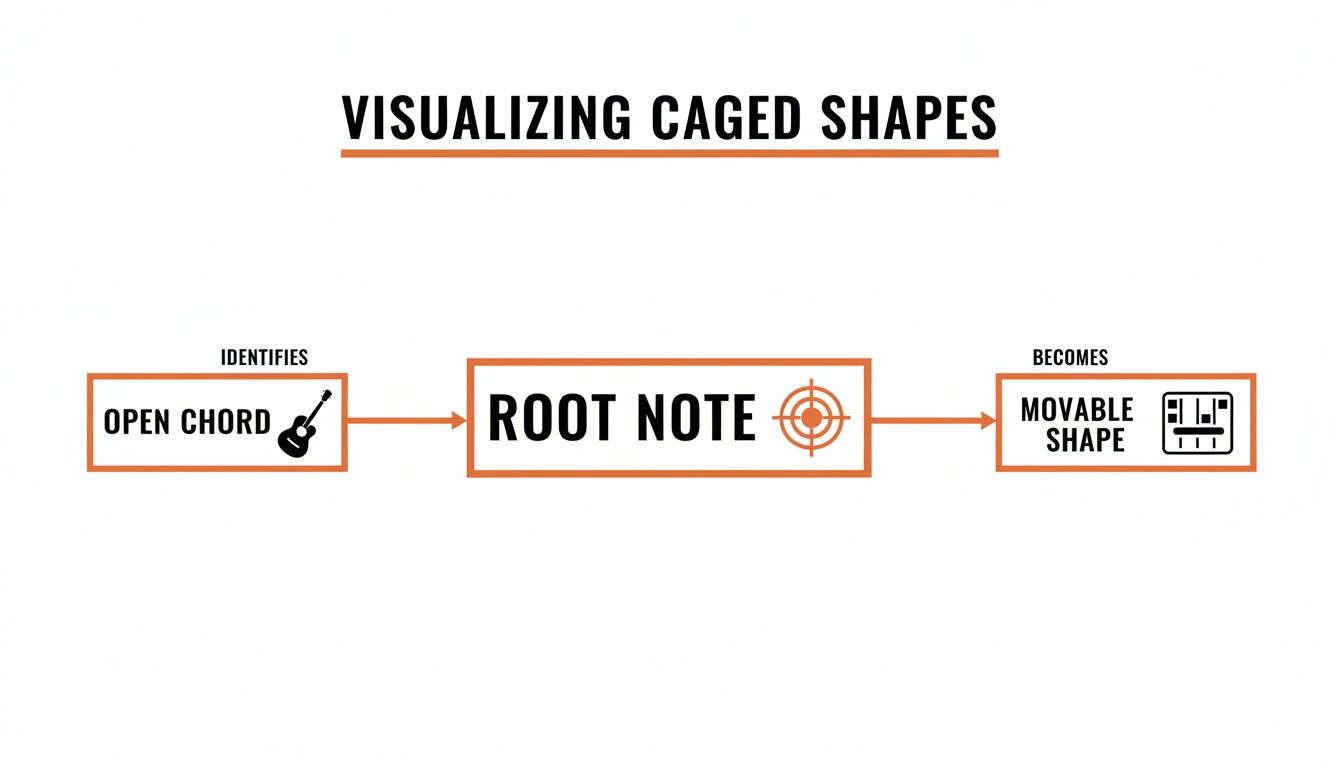
The key takeaway is that finding the root note in any open chord is the trigger. That's what lets you unlock it, pick it up, and move it anywhere you want on the fretboard.
To help visualize this, here’s how the shapes connect in the key of C:
| Starting Position | CAGED Shape Used | Next Connected Shape |
|---|---|---|
| Open Position | C shape | A shape |
| 3rd Fret | A shape | G shape |
| 5th Fret | G shape | E shape |
| 8th Fret | E shape | D shape |
| 10th Fret | D shape | C shape (at 12th fret) |
Seeing it laid out like this makes the repeating pattern much clearer. Each shape acts as a stepping stone to the next one.
Getting this map burned into your brain takes a bit of practice, but the method is simple. You don't need to learn a complex song; you just need to trace the path.
Here’s a simple, super-effective exercise:
The real goal here is to stop seeing the fretboard as a bunch of individual frets and start seeing it as a landscape of interconnected chord zones. When a bandmate says, "Let's do this one in Bb," you won't panic; you'll instantly see five different areas on the neck where you can comfortably play.
This kind of visualization is your ticket to breaking free from the "box" that traps so many players in one tiny section of the neck.

Knowing the CAGED map is one thing. Being able to actually use it in the middle of a song is a whole different ballgame. This is where we stop thinking and start playing, moving the system from your head to your hands.
These exercises are designed to build that crucial muscle memory, making the fretboard feel less like a grid of notes and more like home. Think of them as musical workouts. Consistency beats intensity here—even 15-20 minutes of focused daily practice will pay off big time.
First things first, we need to connect the dots. The single most important exercise is to simply travel up and down the neck using all five shapes for one chord. This drill is the glue that holds the entire CAGED system together.
Let’s walk through it using G Major:
The key is making those shifts between shapes totally seamless. Don't let the rhythm stumble when you change positions.
Once the chord shapes feel comfortable, it's time to layer on some lead playing. This is how you bridge the gap between rhythm and soloing. Every CAGED chord shape has a matching pentatonic scale box that fits right over it like a glove.
This exercise trains your brain to see soloing opportunities sitting right on top of the chords you're playing.
The real "aha!" moment is when you stop seeing chords and scales as two separate things. A chord shape becomes a home base for a scale, and the scale becomes a way to explore the sound of that chord.
Sticking with G Major, try this: after you play each G chord shape, play the G major pentatonic scale pattern that lives in that exact same spot. When you’re on that E-shape G barre chord at the 3rd fret, you’re sitting right in the classic pentatonic Box 1. When you slide up to the D-shape G chord, you'll find the next pentatonic pattern lines up perfectly.
Arpeggios are the secret weapon for crafting melodic solos that sound like they belong with the chords. An arpeggio is just the notes of a chord played one at a time. Practicing them inside each CAGED shape teaches you to hit all the sweet notes that outline the song's harmony.
Here’s a simple way to practice this:
This drill is a game-changer. It’s one of the best ways to truly internalize the sound and feel of each chord, everywhere on the neck. For a deeper dive, check out this lesson on the 5 CAGED shapes of C Major that will add some serious firepower to your playing.
And this isn't just a hunch. A 2023 global survey found that 92% of players using the CAGED system felt they could confidently navigate the entire fretboard within a year. That’s a huge leap compared to the 48% who felt the same way using more linear, scale-based methods. It just goes to show how powerful a visual, shape-based approach can be.
Building this kind of deep fretboard knowledge takes dedication, but the payoff is total musical freedom.
The CAGED system is an amazing tool for mapping out the fretboard, but it’s easy to get tangled up in a few common traps along the way. Knowing what these pitfalls are from the get-go will help you steer clear, making sure you develop real musical fluency instead of just collecting geometric patterns.
Too many players get so obsessed with the shapes that they completely forget about the music. This is how you end up sounding robotic, like you're just running exercises instead of crafting a melody. It’s the difference between reciting the alphabet and actually telling a story.
The number one mistake I see is players becoming "shape-based." This is what happens when you see the five CAGED forms as nothing more than rigid boxes. You start running scales up and down or playing arpeggios without any melodic idea behind them. The very system designed to free you becomes a cage for your creativity.
To break out, you have to connect the patterns you see with the sounds you hear.
Another huge misstep is memorizing the shapes without having a clue where the root note is in each one. If you don't have that anchor, you’re flying blind. Sure, you might be able to play a G chord using the E shape, but you won't know why it's a G chord. That makes it pretty much impossible to use the system in a real jam session.
The root note is your compass for the entire CAGED system. It's the "you are here" marker on your fretboard map. If you lose track of it, you're lost, no matter how well you know the fingerings.
Knowing your roots is non-negotiable if you want to make this system work for you.
Finally, a lot of guitarists learn the five shapes as totally separate, disconnected things. They might nail the C shape and get comfortable with the A shape, but they never practice moving smoothly between them. This leaves these big musical gaps all over the fretboard and completely defeats the purpose of the system. The real magic is in the connections.
Dodging these common mistakes from the start will save you a ton of frustration down the road. To see these ideas in action with expert help, a TrueFire All Access Trial gives you thousands of lessons to make sure you're applying the CAGED system the right way, right from day one.
So, you've got the five major chord shapes down. That's a huge first step, but it's just the beginning of a much bigger journey. Now that you have the basic map laid out, it's time to start exploring some new musical territory with the CAGED system as your compass.
Think of it this way: the system isn't just about major chords. With a few simple tweaks, it unlocks the entire fretboard for minor keys, modes, and all sorts of advanced harmonic ideas. It’s like upgrading your GPS to show different layers—you’ve got the basic roads, now you can add terrain, traffic, and points of interest. Those core shapes will always be your reference points.
The most logical next step is adapting the system for minor chords. It's surprisingly simple. Each of the five major shapes has a corresponding minor version. All you have to do is flat the 3rd of the chord in each shape, and you've instantly doubled your fretboard knowledge. Just like that, you can navigate minor keys with the same confidence you have in major.
From there, you can really start adding color to your playing:
The real goal here is to get to a point where you stop consciously 'thinking' about the system. You want it to become intuitive, a tool you use to create music without a second thought. The CAGED system for guitar is the map, not the destination; it’s just the thing that gets you to a place of pure musical expression.
This is where the magic really happens. True improvisation is all about using these shapes as a launchpad for creating memorable melodies. A great way to start is by targeting chord tones. As a song's chord progression moves, use your CAGED map to land on a note from the current chord. This makes your solos sound incredibly melodic and harmonically intelligent. You can learn a lot more about how to develop your soloing chops using the CAGED system and make your lead lines sound more professional.
If you're ready to continue your journey with structured, in-depth lessons, I strongly recommend exploring the guided learning paths you get with a TrueFire All Access Trial. It’s the perfect next step for applying these concepts and truly mastering the fretboard.
As a guitar teacher, I get asked about the CAGED system all the time. It's a fantastic tool, but a few common questions always pop up. Let's tackle them head-on so you can get the most out of it.
You bet it does. While the system gets its name from the five major open chords, every shape has a minor counterpart.
All you have to do is learn how to tweak one note—the major third becomes a minor third—in each of the five movable shapes. Suddenly, the same fretboard logic you use for major keys works perfectly for minor keys, too. This simple adjustment instantly doubles the system's power.
Not at all. Think of it as a universal map of the guitar's neck that works for any style of music you can imagine.
At its core, CAGED gives you a foundational understanding of the fretboard that transcends genre.
That really depends on the player, but with consistent practice—say, 20-30 minutes a day—most people get comfortable with the five shapes and their root notes within a few weeks.
Getting to a place where you can connect them all seamlessly in any key without even thinking about it? That's a different story. True fluency usually takes several months of dedicated work.
The secret is consistent, focused practice, not cramming it all in during one long weekend session. You're building a deep, intuitive connection with the fretboard over time, making the system feel like a true extension of your playing.
This slow-and-steady approach is what makes the knowledge really stick.
Ready to turn all this theory into actual music with some expert guidance? The structured Learning Paths at TrueFire are the perfect place to start. Kickstart your journey and unlock your potential with a TrueFire All Access Trial.
