Learning scales is your ticket to finally unlocking the fretboard and playing with real creative freedom. It’s the essential process of internalizing the patterns that act as a musical roadmap, letting you improvise solos, write your own melodies, and truly understand the musical DNA of your favorite songs. As a music educator, I can tell you that getting even one or two foundational shapes under your fingers will completely transform how you see the instrument.
Let's be honest—the idea of practicing scales can sound like a chore. But what if I told you they're the secret language behind every killer riff, melody, and solo you've ever loved? Scales are so much more than just boring up-and-down drills; they are the absolute building blocks of music.
Thinking of scales as your musical vocabulary is a game-changer. Just as words form sentences, the notes within a scale combine to create musical phrases. This guide is here to show you exactly how they open up the entire fretboard, giving you the confidence to move far beyond simply copying other people's songs.
The end goal isn't just to memorize a series of patterns. It's about understanding how those shapes connect to sound and emotion. Every scale possesses its own distinct character or mood, which you can tap into to inject a ton of expression into your playing. When you truly internalize these patterns, you’re no longer just playing notes—you’re telling a musical story.
Our journey kicks off with the foundational shapes found in thousands of songs. Take the pentatonic scale—it's one of the oldest and most common scales in music history. Believe it or not, researchers even found a 60,000-year-old Neanderthal flute that was tuned to a similar scale. It just goes to show how these core musical ideas have resonated for millennia.
The big "aha!" moment happens when you stop seeing the fretboard as a random mess of notes and start seeing it as an organized, logical system. Scales provide the very framework for that system.
This guide will zero in on the practical applications that turn scale patterns into actual music. I’ll walk you down a clear path, starting from your very first pattern and leading all the way to crafting your own solos. You'll see how a structured, pedagogical approach makes this material achievable for any player, no matter their starting point. For a deeper dive, check out our guide on the essential fretboard knowledge for every guitarist.
Here’s a quick look at how mastering scales directly translates into tangible guitar skills and musical freedom.
| Core Skill | What You Will Learn | Your Musical Benefit |
|---|---|---|
| Fretboard Navigation | How notes connect across all strings and positions. | You’ll never feel lost on the neck again. |
| Melody & Phrasing | How to create musical "sentences" that sound compelling. | You can write your own hooks and memorable lines. |
| Improvisation | How to create solos on the spot over any chord progression. | You'll be able to jam with anyone, anytime. |
| Ear Training | How to recognize intervals and melodies by ear. | You can figure out songs without needing tabs. |
| Music Theory | The "why" behind what notes work together. | You’ll understand how songs are constructed. |
As you can see, it all connects. What starts as simple pattern practice evolves into a deep, intuitive understanding of the instrument.
Ready to transform your playing? A free TrueFire All Access trial gives you the expert-led courses and interactive tools to make it happen.
Jumping into the world of guitar scales can feel like trying to drink from a firehose. There are dozens, each with an unfamiliar name, and it's easy to get overwhelmed. But I'll let you in on a professional secret: you don't need to learn them all to start making authentic music.
In fact, just two scales will unlock the vast majority of songs you love. They are the keys to the kingdom, giving you the tools to both play your favorite solos and create your own melodies from scratch. These two pillars are the Minor Pentatonic Scale and the Major Scale. Mastering them isn't just a step forward; it's a monumental leap in your guitar journey.
Ever heard a searing Eric Clapton solo or a crunchy Jimmy Page riff? You've heard the Minor Pentatonic scale. It has that soulful, slightly aggressive sound that has defined blues, rock, pop, and soul music for decades. It uses only five notes per octave, which is great news for us because the patterns are much easier to memorize and get under your fingers.
The magic of this scale is its simplicity. Because it has fewer notes, it’s much harder to hit a "wrong" sounding one when you're improvising over a common chord progression. This built-in safety net makes it the perfect place to start your soloing journey. The most common pattern, what players call "box one," is a comfortable, ergonomic shape that just feels right on the fretboard.
If the Minor Pentatonic is raw and bluesy, the Major Scale is the sound of happiness and resolution. Think about the "Do-Re-Mi" scale we all learned as kids—that's it. It’s the structural backbone of countless pop songs, folk tunes, and country melodies.
The Major Scale has seven notes per octave, giving it a more complete and melodic character. The patterns are a bit more involved than the pentatonic, but learning just one provides the DNA for building chords, understanding harmony, and writing those earworm melodic hooks. It’s the key that unlocks how music theory actually works on your guitar.
The single most important concept to internalize right now is the root note. This is your home base, the starting point that gives the scale its name (like the 'A' in A Minor Pentatonic). Once you can locate the root note within any scale pattern, you've unlocked the entire fretboard.
Okay, here’s the game-changing part. Both the Minor Pentatonic and Major Scale patterns are movable. This means the exact same finger pattern you learn for one key can simply be shifted up or down the neck to play in any other key. It's that simple.
This principle is your golden ticket. By learning one pattern and knowing its root note, you've effectively learned to play that scale in all 12 keys. This is how you finally break free from being stuck in one position and start navigating the neck with total confidence.
Ready to see these patterns in action? A TrueFire All Access Trial gives you step-by-step video lessons and interactive tools to get these foundational scales under your fingers faster than you ever thought possible.
Memorizing a scale pattern is a great start, but it’s akin to learning the alphabet without knowing how to form words. The real goal is fretboard fluency—that ability to glide across the neck effortlessly and, most importantly, musically. This is where a smart, structured practice routine comes in, transforming those static "box" shapes into a dynamic, interconnected map of the fretboard.
We're not talking about mind-numbing repetition here. This is about building muscle memory with clear musical intent. Instead of just running up and down a scale like a robot, we need to give our fingers and our brain a much better workout. This is how you build the dexterity and confidence to stop thinking about where the notes are and start focusing on the music you're actually creating.
Your best friend on this journey is a metronome. I know, I know—it can feel like a rigid taskmaster, but it's hands-down the best tool for developing a rock-solid sense of time and clean technique. So many players skip it, but using one is what separates sloppy playing from professional execution.
The process itself is simple:
This gradual climb builds precision and control from the ground up. You're training your hands to be perfectly synchronized and accurate, which is non-negotiable for everything from soulful melodies to lightning-fast solos.
The goal isn't just speed; it's clarity at any tempo. A clean, articulate scale played slowly sounds far more impressive than a fast, sloppy one.
Let's be honest, just playing scales up and down gets boring fast, and it has very limited musical application. To really burn the patterns into your brain and build serious coordination, you must practice them in sequences. This forces your fingers to make new connections and pulls you out of that robotic, linear muscle memory.
Try these simple but incredibly powerful sequencing exercises:
The dedication guitarists put in is no joke: the average enthusiast spends 8 hours a week practicing. A huge chunk of that time is often spent on scale exercises, which have a direct impact on refining picking technique. Considering that 70 percent of players prefer using a pick, drills like these are fundamental to getting better.
The final piece of the fluency puzzle is connecting all those individual scale patterns. Most players learn scales in isolated "boxes," but the pros see the fretboard as one continuous, seamless map. Your goal is to break out of those boxes and move freely up, down, and across the strings.
Start by identifying the notes that two adjacent scale patterns share. Practice shifting between the two positions using those common notes as a bridge. For instance, try sliding from the top of one Minor Pentatonic box shape right into the bottom of the next one up the neck. This single exercise starts to transform your fretboard knowledge from a few isolated islands into a fully connected continent. For more ideas, check out our guide on 5 smart practice tips for guitar players.
Ready to make your practice sessions count with expert guidance? A TrueFire All Access Trial gives you thousands of lessons, jam tracks, and tools designed to build your fretboard fluency, fast.
Alright, this is where all that hard work starts to pay off. We're about to connect the dots between running those mechanical scale exercises and actually making music that breathes and feels alive.
Memorizing patterns is a huge first step, but the real magic happens when you transform those shapes into musical ideas.
The secret? Context. Scales are just a random assortment of notes until you play them over chords. Firing up a jam track or a simple backing loop is the single fastest way to hear how the notes in your scale interact with the harmony underneath, turning your practice into real-time improvisation.
Let's get one thing straight: a great solo has very little to do with playing the most notes the fastest. It’s all about phrasing—how you shape, deliver, and articulate your musical ideas. Think about it like speaking. You don't just spit out a stream of words; you use pauses, inflection, and emotion to tell a story.
This is where techniques like bends, slides, and vibrato become your best friends. These are the tools that give your notes a human voice and a ton of personality.
These aren't just flashy tricks; they are absolutely essential for crafting melodies that people remember. They let a single note say more than a dozen played robotically.
The goal is to make the guitar "sing." When you start thinking less about fret numbers and more about the sound and feeling you want to create, you’ve made the leap from being a scale-runner to being a musician.
Here’s a pro-level tip that will instantly make your solos sound more deliberate and polished: target the chord tones. Chord tones are simply the individual notes that build the chord playing in the background.
When your melody lands on one of these notes right as the chord changes, it creates a powerful sense of resolution. It just sounds right.
For instance, if the backing track switches to a C Major chord (which contains the notes C, E, and G), try to end your phrase on a C, an E, or a G. This simple act of planning your landing spots makes your solos sound like they belong to the song, instead of just floating randomly on top.
Let's make this practical. Find a simple 12-bar blues jam track in A Minor. Grab your guitar, stick to the A Minor Pentatonic scale, and give yourself one mission: don't play a lot of notes. Instead, focus on crafting a simple, tasteful solo.
Start by just playing the root note (A) and holding it with a little vibrato. Now, try bending the 4th note of the scale up a whole step. Experiment with sliding between just two or three notes within the pattern. You'll be blown away by how much music you can squeeze out of so little.
This deliberate, melodic approach is what separates the good improvisers from the great ones. For more ideas on this, you can learn how to create interesting licks and phrases on guitar in our detailed guide.
The ability to improvise is a massive goal for most of us. In fact, research shows that 75 percent of players see improvisation as essential to their style, and mastering scales is the engine that drives it all.
Ready to take your own phrasing and soloing from the bedroom to the stage? A TrueFire All Access Trial gives you thousands of jam tracks and lessons from world-class educators who show you exactly how to apply scales in a real musical context.
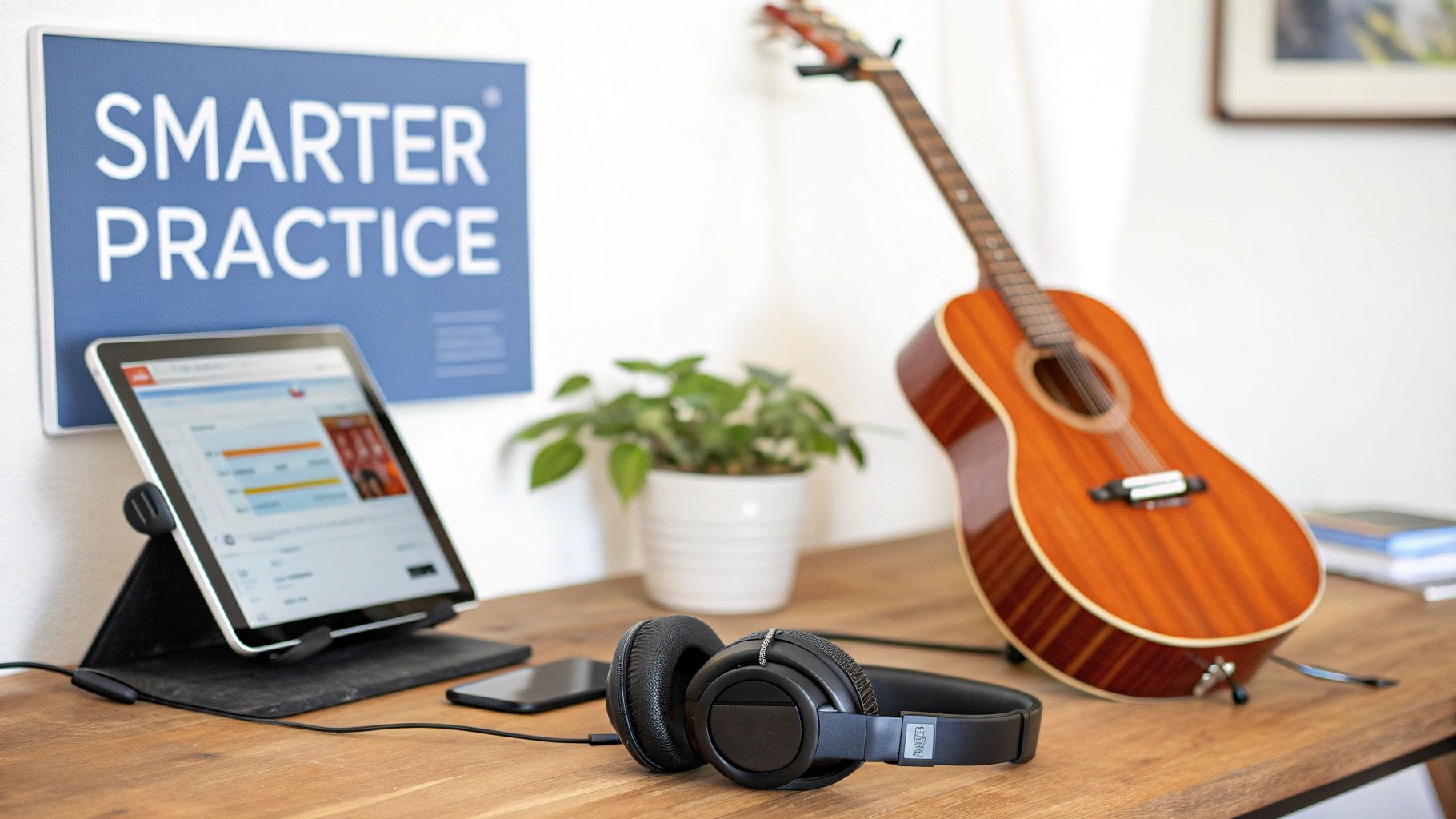
Let's be real: trying to learn guitar by piecing together random online videos is a recipe for frustration. You end up with a disjointed collection of licks and patterns without understanding how they connect. To make real, lasting progress, you need a smarter learning environment.
It’s about moving away from passively watching videos and shifting into active, focused practice. The right platform anticipates your biggest hurdles—like deciphering an instructor's picking technique—and solves them before they can slow you down.
Imagine trying to learn a scale run, but you can't quite see what the player's picking hand is doing. Is it alternate picking? Economy picking? A clear, unobstructed view of both hands isn't just a nice-to-have feature; it’s a game-changer that eliminates ambiguity and helps you nail the technique correctly from the start.
The line between a good and a great learning platform is drawn by its tools. Technology should always serve the music, making complex ideas easier to digest and your practice time more efficient. It’s about building a complete ecosystem that supports you every step of the way.
These are the features that actually make a difference in your playing:
This isn't about looking for shortcuts. It’s about finding a more direct, efficient path to musicality. Smarter tools lead to smarter practice, meaning you spend less time hitting brick walls and more time actually making music.
Ultimately, the best tools exist to support a well-designed curriculum. When you combine high-quality video instruction from world-class educators with these kinds of interactive features, you get a powerful system for truly learning scales on guitar.
You're no longer guessing or fumbling through. You're on a proven path, guided by expert players who know how to get you from point A to point B. This kind of structured environment ensures you’re not just memorizing random shapes, but truly understanding how they all connect to unlock the entire fretboard.
Ready to see how this integrated system can transform your playing? Start a TrueFire All Access Trial.
You now have the building blocks. Seriously. The patterns and exercises we've covered aren't just about getting your fingers moving; they're the vocabulary you’ll use to speak through your guitar for the rest of your musical life.
Think of it this way: learning scales isn't a race with a finish line. It's a lifelong journey. Every time you pick up your guitar to practice, you're not just building speed. You're deepening your relationship with the instrument and the music you love. You've unlocked the door to creating, improvising, and connecting with your favorite songs on a much deeper level.
Once the Minor Pentatonic and Major scales feel comfortable under your fingers, the next logical step is to expand your musical palette. This is where you can explore more colorful, interesting sounds that will add whole new dimensions to your playing.
Here's what I recommend tackling next:
The most important thing here? Apply everything you learn. Don't let a new scale or arpeggio become a sterile exercise you just run up and down. The moment you learn it, pull up a jam track and try to make real music with it.
Ultimately, the goal is to get this material so deep in your brain that you don't even have to think about it anymore. You want to reach that magic point where you can hear a melody in your head and your fingers just know where to go on the fretboard to play it. That kind of freedom only comes from consistent, focused application.
To keep your journey moving forward with expert guidance and the kind of learning tools we've discussed, the best thing you can do is put this knowledge into practice right away. A structured learning path will help you connect these new ideas to what you already know, making sure your progress is steady and, more importantly, musical.
---
I highly recommend starting a TrueFire All Access Trial. It gives you the structured courses, thousands of jam tracks, and the interactive tools you need to bridge the gap between practicing scales and becoming the guitar player you've always wanted to be. Learn more and grab your trial over at TrueFire.com.
