Ever wonder how guitarists in rock, blues, and country music craft those sweet, uplifting melodies that just feel right? The secret ingredient is often the major pentatonic scale. It’s a simple, five-note scale that gives you a “can’t-play-a-wrong-note” roadmap, making it the perfect launchpad for anyone wanting to improvise with confidence.
Picture the full, seven-note major scale as a complete toolkit with every tool you could possibly need. The major pentatonic scale is the streamlined version of that kit—it takes only the five most stable, essential, and pleasing notes and leaves the rest behind.
How does it do this? By ditching the 4th and 7th scale degrees. These are the two notes most likely to create tension or sound a bit "off" when played over common chords. By stripping the scale down to its core, you're left with a pure, consonant sound that’s incredibly versatile and easy on the ears.
The real magic behind the major pentatonic scale is its simple interval formula: Root (1), Major Second (2), Major Third (3), Perfect Fifth (5), and Major Sixth (6). To see it in action, let's look at the key of C Major, which has no sharps or flats.
See what happened? We just kicked out the 4th note (F) and the 7th note (B). What's left is a powerful melodic framework that forms the backbone of solos and riffs from legendary guitarists across almost every genre you can think of.
The major pentatonic scale is a guitarist’s best friend because it provides a reliable road map for creating melodies that always sound strong and resolved. It’s the foundation upon which more complex musical ideas are built.
This scale is your ticket to moving beyond just strumming chords and starting to create your own musical statements. Once you start learning its shapes on the fretboard, you'll begin to hear its happy, open sound in countless songs you already know and love. If you're looking for more ways to jump in, you might be interested in this guide to finding some pentatonic scale magic.
To truly master this essential scale and learn how to use it in a real musical context, having some structured lessons can make all the difference. You can explore thousands of lessons, jam tracks, and interactive tools with a TrueFire All Access Trial.
When you launch into a lick using the major pentatonic scale, you're doing more than just playing a few notes on the guitar. You're actually tapping into one of the most ancient and universal sounds in human history.
This five-note scale is so deeply woven into our musical DNA that it feels less like something that was invented and more like something that was discovered. Its simple, pleasing nature has made it a cornerstone of music across nearly every culture for thousands of years.
Think of this scale as a true musical artifact, connecting us directly to our earliest ancestors. The major pentatonic’s elegant formula—built from the 1st, 2nd, 3rd, 5th, and 6th degrees of the major scale—is part of a profound musical tradition. Archaeologists have found bone flutes in Germany’s Swabian Jura region, dating back over 40,000 years, that are tuned precisely to pentatonic intervals. You can read more about these incredible ancient musical discoveries on Britannica.
So, what gives this scale its universal appeal? It all comes down to its inherent simplicity. By leaving out the more dissonant intervals found in the full seven-note major scale, it creates melodies that are agreeable to just about any ear. That’s why you can hear its signature sound in countless musical traditions all over the world.
Every time you play a major pentatonic lick on your guitar, you are participating in a conversation that started tens of thousands of years ago. It’s a sound that has comforted, celebrated, and told stories for longer than recorded history.
This context gives the scale a whole new meaning. From ancient flutes to modern electric guitars, the major pentatonic sound has been a constant, proving its timeless power. Understanding this lineage adds a layer of depth to your own playing, connecting your solos to a vast and ancient human tradition. You can explore the origins of American music to see how these foundational sounds evolved right here at home.
To dive deeper into this and other core musical concepts with structured lessons from world-class instructors, start your TrueFire All Access Trial today.
Alright, we’ve got the theory down for the major pentatonic scale. Now for the fun part: getting it onto the guitar. This is where abstract notes and intervals become real, tangible patterns you can see, feel, and—most importantly—hear. The fretboard can look like a confusing mess at first, but a brilliant system called CAGED makes it all click into place.
The CAGED system is basically a way of mapping out the entire fretboard using five simple, open chord shapes you probably already know: C, A, G, E, and D. When we apply that same logic to the major pentatonic scale, we end up with five distinct, interlocking patterns.
Think of these shapes like puzzle pieces. Each one connects perfectly to the next, creating a seamless "pentatonic superhighway" that stretches from the nut all the way up the neck.
Once you truly get these five shapes under your fingers, you'll never feel lost on the fretboard again. Learn them in one key, and you can simply slide the whole system up or down to play in any other key you want. This movability is what makes the pentatonic scale such a beast for improvisation.
Each shape has its own unique flavor and opens up different melodic doors, but they all contain the exact same five notes of the scale—just in different octaves and arrangements. For any guitarist who wants to solo with total freedom, learning to move smoothly between these shapes is an absolute game-changer.
The five pentatonic shapes are not just random collections of notes; they are a logical, interconnected network. Learning to navigate this network is the single most important step toward unlocking true fretboard freedom.
Let's break down these five essential patterns. We'll use the G Major Pentatonic scale (G-A-B-D-E) as our home base.
The table below is your quick-reference guide for how these five core CAGED shapes lay out on the neck for G Major Pentatonic. It's a great way to start visualizing how they all connect.
| Shape Number | Based On Chord Shape | Root Note Position (Example in G) | Primary Fretboard Zone |
|---|---|---|---|
| Shape 1 | G Shape | Low E string, 3rd fret | Frets 2-5 |
| Shape 2 | E Shape | A string, 5th fret | Frets 5-8 |
| Shape 3 | D Shape | D string, 5th fret | Frets 7-10 |
| Shape 4 | C Shape | G string, 7th fret | Frets 9-12 |
| Shape 5 | A Shape | B string, 12th fret | Frets 12-15 |
Take your time with these! The best way to learn them is one at a time, without rushing.
My advice? Start with Shape 1. Its root note is right there on the low E string, making it super easy to find your key. Play it up and down until the pattern feels like second nature. Once you have it locked in, move on to the next shape, always paying close attention to how it hooks up with the one you just learned. This methodical work builds that crucial muscle memory and creates a solid mental map of the neck.
By mastering these shapes, you're doing more than just learning a scale; you're learning the very language of the guitar. To really get these patterns flowing with guidance from world-class instructors, grab a TrueFire All Access Trial.
Once you get those five pentatonic shapes mapped out on the fretboard, you've basically unlocked the DNA of modern guitar music. This isn't just some scale to run through for practice; it’s the melodic engine humming behind countless iconic riffs and solos in blues, rock, country, and pop. Its simple, strong sound has a way of cutting right through a mix, making it the go-to choice for crafting hooks that stick in your head for days.
The journey of the major pentatonic from old-school folk tunes to the heart of rock and roll is a great story of creative evolution. Blues pioneers were absolute masters of wringing emotion out of their instruments, often blending the sweet, happy sound of the major pentatonic with the gritty, soulful cry of its minor counterpart. This major/minor ambiguity became the secret sauce of the blues, laying the foundation for pretty much every genre that came after.
You really can't overstate this scale's influence. The major pentatonic scale anchors modern guitar, powering over 85% of blues-rock solos since the 1930s. Early innovators like Robert Johnson laid the groundwork, but it was Chuck Berry who really lit the fuse for the rock explosion. His blistering riff in "Johnny B. Goode" (1958) is pure C major pentatonic—a lick so foundational it's estimated to have influenced 80% of early rock 'n' roll guitarists. You can dive deeper into the history of pentatonic scales and their modern use to see just how deep its roots go.
This chart helps you visualize how core concepts like the CAGED system, movable shapes, and pattern recognition all connect, creating a kind of "Fretboard Highway" for your pentatonic soloing.
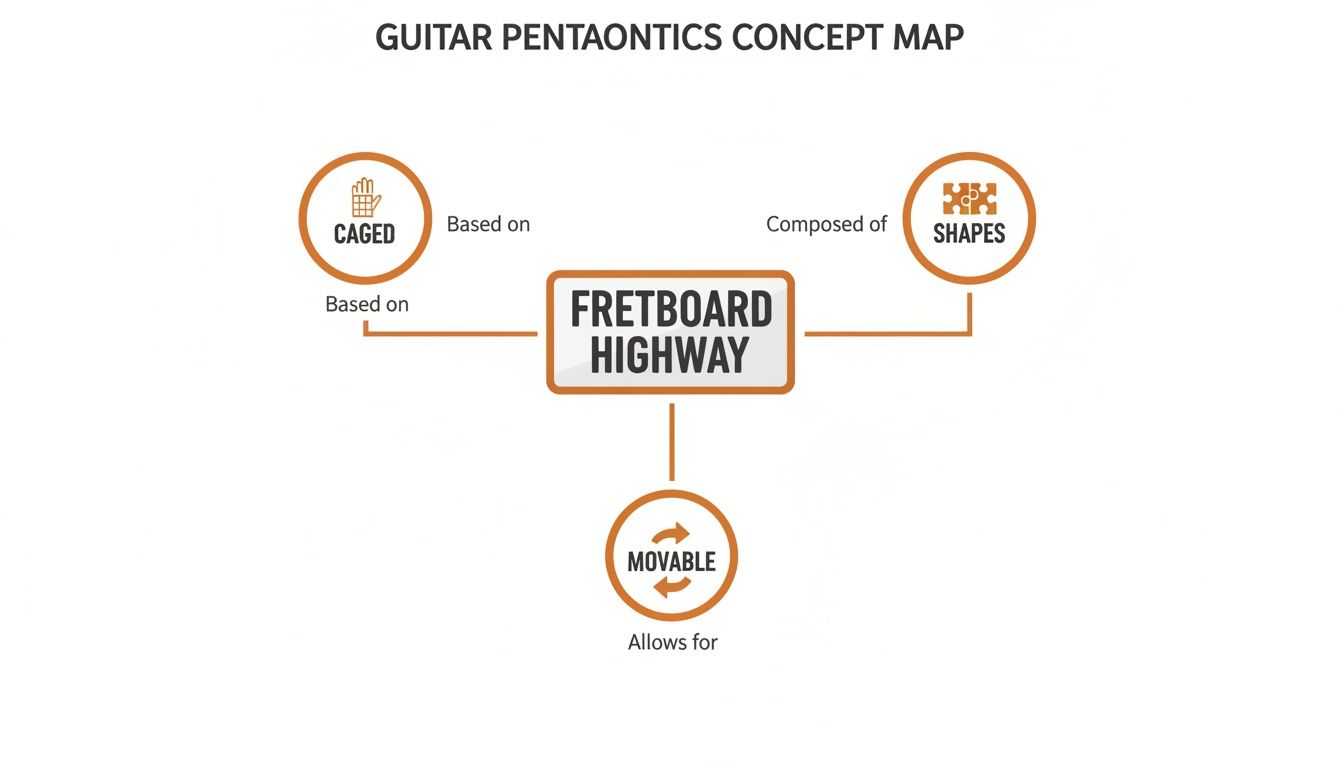
Seeing these ideas linked together helps drive home the point that you're not just memorizing isolated shapes. You're learning a complete system for navigating the entire neck.
Once you train your ear for it, you'll start hearing the major pentatonic scale everywhere. Its cheerful, definitive sound is perfect for creating those big, anthemic leads and catchy melodies. Here are a few examples to listen for:
The beauty of the major pentatonic scale lies in its simplicity. It’s a framework that allows for immense creativity without the risk of hitting a "wrong" note, which is why guitarists from every generation keep coming back to it.
By understanding how it's used in hit songs, you stop just knowing the patterns and start internalizing the sound. You begin to grasp not just where to put your fingers, but why those notes work so well together. And that, right there, is the key to truly musical improvisation.
To get these iconic sounds under your own fingers with interactive lessons and thousands of jam tracks, start your TrueFire All Access Trial.
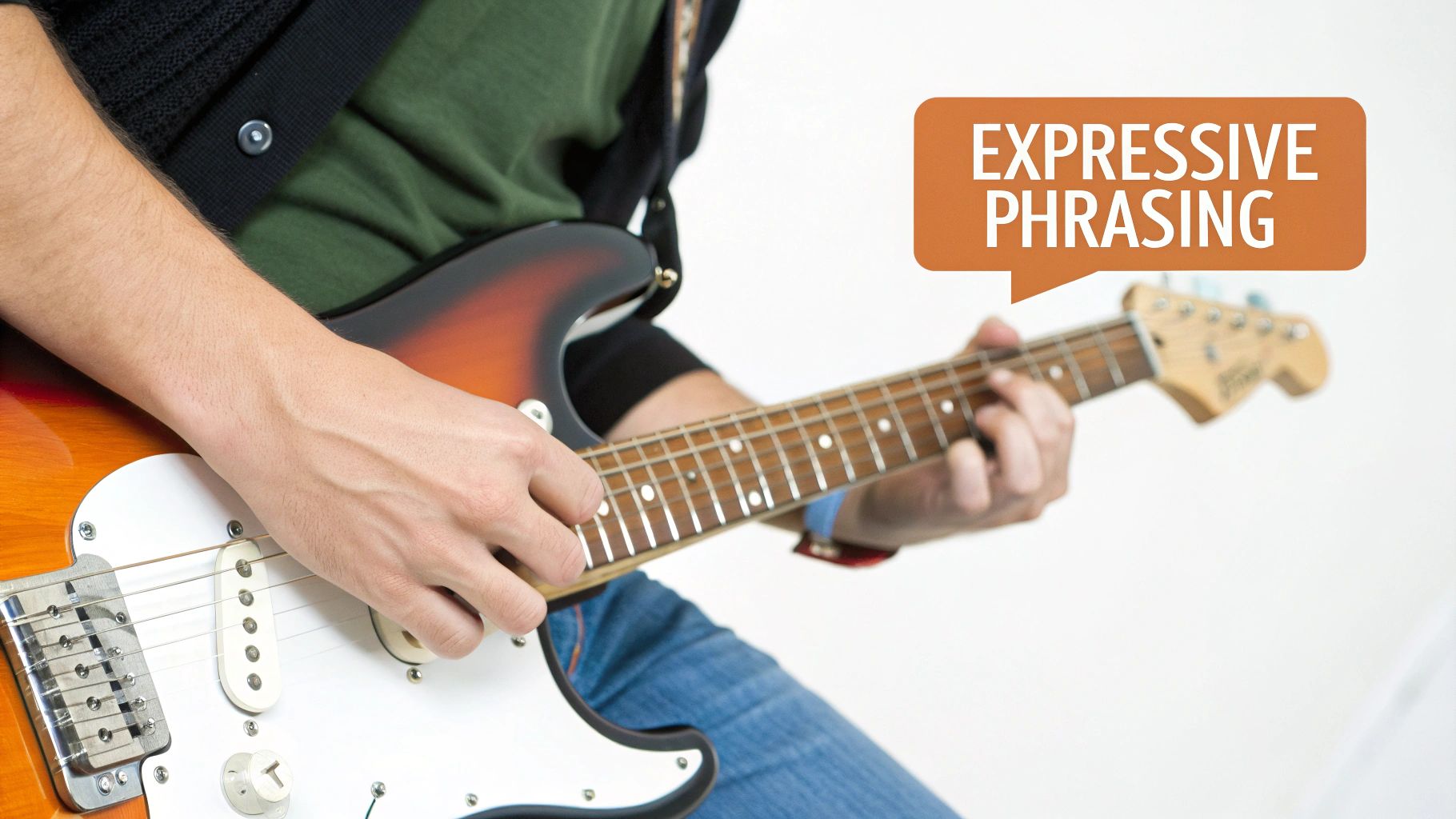
Knowing the shapes of the major pentatonic scale is like learning the alphabet. It’s a crucial first step, but it’s not the same as actually speaking in full, compelling sentences. To really start making music, you’ve got to move beyond just playing the right notes and start phrasing them.
Phrasing is what breathes personality, emotion, and life into your guitar playing. It's the huge difference between a robot running up and down a scale and a guitarist who’s telling a story. This is where your touch and technique—things like bends, slides, hammer-ons, and pull-offs—really come into play.
These articulations are your expressive toolkit. They’re what turn a simple pentatonic lick into a memorable musical statement, allowing you to mimic the subtle nuances of the human voice and make your guitar sing, cry, or soar.
To start injecting this kind of musicality into your playing, you'll want to get a solid handle on a few core techniques. Think of these as the fundamental vocabulary of lead guitar.
Phrasing is not about how many notes you play, but how you play the notes you choose. A single, perfectly bent note can have more emotional impact than a dozen notes played without feeling.
Try this: take a simple three-note phrase from one of the major pentatonic shapes you’ve learned. Now, play it again, but this time slide into the first note, bend the second one, and use a pull-off on the third. The difference is immediate and massive. If you're ready to go deeper, you can learn how to create interesting licks and phrases and start building a killer melodic vocabulary.
Get ready for one of the biggest "a-ha" moments for any guitarist learning the major pentatonic. Every major key has a "relative minor" key that shares the exact same notes, just starting from a different place. For example, G Major Pentatonic (G-A-B-D-E) contains the exact same notes as E Minor Pentatonic (E-G-A-B-D).
So what does that mean for you? It means the five pentatonic shapes you've been learning for major keys are also the five shapes for minor keys. The only thing that changes is the musical context—the chords you’re playing over—and which note feels like your "home base" or root note.
Play those G Major Pentatonic shapes over a G major chord progression, and you'll get that happy, bright sound. But play those exact same shapes over an E minor chord progression, and suddenly it will sound bluesy and melancholic. This dual functionality is an incredible shortcut, effectively doubling the usefulness of every single pattern you learn. It’s the key to switching seamlessly between different emotional tones in your solos, all without ever changing your hand position.
Ready to put these phrasing concepts into action with guided lessons and a massive library of jam tracks? A TrueFire All Access Trial gives you everything you need to transform your scales into unforgettable music.
Once you've got the major pentatonic shapes and some basic phrasing under your fingers, it's time to start blending it with other scales to cook up some more sophisticated sounds. This is where you graduate from playing simple melodies to crafting solos with real character—a trick every seasoned player has up their sleeve, no matter the genre.
One of the most powerful and time-tested ways to do this is by mixing the major and minor pentatonic scales. This single technique is the absolute cornerstone of blues, rock, and country soloing. By jumping between the bright, happy vibe of the major pentatonic and the gritty, soulful sound of the minor pentatonic—all over the same chord—you create a dynamic push-and-pull that's incredibly expressive.
Think of it like this: the major pentatonic notes are your sweet, comfortable "home base." The minor pentatonic notes, especially that flat 3rd and flat 7th, are your "blue notes" that inject some serious attitude and flavor.
This blending technique gives your solos an almost conversational quality, letting you build excitement and tell a much more interesting musical story.
The real art of soloing isn't just about knowing scales; it's knowing when to use which sound to create a specific emotion. Mixing major and minor pentatonics is your first real step into this bigger world of musical expression.
This idea of using the pentatonic scale for its unique texture isn't just a modern guitar thing, either. Back in the late 19th and early 20th centuries, classical composers like Claude Debussy and Maurice Ravel used the major pentatonic to create dreamy, impressionistic moods. Debussy’s 1910 piano piece 'Voiles' is built entirely on a pentatonic scale, creating a shimmering, tension-free soundscape. You can dive deeper into the pentatonic scale's use in various musical traditions to see just how versatile it is.
To really dig into these hybrid concepts with interactive lessons from world-class instructors and thousands of jam tracks to practice over, check out a TrueFire All Access Trial.
Alright, you've got the full roadmap. We’ve unpacked the theory behind that sweet, uplifting sound, put the five fretboard shapes under your fingers, and touched on the key techniques that bring the major pentatonic scale to life. The next move is all yours—it's time to make some music.
The path forward is actually pretty simple. Just focus on getting that major pentatonic sound stuck in your head. Hum it. Sing it. Then, get methodical and drill those five interlocking shapes until you don't have to think about them anymore. Once they feel like home, you can start stringing notes together into simple licks and jamming over some backing tracks.
Getting this scale down is a huge turning point for any guitarist. It’s where you shift from just copying other people's riffs to truly speaking your own language on the fretboard.
Remember, this isn't a race. It’s all about consistent, focused time with your instrument. That's how you turn these abstract patterns and ideas into real, honest musical expression. If you ever feel stuck in a rut, a great next step is to check out our guide on how to bust out of a playing rut using the five pentatonic shapes. Take what you've learned here, apply it every day, and you'll be amazed at how much your playing will open up.
Ready to really kick your progress into high gear? A TrueFire All Access trial hooks you up with structured courses, thousands of jam tracks, and a whole suite of interactive learning tools. It's everything you need to take these concepts and make them completely your own. Find out more and start your trial over at https://truefire.com.
