
If you want to truly understand music on the guitar, the major scale is where your journey begins. No exceptions. This one scale is the blueprint for a staggering amount of music, from simple folk tunes and pop hits to mind-bending jazz solos. Its bright, resolved sound is the very foundation of Western music.
Ever hummed "Do-Re-Mi-Fa-So-La-Ti-Do"? If so, you already know the major scale. For us guitar players, learning it is like getting the architectural plans for the entire fretboard. It's less about memorizing a rigid pattern and more about learning to speak a new language—a language you'll soon start hearing everywhere.
The secret sauce is a specific formula of whole and half steps: Whole-Whole-Half-Whole-Whole-Whole-Half (or W-W-H-W-W-W-H). On the guitar, a whole step is two frets, and a half step is one fret. That exact sequence is what gives the scale its happy, complete vibe.
We're going to kick things off with the C Major scale, and for a very good reason: it has no sharps or flats. The notes are just C, D, E, F, G, A, and B. This makes it the perfect vehicle for seeing that W-W-H-W-W-W-H formula in action without any extra mental gymnastics. Once you nail this concept in the key of C, you can take that knowledge and apply it to any key, anywhere on the neck.
This scale isn't some new-fangled invention, either. Its roots stretch back over 2,000 years to ancient Greece. Thinkers like Pythagoras were already exploring mathematical ratios to create diatonic scales—early versions of what we play today. It's no wonder that modern music schools report that 85% of beginner guitar curricula worldwide start with C major. The tradition is built on its pure simplicity.
Learning the major scale isn't just a finger exercise; it's about training your ear to hear the fundamental building blocks of music. It's the bridge that connects what your fingers are doing to what your ears are hearing.
Getting the major scale under your fingers is about so much more than just playing notes in order. It's the source code for everything else in music:
Ultimately, practicing scales is great for more than just memorizing notes; it builds your technique, sharpens your ear, and makes you a better all-around musician. When you truly learn the major scale, you're not just learning a pattern—you're learning the language of music itself.
Knowing the major scale formula is one thing, but actually making it sing on your guitar? That's a different discipline altogether. The real magic happens when you can see and feel those patterns all over the fretboard, freeing you from being stuck in one little box. This is where we jump from theory to playing, turning that scale formula into real shapes your fingers can fly through.
The goal isn't just to blindly memorize patterns. It's about understanding how they all lock together, creating one continuous musical map across the neck. We're going to look at two powerful systems that pros use to navigate this map: the CAGED system for guitar and the 3-Note-Per-String system. Each gives you a unique lens for seeing the major scale guitar fretboard as one big, interconnected grid.
Think of it like this: the abstract scale formula is the DNA, which then becomes the blueprint for the sounds you create.
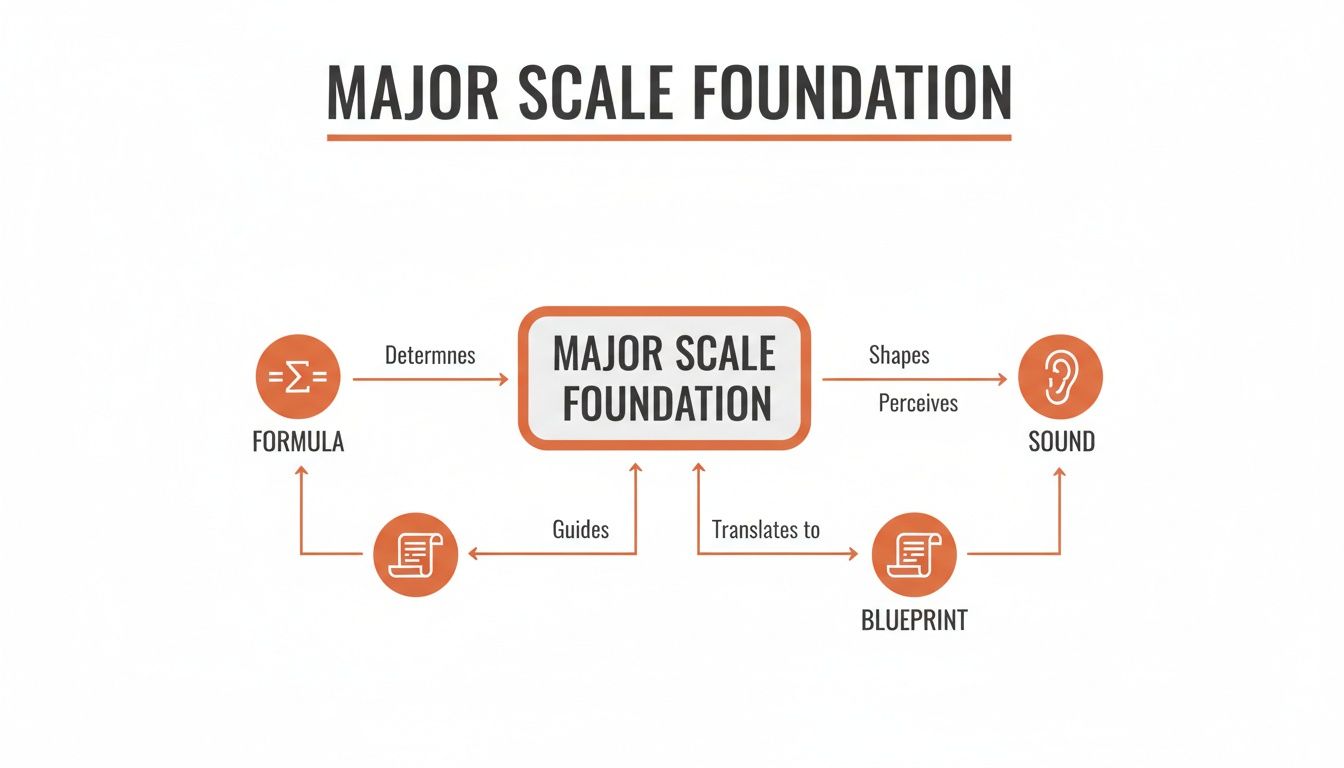
That W-W-H-W-W-W-H formula is the core of it all. It's what gives the scale its signature sound and lays the foundation for every chord and melody you'll build from it.
For countless players, the CAGED system is a total game-changer. Why? Because it cleverly links the five open chord shapes you probably already know—C, A, G, E, and D—to five major scale patterns that fit right over them. It's like having a GPS for your fretboard.
Each of those chord shapes has a corresponding scale pattern that fits around it like a glove. Better yet, these five patterns connect to each other, forming an unbroken chain all the way up and down the neck. The C shape pattern flows right into the A shape, which hooks up with the G shape, and so on. Once you internalize these five shapes, you can play the major scale in any key just by sliding the whole system to a new root note.
The real power of CAGED is how it connects scales directly to chords. When you're playing a G major scale pattern, you can literally see the G major chord shape right there under your fingers. This makes it so much more intuitive to target chord tones when you're soloing.
The best way to start is to tackle one shape at a time. Let's say you're working on the G major scale. Find the "E shape" pattern, which starts on the 3rd fret of your low E string. Play it up and down until it feels second nature. Then, find the "G shape" that connects to it higher up the neck. This methodical approach is your key to unlocking the whole fretboard. For a deeper dive, this guide on Dweezil Zappa's Fretboard Freedom is an excellent resource.
While CAGED is brilliant for its chord-to-scale logic, the 3-Note-Per-String (3NPS) system is all about linear speed and fluid technique. Just like the name says, every pattern in this system has you playing exactly three notes on each string. This consistency makes it a huge favorite among rock, metal, and fusion players like Joe Satriani and Steve Vai.
The 3NPS system carves the major scale into seven distinct patterns that, like CAGED, cover the entire fretboard. Because the structure is so uniform, it's perfect for blazing, sequential runs. Your picking hand can get into a steady rhythm, which makes techniques like alternate picking and legato (hammer-ons and pull-offs) feel much, much smoother.
One thing you'll notice is that 3NPS patterns can involve some wider stretches for your fretting hand. Don't see this as a downside—it's actually a fantastic way to build finger independence and strength. Just be sure to start slowly with a metronome to nail down clean technique.
So, CAGED or 3NPS? Which one should you learn? As a music educator, my answer is: both. They aren't rivals; they're teammates that complement each other beautifully. CAGED gives you a deep, harmonically-aware view of the fretboard, while 3NPS gives you the tools for those fast, linear passages that turn heads.
Most players start with one system and then add the other to round out their skills. This table breaks down the key differences to help you decide which path to start on.
| Attribute | CAGED System | 3-Note-Per-String (3NPS) System |
|---|---|---|
| Primary Strength | Connecting scales directly to chord shapes. | Facilitating fast, linear runs and consistent picking. |
| Best For | Blues, Country, Folk, and chord-melody playing. | Rock, Metal, Fusion, and technical shred styles. |
| Pattern Structure | Five patterns based on C, A, G, E, D open chords. | Seven patterns, each with three notes on every string. |
| Learning Curve | Often more intuitive for beginners familiar with open chords. | Can require more initial focus on finger stretches and consistent picking. |
A good way to choose is to look at the music that inspires you. If you love the melodic, chord-tone-heavy solos of players like Jerry Garcia or John Mayer, CAGED is a fantastic place to start. If you're drawn to the technical fluency of modern rock shredders, diving into 3NPS will pay off big time.
Ultimately, getting comfortable with both systems will give you total command of the major scale guitar fretboard, letting you switch seamlessly between playing "vertically" (in one position) and "horizontally" (up and down the neck).
Having the major scale patterns mapped out across the fretboard is a massive win, but it's really just the starting point. If you want to truly master the major scale, you need routines that connect what your fingers know with what your ears hear and what your musical mind wants to say.
Simply running scales up and down is fine for getting the initial muscle memory down, but it quickly leads to robotic, uninspired playing. The real goal here is fluency—being able to move through the scale effortlessly and melodically. We're going to build that fluency by breaking out of the linear box, training your fingers to find new pathways and your ears to recognize new sounds. These are the kinds of exercises that separate amateur players from those who sound polished and confident.
The very first step toward musical freedom is to break the habit of only playing scale notes one after the other. We need to introduce patterns that force your fingers and brain to think in melodic leaps, not just steps. This is where sequences are your new best friend.
A sequence is just a short melodic idea repeated starting on each note of the scale. The most common and effective ones are based on intervals, particularly 3rds and 4ths.
Start by applying these sequences to a single scale shape you're comfortable with. Go slowly at first, focusing on clean, even notes. You'll be surprised how quickly you start to hear new melodic possibilities that were hidden inside that basic scale pattern.
Listen to me on this one. Many guitarists see the metronome as a frustrating chore, but it is the single most important tool for building professional-level timing and technique. A metronome gives you an honest, objective measure of your rhythm, forcing you to develop a rock-solid internal clock.
Don't just turn it on and shred. Use it strategically. Start at a tempo where you can play a scale or sequence perfectly, with zero mistakes. I'm talking painfully slow, maybe 60 BPM. Focus on making every single note clear, with no fret buzz or sloppy picking.
The metronome doesn't just build speed; it builds precision. By practicing slowly and perfectly, you are programming your muscle memory for accuracy. Speed will come naturally as a byproduct of that clean technique.
Once you nail the exercise flawlessly a few times in a row, nudge the tempo up by just a few BPM—say, from 60 to 64. Repeat the process. This gradual, incremental approach is the key to building clean, usable speed without ingraining bad habits. It's a cornerstone of what makes for a smart guitar practice routine, making sure every minute you spend is productive.
Technical exercises are crucial, but let's be honest, they can feel sterile and detached from real music. The final and most enjoyable step is to apply your skills over a musical context. This is where backing tracks become invaluable.
Practicing the major scale over a simple chord progression (like G-C-D if you're in the key of G) transforms a mechanical drill into a creative conversation. Suddenly, you're not just playing notes; you're making melodic choices. You begin to actually hear how certain scale degrees sound against different chords.
Here's a simple but effective way to get started:
This process bridges the gap between technique and improvisation. It forces you to listen and react—which is the heart of making music. You'll quickly discover that all those patterns and sequences aren't just exercises; they're the vocabulary you use to express your musical ideas.
This combination of interval training, metronome work, and contextual practice will completely transform your command of the major scale, building the kind of deep fluency that lets you play with confidence and creativity.

Alright, this is where the real magic happens—turning those patterns into actual music. A scale is just a collection of notes, your palette of colors. Now it's time to learn how to paint with them. We're about to bridge that huge gap between mindlessly running up and down a major scale guitar shape and creating solos that actually tell a story.
The secret to sounding like a pro instead of someone just practicing an exercise? It all comes down to musical intention. It's about consciously choosing which notes to play, and just as importantly, when to play them. This is where we give you the tools to make those choices with confidence.
Ever listen to a solo that just sounds "right"? It feels perfectly locked in with the chords humming along underneath. That's not a happy accident. Great improvisers are masters of landing on specific notes—we call them target notes—at exactly the right moment to make a powerful melodic statement.
The strongest target notes are always the ones that make up the chord being played. For any major chord, that means its root, 3rd, and 5th. When you end a musical phrase on one of these notes right as the chord changes, your melody feels resolved, strong, and intentional.
Instead of just wandering through a scale, give this a shot: throw on a backing track and consciously try to end your little musical ideas on the root of whatever chord is playing. Then, try targeting the 3rd. Your ear will immediately hear how much more connected your solos feel to the song.
A solo isn't just one long, unbroken string of notes. It's a collection of musical sentences we call phrases, or "licks." Thinking in phrases is what separates a noodler from a storyteller. A good lick has a clear beginning, middle, and end. It has rhythm, a unique shape, and a bit of personality.
Building a vocabulary of licks is absolutely essential. You can steal them from your favorite players (we all do!) or, even better, start creating your own. Just take a small three or four-note chunk of the major scale and play it with a distinct rhythm. Repeat it, move it around the neck, and hear how it sounds over different chords.
The real goal isn't just to collect a bunch of licks, but to understand what makes them tick. By analyzing and creating your own phrases, you're learning the language of melody. That's what gives you the power to express your own unique musical voice.
If you're looking for a more structured way to get going, you can learn how to create interesting licks and phrases on guitar and start building your melodic arsenal right away.
Two guitarists can play the exact same notes, and one will sound totally robotic while the other sounds breathtakingly emotional. What's the difference? Expressive techniques. These are the tools that give your notes a human, vocal-like quality. A note is just a pitch until you breathe some life into it.
Here are the essential techniques you absolutely have to master:
Start by isolating each technique. Work on bending a note perfectly in tune every time. Practice getting a consistent, controlled vibrato. Before you know it, you'll be weaving these articulations into your licks naturally, transforming simple melodies into powerful musical statements. These details are what truly make you sound like a musician.
Learning the major scale is a journey, and like any journey, there are a few common potholes that nearly every guitarist hits. Recognizing these traps early is the key to building a strong foundation and progressing much faster.
The good news? For every common mistake, there's a practical, straightforward fix. By tackling these issues head-on, you'll avoid the frustration that derails so many players. Let's diagnose the biggest problems I see and get you back on track.
The single biggest mistake is "getting stuck in a box." This is when you learn one scale shape so well that you never leave it, turning a small section of the neck into a comfort zone that quickly becomes a musical prison.
True freedom on the guitar means seeing the entire fretboard as one seamless scale. The fix is to practice consciously connecting your scale patterns. Don't just play one shape up and down; instead, play through them.
This approach breaks the mental barrier between shapes, helping you navigate the neck with confidence.
Another common pitfall is playing the scale with perfect notes but zero emotion. The notes are correct, but they sound like a computer program, not music. This happens when we focus so much on the "what" (the notes) that we forget the "how" (the feel).
Music is made in the space between the notes. Phrasing, dynamics, and rhythm are what transform a technical exercise into a compelling melody. A simple phrase played with feeling is always more powerful than a fast, lifeless run.
To fix this, start thinking like a singer. Try to make your guitar "breathe" by incorporating pauses and varying your attack. Play a short three-note phrase, then leave a beat of silence before the next one. Play one line softly and the next one with more aggression.
These simple changes instantly add a human, vocal quality to your playing. Many common issues stem from the early days of learning, so it's worth reviewing the 7 mistakes every beginner guitarist makes to ensure you're not building on a shaky foundation.
Finally, many players kill their potential for speed and fluidity by using clumsy, inefficient fingerings. Using the wrong fingers or an awkward hand position creates unnecessary movement, making smooth, fast playing nearly impossible.
Your fretting hand should be relaxed, with your fingers hovering over the frets, ready to move with minimal effort. To address this, focus on the principle of one finger per fret. When you're in a scale position, try to assign each finger to a specific fret. This economy of motion is the secret to playing cleanly at higher tempos.
If a scale pattern requires a stretch, practice it slowly until it feels comfortable, ensuring your thumb is relaxed behind the neck. Optimized fingerings are the key to unlocking a smoother, faster technique on the major scale guitar.
As you start working with these patterns, a few questions always pop up. I've heard them all from students over the years, so let's tackle the most common ones head-on. Getting these concepts straight will save you a ton of frustration down the road.
Think of this as a quick-reference FAQ from someone who's been in the trenches.
This is the big one, and my answer might surprise you. It's not about logging hours. The real question isn't "how long?" but "how focused?"
A locked-in, hyper-focused 15-minute session is worth more than an hour of mindless noodling while the TV is on. Seriously. When you're practicing, you need to be listening intently, feeling the notes under your fingers, and correcting mistakes as they happen. The goal is progress, not just putting in time.
The best practice routine is the one you actually stick with. It's far better to nail short, daily sessions than to cram one long, sloppy practice into your weekend. Quality over quantity, every single time.
Consistency is your secret weapon here. Ten sharp minutes every day will build muscle memory and momentum way faster than one marathon session a week.
Fantastic question. This gets right to the heart of how we create different melodic flavors. The main difference is the number of notes: the full major scale has seven distinct notes (think Do-Re-Mi-Fa-So-La-Ti), while the major pentatonic has a lean five.
To get the major pentatonic, you just strip out two notes from the major scale: the 4th and the 7th. Let's take G Major (G-A-B-C-D-E-F#). If you remove the 4th note (C) and the 7th note (F#), you're left with five notes: G-A-B-D-E. That's your G Major Pentatonic scale.
Think of the major scale as the entire dictionary, while the pentatonic is a curated list of foolproof power words. Players like Jerry Garcia were absolute masters at weaving the sweet, flowing lines of the major pentatonic into their improvisations.
The short answer is: it's tricky. While you technically can, it takes a more advanced understanding of modes to make it work.
Here's the thing: the major scale has a bright, happy character, mostly thanks to its major third interval. A minor chord, on the other hand, gets its sad or pensive sound from its minor third. If you play that bright major third from the scale over a dark minor chord, you're going to get a pretty harsh clash. It's a dissonance that usually doesn't sound good unless you know exactly what you're doing and why.
For now, the best approach is to match your scale to the key. If a song is in G major, the G major scale is your home base and will sound great over most of the chords. Once you get comfortable with that, you can start exploring modes, which are basically different flavors of the major scale that work beautifully over different chord types, including minor ones. But that's the next chapter. For now, lock in the fundamentals.
This guide is just the beginning of your journey. To dive deeper with structured lessons from world-class instructors and get personalized feedback, I highly recommend checking out our All Access Trial.
