
Minor Pentatonic Scale Guitar relies on just five notes—1, b3, 4, 5, b7—yet it's astonishingly versatile. From gritty blues bends to rock power riffs and even jazzy inflections, this single-box pattern opens doors across styles.
Below is a quick glance at how each scale degree fits into that movable box. Think of it as a roadmap to tension and release.
Minor Pentatonic Scale Degrees Summary
| Degree | Interval | Semitone Steps |
|---|---|---|
| 1 | Unison | 0 |
| b3 | Minor Third | 3 |
| 4 | Perfect Fourth | 5 |
| 5 | Perfect Fifth | 7 |
| b7 | Minor Seventh | 10 |
This breakdown highlights how every step relates in semitones.
Imagine these notes as stepping stones across a river—steady, yet full of musical character.
The minor pentatonic scale shifts like a chameleon—five stones across a river that fit any musical landscape.
Anchor your root on the low E string to get an E minor groove going.
Want to switch to A minor? Simply slide the box down two frets. For deeper tricks and cool licks, see our guide on Easy Pentatonic Scale Magic.
With this under your fingers, you've got an instant jam toolkit. Dive into a TrueFire All Access Trial for in-depth lessons and pro jam tracks to cement these foundations.
That's one box spanning five frets, slicing across two adjacent strings on each diagonal.
Commit to daily practice on this shape and watch your fretboard confidence soar. Once those semitone relationships become second nature, riff creation feels as fluent as speaking your native tongue. Happy exploring!
The story of the minor pentatonic scale actually begins long before guitars—think flutes carved from bone and ivory. Archaeologists have uncovered instruments tuned to a five-note pattern dating back 40,000 to 60,000 years.
Long before frets and strings, cultures around the globe discovered the emotional power of those same five tones:
Over centuries, this simple five-note language traveled on folk melodies, church hymns, and seaside shanties. By the time guitarists picked it up, each degree of the scale was already charged with feeling.
By the early 1900s, Delta blues pioneers had pressed those five notes onto guitar necks. Robert Johnson's haunting riffs centered on the minor pentatonic's 1, b3, 4, 5, and b7 degrees.
"Those five simple notes became the bedrock of modern guitar phrasing."
That moment wired the scale into blues and sparked the birth of rock's soulful roar. Soon, British and American players answered the call:
Each box shape locks into the next, so once you learn one position, a whole new fretboard vista opens.
Today's jazz soloists and rock icons still turn to these movable boxes. Each shape is a mini toolkit for riffs, fills, and melodic runs you can slide anywhere on the neck.
Understanding this lineage adds depth to your phrasing and connects you to a centuries-old tradition.
Embrace this history to infuse your playing with genuine emotional weight.
Ready to unlock the full potential of these time-tested patterns? Start your TrueFire All Access Trial now and dive into video lessons taught by masters of blues, rock, and jazz.
The minor pentatonic scale is essentially the natural minor stripped down to its essentials: the 1, b3, 4, 5, and b7. By dropping the 2nd and 6th degrees, you get a cleaner, more direct sound that cuts through without any flab.
Imagine crossing a creek on just five stepping stones. Each note is like one of those stones—providing tension, release, and a clear path forward with no extra clutter.
This pattern covers one octave in a tight, five-fret box that hugs the fretboard. No wonder 75% of beginner-to-intermediate guitar lessons rely on this layout. Standard tuning (E-A-D-G-B-E) and the way our fretboard is built make it feel like second nature.
Learn more about these findings on from Marc Schonbrun.
By cutting out those two scale steps, you remove the risk of clashing notes over chord changes. Major or minor flavors become instantly clear.
It's like walking a bridge with just enough planks—steady and straightforward. Your phrasing stays focused, freeing you from overthinking each semitone.
This infographic traces the journey from bone flutes to Delta blues harp players, all the way to modern rock freestylers.
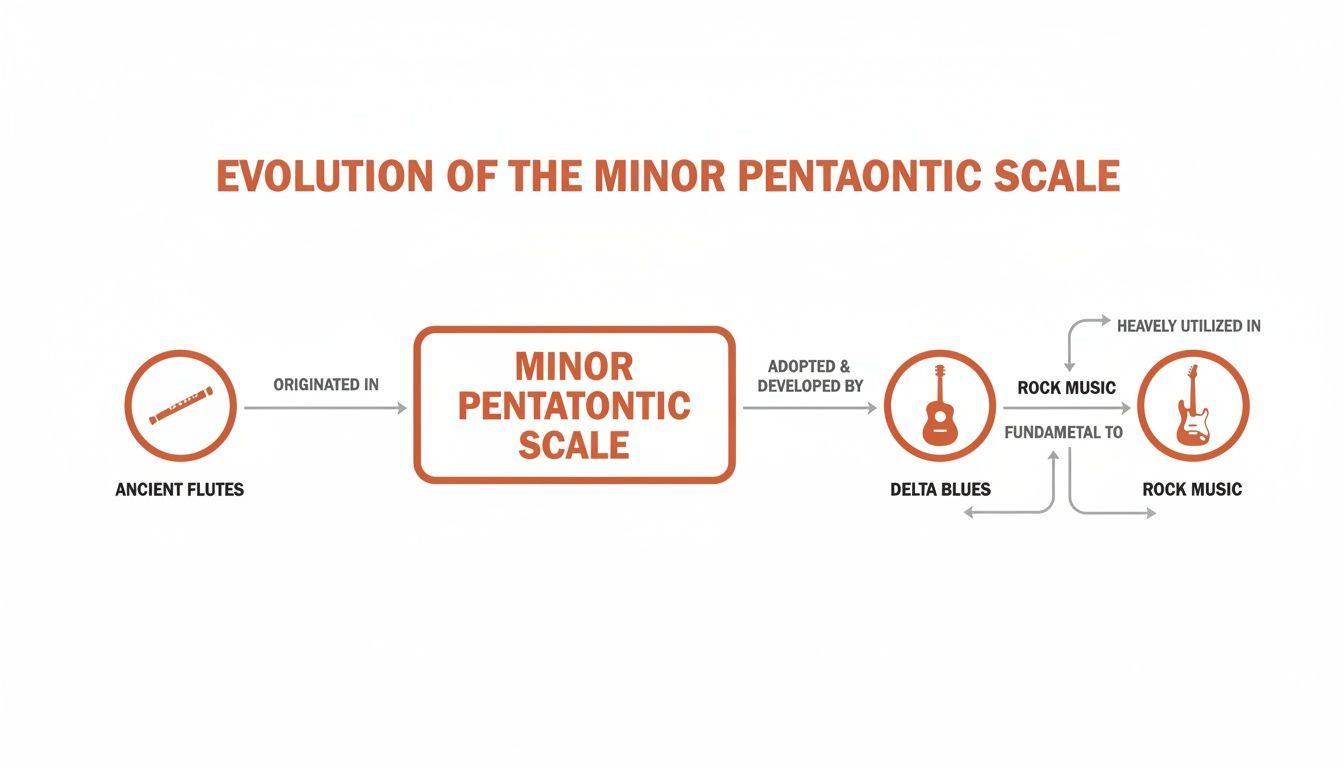
You can almost hear the echoes of each era shaping how we use these five notes today.
Every pentatonic box hides its root on a single string. Spot that root, and you unlock all five movable shapes.
Below is a quick overview of each pentatonic box: where the root lives, the fret span, and an example key to try.
Box Shapes Comparison
| Shape Number | Root String | Fret Span | Example Key |
|---|---|---|---|
| 1 | 6th String | 1–5 | E Minor |
| 2 | 5th String | 3–7 | D Minor |
| 3 | 4th String | 5–9 | C Minor |
| 4 | 3rd String | 7–11 | B Minor |
| 5 | 2nd String | 8–12 | A Minor |
Use this chart as your roadmap before moving into the exercises below.
Linking these boxes stops you from hunting for notes mid-solo. You'll move effortlessly over chord changes, almost instinctively.
For richer licks, run shapes side by side across the neck.
Mastering all five pentatonic boxes gives you a complete map of the neck for improvisation.
Once those patterns are under your fingertips, you can dial in techniques like bends and vibrato without getting lost.
Consistent review cements these shapes in your muscle memory—and sparks fresh ideas.
Ready to push forward? Sign up for a TrueFire All Access Trial for in-depth video demos, jam tracks, and interactive lessons that make these patterns real.

We've pulled together three gritty riffs in A minor, E minor, and G minor to get those pentatonic boxes moving. Each example comes with tab, tempo pointers, and timing cues so you can lock in groove and phrasing. Practice these with short jam-track ideas to build muscle memory across all five box shapes.
Kick things off with a classic blues-tinged lick in A minor. Set your metronome to 90 BPM for a relaxed pocket. Lean into the tension by bending the b3 (C) up to the fourth (D).
e|-------------------------5-8b(7)r8-5---------|
B|-------------------5-8----------------8-5-----|
G|-------------5-7----------------------------7-5-|
D|-------5-7---------------------------------------|
A|---5-7-------------------------------------------|
E|-------------------------------------------------|
Practice Note
Nail the bend and release in one smooth motion—think of it like a singer inhaling and exhaling.
Slide the same shape down to the 12th fret for E minor. Crank the tempo to 100 BPM and lean on syncopation around beats 2 and 4. You'll outline the 5th (B) and root (E) for a driving feel.
e|----------------12h15-----------12-------------|
B|-------------12-------15p12-------------12------|
G|--------12--------------------14----12----------|
D|--14-14------------------------------14-12------|
A|------------------------------------------------|
E|0~-----------------------------------------------|
Timing Tips
Drop into the 3rd-fret box for G minor. Slow it down to 80 BPM and savor each note. A wide vibrato on the b3 (B♭) will add warmth.
e|--------------------------3-6--3--------------|
B|--------------------3-6-----------6-3---------|
G|---------------3-5---------------------5-3----|
D|----------3-5----------------------------------|
A|----3-5---------------------------------------|
E|3-6--------------------------------------------|
Jam Track Ideas
By running through these riffs in different keys, you'll see how each pentatonic box flows into the next. Your solos become a highway, not a series of dead-ends.
"Using shared tones is like building bridges between islands of sound—you'll span the entire neck with ease."
Explore more chromatic passing tones and variations in our article on 6 Penta-Sonic Blues Licks You Must Know.
When you sprinkle in bending, sliding, hammer-ons, pull-offs, and vibrato, your minor pentatonic lines suddenly start to sing. Even a tiny shift in timing or a slight change in finger pressure can reshape the entire vibe of your solo.

Take B.B. King, for instance. His Chicago blues bends on the b3 and 4 notes almost sound like a voice crying out. Flip the script to Jimi Hendrix, and you'll hear how wide vibrato and smooth slides turned rock solos into otherworldly journeys.
Use these four fundamental moves to craft memorable, expressive lines:
Chicago blues often leans on a slow, sustained bend over the backbeat. That one simple gesture teaches you how to build tension and then release it with impact.
Classic rock solos, on the other hand, thrive on wide vibrato and double-stop bends for maximum drama. Meanwhile, jazz fusion players sneak in rapid hammer-ons and pull-offs along with chromatic passing tones, creating a web of sophisticated lines.
"A single bend can speak more than ten notes." – Legendary guitarist insight
Try weaving these ideas into your next practice session:
Once you've got those building blocks, start matching your phrasing to backing tracks. A tiny shift in rhythm can turn an old lick into something fresh. Over a slow jazz fusion groove, try pulling a note just behind the beat to give your melody a floating feel. Flip to a fast rock shuffle and tighten your slides for a punchier attack.
I like to visualize bending as stretching a rubber band—control the tension and bring it back precisely. Sliding feels like stepping stones across a stream. And those hammer-ons and pull-offs? They're a fingerboard conversation, question and answer.
For deeper bending drills, check out our guide on expressive guitar bends for step-by-step exercises and pro tips.
| Technique | Emotion | Practice Tip |
|---|---|---|
| Bend | Longing | Hold the full bend for 2 beats |
| Slide | Smooth Transition | Slide into a chord tone on beat four |
| Vibrato | Warmth | Vary speed to create emotional peaks |
Then slot these drills into your routine:
Finally, record your phrases and listen back for those subtle nuances. Let your ear guide you—what feels natural will ultimately shape your unique minor pentatonic voice.
Kick off your journey with a TrueFire All Access Trial to unlock HD lessons, jam tracks, slow-motion loops, and interactive tabs to elevate your minor pentatonic scale guitar techniques today.
Building a day-by-day framework brings order to your minor pentatonic studies. Short, focused sessions sharpen both your technique and creative instincts.
Consistency in these blocks cements note locations, builds muscle memory, and boosts improvisational confidence.
Choose one clear, measurable goal each week—like flawlessly switching through all five boxes in under two minutes. Record a quick video or audio clip so you can assess your timing, tone, and rhythmic feel.
"Review turns practice into progress."
You might be interested in our 15 Reasons Why Practicing Scales Unlocks Musical Growth
Don't forget to schedule a rest day. Recovery helps your body and mind absorb what you've learned.
Start each session with a single, well-defined objective to stay on track. Link your practice time to an existing routine—morning coffee or an evening cool-down.
At the end of each week, listen back to your recordings. Jot down what worked well and where you stumbled.
"Reflection fuels progress by turning mistakes into muscle-memory insights."
Keep a simple journal to log breakthroughs and challenges so you can tweak your plan as you grow.
TrueFire offers targeted modules that align perfectly with this routine. Here's a suggested month-long roadmap:
Each lesson or pack comes with variable tempos and backing tracks designed to match your current level. Regular check-ins ensure you see steady progress.
Kick off your journey now with a TrueFire All Access Trial and unlock HD lessons, interactive tabs, and jam tracks for your minor pentatonic scale guitar practice.
Navigating the minor pentatonic journey brings up familiar questions about notes, shapes, solo integration, and scale color. Let's untangle each one and keep your practice moving forward.
At its core, the minor pentatonic scale is built on five notes:
Lock these in and you've got the foundation for countless riffs and solos.
Memorization becomes effortless when you combine visual landmarks with kinesthetic cues:
Soon, you'll navigate the neck without a second thought.
Fluid solos come from connecting boxes horizontally and leaning on shared tones:
Each connection is like a stepping stone—make them smooth and natural.
Introducing the flat 5 (blues note) injects that tasty tension we love:
A little goes a long way—treat the blues note like seasoning, not the main dish.
When you're ready to level up, chromatic passing tones bridge the gaps between boxes:
These small additions open new melodic paths across the fretboard.
Don't forget to start your TrueFire All Access Trial to unlock all lessons, jam tracks, and exclusive resources.
