Think of a pentatonic scale chart for guitar as your personal roadmap to killer solos in rock, blues, pop, and just about everything in between. These charts visually lay out the five key patterns—or "boxes"—that hold all the safest, most musical-sounding notes, letting you finally navigate the fretboard with total confidence. As a guitar educator, I can tell you this is the most important scale system for any aspiring lead player to master.
If you've ever cranked up a classic solo from Angus Young, felt a soulful lick from B.B. King, or tapped your foot to a country riff by Brad Paisley, you've heard the pentatonic scale in action. This five-note powerhouse is the secret language spoken by guitar players across almost every single genre.
It helps to think of it less like a rigid, formal scale and more like a curated collection of notes that are guaranteed to sound good together. It’s the skeleton key that unlocks the fretboard, stripping away all the "wrong" notes and leaving you with a foolproof framework for crafting awesome melodies and solos.
The pentatonic scale comes in two main flavors, and each one has its own distinct vibe. Getting a feel for these moods is your first real step toward using a pentatonic scale chart for guitar like a pro.
Here’s the best part: these two scales are actually related. As you’re about to see, they share the exact same patterns on the fretboard. The only thing that changes is your "home base" note—the root you choose to emphasize.
A guitarist who knows their pentatonic shapes can confidently navigate jam sessions, write original solos, and speak the universal language of modern music. It’s not just a scale—it's your foundation for creative freedom.
Let's be honest, music theory can feel pretty intimidating. The pentatonic scale, however, is the perfect on-ramp. Its simple, symmetrical patterns are incredibly easy to visualize and memorize on the guitar neck.
The five shapes connect across the fretboard like puzzle pieces, eventually allowing you to see the entire neck as one big, unified map. Mastering these shapes is the single most important skill for any aspiring lead guitarist. It’s the foundation that every other soloing technique is built upon. This guide will give you the charts and the know-how to stop guessing and start playing with real purpose.
This is where the rubber meets the road. If the pentatonic scale is the secret language of the guitar, then these five shapes are your alphabet. Often called "box patterns," they're your complete map to the fretboard, letting you play the right notes in any key, all over the neck.
Think of the fretboard as uncharted territory. Trying to nail a solo without knowing these shapes is like wandering around lost, just hoping you stumble on the right notes. A pentatonic scale chart for guitar is your guide, breaking the neck down into five manageable, connected patterns. Memorizing them isn't just a chore; it's about truly learning the geography of your instrument.
Before we jump into the shapes, let's quickly go over what you're looking at. Each diagram is a snapshot of your guitar's neck.
Once you get these simple elements down, you can unlock any pentatonic chart you come across.
The pentatonic scale is so central to modern guitar that its popularity is almost hard to believe. It dominates guitar education, with the minor pentatonic consistently ranked as the #1 scale taught to beginners. It’s a key ingredient in roughly 85% of introductory lessons because it just works over common chord progressions in blues, rock, and pop.
This boom really took off after World War II with the rise of the electric guitar. By the 1950s, pioneers like B.B. King and Muddy Waters had embedded minor pentatonic licks into 90% of their recordings. That sound went on to directly influence over 50 million blues-rock albums sold worldwide by the year 2000. For a deeper dive on its journey, you can discover more insights about its history and use at Lifein12Keys.
Now, let's get into the five shapes that built this legacy. We'll use the key of A Minor for our examples—a classic choice for rock and blues.
The "box" idea is a great starting point, but don't let it fence you in. The real goal is to see how these five shapes connect, letting you flow across the entire fretboard instead of being trapped in one spot.
Learning these shapes up and down the neck is the first step. The next, more exciting step is to start seeing them horizontally. That's where true fretboard freedom kicks in, as you learn to slide between positions to create longer, more expressive phrases. For more on this, check out our guide on developing horizontal vision for the pentatonic scale.
Each of the five patterns has its own vibe and sits on a different part of the fretboard. Getting to know their individual personalities helps you pick the right shape for the right musical moment.
Here's a quick look at all five positions in the key of A Minor. This puts our first shape right at the 5th fret, a very comfortable place to start.
| Position | Fret Range (for A Minor) | Primary Root Note String | Common Musical Feel |
|---|---|---|---|
| Position 1 | Frets 5-8 | 6th String (Low E) | The iconic "blues box." Gritty, powerful, and home to countless classic rock riffs and soulful blues licks. |
| Position 2 | Frets 8-10 | 4th String (D) | A bit more melodic and open-sounding. Great for connecting phrases and moving up the neck. |
| Position 3 | Frets 10-12 | 4th String (D) | Offers easy access to higher-register bends and is perfect for building intensity in a solo. |
| Position 4 | Frets 12-15 | 5th String (A) | Has a bright, singing quality. Excellent for melodic lines and country-influenced playing. |
| Position 5 | Frets 3-5 (and 15-17) | 6th String (Low E) | Connects back to Position 1. Often used for lower, moodier phrases or high-octave screams. |
As you start practicing, really dig into Position 1. Get comfortable with its shape and sound over a backing track. Once it feels like home, move on to Position 2 and pay close attention to how it overlaps with the first. Thinking of them like puzzle pieces is the best way to build a complete picture of the fretboard in your mind.
You've memorized the five pentatonic shapes. That’s a huge step, but it’s really only half the battle. The real magic happens when you can make those shapes work in any song, no matter what key it's in. This is where the crucial skill of transposition comes into play—the ability to move these patterns anywhere you want on the fretboard.
Think of your Position 1 chart as a movable stencil or a piece of tracing paper. Once you know the shape, you can slide it up or down the neck to fit any musical situation. This simple idea is what frees you from being stuck in one key and truly unlocks the entire fretboard.
The quickest way to get your pentatonic scales into a new key is by anchoring them to a root note on the low E-string (the 6th string). It’s a dead-simple, reliable method that works every single time.
Here's how you do it:
This whole concept is laid out in the chart below. It shows how that core pattern connects to a root note, which can then be shifted anywhere up and down the neck.
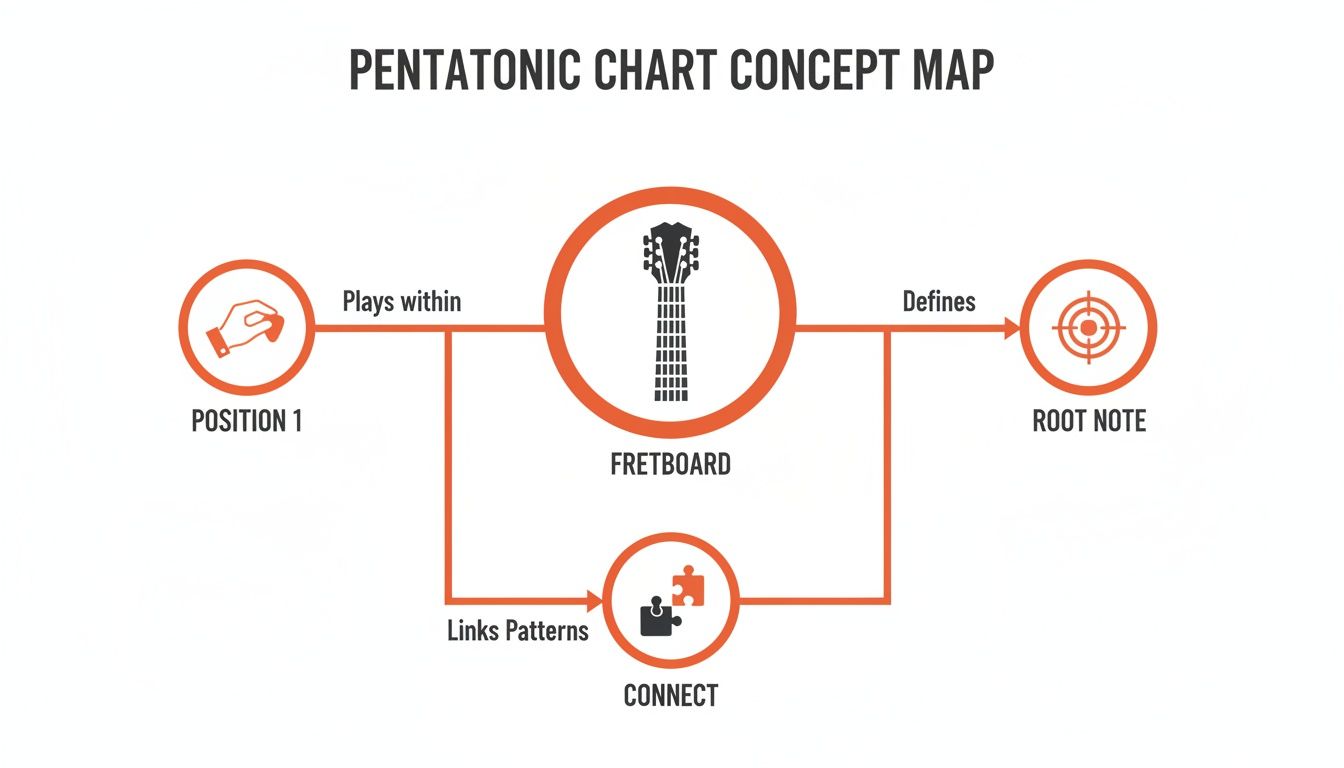
This process reveals the three core ideas for owning the fretboard: understanding the Position 1 pattern, knowing your root note locations, and seeing how all the shapes interconnect.
Here’s a secret that will instantly double your musical vocabulary without you having to learn a single new shape. The minor pentatonic and major pentatonic scales use the exact same five patterns. The only thing that changes is which note you treat as your "home base," or root.
The shapes don't change, but your musical focus does. For A minor pentatonic, 'A' is the root. For its relative, C major pentatonic, 'C' becomes the root, even though you're playing the same five notes. This simple shift in perspective is everything.
This relationship is called relative major and minor. Every minor key has a relative major that shares the exact same notes, and vice versa. To find the relative major, just go up three frets from the minor root note. So, for A minor, its relative major is C major.
This means your A minor pentatonic chart is also your C major pentatonic chart. The difference is purely contextual. You emphasize the 'C' notes to get that happy, major sound, or lean on the 'A' notes for that classic, bluesy minor vibe. You can dive deeper into this concept and transpose scales and chords on TrueFire.
Ultimately, guitar charts map out five interconnected shapes, usually starting with Position 1 at the 6th-string root. These shapes are movable to any fret to cover all 12 keys, and their patterns are designed to sound good over 95% of standard chords, which keeps you from hitting clashing notes. This system of movable shapes is the absolute key to improvisation and musical freedom. With this knowledge, you can grab any pentatonic scale chart for guitar and make it your own in any musical context.
Memorizing those five pentatonic scale shapes is like learning the alphabet. It's a huge first step, but just knowing the letters doesn't automatically make you a great storyteller. The real magic happens when you start forming words and sentences—turning those static dots on a chart into living, breathing music.
This is where you graduate from just running scales up and down. We're about to dig into the expressive techniques that inject your notes with character, emotion, and life. It's how you stop sounding like you're practicing and start sounding like you're playing a solo that actually says something.
Raw notes are just the start; how you play them is what carves out your unique voice on the guitar. Articulation is everything. It's the difference between a robot reciting notes and a human being singing them with real feeling.
Here are the essential techniques you need to start weaving into your playing right away. Seriously, adding just one or two of these can instantly make your solos sound more professional and captivating.
These aren't just fancy tricks; they are the fundamental building blocks of musical phrasing. Start experimenting with them inside the box patterns you've already got under your fingers.
Ever tried jamming along to a classic blues track using just your minor pentatonic scale? You might feel like something is missing. You're playing all the "right" notes, but it just doesn't have that gritty, authentic blues sound. That missing ingredient is almost always the blue note.
The blue note is the flat fifth (♭5) of the scale. It's a beautifully dissonant, "in-between" note that creates a ton of tension and adds that distinctly bluesy flavor. Adding this one note turns your minor pentatonic into the far more authentic-sounding blues scale.
For example, in our A minor pentatonic scale, the blue note would be an E♭. Sprinkling this note into your licks—especially when bending into it or using it as a quick passing tone—is the key to unlocking that timeless, soulful sound you've heard on countless blues and rock solos.
The fastest way to learn how to phrase musically is to learn short musical phrases, or licks. Think of them like your musical vocabulary. The more licks you know, the more you have to "say" in your solos.
Here are five sample licks, one for each of the five pentatonic positions in the key of A minor. Practice them slowly at first, really focusing on the expressive techniques used in each one.
(Note: The following tablature should be displayed in a fixed-width font for proper alignment.)
Position 1 Lick (The Classic Blues Box)
e|---------------------------------|
B|---------------------------------|
G|---7b9--7b9--5h7p5---5-----------|
D|-------------------7---7-5-------|
A|---------------------------7-6-5-|
E|---------------------------------|
Position 2 Lick (Melodic Connection)
e|-----------------------8-10b12---|
B|--------------8--10-10-----------|
G|--------5-7/9--------------------|
D|---5--7--------------------------|
A|---------------------------------|
E|---------------------------------|
Position 3 Lick (High-Intensity Bend)
e|---------------------------------|
B|-------13b15---13--10------------|
G|---12-----------------12-10------|
D|----------------------------12---|
A|---------------------------------|
E|---------------------------------|
Position 4 Lick (Bright and Melodic)
e|---12-15-12----------------------|
B|------------15-13----------------|
G|------------------14-12----------|
D|------------------------14-------|
A|---------------------------------|
E|---------------------------------|
Position 5 Lick (Connecting Back Home)
e|---15b17--15p12------------------|
B|----------------13---------------|
G|-------------------14-12---------|
D|-------------------------14\12---|
A|---------------------------------|
E|---------------------------------|
Learning these licks helps you build a vocabulary and truly understand how to apply articulation. For a deeper dive, you can learn more about incorporating pentatonics into your playing on the TrueFire blog.

Knowing the shapes on a pentatonic scale chart for guitar is the easy part. But owning them? That's a whole different game. True fluency—where your fingers just know where to go without you even thinking about it—only comes from smart, consistent practice.
Without a solid plan, it’s easy to fall into the trap of mindlessly running scales up and down. That might build a little speed, but it does next to nothing for your real-world musicality.
This section lays out a clear, actionable routine designed to burn these patterns into your muscle memory for good. We're talking about building accuracy, timing, and most importantly, the ability to see all five shapes as one seamless map across the fretboard. This is how you stop thinking about scales and start making music with them.
Your journey to mastering these scales starts with a metronome. It might not be the sexiest piece of gear you own, but it's the single most powerful tool for forging a rock-solid sense of rhythm and clean technique. A metronome doesn't lie; it gives you honest, instant feedback on your timing.
Set it to a nice, slow tempo—somewhere around 60-80 BPM. Pull up Position 1 of the minor pentatonic scale. Your goal is simple but crucial: play one note perfectly in time with each click. Really focus on making every note ring out cleanly, with no buzzes or dead strings.
Once you can nail the pattern up and down, try playing two notes per click (eighth notes), and then four (sixteenth notes).
Think of the metronome as your training partner. It doesn't judge, it just keeps you honest. Nailing this foundational timing is what separates sloppy, amateur playing from tight, professional-sounding solos.
This slow, deliberate work is what builds the deep muscle memory you need for fluid playing. It’s also a fantastic way to clean up your picking technique along the way.
Once you're comfortable playing individual box patterns to a click, it's time to break out of those boxes. The real goal is to see the fretboard as one continuous scale, not five isolated shapes. The key to this is practicing the connections between the positions.
Here's a simple but incredibly effective exercise:
Rinse and repeat this for all adjacent positions (2 to 3, 3 to 4, and so on). This horizontal movement is the secret to unlocking the entire neck and crafting those long, flowing solo lines that sound so effortless. You can learn more about why practicing guitar scales is great for more than just memorizing notes in our related article.
Alright, this is where the real fun begins—where all that theory and practice finally turns into music. Jamming over backing tracks is hands-down the fastest and most inspiring way to train your ear and develop your improvisational instincts. It gives you a real musical context to apply everything you've been drilling.
Find a simple blues or rock backing track online in a key you know, like A minor. At first, just try improvising using only Position 1. Then, challenge yourself to sneak into Position 2, then connect to 3. Don't worry about playing perfectly; just listen to the music and try to create simple melodic ideas. This is how you find your own voice on the instrument.
Alright, you've got the map. You know the patterns, you have a practice plan, and you're ready to really dig in and make the pentatonic scale your own. Think of this as the foundation for getting truly creative on the guitar. It’s like graduating from learning the alphabet to finally writing your first story.
Don't ever think the pentatonic scale is just for beginners. It’s a lifelong tool that you'll find in the hands of the greatest players on the planet, from old-school blues legends to today's modern shredders. The five shapes are your constants, but how you use them will evolve for as long as you play.
As you get more and more comfortable with the patterns from any pentatonic scale chart for guitar, something cool starts to happen. Your focus will naturally shift. You’ll stop seeing boxes and start seeing pathways and connections all over the neck. Your playing will become more horizontal, gliding smoothly between positions instead of feeling trapped in one spot.
This is where the real fun begins. You'll start to:
Getting good at an instrument is a marathon, not a sprint. The best guitarists never stop learning, and they never forget the fundamentals. The pentatonic scale will always be your most reliable and expressive tool, no matter how advanced you get. It’s the very core of the guitar's language.
The goal isn’t just to play the scale; it's to make the scale sing. It's about taking those five simple notes and using them to tell your own musical story with some real emotion and conviction.
Keep practicing with purpose, listen closely to your heroes, and never, ever stop experimenting. The map is in your hands now, but the destination is wherever your creativity decides to take you.
Even with the best chart in front of you, a few questions always pop up. It's totally normal. Let's run through some of the most common ones I hear from students to make sure everything clicks.
Ask any seasoned guitar teacher, and you'll get the same answer: start with Position 1. If you're playing in A minor, this is that classic "box" shape that lives at the 5th fret. It's home base for thousands of the greatest rock and blues licks ever played.
Get this pattern down cold. I mean, practice it with a metronome until you don't even have to think about it. Nail this one first, and you'll have a rock-solid foundation before you even worry about Position 2.
This is a huge "aha!" moment for so many players. The five patterns on any pentatonic chart are identical for both major and minor scales. The shapes don't change at all. The only thing that changes is your root note—the one note that feels like your musical home base.
For A minor pentatonic, 'A' is your root and gives you that bluesy, somber feel. For its relative, C major pentatonic, 'C' becomes your root note, even though you're playing the exact same notes and shapes. It’s all about which note you emphasize to create the musical mood.
The secret isn't learning more notes; it's seeing how the patterns you already know overlap. Look closely, and you'll notice that the highest notes in Position 1 are the exact same notes as the lowest ones in Position 2.
Instead of just running up and down inside one box, try practicing slides that take you from one shape into the next using those shared notes. This horizontal thinking is the key to unlocking the entire fretboard and making it feel like one giant, connected scale.
Ready to stop just learning scales and start making real music? TrueFire has over 80,000 interactive video lessons and thousands of jam tracks to accelerate your progress. To take your playing to the next level with a structured learning path, you can start your TrueFire All Access Trial today at https://truefire.com.
