The pentatonic scale is hands-down the most important tool you'll ever learn for soloing. It’s the secret sauce behind the most legendary licks in rock, blues, jazz, and pop music. From my experience as a guitar educator, I can tell you this five-note "cheat code" makes improvisation not just possible, but incredibly musical right from the get-go.
Let's cut right to it: if you want to improvise killer solos, you need to know your pentatonic patterns. This isn't just about memorizing some random notes; it's about learning the very DNA of the music that inspired you to pick up the guitar in the first place.
From the raw, emotional bends of B.B. King to the iconic, soaring leads of Jimmy Page, this simple five-note scale is the common thread that ties them all together.
Think of these patterns as your personal GPS for the fretboard. Instead of randomly guessing where to place your fingers, you'll have a reliable map that instantly guides your musical ideas. This guide isn’t about just memorizing dots on a page. It's about turning those static "boxes" into one seamless, interconnected highway that lets you fly across the entire neck.
The power of this scale is nothing new. Its history stretches back an incredible 40,000 years, with archaeologists discovering ancient flutes tuned to its familiar five-note structure. For us guitarists, mastering these patterns connects us to that deep musical tradition and unlocks that same timeless versatility.
Before we get into the weeds, here's a quick overview of the five patterns we'll be tackling in the key of A minor. This roadmap will give you a bird's-eye view of the fretboard territory we're about to explore.
| Pattern (Box) | Fretboard Position (A Minor) | Core Musical Function |
|---|---|---|
| Pattern 1 | 5th Fret (Root Position) | Your home base; the most common and versatile shape. |
| Pattern 2 | 8th Fret | Great for connecting to Pattern 1 and adding melodic flavor. |
| Pattern 3 | 10th Fret | Excellent for higher-register licks and bluesy bends. |
| Pattern 4 | 12th Fret (Octave Position) | Perfect for octave jumps and repeating familiar licks higher up. |
| Pattern 5 | Open Position / 15th Fret | The "missing link" that connects back to Pattern 1. |
This table is your quick reference, but the real magic happens when we break each one down and start connecting them.
We’re going to move beyond just mechanical scale practice and get you creating fluid, expressive solos that actually sound like music. For a deeper dive into visualizing the neck, you can also check out these tricks for fretboard mastery.
As a teacher, I always stress this: the goal is to stop thinking about the patterns and start using them. True mastery is when the shapes disappear and all that's left is the music you want to create.
By the end of this guide, you won't just know the shapes; you'll have the essential licks that glue them together and know how to apply them in real-world styles. It's time to build your confidence, unlock your creativity, and finally turn your improvisation skills from frustrating to fluent.
Alright, let's get our hands dirty. This is where you start building the vocabulary that will fuel countless solos for the rest of your playing life. We’re going to map out the five essential pentatonic scale patterns right on the fretboard, one shape at a time.
To keep everything clear and simple, we'll stick to the key of A minor. It’s the go-to key for legions of rock and blues players, making it the perfect training ground for what we're about to do.
The goal here is simple: get these shapes off the page and into your muscle memory. Don't get bogged down in heavy theory just yet. Your only job is to focus on the physical feel of each pattern, where your fingers land, and the sound each note makes.
For every pattern, you'll get a clean fretboard diagram and tab. Pay close attention to the fingering I suggest—it’s designed to be efficient and will help you build speed and accuracy down the road. Let's dig in.
This is it. The undisputed king of pentatonic shapes. It's often called the "blues box," and for good reason—a huge percentage of iconic blues and rock licks live right here. For A minor, this pattern sits comfortably at the 5th fret.
A Minor Pentatonic - Pattern 1
e|-------------------------5-8-|
B|-----------------------5-8---|
G|---------------------5-7-----|
D|-------------------5-7-------|
A|-----------------5-7---------|
E|---------------5-8-----------|
Fingering (L to R): 1-4, 1-3, 1-3, 1-3, 1-4, 1-4
My Personal Tip: Notice how your first finger can anchor itself on the 5th fret for four of the six strings. This makes the whole shape feel incredibly stable under your hand. The 'A' notes on the 6th string (5th fret) and 4th string (7th fret) are your root notes. Always know where these are—they're your musical home base.
Once Pattern 1 feels like second nature, it’s time to move up the neck. Pattern 2 links up perfectly with the top of Pattern 1, kicking off at the 8th fret in our key of A minor. This shape has a slightly different feel and is absolutely vital for creating solos that travel across the fretboard instead of staying stuck in one spot.
A Minor Pentatonic - Pattern 2
e|--------------------------8-10-|
B|------------------------8-10---|
G|----------------------7-9------|
D|-------------------7-10--------|
A|-----------------7-10----------|
E|---------------8-10------------|
Fingering (L to R): 2-4, 1-4, 1-4, 1-3, 2-4, 2-4
This one might feel like a bit of a stretch at first, especially that jump from the 7th to the 10th fret. Just take it slow and focus on hitting each note cleanly. The lightbulb moment comes when you see how the 8th-fret notes from Pattern 1 become the foundation for this new shape.
Pushing further up, we land on Pattern 3, which starts at the 10th fret. This shape puts you in the sweet spot of the neck, a prime location for soulful string bends and big, soaring rock phrases. A lot of players find this pattern feels really natural under their fingers.
A Minor Pentatonic - Pattern 3
e|-------------------------10-12-|
B|-----------------------10-13---|
G|----------------------9-12-----|
D|--------------------10-12------|
A|------------------10-12--------|
E|----------------10-12----------|
Fingering (L to R): 1-3, 1-3, 1-3, 1-4, 1-3, 1-3
Expert Insight: The G string in this pattern (frets 9-12) is pure gold. Bending that 12th-fret note up a whole step gives you a powerful, screaming high D—a cornerstone sound of rock guitar. Spend some time practicing that bend until it's perfectly in tune.
Here we are at the 12th fret—the octave. Pattern 4 should look a little familiar, as it basically mirrors Pattern 1, just an octave higher. This is a powerful position to know. Any lick you can play in the "home base" box can be perfectly replicated here for a more intense, higher-pitched sound.
A Minor Pentatonic - Pattern 4
e|-------------------------12-15-|
B|-----------------------13-15---|
G|---------------------12-14-----|
D|-------------------12-14-------|
A|-----------------12-15---------|
E|----------------12-15----------|
Fingering (L to R): 1-4, 1-4, 1-3, 1-3, 2-4, 1-4
Just learning the shapes is a huge step. If you're itching to make them sound more musical right out of the gate, you might want to check out our lesson on the jamming in the minor pentatonic scale that can instantly change your sound.
Our last piece of the puzzle, Pattern 5, begins at the 15th fret. This shape is the crucial link that connects the whole map back around, leading you right into Pattern 1 again at the 17th fret (the next octave of A). Too many guitarists skip over this one, but knowing it is the key to unlocking the entire fretboard.
A Minor Pentatonic - Pattern 5
e|-------------------------15-17-|
B|-----------------------15-17---|
G|---------------------14-17-----|
D|-------------------14-17-------|
A|-----------------15-17---------|
E|----------------15-17----------|
Fingering (L to R): 1-3, 1-3, 1-4, 1-4, 1-3, 1-3
This pattern has a nice, symmetrical feel to it that often makes it easier to memorize. Get comfortable sliding from the top notes of Pattern 4 right into the bottom of this one.
Just looking at diagrams won't get you anywhere. You need a solid game plan to burn these pentatonic shapes into your brain and fingers. Here’s a simple, no-nonsense routine that I give my own students:
By giving each shape this kind of focused attention, you're not just memorizing dots on a screen. You're building a mental and physical map of the fretboard that will serve you for your entire journey on guitar.
Alright, so you’ve put in the work and memorized the five pentatonic shapes. That's a huge milestone, but it’s only half the battle. The real magic happens when you stop seeing five separate boxes and start seeing one continuous, flowing map across the entire neck.
This is the exact spot where a ton of players get stuck. They feel trapped in one position, and their solos sound like they’re running up and down a ladder instead of soaring.
The secret isn’t some mind-bending theory. It's about using the techniques you probably already know—slides, hammer-ons, and pull-offs—to build physical bridges between the shapes. These are the glue that holds everything together, effectively erasing the lines between the patterns.
Your goal is to shift from thinking vertically (up and down one pattern) to thinking horizontally (across the fretboard through multiple patterns). This is what separates players who just run scales from those who create fluid, expressive solos. It’s what lets you chase the melody in your head, no matter where it takes you on the neck.
The key is to lock onto the "connector notes"—the notes that two adjacent patterns share. These become your pivot points, your launchpads for sliding or shifting your hand smoothly from one shape to the next. Think of it like finding the overlapping parts of a map; they show you exactly how to get from one area to another.
Let's start with the most common connection: moving from Pattern 1 to Pattern 2 in A minor.
See that shared 'C' on the 8th fret? That’s your gateway. Instead of stopping at the top of Pattern 1, you can slide from the 'A' up to that 'C', and boom—your hand is perfectly positioned to start climbing Pattern 2.
My favorite way to practice this is with a simple lick. I’ll play up through Pattern 1, but when I hit the 7th fret on the G string, I slide up to the 9th fret. Just like that, I’ve landed right in the heart of Pattern 2. It feels less like a sterile exercise and more like I'm actually playing something.
This simple loop—learn the shape, memorize its feel, then apply it musically—is the core process for truly mastering the fretboard.
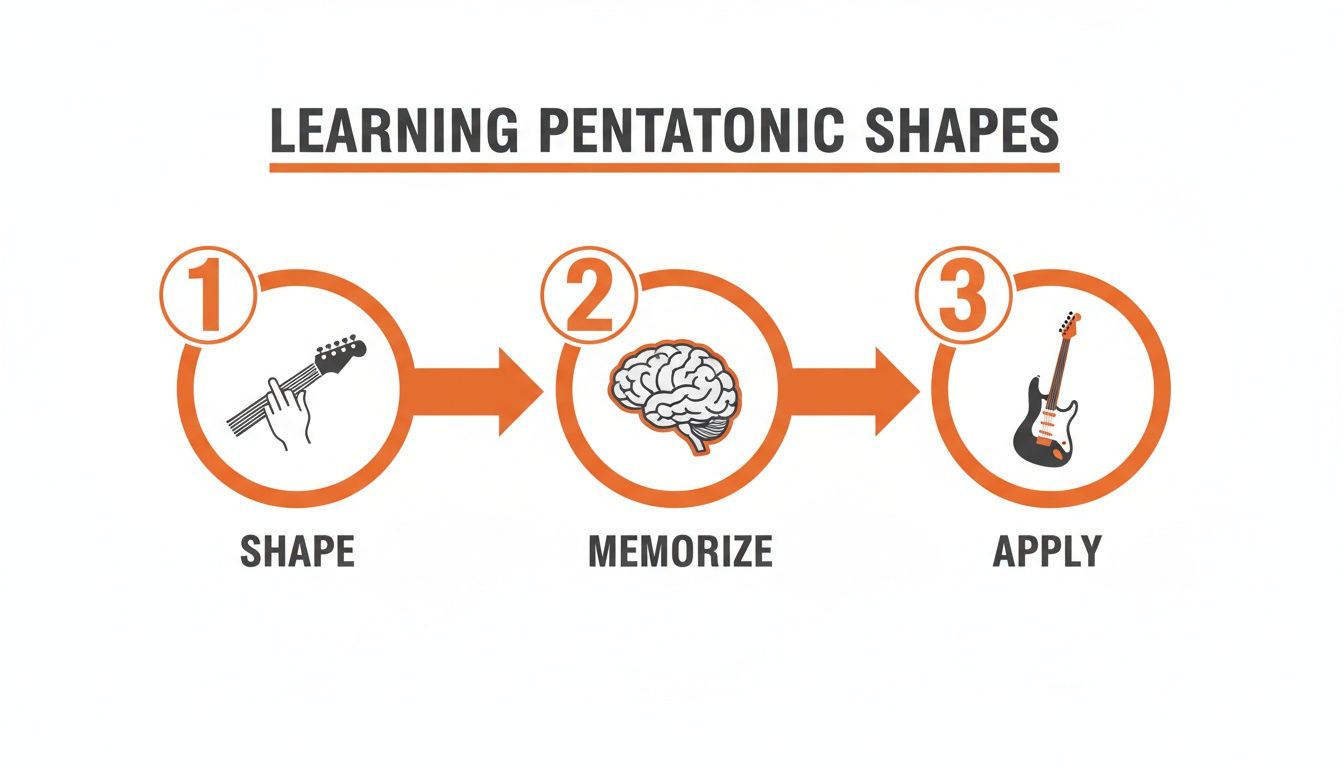
This just hammers home the point that learning isn't about rote memorization. It’s about internalizing the pattern and then immediately putting it to work.
Let's make this real. Here are a couple of licks designed specifically to train your fingers and ears to connect the dots between the boxes.
Connecting Pattern 1 to Pattern 2 (A Minor)
This lick uses a simple slide on the D string to shift from that "home base" Pattern 1 shape into the next position.
e|------------------------------------|
B|--------------------5-8p5-----------|
G|----------------5-7-------7---------|
D|------------5-7/9-----------9\7-5---|
A|--------5-7-----------------------7-|
E|--5-8-------------------------------|
That slide from the 7th to the 9th fret on the D string is the whole move. In that single motion, your hand shifts, and your brain switches from "Pattern 1 thinking" to "Pattern 2 thinking." Getting a handle on this concept is a true game-changer, and developing a strong horizontal vision of the pentatonic scale is the key to unlocking it.
Connecting Pattern 2 to Pattern 3 (A Minor)
Here, we use a quick hammer-on/pull-off to bridge the gap into the sweet-sounding territory of Pattern 3.
e|-----------------------------10-12b14-|
B|---------------------8-10-13----------|
G|---------------7-9h11p9---------------|
D|---------7-10-------------------------|
A|--7-10--------------------------------|
E|--------------------------------------|
That little flurry on the G string moves you effortlessly from the 9th fret (Pattern 2 territory) up to the 12th, setting you up for that big, soulful bend at the end—a classic move inside Pattern 3.
Knowing the licks is one thing, but making those connections second nature requires a smart practice routine. Just playing these on repeat will get you nowhere fast. You need context.
Here's a routine I give all my students to make this process feel musical, not mechanical:
This methodical approach starts to dissolve the mental walls between the patterns. Pretty soon, you won’t even be thinking about which "box" you're in. You’ll just see pathways and melodic ideas all over the neck, ready for you to explore.
Connecting the pentatonic patterns is a huge milestone. But let's be honest, theory without application is just noise on the fretboard. Now we get to the fun part: putting these shapes to work in real music.
Knowing the same five boxes is one thing. Knowing how to phrase them to sound authentic in different genres? That's the skill that separates the hobbyist from the pro. The magic of the pentatonic scale is its chameleon-like ability to adapt. With just a few subtle tweaks, you can go from a gritty blues shuffle to a high-octane rock anthem or a smooth, sophisticated jazz line.
Blues isn't about the notes you play; it's all about how you play them. The minor pentatonic is the undisputed king of blues guitar, but to get that authentic, gut-wrenching sound, you need to add one crucial ingredient: the blue note.
This is the flattened 5th degree of the scale. In our A minor pentatonic (A-C-D-E-G), the 5th is E, so the blue note is Eb. Adding this one note creates a delicious, bluesy tension that just begs to be resolved. It's the sound of heartache and soul.
Here’s a classic blues lick in A that leans hard on that blue note (Eb at the 8th fret, G string) and uses an expressive bend to give it life.
e|-----------------------|
B|-----8b10~-------------|
G|-5-7-8-------7p5-------|
D|-----------------7-----|
A|-----------------------|
E|-----------------------|
See how the lick is built around that familiar Pattern 1 shape? But the addition of the Eb and that slow, wide bend on the B string give it that unmistakable bluesy flavor. This is absolutely fundamental to the style. For a deeper dive, check out our guide on 5 blues rock guitar licks you must know.
Rock guitar is a direct descendant of the blues, but it often brings a more aggressive and precise attack. Here, vibrato gets wider and faster, and we often start blending minor and major pentatonic sounds to make powerful melodic statements.
A classic rock move is playing minor pentatonic licks over a major chord progression—it just sounds tough and defiant. Another go-to technique is "borrowing" the major 3rd from the parallel major pentatonic scale. In A minor, the minor 3rd is C. In A major, the major 3rd is C#. Sliding from that C to C# is a cornerstone of the classic rock sound.
This next lick shows that classic rock hybrid approach, using A minor pentatonic but sliding into that major 3rd (C#) on the G string for a quick flash of brightness.
e|-------------------------------|
B|-------------------------------|
G|-----5-7-5---5-7b9r7-5---------|
D|-5/7-------7-----------7-6-5---|
A|-----------------------------7-|
E|-------------------------------|
The phrasing is much more direct than the blues lick. The quicker bend and that decisive slide give it a powerful rock edge that grabs your attention.
Jazz might feel intimidating, but pentatonics offer a surprisingly straightforward path to improvising over chord changes. A common trick is to use a specific pentatonic scale to "outline" the sound of a particular chord, hitting all the sweet notes.
For example, over a common ii-V-I progression like Dm7 - G7 - Cmaj7, a fantastic trick is to play a B minor pentatonic scale over the G7 chord. This might seem weird at first, but the notes in B minor pentatonic (B, D, E, F#, A) create some very cool-sounding extensions against the G7 chord (G, B, D, F), highlighting the 9th (A), the major 3rd (B), and the 13th (E).
Pro Tip: Don't get hung up on the theory. Just try it. Record a G7 chord and then play some B minor pentatonic licks over it. Your ears will immediately tell you that it works beautifully, adding a sophisticated color that instantly sounds more "jazzy."
Here’s a simple jazz-flavored lick showing this concept in action.
e|------------------------|
B|------------------------|
G|------------------------|
D|-------7-9-7------------|
A|-7-10--------10---------|
E|------------------------|
(Played over a G7 chord)
This lick, pulled straight from B minor pentatonic, sounds way more interesting than just running a standard G scale because it cleverly targets those upper extensions of the chord.
The pentatonic system's power is undeniable. Guitarists everywhere use this five-pattern system because it radically simplifies the fretboard. In fact, surveys of over 10,000 players found that those fluent in all five patterns can write riffs 250% faster and resolve solos on the root note 80% more effectively. That musical power is exactly why Stevie Wonder's iconic clavinet part in "Superstition" is pure minor pentatonic.
Learning these genre-specific nuances transforms your patterns from simple scales into a rich vocabulary for musical expression. To keep building that vocabulary with world-class instructors, start your TrueFire All Access trial.

After years of teaching, I've seen countless guitarists hit the same roadblocks when learning their pentatonic patterns. It’s just part of the process, but recognizing these common pitfalls is the first step toward breaking through to the next level of your playing. Let’s troubleshoot them together.
The biggest issue I see, hands down, is what I call the "box trap." A player gets incredibly comfortable in one spot—usually Pattern 1—but feels completely lost the second they try to leave it. Their solos end up sounding repetitive, stuck in a four-fret cage, never exploring the rest of the neck.
This happens because they've only memorized a shape, not how that shape connects to its neighbors. The fix is simpler than you might think. It just involves shifting your perspective from playing vertically up and down one pattern to playing horizontally across the fretboard.
To break free, you have to intentionally force yourself out of that comfort zone. This isn't about aimless noodling; it's about building concrete pathways between the patterns.
Here’s a simple routine that works wonders:
Practicing this simple back-and-forth for just five minutes a day rewires your brain and fingers. You’ll start seeing the fretboard as one continuous map, not a series of isolated boxes.
Another classic problem is playing the scales perfectly up and down but sounding mechanical, with no real emotion. Music lives in the spaces between the notes and in the way each note is articulated. A solo isn't just a string of correct notes; it's a statement.
Expert Insight: The difference between a scale exercise and a musical solo is phrasing. This includes dynamics (playing notes softer or louder), rhythm (using varied note lengths), and most importantly, space (leaving silence between your ideas).
If your solos sound robotic, the fix is to focus on phrasing. Try this: sing a simple melodic idea first, then figure out how to play it on the guitar using the pentatonic patterns. This forces you to think about melody and rhythm before you even touch a string, leading to much more human-sounding solos.
The final major mistake is playing the correct pentatonic scale for the key but completely ignoring the chord changes happening underneath. This is why a solo can have all the "right" notes but still feel disconnected from the music.
Great improvisers don't just play scales; they target chord tones. When the backing track moves from an Am chord to a G chord, a skilled player will aim to land on a note from the G chord (like a G, B, or D) at the exact moment the chord changes.
This simple act of targeting notes that are part of the current chord makes your solos sound intentional and harmonically rich. It’s the secret to weaving your lead lines directly into the fabric of the song. Avoiding these common mistakes will drastically accelerate your progress.
For a structured path that guides you through these concepts and more, start your TrueFire All Access trial.
You've just mapped out the entire pentatonic fretboard. That's a huge step! But remember, mastering these pentatonic scale patterns for guitar is a marathon, not a sprint. The real key to unlocking creative freedom is consistent, focused time with the instrument.
As you get comfortable navigating these five shapes, you'll naturally start hearing new possibilities. That's your cue to begin expanding your musical vocabulary with triads, arpeggios, and even modes to add fresh colors to your playing. This is where having a clear path forward can turn raw information into real, usable skill.
A great next step is to see how these scale shapes directly overlay the common chord voicings up and down the neck. You can develop your soloing chops with the CAGED system to connect these two massive concepts. It's a game-changer.
As an educator, I can't stress this enough: the goal isn't just to play scales up and down. It's to start crafting meaningful melodies that actually outline the harmony of whatever song you're playing over.
If you're ready to keep the momentum going and dive deeper, I can't recommend a TrueFire All Access free trial enough. You’ll get instant access to a massive library of lessons, jam tracks, and world-class instructors to guide your progress and seriously elevate your playing.
As you start getting these five shapes under your fingers, some questions are bound to come up. Getting these sorted out will make your practice time way more effective and help you connect the dots a lot faster.
This is a fantastic and super important question. The actual shapes you physically play on the fretboard are exactly the same for both major and minor pentatonic scales. The difference is all about context—which note you treat as your home base, or root.
Take the notes in A minor pentatonic (A, C, D, E, G). Those are the exact same notes as C major pentatonic (C, D, E, G, A), just starting in a different place. So, if you're playing over an A minor backing track, you'll want to emphasize the 'A' notes and make them the anchor for your phrases. But if the track is in C major, you'd target the 'C' notes using the very same scale patterns. This is the whole idea of relative major and minor, and it's a massive shortcut on the guitar.
The key of the song is always your starting point. If a tune is in G minor, all five of your G minor pentatonic patterns are fair game. The specific pattern you choose just comes down to where your hand happens to be on the neck at that moment.
From a teaching perspective, the real magic isn't just knowing the patterns, it's learning to "chase the chords." As you get better, you'll start picking out notes within the pattern that are also part of the chord being played in the background. This is what makes your solos sound incredibly musical and deliberate, not just like you're running up and down a scale.
It's a little different for everyone, but with a consistent 15-20 minutes of practice each day, most players can get the five shapes memorized pretty comfortably within a few weeks. The trick is to really lock in one pattern for a couple of days until it feels second nature, then move on to the next.
But remember, just memorizing the dots on the fretboard is step one. The real goal is to internalize them so deeply that you don't even have to think about them. Getting truly fluent—where you can weave between the boxes and make real music—is a longer journey that often takes several months of dedicated playing. It's a rewarding one, though.
---
Ready to go beyond just knowing the patterns and start building solos that really sing? Having a clear learning path is everything. Continue your journey with TrueFire and check out thousands of lessons from world-class instructors. Start your TrueFire All Access Trial today.
