
If you want to nail sweep picking, you have to start with a rock-solid foundation. Forget about speed for now. This is all about isolating your picking hand, mastering muting with both hands, and getting everything locked in at a painfully slow tempo. This deliberate, foundational work is what separates clean, articulate playing from a noisy mess.
So many guitarists dive headfirst into complex arpeggio shapes, thinking that's the secret. They drill fretting-hand patterns for hours only to get frustrated when it all sounds chaotic and jumbled.
Here’s the secret most guides gloss over: world-class sweep picking is built in the picking hand, not the fretting hand. Before you even think about a five-string arpeggio, your one and only goal is to master the physical motion of a smooth, continuous sweep.
Think of your pick as a bulldozer, not a pogo stick. It shouldn't be hopping over each string; it needs to plow straight through them in one fluid movement. This is the core mechanical truth that separates the pros from the amateurs. All the fancy fretwork in the world is useless if your pick is stopping and starting between each string.
To build that bulldozer motion, you have to practice it in isolation. For a minute, forget your fretting hand even exists—it's not invited to this first lesson. We're going to focus entirely on what your right hand is doing. The goal here is to program the correct muscle memory from day one so you don't have to unlearn bad habits later.
A killer exercise for this is the "string catch" drill:
This simple drill forces your hand to feel what a continuous stroke is, completely eliminating that instinct to lift the pick after hitting a note.
Once the picking motion starts to feel more natural, your next challenge is noise control. Clean sweeping is just as much about the notes you don't play as the ones you do. Hearing unwanted strings ring out is the number one sign of an amateur sweeper. This is where meticulous muting becomes your most valuable skill.
Your muting strategy needs a two-pronged attack:
At the same time, you have to get "finger rolling" down. Instead of lifting your finger to move to a new note on the same fret, you simply roll the tip of your finger from one string to the next. This is what ensures only one note of the arpeggio rings out at a time, giving you that distinct, articulate sound. Getting your right-hand mechanics locked in is a huge step, and you can explore more advanced techniques in our detailed guide.
The biggest mistake I see is players rushing the tempo. Your practice should sound awful at first because you're moving so slowly and deliberately. If it sounds like music, you're not practicing—you're playing. True progress happens when you have the discipline to sound bad in the practice room so you can sound incredible on stage.
This foundational practice isn't glamorous, but it is absolutely essential. By focusing on the picking motion, muting, and finger rolling before you even think about adding speed, you're building a technique that will be clean, precise, and reliable under pressure.
Once you've got the basic picking motion down, the real challenge begins: getting both hands to work together as one perfectly oiled machine. Think of it like a drummer—the kick and snare have to be absolutely locked in to create a solid groove. For sweep picking, your pick and your fretting fingers are that rhythm section. Even the tiniest timing discrepancy will make your sweeps sound messy and unprofessional.
This is where your metronome goes from being a helpful tool to your best friend. Forget about speed for now; our only goal is absolute, robotic precision. We'll start with simple two and three-string arpeggio fragments, focusing entirely on creating that unbreakable link between your left and right hands.
Let's kick things off with a simple A minor arpeggio fragment on the G and B strings. All you need to do is fret the 5th fret of the G string (the C note) and the 5th fret of the B string (the E note).
Now, fire up your metronome and set it to a painfully slow tempo, somewhere around 40-50 BPM. The entire point of this exercise is to make the pick strike the string at the exact same nanosecond your fretting finger lands on the note.
This exercise seems almost laughably basic, but this is where most guitarists go wrong. They rush through it, building a fundamental timing flaw that will haunt them and sabotage their playing at higher speeds. Seriously, spend a few solid minutes just on this two-note pattern until every single repetition is flawless.
One of the most common questions I get is, "How do I even know which hand is messing up?" Your guitar will tell you everything you need to know. Just listen for the clues.
The ultimate test for synchronization is achieving perfect clarity at a snail's pace. If you can't play a two-note sweep perfectly clean at 40 BPM, speeding up will only make the mistakes louder. Machine-like precision is built from these slow, deliberate movements.
Once you feel your basic synchronization is getting solid, you can add a layer of fluidity by working in some hammer-ons and pull-offs. This is a key technique for making your lines sound more musical and less like a robot running scales.
Let's expand our A minor arpeggio to three strings to see how this works. Try this pattern across the G, B, and high E strings:
Just by adding a single hammer-on, you've created a more dynamic phrase while using one less pick stroke. Incorporating legato is a fantastic way to add expression and texture, and it's one of the 3 easy tricks for building speed and stamina as a guitar player.
The journey to perfect hand synchronization is all about patient, focused practice. Use these drills to find and fix your timing issues at the source, and you'll build the clean, articulate sweeping ability you've been chasing.
Okay, your hands are starting to sync up. Now comes the fun part: turning that mechanical motion into actual music. This is where sweep picking stops being a sterile exercise and becomes a truly expressive tool in your arsenal. The entire foundation for this is built on arpeggios—playing the notes of a chord one by one.
Think of it like learning a language. Mastering these arpeggio shapes all over the neck is like building your vocabulary. The more "words" you know, the more powerful and articulate your musical sentences will be.
We'll kick things off with the most fundamental building blocks: major and minor triads. Forget about those intimidating, six-string behemoths for a minute. The goal here is to get simple, repeatable three-string shapes so deeply ingrained that you don't even have to think about them. This approach builds a solid mental map of the fretboard, letting you finally see the connections between chords and your lead lines.
Let's dive in with a classic A minor arpeggio shape on the top three strings (G, B, and E). It's a comfortable shape that sits nicely under the fingers, making it the perfect starting point.
Once that feels smooth, let's switch it to its major counterpart.
Drilling these two shapes back-to-back is an incredibly potent exercise. It trains your fretting hand to make those subtle, yet crucial, adjustments needed to outline different chord qualities on the fly.
Here's a quick reference table for the most common 3-string major and minor shapes you should get under your fingers. We'll stick to the G-B-E string set for now to keep things focused.
| Arpeggio Type | Root Position Shape (Example A) | 1st Inversion Shape (Example C#) | 2nd Inversion Shape (Example E) |
|---|---|---|---|
| Major Triad | E: 5, B: 5, G: 6 | E: 9, B: 10, G: 9 | E: 12, B: 12, G: 13 |
| Minor Triad | E: 5, B: 5, G: 5 | E: 8, B: 10, G: 9 | E: 12, B: 12, G: 12 |
Work on these shapes until you can switch between them without hesitation. This foundation will make everything that comes next much easier.
When those three-string patterns feel like second nature, it's time to expand them into the bigger, more impressive five-string forms. These shapes are the bread and butter of the shred style and are the basis for countless iconic guitar solos.
Think about how sweep picking exploded onto the scene in the 1980s. It went from a niche technique used by jazz fusion players to the absolute hallmark of shred guitar, largely thanks to players like Frank Gambale and Yngwie Malmsteen. Malmsteen, heavily influenced by classical violinists like Paganini, was pushing sweep speeds to blistering 16th notes at 200 BPM on tracks like 'Black Star' from his 1984 Rising Force album. That record inspired what Guitar World reader polls estimated to be over 500,000 guitarists to try and nail similar runs between 1985 and 1990. You can learn more about the history of this groundbreaking technique on Wikipedia.
Here’s a go-to five-string A minor shape you’ll see and hear everywhere:
The real secret to making these big shapes musical isn't just memorizing the finger pattern. It's about understanding the intervals you're playing. See the root, the third, and the fifth within the shape. That's the knowledge that lets you move these patterns to any key and adapt them on the fly.
True mastery arrives when you stop seeing arpeggios as isolated "boxes" and start seeing them as an interconnected web that blankets the entire neck. Every shape has inversions—different ways of ordering the same notes—which act as bridges, allowing you to move smoothly from one fretboard position to another.
For example, that A minor arpeggio you learned on the top three strings is just one possible inversion. You can find those same three notes (A, C, and E) all over the place, creating a seamless highway for your solos. This is a massive topic, and if you're ready for a deep dive, check out this complete guide to using guitar arpeggios effectively in your playing.
As a starting point, try finding a C major triad on the D, G, and B strings. Now, find the next inversion of that same C major triad higher up the neck. Practicing these connections is what will finally free you from being trapped in one position, opening up the whole fretboard. This is how you make the technique truly your own.
Knowing the shapes and having your hands in sync is a great start, but the real secret to mastering sweep picking lies in smart, consistent practice. Trust me, trying to cram a three-hour session on a Saturday won't get you nearly as far as a focused 30-minute routine every day.
This isn't about mindlessly drilling arpeggios until your fingers fall off. It's about having a solid plan that balances raw mechanics, building speed, and actually making music. This way, you take the guesswork out of it and make sure every minute you spend with your guitar is a minute well spent.
Consistency is everything. A short, highly focused daily session blows sporadic, marathon practices out of the water every time. Here's a blueprint I've used with countless students to structure their daily grind.
These are the fundamental arpeggio qualities—Major, Minor, and Diminished—that you'll be building your practice around.
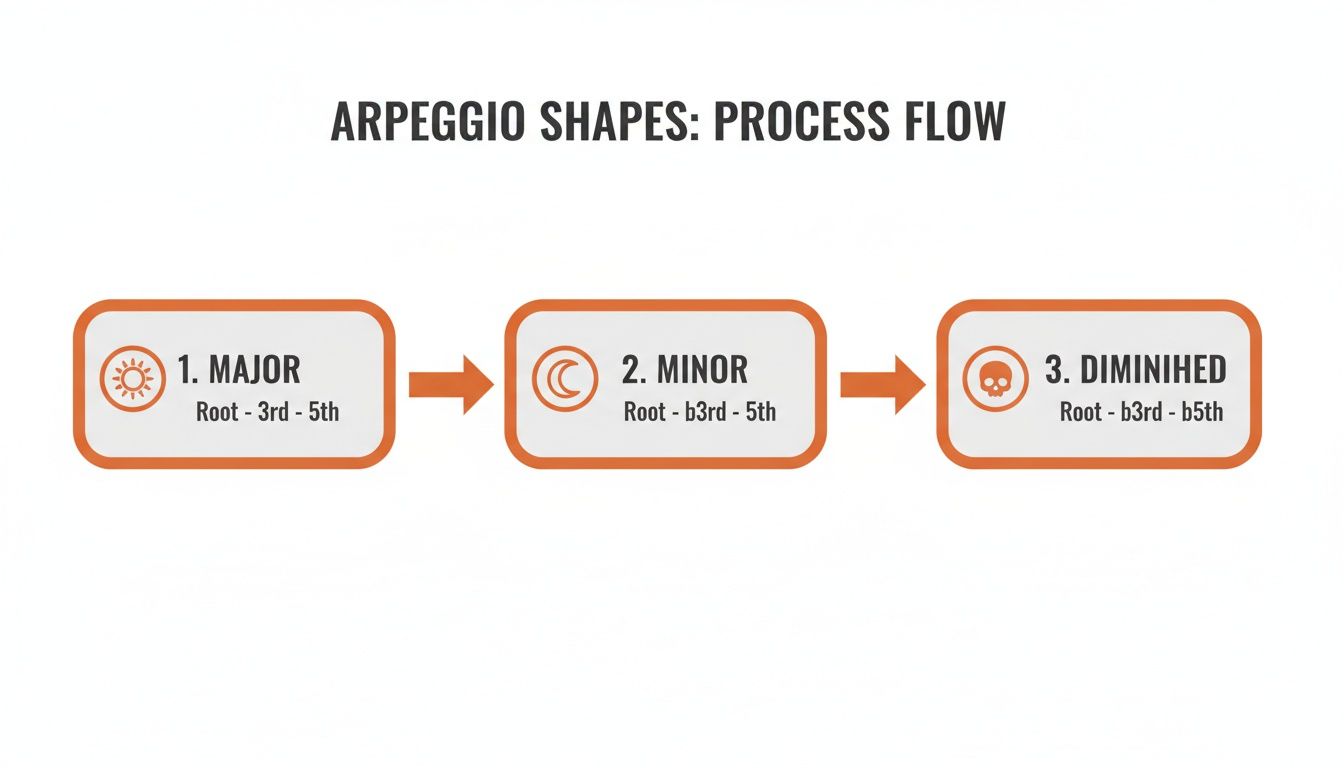
Getting these core sounds into your ears and under your fingers is what will ultimately let you use sweeps to create powerful melodies and solos.
Your metronome is your most honest coach; it won't let you get away with anything. To use it right, you need to think progressively. The goal isn't some crazy jump from 80 BPM to 140 BPM in a week. It’s all about small, consistent wins.
First, you need to find your "clean speed." That's the absolute fastest tempo you can play a five-string arpeggio perfectly, say, eight times in a row. Let's imagine that's 70 BPM (playing 16th notes). Your goal for tomorrow is simple: 72 BPM. This slow-and-steady approach builds speed on a flawless foundation, so bad habits never get a chance to sneak in.
Don't let your ego write checks your fingers can't cash. Chasing a high number on the metronome while playing sloppily is the fastest way to hit a wall. True speed is just a side effect of perfect, relaxed technique practiced slowly.
Below is a sample plan for how you might structure your progress over a month. The idea is to build sustainable speed without sacrificing clarity.
| Week | Daily Focus | Starting BPM (16th notes) | Target BPM | Notes |
|---|---|---|---|---|
| 1 | Flawless execution | 60 | 70 | Focus 100% on clean notes and perfect muting. Don't increase speed until it's perfect. |
| 2 | Incremental bumps | 70 | 85 | Nudge the tempo up by 2-4 BPM per day. Dial back immediately if you hear mistakes. |
| 3 | Stamina and consistency | 85 | 100 | Work on playing the arpeggio cleanly for longer durations (1-2 minutes) at each tempo. |
| 4 | Push and refine | 100 | 110+ | Start pushing your top speed, but dedicate half the time to playing at 80% of your max to lock it in. |
This kind of structured approach takes the pressure off and lets you see real, measurable progress day after day.
The final piece of the puzzle is taking your sweeps out of the practice woodshed and into actual songs. This is where backing tracks become your best friend. A metronome builds precision, but jamming over a track teaches you phrasing, timing, and how to make arpeggios actually fit over chord changes.
This journey from a sterile exercise to a powerful musical tool is what it’s all about. Building a great routine is your first step on that path. If you want to dig even deeper into optimizing your sessions, our guide on how to achieve the perfect guitar practice offers even more ways to structure your time effectively.
Ultimately, the goal is to internalize this technique so completely that you can forget about the mechanics and just play. This structured approach is the map that gets you there.
Every single guitarist learning to sweep hits a wall. It's almost a rite of passage. You'll be grinding away, things start to feel smoother, and then—bam. You're stuck. Those same messy notes, that infuriating string noise, and timing that feels just off all come creeping back.
It can make you want to throw your guitar out the window. But this is a totally normal part of the process. The secret to breaking through is understanding why these mistakes happen.
Think of yourself as a mechanic for your own technique. Instead of just playing a lick over and over, hoping it magically cleans itself up, we need to pop the hood, figure out the specific problem, and use the right tool for the job. This focused troubleshooting will save you countless hours of frustration.
The most common complaint I hear from students is, "My sweeps are just so noisy!" It sounds like a wash of ringing open strings, or notes from the arpeggio bleeding into each other. Here's the thing: the problem is almost never your picking hand. It's a failure in your muting game.
Clean sweep picking demands a constant, active muting strategy from both hands. They have to work in perfect sync to create a tiny "window" of sound, letting only one note ring out at a time.
If you’re still getting noise, slow way down and just watch your hands. See that tiny gap where a string isn't being touched by either hand? That's your noise source, right there.
Another classic problem is having inconsistent dynamics. You'll play a five-string arpeggio, and maybe two notes pop out loud and clear while the others sound weak and get lost in the mix. This completely robs your playing of its power and makes your lines sound hesitant.
This issue comes directly from an inconsistent picking attack. So many players start with a strong first stroke but lose momentum as they cross the strings. This is especially true for upstrokes, which often sound way weaker than the downstrokes.
Your pick should feel like a bulldozer, not a feather. The goal is to maintain a consistent, firm pressure as it plows through the strings. The speed of the sweep never changes; it’s a single, continuous motion.
To fix this, go back to the "string catch" drill we talked about earlier. As you push your pick through one string and let it come to rest on the next, really pay attention to the force you're using. Make a conscious effort to make the pressure feel exactly the same on every single string, going up and down. This builds the muscle memory for a powerful, even attack.
Finally, we have the "raking" or "strumming" sound—where all the individual notes of the arpeggio just blur together into a messy chord. This is the ultimate sign of bad hand synchronization. Your fretting hand simply isn't keeping up with your picking hand.
The fix is simple, but it takes discipline: slow down.
I mean, really slow down. Set your metronome to a tempo that feels painfully slow, maybe 40 BPM. For every single note in the arpeggio, your fretting finger has to land on the fret a split-second before your pick hits the string. This is non-negotiable. It guarantees that each note is cleanly fretted before it's ever played.
By breaking down your practice and troubleshooting these specific issues, you can systematically hunt down and eliminate the flaws in your technique. This targeted approach is the absolute fastest way to get that clean, articulate, and powerful sweep picking sound you're after.
This level of detailed practice is essential for mastery. For even more in-depth lessons that guide you through these challenges, you can start a TrueFire All Access Trial and explore thousands of exercises from world-class instructors.
So, you've put in the work. You've gotten the basic mechanics down, started syncing up your hands, and you're getting comfortable with the core arpeggio shapes. That’s a huge step, but the journey to making this technique truly musical is just getting started.
Think of it this way: mastering sweep picking is a long game. It demands patience and a smart approach to keep moving forward without hitting those frustrating plateaus. The drills we've covered are your launchpad, but to really make this technique a part of your DNA, you need a clear path forward. This is where you go from just playing an exercise to actually making music, a process that takes some serious dedication, as you can see in this awesome 100-day sweep picking challenge.
If you're serious about continuing your journey with expert guidance, thousands of exercises, and tools that adapt to your playing, I can't recommend TrueFire enough. They have a massive library of resources to take you as far as you want to go. Take the next step and see what a proven method can do for your playing. Start your TrueFire All Access free trial today and unlock your full potential.
As a teacher, I hear the same questions over and over from students trying to nail this technique. Let's tackle some of the most common hurdles to get your sweep picking practice on the right track.
This is the big one, and the honest answer is... it depends. Everyone's journey is different.
With focused, daily practice of around 30 minutes, most intermediate players can get clean three-string sweeps down in a few weeks. But mastering those big, complex five or six-string arpeggios at high speed? That's a much longer road, often taking several months to a year of dedicated work.
The secret isn't the clock, it's the quality of your practice. You have to focus on flawless, clean execution at painfully slow tempos before you even think about speeding up. Patience is everything here.
It's easy to get these two mixed up because they're so closely related. The best way to think about it is like this:
So, you could say all sweep picking is a form of economy picking, but not all economy picking involves sweeping across arpeggios.
This is easily the most common complaint, and it almost always boils down to two culprits: your hands are out of sync, or your string muting isn't tight enough.
First, you need to slow your metronome way, way down. I mean, slow it down until every single note is crystal clear and perfectly timed. This is the only way to force your fretting and picking hands to lock in together.
Second, you have to get militant about your muting. Your picking-hand palm needs to be lightly resting on the strings below the one you're playing. At the same time, the underside of your fretting-hand index finger should be muting the strings above it.
You're essentially creating a "noise gate" with your hands, making it impossible for any string to ring out unless you want it to. If you hear extra noise, it means a string has escaped that gate.
Absolutely! While shred guitar is where sweep picking blew up, its roots actually go deep into jazz fusion with players like the legendary Frank Gambale.
It's an incredibly versatile tool. You can use it to beautifully outline chord changes in a jazz solo, add a burst of flair to a blues turnaround, or create lush, cascading textures in pop and R&B. The trick is to apply it musically and tastefully. It's a powerful technique for any advanced guitarist's toolkit, no matter what genre you play.
Getting these questions answered is a great start, but to really get this technique dialed in, nothing beats structured lessons. To find thousands of interactive exercises and expert guidance, I highly recommend exploring the resources at TrueFire. Take the next step in your musical journey with a TrueFire All Access Trial and see how it can totally transform your playing.
