Triad chords are the bedrock of pretty much every song you love. Seriously. Think of them like the three primary colors of music—with just three simple notes (root, third, and fifth), you can paint any harmonic picture you can imagine. As a music educator, I can tell you that getting a handle on these simple shapes is the key to unlocking the entire guitar neck.
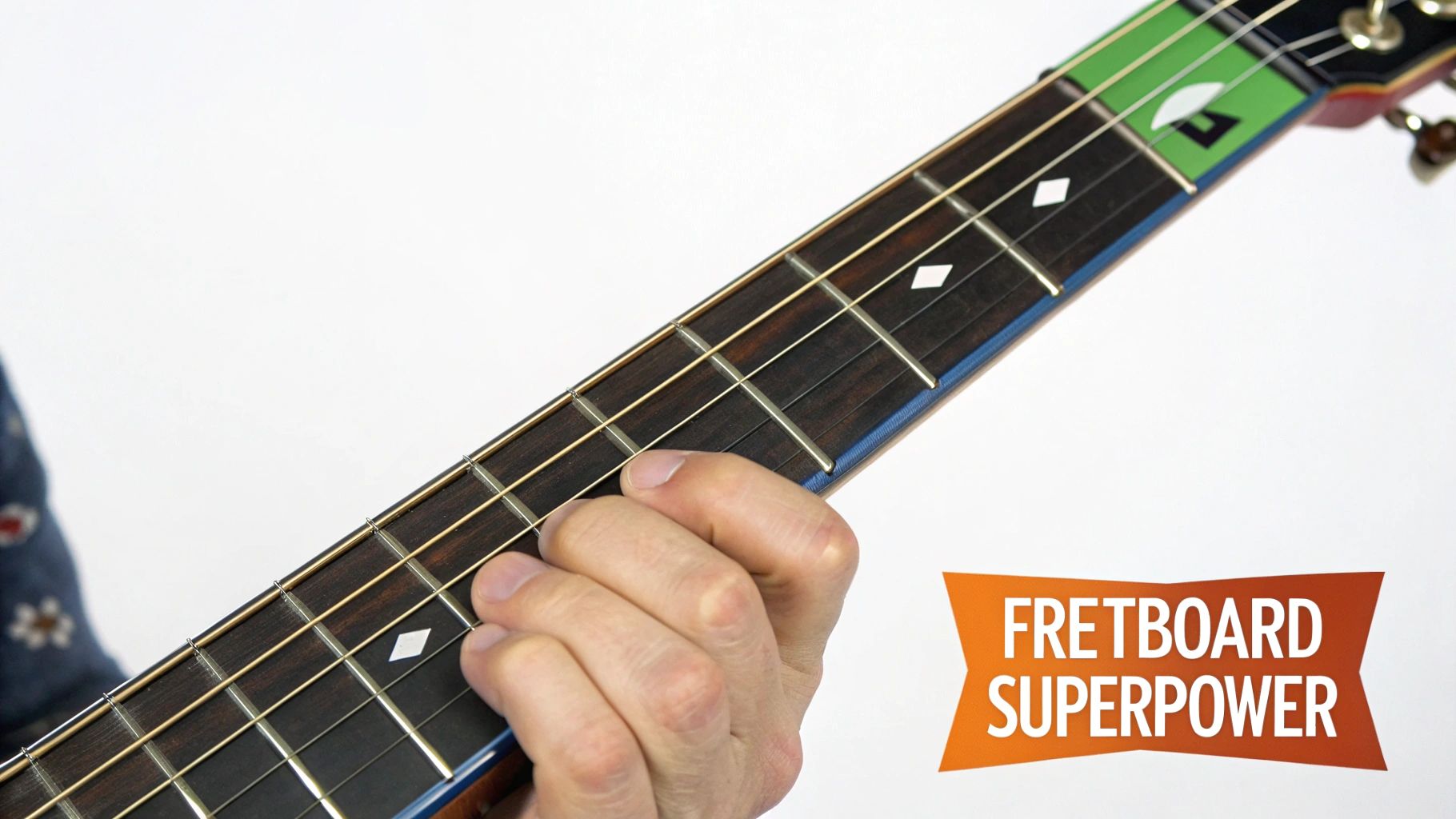
Ever feel stuck playing the same old clunky barre chords? Or maybe you feel chained to the first few frets? If that sounds familiar, learning triad chords on guitar is your ticket out. These tight, three-note voicings are the DNA of music theory and the secret language that pros use to glide across the fretboard.
Instead of seeing the neck as a confusing jumble of notes, triads transform it into an interconnected map of musical ideas. They're simpler, more focused, and often sound way cleaner than their big, six-string cousins.
Triads aren't some new-fangled concept; they’re the backbone of Western harmony, going all the way back to the classical era around 1600. Their real power is in their predictability. In any major scale, the triads built on each note follow a specific pattern of major, minor, and diminished chords. This underlying structure is exactly why certain chord progressions just sound right.
The proof is in the pudding. In a massive analysis of popular songs from 1950-2020, progressions built on the three major triads of a key (the I, IV, and V chords) showed up in an incredible 65% of all hits.
That one stat tells you everything you need to know about how fundamental these shapes are. From rock anthems to pop ballads, triads are the engine driving the harmony.
Getting comfortable with triads will completely change how you see the guitar. Here are just a few reasons why they’re a game-changer for any player:
By focusing on these essential three-note shapes, you’ll build a much deeper understanding of how harmony works and how it all lays out on the fretboard. You can learn more about how this all connects in our detailed guide to fretboard knowledge.
Think of this guide as your roadmap to finally connecting the dots. And when you're ready to take your practice up a notch with guided lessons and interactive jam tracks, grabbing a TrueFire All Access Trial is the perfect next step.
Alright, now that you know why triads are such a game-changer for guitar, let's get our hands dirty and build your foundational toolkit. Think of this as your sonic workshop, where we'll assemble the four essential shapes that are the bedrock of pretty much all Western harmony. These aren't just random clusters of notes; they're distinct emotional building blocks.
Each type of triad has its own unique character, a specific mood it brings to the table. Once you learn their simple formulas, you'll be able to intentionally craft feelings with your playing. You'll go from someone who just plays chords to a musician who tells a story. We’ll start by exploring these shapes on the G, B, and E strings—their bright, cutting tone makes them perfect for learning.
The major triad is the sound of bright, open, and happy music. It’s the sonic equivalent of a sunny day—totally stable, resolved, and familiar. You’ve heard it in countless pop choruses, rock anthems, and folk songs.
Its construction is dead simple, built from the first, third, and fifth notes of a major scale.
Playing a G major triad (G-B-D) on the top strings feels instantly satisfying. It’s a cornerstone of learning triad chords on guitar.
If the major triad is a sunny day, the minor triad is the thoughtful, reflective mood of twilight. It can sound sad, serious, or beautifully melancholic. This is the sound of the blues, heartfelt ballads, and dramatic rock verses.
The only difference between a major and minor triad? Just one note—the third.
By simply lowering the third by one fret (a semitone), you completely change the chord’s emotional impact. This is called "flattening the third," and it's one of the most powerful tools in music for shifting the mood.
The formula is: Root (1), Minor Third (♭3), and Perfect Fifth (5). That one small change is everything. Playing a G minor triad (G-B♭-D) immediately shows you this shift from bright to somber.
These next two triads are your "spice rack" chords. You won't use them as often as major and minor, but they add incredible tension and color right when you need it.
The diminished triad is all about tension. It feels unstable and unresolved, like it’s desperately trying to lead somewhere else. It's built with a Root (1), Minor Third (♭3), and a Diminished Fifth (♭5). That flattened fifth is what creates its signature tense, edgy sound.
On the other hand, the augmented triad sounds dreamy, unsettled, and mysterious. It's often used as a bridge between other chords to create a feeling of suspense. Its formula is a Root (1), Major Third (3), and an Augmented Fifth (♯5). Raising the fifth creates this wide, ethereal sound that just refuses to sit still.
This foundational knowledge of the four triad types has been the entry point for countless guitarists for decades. Since guitar sales exploded post-WWII—with a projected 45 million units sold in the US alone by 2025—these simple three-note chords have remained essential. In fact, an analysis of over 1,000 popular songs shows that triads form the basis of 85% of chord progressions, with minor triads often defining the emotional core of ballads.
Now, let's put it all together in one place.
Here's a quick cheat sheet that breaks down the interval structure and sonic character of each of the four primary triad types.
| Triad Type | Interval Formula | Sound Description | Example (in C) |
|---|---|---|---|
| Major | 1 – 3 – 5 | Happy, bright, stable | C – E – G |
| Minor | 1 – ♭3 – 5 | Sad, melancholic, serious | C – E♭ – G |
| Diminished | 1 – ♭3 – ♭5 | Tense, unstable, dark | C – E♭ – G♭ |
| Augmented | 1 – 3 – ♯5 | Dreamy, mysterious, unresolved | C – E – G♯ |
Getting these four core shapes under your fingers and into your ears is the key to building the vocabulary you need to speak the language of music fluently. To learn more practical applications, check out our lesson on how to use three-string triads effectively.
And if you're ready to really dive deep with guided video lessons and interactive jam tracks, a TrueFire All Access Trial is an invaluable resource.
If you’ve ever felt glued to one spot on the fretboard, get ready for a serious breakthrough. This is where getting a handle on triad chords on guitar really unlocks the entire neck. We’re about to dive into inversions, a surprisingly simple concept that will completely change how you move between chords.
So, what’s an inversion? It’s just a different way of stacking the same three notes of a triad. Instead of the root always being the lowest note, you can put the third or the fifth in the bass. This simple reordering is the secret to moving like a pro across the fretboard.
Think of it like this: you have three LEGO bricks—a red one (Root), a yellow one (Third), and a blue one (Fifth). You can stack them in three different orders, but you always have the same three bricks. That’s exactly how triad inversions work.
Each triad has three possible forms, depending on which note is the lowest in pitch:
Even though the chord is the same (G Major), each inversion has a unique flavor and, more importantly, a different shape on the fretboard. And that gives you a ton of new options.
Why bother learning three ways to play the same chord? The answer is a crucial musical concept called voice leading. In short, voice leading is the art of moving from one chord to the next as smoothly as possible, using the smallest fretboard movements.
Instead of making big, clumsy jumps up and down the neck, voice leading allows you to connect chords with small, efficient, and musical steps. It’s the difference between walking a smooth path versus leaping over huge gaps.
Think about a simple G-C-D chord progression. Most beginners jump from an open G chord down to an open C, then slide up for a D. With triad inversions, you could play that whole progression high up the neck with your hand barely moving an inch. This is how seasoned rhythm players create those slick parts that sound amazing and are often physically easier to play.
This chart shows the basic formulas for the most common triads you'll be flipping around.
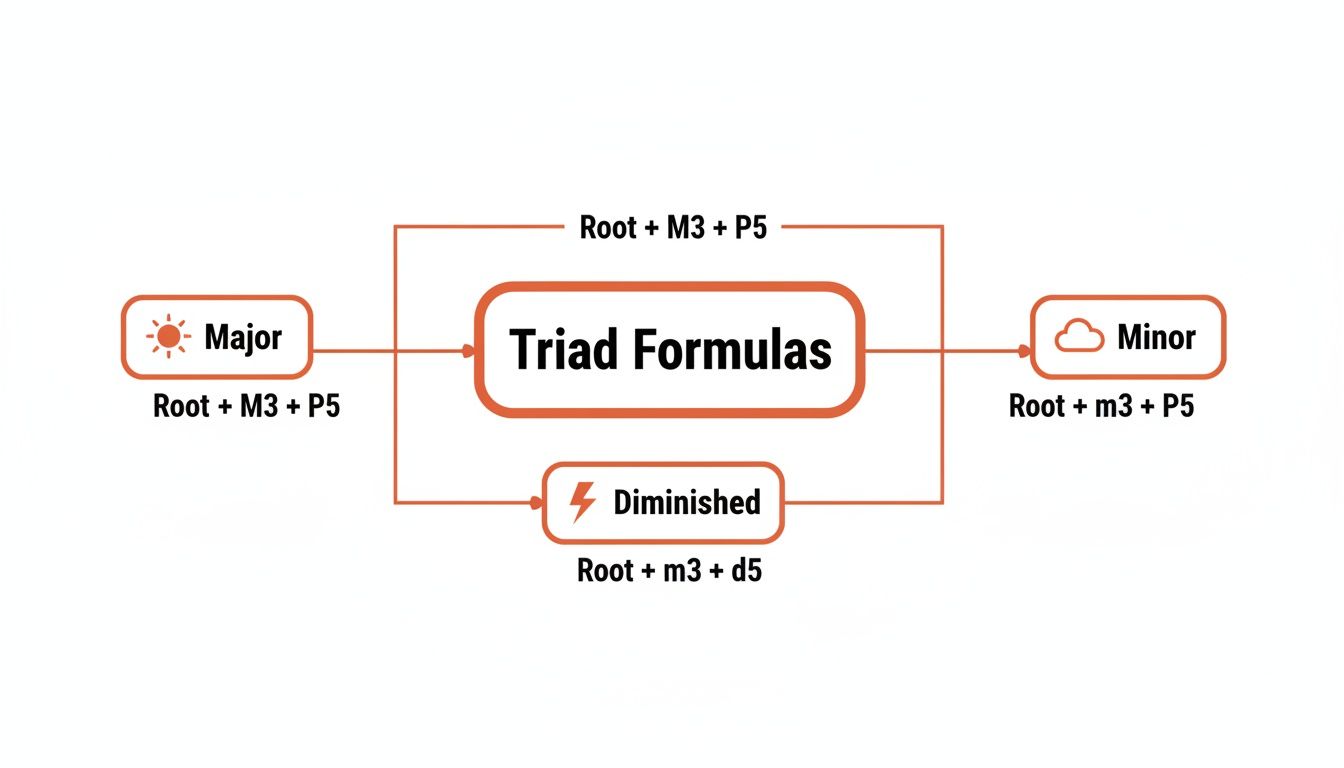
You can see how just changing one note—like flattening the third—completely transforms the chord's identity from major to minor.
The real magic kicks in when you start mapping these inversion shapes across different sets of strings. The guitar gives us several groups of three adjacent strings, and each one is a new canvas for your triads.
The most common string sets to start with are:
Let’s take a C Major triad (C-E-G) on the top three strings. You can find a root position shape, a first inversion, and a second inversion all within a few frets of each other. Once you learn those three little shapes, you can connect them to play a C major chord anywhere you want on that string set.
By learning the three inversions for major and minor triads on just one or two string sets, you suddenly have a dozen new ways to play the chords you already know. You're no longer trapped by a handful of shapes; you have a fluid, connected system for navigating harmony. For a deeper look at this, you might be interested in our guide to guitar chord inversions.
This approach transforms the fretboard from a bunch of disconnected boxes into a cohesive, logical map. It’s a total game-changer for rhythm playing, composing, and even soloing.
Alright, you've put in the work and have those triad shapes and inversions living under your fingers. Now for the fun part: turning them into actual music. This is where the rubber meets the road, transforming theory into expressive, dynamic rhythm parts that feel great to play. We're officially moving beyond just knowing shapes and into the art of using them to become a more creative, valuable player in any band.
Think of triads as your secret weapon for adding color and texture. Instead of a thick, six-string chord that can easily muddy up a mix, these focused three-note voicings give you surgical precision. They let you carve out your own sonic space, supporting the song without overpowering everyone else. Honestly, this is the key to sounding like a seasoned pro.
One of the quickest ways to elevate your rhythm playing is to start layering triads over basic open chords. This simple move adds a beautiful harmonic sparkle and complexity, all without messing with the core chord progression. It’s a classic Nashville session trick used to make simple chord parts sound absolutely massive and polished.
For example, try holding down an open G major chord and then, with your pick, strum a small G major triad inversion way up on the top three strings. You'll immediately hear that rich, shimmering texture that's impossible to get with a single chord shape.
This technique is a cornerstone of professional comping. The clarity and mobility of three-string triads, especially on the top strings, are unmatched. Each shape can be moved to any of the 12 frets, allowing for instant key changes and creative voicings.
In fact, guitar triads are brilliant for turning basic strumming into something special. They can simplify the harmony of many open chord songs while creating a layered, almost 12-string guitar effect. That classic intro to Van Morrison's "Brown Eyed Girl"? You can get a similar vibe just by strumming a G major triad over an open G chord—a simple move that dramatically boosts the harmonic richness.
Not all triads are created equal, and where you play them on the neck has a huge impact on their tone and job in the song. The different string sets on your guitar offer distinct sonic flavors, and learning to pick the right one is a crucial skill.
Choosing the right string set allows you to think like a producer, making conscious decisions about texture and frequency from right there on the fretboard.
Let’s get specific. Here are a couple of practical ways you can start weaving triads into your rhythm guitar playing today:
By mastering these techniques, you'll be able to create rhythm parts that aren't just "correct" but are genuinely compelling and musically interesting. For more ideas on this topic, check out our guide on practice songs for great rhythm guitar.
Ready to see these concepts demonstrated by world-class instructors? A TrueFire All Access Trial gives you thousands of lessons to take your rhythm playing to the next level.
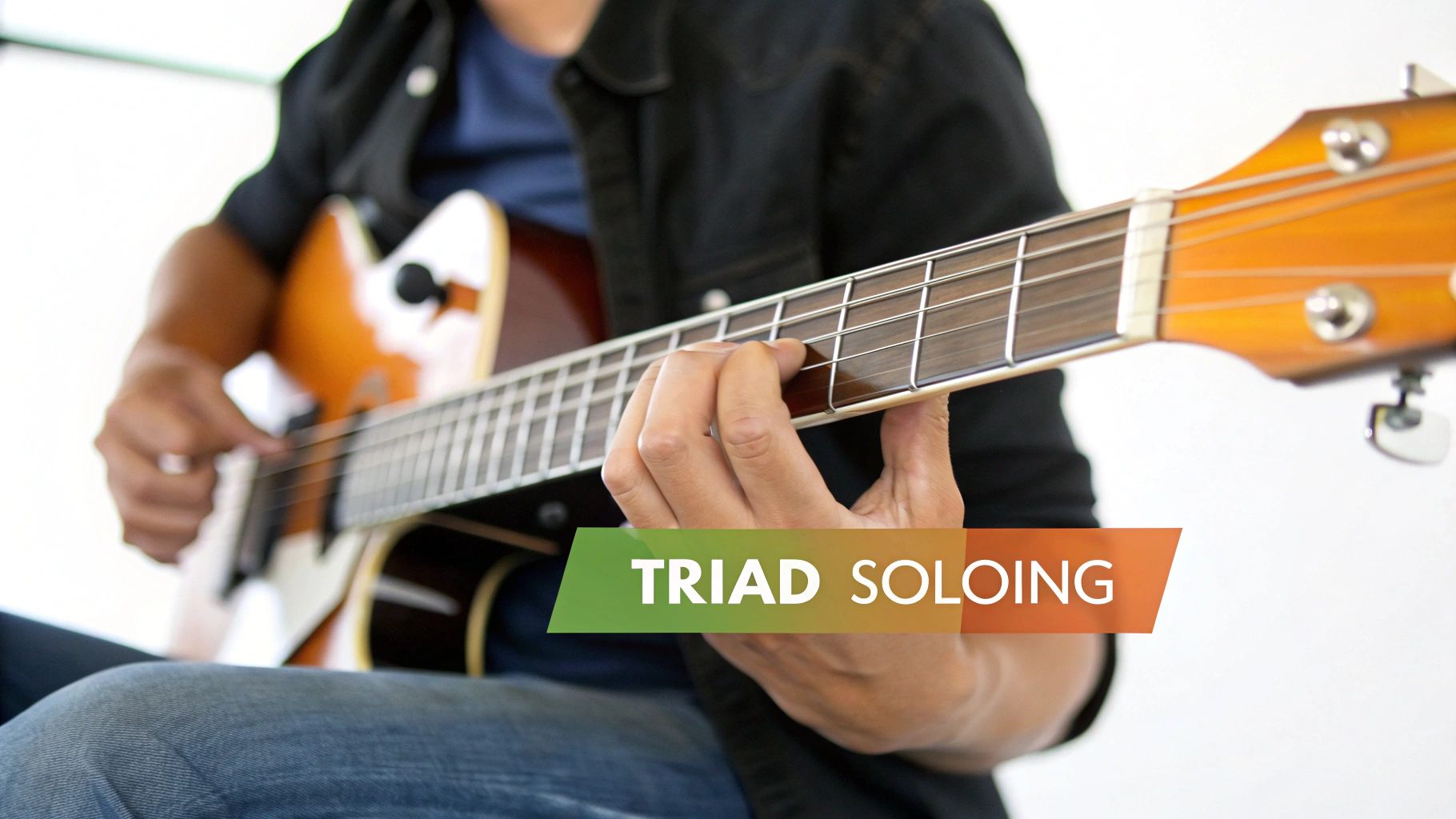
So far, we’ve been all about using triad chords on guitar for rhythm. Now, let’s flip the script and talk about one of their most powerful uses: soloing. If you've ever felt like your lead playing is just wandering through scale patterns without a purpose, triad arpeggios are the fix you've been looking for. This is the key to making your solos sound melodic and locked into the music.
This whole approach is often called chord tone soloing, and the idea is beautifully simple. Instead of just thinking about scales, you start thinking about the actual notes inside each chord of the progression. When you aim for these strong notes—the root, 3rd, and 5th—your lead lines instantly sound like they belong.
Here’s the great news: you’ve already done the hard work by learning all those triad inversion shapes. A triad arpeggio is just a triad played one note at a time. The shapes are exactly the same; we’re just changing how we use them, shifting from harmony to melody. The goal is to stop seeing them as static blocks and start seeing them as pathways to connect your musical ideas.
Instead of strumming a C major triad, you’ll play the notes C, E, and G as a flowing melodic phrase. This immediately anchors your solo to the harmony underneath, creating a sound that’s both strong and makes perfect sense. It's the difference between guessing which notes will sound good and knowing which ones will land with real impact.
The secret to making your solos tell a story is to follow the chord changes. Triad arpeggios give you a direct roadmap to the most important notes at any given moment, ensuring your lead lines always sound intentional and musical.
The real magic kicks in when you start stringing your triad inversion shapes together to follow a chord progression. Let’s say the chords are changing from G to C. Your mission is to play a G major arpeggio and then, with as little movement as possible, slide gracefully into a C major arpeggio.
This is where voice leading—which we talked about for rhythm—becomes a melodic superpower. By moving to the closest available note in the next chord, your solo lines will have a smooth, almost vocal-like quality.
Here’s a quick exercise to get you started:
This exercise trains your fingers, eyes, and ears to see the connections between chords all over the neck. For a deeper dive into this concept, check out our course on using arpeggios for guitar solos.
This approach really changes how you think about soloing. You're no longer just playing a scale over the chords; you're playing through them, weaving melodies that perfectly outline the song's harmonic landscape.
To see this powerful technique in action and practice it with world-class instructors and interactive jam tracks, a TrueFire All Access Trial is the perfect next step.
Alright, so you’ve got the theory and the shapes down for triad chords on guitar. That's a great start, but let's be honest—knowing something in your head and knowing it in your hands are two totally different things. The real magic happens when you stop thinking and start playing.
This is your roadmap to move that knowledge from your brain into your muscle memory. Forget about just noodling around. We're going to build these triads into your playing, one focused step at a time, so you can grab them instinctively when you need them.
Your first week is all about getting the core mechanics right. Don't even think about speed or complex progressions yet. The goal here is clean execution and instant recall. If you build a solid foundation now, everything that comes next will be ten times easier.
Here's the mission for this week:
We're not chasing speed here. We're chasing clarity and recognition. By the end of this week, you should be able to find any of the three G Major inversions on those top strings without having to hunt for them.
Now that you've got one sound dialed in, it's time to add its counterpart and start connecting the dots. This is where you'll really begin to see—and hear—how these shapes relate to each other on the fretboard.
You’ve got a handful of chords under your belt. Now it's time to actually make some music. This week is all about moving smoothly between chords and thinking like a real musician.
Start with a basic two-chord jam, like G to C. Here’s the challenge: move between the chords using the closest possible inversion. If you’re holding a G triad in root position, find the C inversion that requires the least amount of hand movement. This is the heart of voice leading, and it’s what separates clunky rhythm playing from smooth, professional-sounding parts.
Once you're cruising through the weekly plan, start sprinkling these exercises into your routine. These are designed to break you out of rigid, box-pattern thinking and build true fretboard fluency.
This structured approach is the fastest way to make triad chords guitar a second-nature part of your playing. When you're ready to really dig in with guided lessons, interactive jam tracks, and world-class instructors, there's no better way to do it than with a TrueFire All Access Trial.
As a guitar educator, I hear a lot of the same questions when students start digging into triad chords on guitar. It happens to everyone. Let's clear up a few of the most common ones so you can keep moving forward with confidence.
This is a great question. While a big, six-string barre chord does technically contain a triad, it’s also packed with doubled-up notes. All those extra notes can sometimes muddy up the sound, not to mention they’re a real workout for your fretting hand to play cleanly.
A pure triad, on the other hand, is all about efficiency. You're only playing the three essential notes: the root, third, and fifth. This gives you a much clearer, more focused sound, it’s way easier on your hand, and it unlocks a ton of new ways to move between chords smoothly.
The key is to not bite off more than you can chew. It's tempting to try and learn every inversion for every chord all at once, but that’s a fast track to getting overwhelmed.
Instead, zero in on just one string set. The top three strings (G-B-E) are the perfect place to start. Pick a single chord, like G Major, and just work on its three inversion shapes on that string set. Get comfortable moving between the root position, first inversion, and second inversion. Once that feels like second nature, then you can start exploring other chords or moving to different strings.
This methodical approach really works. When you truly master one small piece of the fretboard first, expanding that knowledge later on becomes so much easier and more effective.
Absolutely. Triads are the fundamental building blocks of Western harmony, which means they are everywhere once you start listening for them. They're the universal language of chords.
You'll hear them in the chiming, delay-drenched rhythms of U2's The Edge and in the slick, intricate funk grooves of a player like Cory Wong. They’re all over modern country solos and sophisticated jazz comping. Seriously, triads are one of the most versatile tools you can have in your musical toolbox.
Ready to make these shapes and sounds a core part of your playing? With over 80,000 video lessons from world-class instructors, interactive jam tracks, and structured Learning Paths, TrueFire has everything you need to finally master triad chords and unlock the entire fretboard. Get started on your journey with a TrueFire All Access Trial today.
