Jazz guitar chord voicings are all about how you arrange the notes of a chord on the fretboard. It's what gives jazz its sophisticated, clean sound. Unlike the big, beefy six-string chords you hear in rock and pop, these voicings are often leaner, using fewer notes to outline the harmony. This creates clarity and leaves room for the rest of the band.
Think of them as the fundamental building blocks for authentic jazz comping and chord melody playing. As a guitar educator, I've found that mastering these voicings is the most direct path to sounding like a real jazz player.

If you've ever felt completely overwhelmed by the sheer number of jazz chord shapes, you're not alone. So many guitarists approach jazz harmony like an endless list of grips to memorize. It feels like trying to drink from a firehose. This guide offers a different path: a clear, logical roadmap.
Instead of seeing voicings as random shapes, we need to think of them as organized systems. Learning these systems is far more powerful than just memorizing individual chords. Once you get the concepts down, you can build beautiful, functional voicings all over the neck for any chord that comes your way. This is how you break free from static chord charts and truly start improvising your accompaniment.
The journey really begins with a mental shift. You have to move away from the "cowboy chords" and power chords that drive so many other styles of music. A G major chord in folk music might ring out across all six strings, but a jazz guitarist might play that same chord using only three or four carefully chosen notes.
Why the difference? It all comes down to function and context.
This guide is designed to demystify all of this. We won't just show you what to play; we'll dig into why it works, giving you the tools to build your own harmonic vocabulary from the ground up.
We're going to explore the essential families of jazz guitar chord voicings, each with its own distinct sound and purpose. We'll take it step-by-step, starting with the absolute fundamentals and building toward more modern, colorful sounds. By uncovering the secrets to learning jazz guitar, you'll see how just a few core ideas can unlock the entire fretboard.
We'll start with the skeletal framework of shell voicings, move into the rich textures of drop voicings, and finally touch on the contemporary sounds of quartal harmony. Each section will give you practical fretboard examples and show you how to apply these ideas in real musical situations, like the classic II–V–I progression.
This journey takes dedication, but the payoff is huge. As a professional educator, I know that structured learning makes all the difference.
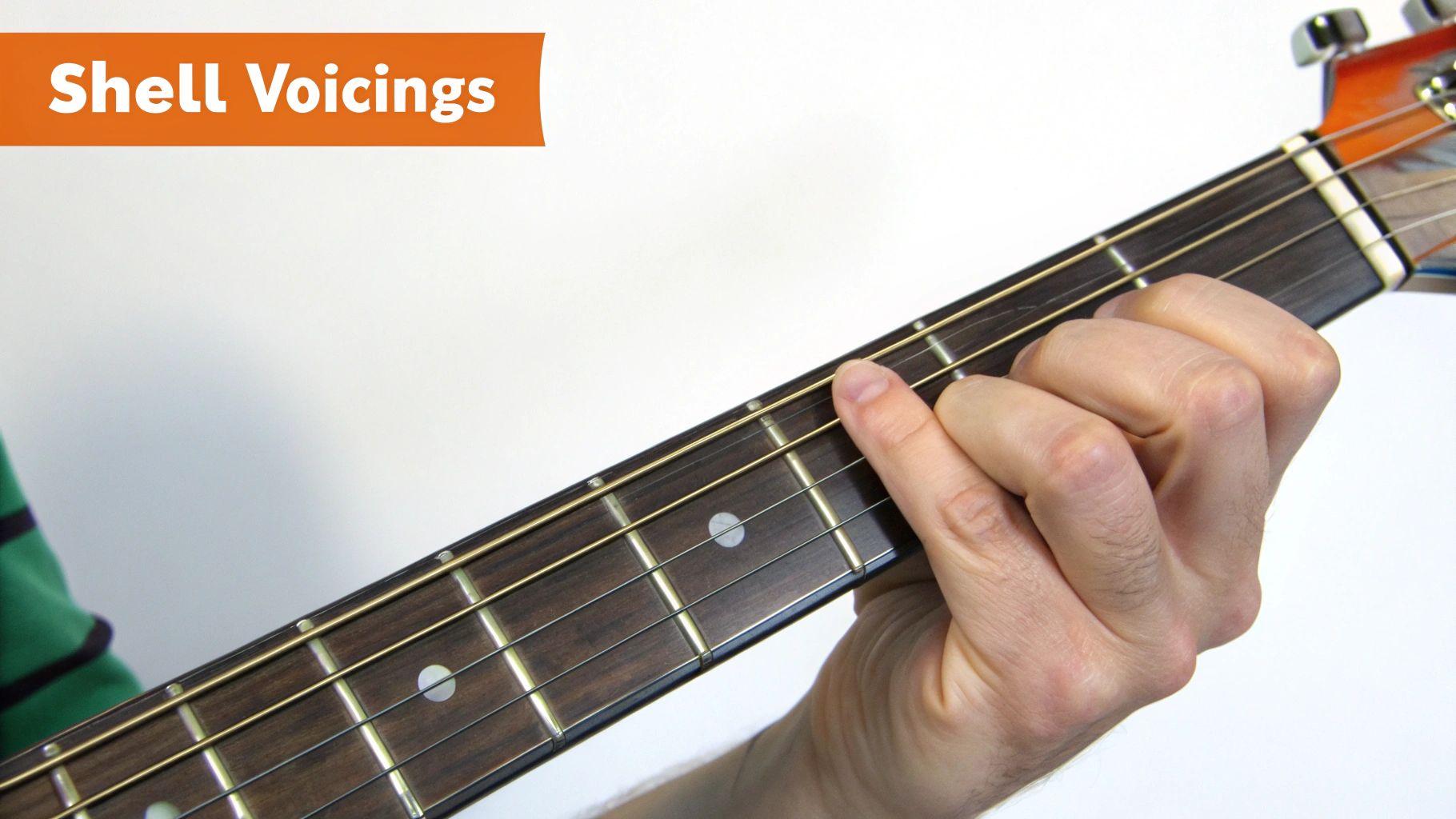
If you're looking for the "skeleton key" that unlocks the sound of classic jazz guitar, this is it. Shell voicings are the absolute bedrock. Think of them as the DNA of a chord—a stripped-down, three-note shape that gives you all the crucial harmonic information without any of the fluff. For any guitarist serious about jazz, this is ground zero.
Instead of getting tangled up in bulky four, five, or even six-note chords, shell voicings get right to the point. They keep only the essentials: the root, the 3rd, and the 7th. These three notes do all the heavy lifting, defining a chord's entire personality and function.
So, why are these three notes so potent? It's because they carry the most vital harmonic information.
By zeroing in on just these notes, you're essentially playing the "guide tones" (the 3rd and 7th). This super-efficient approach is a hallmark of jazz guitar comping because it captures 66–75% of a seventh chord's identity while making things way easier on your fretting hand. You end up reducing the notes you need to finger by up to 50% compared to full four-note voicings.
But this isn't just about making chords easier to play; it's a smart musical choice. Using fewer notes leaves room in the mix. You're not stepping on the bassist's toes or cluttering the space for a pianist or soloist. That's the heart of great comping—playing a supportive, interactive role in the band.
Let's get these shapes under your fingers. We'll use G as our root note for all three examples, but remember, these are movable shapes you can slide anywhere up and down the neck.
G Major 7 (Gmaj7)
This voicing packs in the root (G), the major 3rd (B), and the major 7th (F#).
E|-------|
A|-------|
D|---5---|  (Root)
G|---4---|  (Major 3rd)
B|---4---|  (Major 7th)
e|-------|
G Dominant 7 (G7)
Here, we just flatten the 7th. Now you have the root (G), the major 3rd (B), and the minor 7th (F).
E|-------|
A|-------|
D|---5---|  (Root)
G|---4---|  (Major 3rd)
B|---3---|  (Minor 7th)
e|-------|
G Minor 7 (Gm7)
For this one, we flatten both the 3rd and the 7th. You're playing the root (G), the minor 3rd (Bb), and the minor 7th (F). If you want to dive deeper, check out our guide on the three essential 7th chord types.
E|-------|
A|-------|
D|---5---|  (Root)
G|---3---|  (Minor 3rd)
B|---3---|  (Minor 7th)
e|-------|
Once you get these three simple shapes down, you've got the tools to navigate countless jazz tunes. The real magic starts when you learn to connect them smoothly.
Alright, let's put these voicings to work in a real-world scenario: a standard 12-bar blues in G. This is the perfect workout to see just how elegantly these shapes connect with very little hand movement.
Here's the progression:
G7 | C7 | G7 | G7 |
C7 | C7 | G7 | G7 |
D7 | C7 | G7 | D7 |
You can play through this entire progression using only shell voicings, making small, logical shifts across the fretboard. This is a fundamental exercise for building muscle memory and, more importantly, training your ear to hear how the guide tones lead from one chord to the next.
Nailing these basic forms is your first and most critical mission. Once they feel like second nature, you'll have a solid foundation to build on with more complex and colorful voicings.
Alright, you've got the essential framework of shell voicings under your fingers. Now it's time to add more color, texture, and melodic richness to your playing. Let's dive into the world of Drop 2 and Drop 3 voicings. If shell voicings are the skeleton, these are the muscle and flesh that give jazz guitar its full, lush sound.
These voicings might sound technical, but the idea behind them is beautifully simple. They're really just a clever solution to a physical problem: some four-note chords, when stacked tightly, are physically impossible to play on the guitar. By systematically "dropping" a note down an octave, we create shapes that are not only playable but also sound more open and resonant.
Imagine a C Major 7 chord built in what's called a close position voicing. The notes, from lowest to highest, would be C-E-G-B. A pianist can play this easily, but for us guitarists, it's a nightmare.
Drop voicings fix this by rearranging the stack to fit the fretboard perfectly. The two most common and useful types you'll encounter are Drop 2 and Drop 3.
This simple rearrangement creates the characteristic sound of jazz guitar—open, balanced, and perfect for both comping and chord melody playing.
The real power of these voicings gets unlocked when you start using their inversions. Because each four-note chord gives you four possible notes on top, you gain four distinct melodic options for every single chord. This is the key to creating smooth, connected lines when you comp.
Drop 2 voicings are, without a doubt, the most important voicing family in jazz guitar. They're incredibly versatile and sit beautifully on adjacent string sets, which makes them comfortable to play and easy to connect. They give you just enough harmonic density without sounding muddy—a quality that makes them perfect for comping in a small group.
Let's look at a Dm7 chord voiced as a Drop 2 on the middle four strings (A-D-G-B).
Dm7 Drop 2 Voicing Example (Root Position)
Here, the top note is the 5th of the chord (A).
E|-------|
A|---5---|  (Root - D)
D|---3---|  (5th - A)
G|---5---|  (Minor 7th - C)
B|---5---|  (Minor 3rd - F)
e|-------|
The real magic happens when you explore its inversions. By systematically rearranging the notes, you can put the root, 3rd, 5th, or 7th on top, giving you complete melodic control over your chord lines. Working through these shapes is a fantastic way to master the fretboard, and you can learn more by exploring free lessons on chord inversions for guitar. This is what allows you to create that seamless voice leading everyone talks about.
Let's see this in action over the most common progression in jazz: the II–V–I. We'll use a II-V-I in the key of C Major: Dm7 – G7 – Cmaj7. The goal here is to move between these chords with as little fretboard movement as possible, letting the notes connect melodically.
Using Drop 2 voicings, we can create a line that flows smoothly from one chord to the next. Notice how the top note of each chord resolves logically into a note from the next one. This is voice leading at its best—making chord changes sound like a beautiful, connected melody rather than a series of clunky, disconnected shapes.
Mastering these shapes on different string sets is a rite of passage for any serious jazz guitarist. It opens up the entire neck and gives you the vocabulary to navigate any standard with confidence and grace.
To really get a handle on modern jazz guitar voicings, it helps to rewind and see why they were cooked up in the first place. These shapes weren't invented in a theory class; they were forged on the bandstand out of pure necessity. The story of the guitar in jazz is all about adaptation, driven by the changing sounds and demands of the music itself.
In the early days of big band and swing, the guitarist's job was almost entirely rhythmic. Picture players like Freddie Green in the Count Basie Orchestra. His whole gig was to lay down a powerful, percussive pulse, chunking out four strums to the bar on a big archtop. The chords were full, often using four or more notes, built to slice through a loud horn section and keep the rhythm chugging along.
Then, everything flipped upside down with the arrival of bebop in the 1940s and 50s. The music got faster, the harmonies got way more complex, and the bands got smaller. The big band's wall of sound gave way to the nimble dance of trios and quartets. In this new, more intimate setting, the old-school, four-to-the-bar strumming just didn't cut it anymore. It was too dense, too loud, and it stepped all over the pianist and soloists.
This musical shift demanded a whole new language for the guitar. Players like Jim Hall, Joe Pass, and Barney Kessel needed voicings that were more agile and could pinpoint complex chord changes on the fly without cluttering things up. This need for harmonic efficiency and clarity led straight to the development of the voicings we're talking about today.
This simple flowchart shows how a dense, stacked chord gets rearranged into a much more playable Drop 2 voicing.
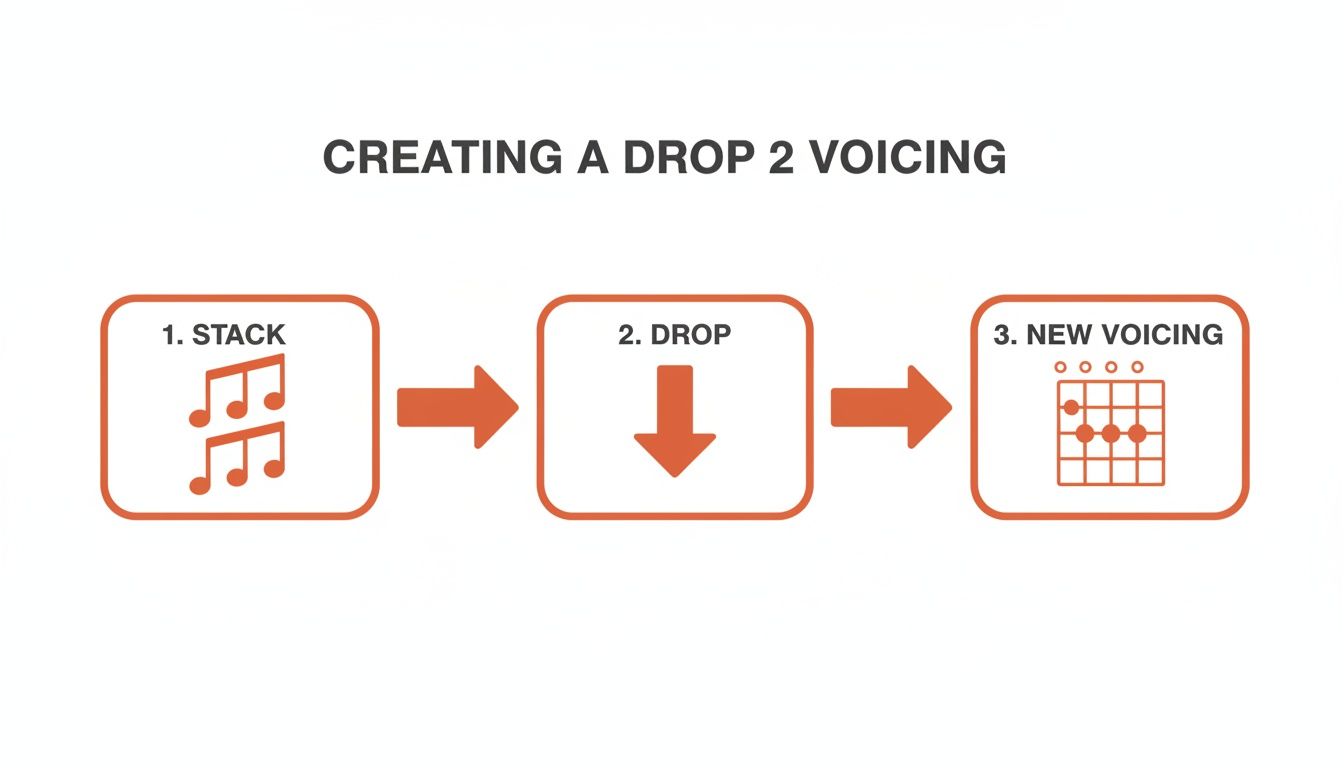
The process of "dropping" a note down an octave creates those open, guitar-friendly shapes that define the modern jazz sound.
This historical jump explains the move away from bulky, root-position chords. Jazz guitar voicings went from full 4-note shapes in the 1940s to much leaner 'shell' and drop voicings by the 1960s. Teachers and players started formalizing the "guide-tone" approach, zeroing in on the 3rd and 7th as the essential notes needed to spell out the harmony. This led to the widespread use of sparse voicings that often left out the 5th, creating crucial space for other instruments in the combo. You can dig deeper into how jazz chord progressions developed over time to see this evolution in action.
When you understand this context, you stop seeing shell, Drop 2, and Drop 3 voicings as abstract theory. You see them as what they are: practical tools developed by working musicians. They are elegant solutions to the real-world problem of playing complex harmony in a dynamic, interactive group.
This perspective makes learning these shapes feel much more intuitive. Each voicing has a job to do, born from a specific musical need. Embracing this history helps you play with more purpose and authenticity.
Once you've got a handle on the classic sounds of shell and drop voicings, you're ready to step into the more contemporary side of jazz harmony. Quartal and Spread voicings are your ticket to unlocking those modern, sophisticated textures you hear from guitarists like Julian Lage and piano giants like McCoy Tyner. They offer a completely fresh way to see—and hear—the fretboard.
Instead of building chords by stacking notes in thirds (like C-E-G), quartal harmony stacks notes in fourths. It's a simple change on paper, but it completely transforms the sound, creating voicings that are open, harmonically ambiguous, and full of modern color. If this is a new idea, it's worth brushing up on your intervals like 4ths and 5ths to really solidify the concept.
This different construction method is precisely what gives quartal voicings their signature sound—less direct and more atmospheric than the major or minor chords you're used to.
The real magic of quartal voicings is their versatility. Because they don't scream "major" or "minor," a single quartal shape can work over several different chords. This makes them incredibly efficient tools for comping, especially in modal jazz tunes where the harmony might sit still for a while.
Let's take a look at a common three-note quartal voicing on the G, B, and high E strings.
E|---8---|  (G)
B|---8---|  (D)
G|---7---|  (A)
D|-------|
A|-------|
e|-------|
This one little shape, built from the notes A, D, and G, can be used over a surprising number of chords:
This chameleon-like quality lets you create sophisticated harmonic movement with very little effort. The rise of these open shapes went hand-in-hand with the modal jazz experiments of the post-1950s. Players needed voicings that supported that open, pedal-based harmony, and quartal voicings were the perfect fit.
Think of quartal harmony as being less about defining a specific chord and more about creating a sonic texture. It's like using a broader brush to paint with harmonic color, giving you and the other musicians more freedom to explore.
While quartal harmony changes the ingredients of a chord, spread voicings (sometimes called open-triad voicings) change how those ingredients are arranged. They create a wide, almost orchestral sound by spacing the notes of a chord across non-adjacent strings. It's a great technique for emulating the sound of a pianist's left and right hands playing far apart on the keyboard.
A spread voicing takes a simple triad and "spreads" it out. A common approach is to place the root and 5th on lower strings and the 3rd on a higher string, often with an open string ringing in between.
For example, here's how you could create a G Major spread voicing:
This creates a massive, resonant sound that's perfect for intros, endings, or playing in a trio setting where you need to fill more sonic space. Both quartal and spread voicings are essential tools for any player looking to break free from standard shapes and add some fresh, modern vocabulary to their playing.
So, we've explored the essential families of jazz guitar chord voicings, from the basic shell voicings all the way to modern quartal sounds. Now it's time to turn that theoretical knowledge into actual music.
The secret ingredient that ties all these shapes together and makes them sound truly professional isn't just knowing the chords—it's voice leading. This is the art of moving between chords with maximum smoothness, creating a melodic thread that connects one harmony to the next.
Think of poor voice leading as jumping randomly all over the fretboard. Sure, your chords might be correct, but they'll sound disconnected and clunky. Good voice leading, on the other hand, is like walking gracefully from one room to another. It prioritizes minimal movement, often by keeping notes in common between chords or moving the other notes by the smallest possible step.
This creates a beautiful, flowing accompaniment that supports the music instead of getting in the way.
The best way to see voice leading in action is over the classic jazz progression: the II-V-I. Let's take Dm7 – G7 – Cmaj7 in the key of C. A beginner might play three unrelated, blocky chord shapes that are miles apart from each other. An experienced player, however, will find voicings that link together seamlessly.
For example, instead of leaping from a low Dm7 voicing to a high G7, you'd find a G7 shape right next to your Dm7 that only requires you to move a finger or two. The goal is to make the chord changes sound like a subtle, logical resolution rather than an abrupt gear shift. A closely related concept that will really train your ears and fingers for this is to learn to craft sweet solos using guide tones.
Good voice leading is less about the individual voicings and more about the melodic lines you create between them. When you connect chords smoothly, you're not just comping; you're creating a counter-melody that elevates the entire performance.
Mastering this skill demands a structured, step-by-step approach. Just randomly learning chords will only lead to confusion. As an educator, I can tell you that following a clear pathway is the key to making these skills stick.
Here's a four-step routine to take you from foundational shapes to fluidly comping over standards:
This journey requires patience and real dedication, but following a clear plan is the fastest way to develop a professional comping sound.
As you start digging into jazz harmony, you're bound to hit a few roadblocks. It happens to everyone. After years of teaching, I've heard pretty much every question in the book. Let's tackle some of the most common ones I hear from players just like you.
This is the big one, and the answer usually surprises people: a lot fewer than you think. Jazz guitar isn't about cramming your brain with thousands of chord shapes. It's about deeply understanding the systems behind them.
If you can truly get inside shell voicings, Drop 2, and Drop 3—and I mean really know their inversions on a couple of string sets—you'll be in great shape. A seasoned player can navigate almost any jazz standard with a surprisingly small, well-chosen vocabulary. The real goal is fluidity, not just collecting shapes. Quality over quantity is the name of the game.
There's no single "best" voicing. The right choice is always dictated by the music happening around you. It's all about context.
Start by asking yourself a few simple questions:
Ultimately, your ears are the final judge. If a voicing sounds too muddy, too thin, or just doesn't connect to what you played a second ago, it's probably not the right move. Trust your gut.
Ready to go deeper and get some one-on-one feedback? An All Access Trial with TrueFire puts you in touch with world-class instructors who can answer your specific questions and set you on a structured path to success.
Accelerate your learning with over 80,000 interactive video lessons from GRAMMY-winning artists. Start your TrueFire All Access free trial today at https://truefire.com.
