A solid warm-up is probably the single most important habit you can build for making real, consistent progress on the guitar. It's the bridge that takes you from clumsy fumbling to fluid, productive playing. This isn't just about wiggling your fingers for a minute—it's about getting your body and mind ready for the focused work ahead, sidestepping injuries, and actually unlocking what you're capable of.
Ever picked up your guitar, totally amped to finally nail that tricky solo or a new chord progression, only to have your fingers feel like clumsy, uncooperative strangers? It's a maddeningly common feeling, and I’ve been there more times than I can count.
The real culprit behind a stalled practice session usually isn't a lack of talent or effort. It’s almost always because you skipped the most fundamental step of all.
Trying to jump straight into a difficult piece cold is like asking a sprinter to go all out without a single stretch. You're just setting yourself up for sloppy technique, mental frustration, and even physical strain. I've personally seen countless students break through plateaus they've been stuck on for months, just by committing to a structured 10-minute warm-up before every single session. It really does change the game.
Before we dive into the "how," let's talk about the "why." A dedicated warm-up isn't just a ritual; it's a physiological necessity that has a direct, measurable impact on your playing. When you spend a few minutes on targeted, low-intensity exercises, you're triggering a few key things that make all the difference.
| Benefit | Impact On Your Playing |
|---|---|
| Improved Circulation | Gentle movements get blood flowing to the muscles and tendons in your fingers, hands, and forearms, increasing flexibility and drastically reducing the risk of strain or injury. |
| Enhanced Muscle Memory | Repetitive, controlled patterns prime the neural pathways between your brain and your fingers, leading to much sharper accuracy and more fluid movements when you start playing for real. |
| A Focused Mindset | The act of warming up is a mental transition. It helps clear away the day's distractions and signals to your brain that it’s time to lock in and concentrate on the guitar. |
That "no pain, no gain" mentality can be incredibly damaging for musicians. There's real science backing this up.
Research has shown that guitarists who implemented targeted exercise programs saw significant reductions in playing-related pain and marked improvements in endurance.
Skipping this prep phase is just a massive missed opportunity. It’s why you need to start seeing your warm-up as the most critical part of your practice, not an optional extra. For more on this, our guide on daily practice routines is a great resource for building effective habits.
The goal here is a complete perspective shift. Stop seeing it as a chore. Instead, recognize that a great warm-up is what makes every single minute that follows more productive, more musical, and completely injury-free.
Ready to build a routine that actually works for you? You can explore thousands of exercises and structured lessons with a TrueFire All Access trial.
Let's face it, the biggest thing holding most guitarists back isn't a lack of time—it's not using that time well. A killer warm-up routine has to be flexible, something you can squeeze in whether you’ve got ten minutes before work or a whole hour on a Sunday afternoon. The secret is having a scalable plan you can adjust for whatever you're trying to accomplish in that day's practice session.
Forget about those rigid, one-size-fits-all approaches. Your warm-up should feel more like a modular system—something you can build up or strip down depending on your schedule. This mindset shift turns what feels like a chore into a focused, powerful start to every single time you pick up the guitar.
Think of it as a simple, three-part flow that gets you ready physically and mentally, moving from basic readiness to locked-in execution.
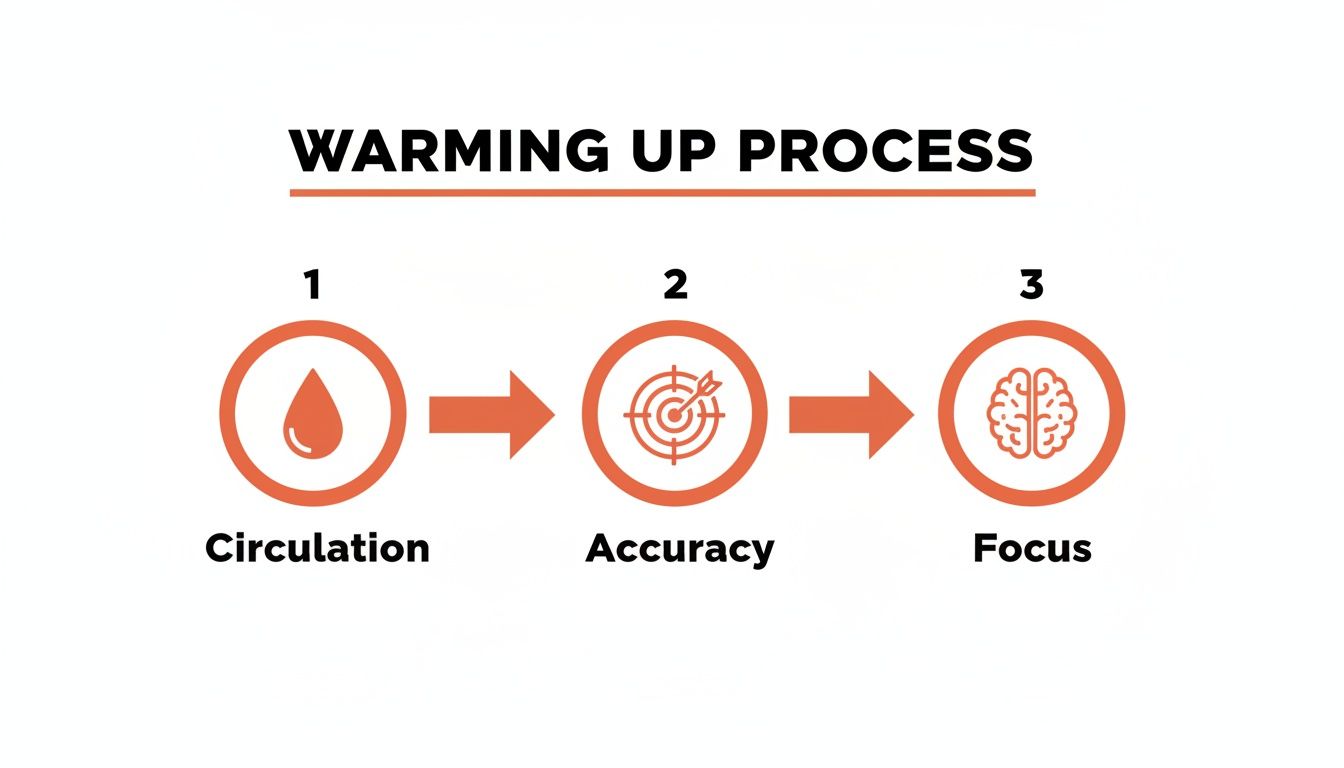
As you can see, getting the blood flowing is the absolute first step. You can't skip it. That physical readiness is what supports the fine motor control you need for accuracy, which in turn primes your brain to really focus.
This is your bare-bones, no-excuses daily minimum. Even if you only have ten minutes, this routine gets your hands moving, helps prevent injury, and keeps your most basic skills from getting rusty. It's the guitarist's version of a morning coffee.
When you’ve got a little more time to play with, you can build on that 10-minute foundation to start honing specific techniques. This is perfect for a regular practice day where you know you're going to be tackling something challenging.
A structured warm-up isn't about mindless repetition; it's about intentional practice. Every exercise should have a purpose that directly prepares you for what you want to improve in your main session.
This 20-minute block adds a few more layers to work on coordination and musicality.
This is the full-service warm-up. It's ideal for days when you're gearing up for a gig, a recording session, or a serious practice session on some advanced material. It covers all the bases and gets you into a peak state of readiness. You can find more ways to make your practice time count by checking out these 5 smart practice tips for guitar players.
This routine really pushes into more complex skills.
Building a flexible routine like this ensures you're always prepared to play your best. To explore thousands of specific exercises and guided lessons from world-class instructors, start a TrueFire All Access Trial.
Alright, we've got a framework for your time. Now, let's get our hands dirty on the fretboard with exercises that build technique you can actually use. Generic drills have their place, but they can only take you so far. The real goal is to practice patterns that translate directly into cleaner, more confident playing.
Think of it this way: every exercise in your warm-up should have a clear purpose. We're not just going through mindless motions. We're focusing on patterns that sharpen finger independence, nail your picking accuracy, and, most importantly, sync up your two hands. Remember, the name of the game is clean, quality movement, not just raw speed.
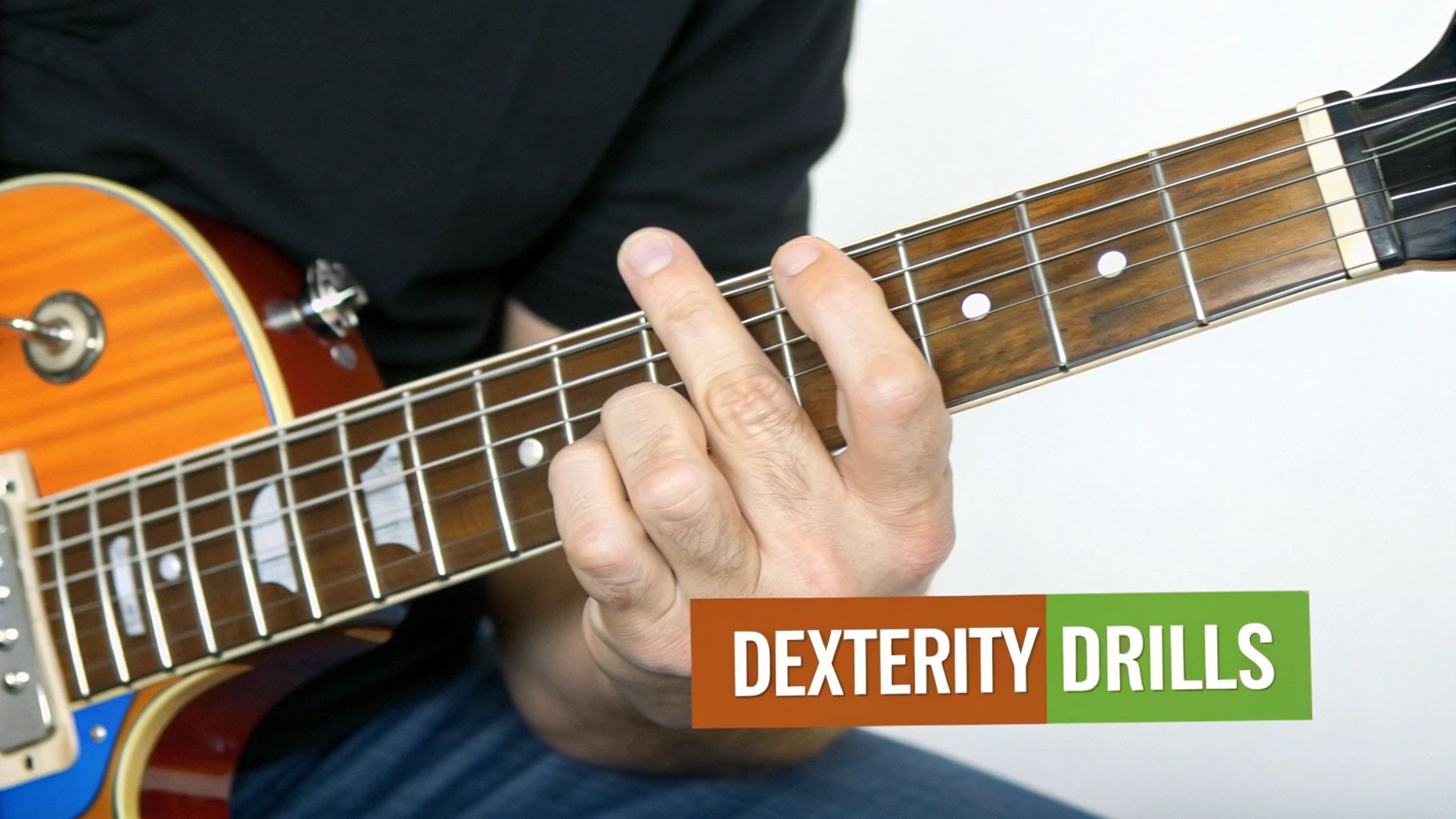
Strong, independent fingers are the bedrock of fluid playing, especially when it comes to legato techniques like hammer-ons and pull-offs. A fantastic way to build this is with a simple ascending and descending legato drill.
Here's the acid test for any good warm-up: does it sound musical, even at a snail's pace? If your notes are buzzing or the volume is all over the place, you're just practicing bad habits. Slow it down until every movement is deliberate and clean.
For laser-focused picking, you need drills that force you to cross strings cleanly. Let's break this down into two key movements: alternate picking on one string, and then tackling the tricky business of inside and outside picking across two strings.
Single-String Alternate Picking
Pick a single string and play a simple four-note chromatic pattern (frets 5-6-7-8 is a classic) using strict down-up-down-up picking. The key here is to keep your pick strokes small and efficient. All the motion should come from your wrist, not your whole arm. Focus on making every attack consistent so each note has the same volume.
Inside and Outside Picking
Now, let's get those strings crossing.
Alternate between these two patterns slowly. Seriously, this drill is a game-changer for playing fast, articulate lines that jump across the fretboard. You can find more killer tips for building speed and stamina in our dedicated article.
Finally, let's tie it all together. We need exercises that force your fretting and picking hands to work in perfect unison. A simple, musical scale sequence is perfect for this.
Try this with a C major scale: instead of just running it up and down, play it in groups of four. Start with (C-D-E-F), then begin on the next note (D-E-F-G), then (E-F-G-A), and keep going. This simple twist forces you to think ahead and ensures your hands stay locked in.
For fingerstyle players, a great sync exercise is playing a PIMA (thumb, index, middle, ring) pattern on open strings. Just focusing on that right-hand control builds an incredible foundation. These kinds of targeted drills will make every minute of your warm-up count.
Great technique is a huge part of playing well, but let’s be real—it’s only one piece of the puzzle. An effective warm-up goes way beyond just your fingers. You've got to prime your musical senses, too. This means waking up your ears, locking in your internal clock, and getting a handle on your guitar's voice before you dive into a serious practice session.
Lots of players fall into the trap of treating their ears like passive bystanders. Your ears are an active tool, not just an audience! Weaving some simple ear training and rhythmic exercises into your routine can transform a mechanical warm-up into a truly musical one. It’s all about connecting what your hands are doing to the actual sounds you want to make.

That metronome isn't just there to bust you for speeding up. Think of it as your practice partner for building a killer rhythmic feel, what musicians call being "in the pocket." Instead of just trying to nail the click perfectly every time, try this incredibly powerful exercise to stretch your rhythmic awareness.
First, play a simple scale or a single-note line right on the beat. I mean, dead on. Aim for a robotic, precise feel. This is your baseline, your rhythmic center.
Next, see if you can intentionally play each note just a fraction of a second after the click. This creates that lazy, laid-back groove you hear all over blues and soul music. It's way harder than it sounds and takes a surprising amount of control.
Finally, try pushing every note to land slightly before the click. This gives your playing a sense of urgency and drive, perfect for punk or high-energy rock styles.
Just spending a few minutes switching between these three feels will do wonders for your timing. You'll start to gain conscious control over the groove instead of just letting it happen by accident.
Here's a secret: your best tone isn't in your pedals or your amp settings. It's in your hands. A fantastic way to warm up your sense of touch is to focus entirely on dynamics—the volume of your playing.
Grab a simple lick or melodic phrase, something you can play without even thinking about it, and start exploring its dynamic range.
A guitarist's true voice is found in their ability to control dynamics and tone with their hands. It’s what separates mechanical playing from expressive, soulful musicianship.
You can also do a lot just by changing where you pick. Try picking closer to the bridge; you'll get a bright, sharp, and trebly sound. Now, slide your picking hand up toward the neck. The tone gets warmer, rounder, and fuller. Moving your pick just a couple of inches can completely change the character of a note.
These exercises get your mind and ears ready for the real creative work ahead. By the time you start your main practice, you won't just be playing notes—you'll be making music. To explore jam tracks and interactive tools that can help refine your timing and tone, check out the TrueFire All Access Trial.
It’s one thing to know you should warm up, but it's another thing entirely to do it right. A sloppy, unfocused routine can be just as bad as skipping it altogether, digging bad habits in deeper and just plain wasting your time. Over the years, I’ve seen students make the same handful of mistakes that actively hold their playing back.
One of the biggest offenders is jumping straight into aggressive stretching before the muscles and tendons in your hands are even awake. This is called cold stretching, and it's a great way to risk a strain. Your hands need blood flow first, so always start with a few minutes of light, gentle playing—think slow open-string picking or simple, easy chord changes—before you even think about deeper stretches.
Another classic trap is playing too fast, too soon. Look, the goal of a warm-up isn't to shred; it’s to build control, precision, and accuracy. When you rush, your playing gets messy, and you end up practicing mistakes instead of correcting them. Fire up a metronome and start every exercise at a snail’s pace. The focus should be on clean notes and perfect timing.
This ties into a pretty dangerous mindset a lot of players fall into. A revealing study of experienced guitarists showed that a staggering 55% believed in the "no pain, no gain" mantra, mostly because they had zero training in injury prevention. But here's the kicker: after those same players implemented targeted exercises, they saw a significant drop in pain and could play for much longer. It just goes to show that a smart, pain-free warm-up is the real key to endurance.
The point of a warm-up is to get your body ready to play, not to test its limits. If you feel sharp pain, stop. That's your body telling you to slow down, not to push through it.
Finally, watch out for mindless, robotic repetition. We've all seen drills like the "spider exercise." They have their place, but if you're just going through the motions without any focus, it becomes a mechanical habit that doesn't actually help you make music.
Instead of just walking your fingers up and down the fretboard on autopilot, try these musical alternatives:
These exercises build the exact same dexterity but keep your brain and your ears plugged into the act of making music. Remember, some fingertip soreness is normal when you're starting out, but sharp pain is a red flag. For more on that, check out our guide on reducing fingertip pain when learning guitar.
By sidestepping these common mistakes, you can make sure your guitar warm-up is an investment in your playing, not a liability. To discover structured lessons that build excellent habits from day one, go ahead and start a TrueFire All Access Trial.
So, you’ve got the what, why, and how of a solid guitar warm-up. You understand that a great routine is more than just noodling—it’s a structured system designed to make you a better player. That’s the exact philosophy we’ve built into our 80,000+ interactive lessons here at TrueFire. Our world-class instructors don’t just show you licks; they guide you on the path to becoming a more complete musician.
Every single exercise in this guide can be turbocharged using TrueFire’s built-in practice tools. Got your metronome handy? We’ve got one built right in, along with thousands of jam tracks to lock in your timing. You can also grab any warm-up pattern, pop it into our looper, and use the slo-mo function to nail the technique at a pace that works for you.
This is how you turn a simple warm up for guitar into a powerful, goal-oriented practice session. Instead of just going through the motions, you're actively building better habits with features designed for real, measurable progress.
A structured warm-up isn't just about preventing injury—it's about making every single minute you spend with your guitar count. When you integrate the right tools, that foundational work translates directly into better, more confident playing.
Ready to see what that feels like? Start your TrueFire All Access free trial today and discover a smarter way to learn and play.
To wrap things up, let's tackle a few of the most common questions guitarists have about building a solid warm-up routine.
This is a classic question, and the answer is simple: consistency trumps duration, every time. Think of it as a non-negotiable part of your playing.
A focused 10-minute routine is a fantastic daily minimum. It’s just enough to get the blood flowing, activate your muscles, and help prevent injury. Before a longer practice session, a gig, or a recording date, you'll want to extend that to 20 or even 30 minutes. That extra time lets you dig into more advanced techniques and get completely locked in, both mentally and physically.
Yes, but with a huge caveat: only after your hands are physically warm. "Cold stretching" can actually do more harm than good and might even lead to strains.
Always start with two or three minutes of gentle playing. Slow scales, simple open chords, or easy fingerstyle patterns are perfect for getting the blood moving. Once your hands feel warm to the touch, you can add in some gentle, dynamic stretches. Never, ever stretch to the point of pain—that's your body's way of telling you to back off.
You can, but you have to be smart about it. Choosing a slow, simple piece is a perfectly fine way to get your fingers moving and your brain engaged. I've done it plenty of times when I'm short on time.
However, launching straight into a blistering solo or a technically demanding song is not a warm-up. In fact, it's a great way to risk a strain or just feel sloppy for the first 15 minutes of your session. It's always better to start with targeted exercises that isolate specific motor skills before you dive into your repertoire.
Ready to build a warm-up routine that actually transforms your playing? Unlock thousands of lessons, exercises, and pro practice tools with a free All Access trial from TrueFire. Start your journey here. Don't forget, a TrueFire All Access Trial gives you access to our entire library of courses.
